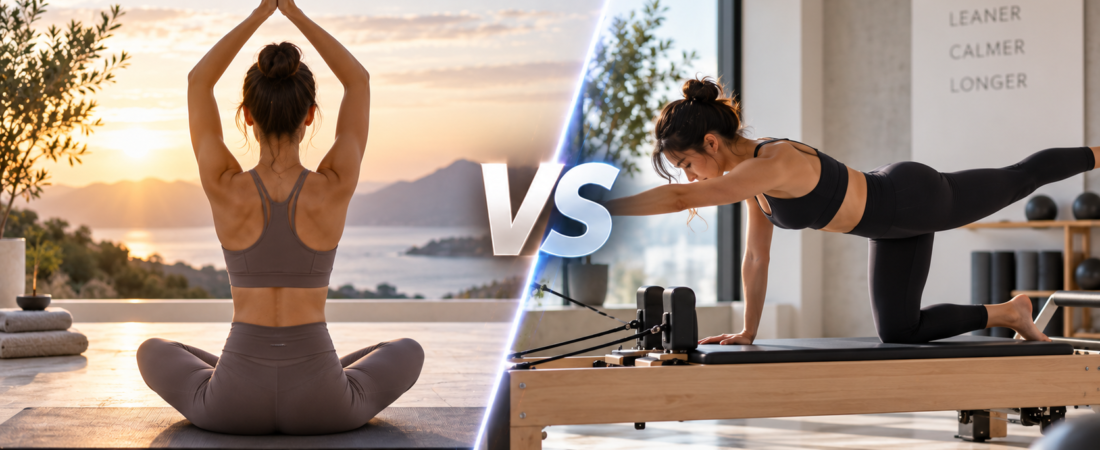
Yoga and Pilates are often grouped together.
Both are low-impact. Both can improve flexibility, balance, posture, and body awareness. And both are popular among people who want to stay active without putting excessive stress on their joints.
But if your goal isn’t just fitness — but staying healthy as you get older — is one actually better?
A recent study highlighted by Arizona State University has made that question especially interesting.
Researchers examined a wide range of complementary health practices and found that yoga and Pilates were among the activities associated with a lower risk of mortality.
That doesn’t prove either activity will make you live longer.
But it adds another reason to look closely at what each exercise can offer for long-term health.
So:
Yoga vs. Pilates — which may be better for healthy aging and longevity?
Let’s compare them.
Quick Comparison
| Yoga | Pilates | |
|---|---|---|
| Main Focus | Flexibility, balance, mind-body connection | Core strength, stability, control |
| Strength | Moderate | Strong advantage |
| Flexibility | Excellent | Very good |
| Balance | Excellent | Very good |
| Stress Reduction | Excellent | Good |
| Core Strength | Good | Excellent |
| Joint Impact | Low | Low |
| Equipment Needed | Minimal | Mat or equipment |
| Beginner Friendly | Yes | Yes |
| Healthy Aging | Excellent | Excellent |
| Our Pick | Best overall balance | Best for strength & stability |
Why Is Longevity Even Part of the Conversation?
Longevity isn’t simply about living as many years as possible.
The more important goal is often healthspan — staying physically and mentally capable during those years.
As we age, several things become increasingly important:
Maintaining muscle.
Maintaining balance.
Preserving mobility.
Protecting cardiovascular health.
Managing stress.
Avoiding falls.
Staying socially and physically active.
Neither yoga nor Pilates solves all of those problems by itself.
But both address several of them at the same time.
That’s what makes this comparison interesting.
What Did the Recent Research Find?
Researchers associated with Arizona State University recently examined data involving numerous complementary health practices.
Among the activities studied, yoga and Pilates stood out for their association with lower mortality risk.
That’s an interesting finding, but there’s an important distinction.
This was an association.
It doesn’t prove that doing yoga or Pilates directly caused people to live longer.
People who regularly participate in these activities may also exercise more generally, eat differently, have different socioeconomic circumstances, or engage in other healthy behaviors.
Still, the findings support something we already know:
Regular physical activity that improves strength, mobility, balance, and overall well-being can be an important part of healthy aging.
And both yoga and Pilates fit that description very well.
Strength: Pilates Wins
Pilates was originally developed around controlled movement, stability, and core strength.
And that’s still where it shines.
Pilates exercises frequently challenge the muscles around your abdomen, hips, back, and pelvis.
Those muscles aren’t just about getting visible abs.
They’re important for everyday movement.
Standing.
Walking.
Lifting.
Turning.
Getting out of a chair.
Maintaining posture.
As we get older, preserving muscular strength becomes increasingly important for maintaining independence.
Yoga can certainly build strength too.
Holding poses like planks, warriors, and chair poses can be surprisingly demanding.
But if strengthening the core and improving muscular control are your primary goals, Pilates has the advantage.
Winner: Pilates
Flexibility: Yoga Wins
Yoga has a clear advantage when flexibility is the priority.
Many yoga practices involve moving through larger ranges of motion and holding positions that gradually challenge flexibility.
That can be particularly valuable as we age.
People often lose mobility slowly.
You may not notice it happening until bending down, reaching overhead, turning around, or getting off the floor becomes more difficult.
Maintaining flexibility helps preserve those everyday movements.
Pilates also improves mobility and flexibility, but it generally places greater emphasis on controlled strength and stability.
Winner: Yoga
Balance: Yoga Wins by a Small Margin
Balance becomes increasingly important with age.
Falls are a major health concern for older adults, and maintaining balance and lower-body strength can help reduce risk.
Yoga includes many poses that directly challenge balance.
Tree pose is the obvious example, but many standing yoga movements require continuous adjustments from your feet, legs, hips, and core.
Pilates also improves stability and body control.
But traditional yoga generally exposes you to a wider variety of standing balance positions.
That’s enough to give it a slight advantage.
Winner: Yoga
Core Stability: Pilates Wins
This one isn’t particularly close.
Core stability is central to Pilates.
Many exercises require you to stabilize your torso while moving your arms or legs independently.
That can translate well into everyday movement.
A strong, stable core can help with posture, lifting, walking, and maintaining control during other exercise.
It may also be particularly attractive for golfers, runners, cyclists, and people who participate in sports requiring rotational control.
Yoga develops the core too.
But Pilates makes it one of the main objectives.
Winner: Pilates
Stress: Yoga Wins
Longevity isn’t purely physical.
Chronic stress can affect sleep, mood, cardiovascular health, eating habits, and overall quality of life.
Yoga often combines movement with breathing, concentration, and relaxation.
Some forms also incorporate meditation.
That mind-body combination gives yoga an advantage for people who want their workout to double as a stress-management practice.
Pilates requires concentration and controlled breathing too, and many people find it relaxing.
But stress reduction is more deeply integrated into traditional yoga practice.
Winner: Yoga
Posture: Pilates Wins
Modern life isn’t particularly friendly to posture.
We sit at desks.
Look down at phones.
Drive.
Work on laptops.
Then sit on the couch.
Pilates can be especially useful here because it emphasizes alignment, core stability, spinal control, and awareness of how different parts of the body move together.
Yoga can also improve posture by increasing mobility and body awareness.
But Pilates’ focus on controlled alignment gives it the edge.
Winner: Pilates
Joint Friendliness: Tie
One reason both activities are so attractive for healthy aging is that they’re generally low-impact.
You’re not repeatedly pounding the pavement or jumping.
That can make both activities accessible to people who don’t enjoy high-impact exercise.
But low-impact doesn’t mean zero risk.
Some yoga positions require substantial flexibility.
Some Pilates exercises can be difficult for people with existing back, neck, or joint problems.
The solution is simple:
Start at the appropriate level.
A qualified instructor can modify exercises based on your ability.
Winner: Tie
Convenience: Yoga Wins
Yoga has one extremely practical advantage.
You need almost nothing.
A yoga mat is useful, but that’s about it.
You can practice at home, at a studio, outside, or while traveling.
Pilates can also be done on a mat with minimal equipment.
But many people associate Pilates with reformer classes, which require specialized equipment and can be considerably more expensive.
If convenience and cost matter, yoga is easier to maintain consistently.
And consistency may matter more than choosing the theoretically “perfect” exercise.
Winner: Yoga
Which Is Better After Age 50?
This is where both become particularly attractive.
After 50, maintaining strength, balance, mobility, and flexibility becomes increasingly important.
Pilates can help maintain:
Core strength.
Posture.
Muscular control.
Stability.
Yoga can help maintain:
Flexibility.
Balance.
Mobility.
Stress management.
Ideally, you wouldn’t necessarily choose only one.
Someone who does Pilates twice per week and yoga once or twice per week could get complementary benefits from both.
And neither should necessarily replace aerobic activity or traditional resistance training.
Walking, cycling, swimming, or other cardiovascular exercise still matters.
So does maintaining muscle through resistance exercise.
Think of yoga and Pilates as valuable pieces of a larger healthy-aging routine.
Which Burns More Calories?
If weight loss is your main objective, neither activity should be selected purely because of calorie burn.
Some vigorous yoga styles can be physically demanding.
Pilates can also become quite intense, especially advanced reformer sessions.
But neither typically competes with sustained running, cycling, swimming, or other vigorous cardiovascular exercise for energy expenditure.
Their biggest strengths lie elsewhere:
Movement quality.
Strength.
Mobility.
Balance.
Flexibility.
Body awareness.
Those benefits may actually make it easier to remain active over decades.
And that could matter more for longevity than how many calories one individual session burns.
Which One Will You Actually Keep Doing?
This may be the most important question in the entire comparison.
Imagine Pilates were theoretically 5% better for one health metric.
It wouldn’t matter if you hate Pilates and quit after three weeks.
The same applies to yoga.
Long-term health benefits come from consistency.
If you enjoy the quiet, stretching, breathing, and flowing movements of yoga, choose yoga.
If you enjoy structured movements, core training, and controlled strength exercises, choose Pilates.
If you enjoy both?
Do both.
That’s arguably the best answer.
Compareason Verdict
So which is better for longevity?
Our Pick: Yoga — by a very small margin.
Not because yoga has been proven to make you live longer.
It hasn’t.
And the recent research should not be interpreted that way.
We give yoga the slight advantage because it combines several characteristics that become especially valuable as we age:
Flexibility + balance + mobility + stress management + accessibility.
It’s inexpensive.
It’s easy to practice almost anywhere.
And it can be adapted across a very wide range of fitness levels.
But Pilates is extremely close.
In fact, if your biggest concerns are core strength, posture, and stability, Pilates may actually be the better choice for you.
The best longevity exercise isn’t necessarily yoga or Pilates.
It’s the one you can safely and consistently continue for years.
And if you can combine both?
Even better.
Compare with Reason.