For millions of people, coffee is simply part of the morning routine.
It wakes you up, helps you focus, and for many people, makes the idea of starting the day a little easier.
But coffee has also been linked to something much more interesting:
Body composition.
Recent research has found an association between coffee consumption and having more lean body mass and less body fat.
That immediately raises an obvious question.
Could drinking coffee actually help you stay leaner?
Or are coffee drinkers simply different from non-coffee drinkers in other ways?
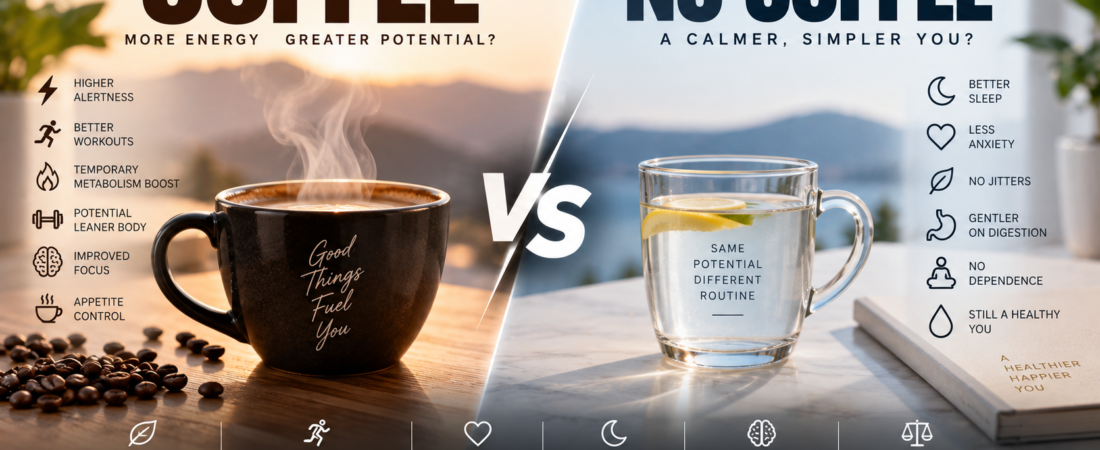
Let’s compare Coffee vs. No Coffee and look at what coffee may — and may not — do for your body.
Quick Comparison
| Coffee | No Coffee | |
|---|---|---|
| Morning Alertness | Excellent | Depends on sleep |
| Exercise Performance | Potential Advantage | Normal |
| Metabolism | Small Temporary Boost | Baseline |
| Appetite | May Temporarily Reduce | Normal |
| Lean Body Mass | Possible Association | No Known Advantage |
| Body Fat | Possible Association | No Known Advantage |
| Sleep | Can Interfere | Advantage |
| Anxiety/Jitters | Possible | Advantage |
| Dependence | Possible | None |
| Best For | Healthy caffeine-tolerant adults | Caffeine-sensitive adults |
What Did the New Research Find?
The latest attention comes from research involving more than 2,200 adults.
Researchers examined coffee consumption and measures of body composition, including fat mass and lean mass.
The interesting finding?
Greater coffee consumption was associated with higher lean body mass and lower body fat.
That sounds like great news for coffee drinkers.
But there’s an important word here:
Associated.
The study does not prove that drinking coffee directly caused people to gain muscle or lose fat.
People who drink coffee may differ from non-coffee drinkers in many ways.
They may exercise differently.
Eat differently.
Sleep differently.
Have different jobs.
Or have different overall lifestyles.
So don’t start adding five cups of coffee to your day expecting a six-pack.
The research is interesting, but it isn’t a weight-loss prescription.
Metabolism: Coffee Wins
Caffeine is a stimulant.
One of its effects is temporarily increasing energy expenditure.
Your body may burn slightly more energy after consuming caffeine than it would otherwise.
Coffee can also increase thermogenesis — the process through which your body produces heat and expends energy.
That sounds impressive.
But the effect isn’t enormous.
A cup of coffee isn’t going to compensate for a high-calorie diet or lack of physical activity.
Think of caffeine’s metabolic effect as a small advantage, not a shortcut.
Winner: Coffee
Exercise Performance: Coffee Wins
This is where caffeine has much stronger evidence behind it.
Caffeine is one of the most widely used performance-enhancing substances in sports.
It can improve alertness and reduce perceived effort during exercise.
For some people, that means:
Running feels slightly easier.
A workout feels more manageable.
You can maintain effort longer.
You feel more motivated to train.
That matters because the indirect effect may be more important than the calories coffee itself helps you burn.
If coffee helps you exercise more consistently or train more effectively, it could indirectly contribute to better body composition over time.
Winner: Coffee
Muscle Mass: Interesting, But Not Proven
This is one of the most intriguing parts of the recent research.
Coffee drinkers appeared to have more lean body mass.
But that doesn’t mean coffee builds muscle.
Muscle growth still primarily depends on things such as:
Resistance training.
Adequate protein.
Calories.
Recovery.
Sleep.
Genetics.
Coffee cannot replace any of those.
There are several possible explanations for the observed association.
Caffeine could support better exercise performance.
Coffee contains numerous biologically active compounds.
Or people who drink coffee may simply have different lifestyle patterns.
For now, it’s better to say:
Coffee may be associated with better lean-body composition, but it isn’t a muscle-building supplement.
Winner: Coffee — potentially
Body Fat: Coffee Has a Small Edge
Coffee may also have several characteristics that could support weight management.
Caffeine can temporarily increase energy expenditure.
It may reduce appetite for some people.
And plain coffee contains very few calories.
That’s important.
Replacing a 250-calorie breakfast drink with a nearly calorie-free black coffee could make a meaningful difference over time.
But there’s a huge catch.
Not all coffee is low calorie.
A plain coffee and a large flavored coffee drink are completely different things.
Add:
Sugar.
Cream.
Syrup.
Whipped cream.
Sweetened milk.
And your “coffee” can quickly become a dessert.
Coffee may have an advantage for weight management.
Coffee drinks don’t necessarily have the same advantage.
Winner: Coffee — if you keep it simple
Appetite: Coffee May Help Temporarily
Some people notice that coffee reduces their appetite.
Caffeine can temporarily suppress hunger in certain situations.
That could make it easier to delay snacking or control calorie intake.
But this effect varies significantly between people.
And it usually isn’t strong enough to serve as a reliable long-term weight-management strategy.
There’s another problem.
Skipping food all day because caffeine suppresses your appetite can backfire later.
You may become extremely hungry in the evening and overeat.
Coffee can be part of a healthy routine.
It shouldn’t replace proper nutrition.
Winner: Coffee — narrowly
Energy and Focus: Coffee Wins Easily
This is the category where most coffee drinkers don’t need a scientific study.
Caffeine blocks adenosine receptors in the brain.
Adenosine contributes to feelings of sleepiness.
Blocking those signals can make you feel:
More awake.
More focused.
More energetic.
More motivated.
That can have indirect health benefits.
If coffee helps you get outside for a morning walk or gives you enough energy for an afternoon workout, that’s meaningful.
But there’s a dangerous cycle to watch for.
Poor sleep → more coffee → worse sleep → more coffee.
Which brings us to coffee’s biggest weakness.
Winner: Coffee
Sleep: No Coffee Wins
Coffee’s greatest advantage can also become its greatest disadvantage.
Caffeine lasts much longer in the body than many people realize.
Its average half-life is around several hours, although this varies significantly between individuals.
That means an afternoon coffee can still leave caffeine circulating in your body at bedtime.
You may still fall asleep.
But sleep quality can suffer.
And poor sleep is strongly connected to appetite regulation, exercise recovery, mood, and overall health.
So if drinking coffee at 4 p.m. helps you burn a few more calories but disrupts your sleep that night, the tradeoff probably isn’t worth it.
For many people, limiting caffeine to the morning or early afternoon makes sense.
Winner: No Coffee
Stress and Anxiety: No Coffee Wins
Not everyone handles caffeine well.
For caffeine-sensitive people, coffee can cause:
Jitters.
Anxiety.
Heart palpitations.
Restlessness.
Digestive discomfort.
Headaches.
Higher perceived stress.
If one cup makes you feel great, that’s one thing.
If one cup makes your heart race and your hands shake, your body is giving you useful information.
You don’t need coffee to be healthy.
Winner: No Coffee
What About Decaf?
Here’s where things get interesting.
Coffee isn’t just caffeine.
Coffee contains hundreds of compounds, including polyphenols and other antioxidants.
That means some potential benefits associated with coffee may not depend entirely on caffeine.
Decaf coffee can therefore be an excellent option for people who enjoy coffee but are sensitive to caffeine.
You get the ritual.
The flavor.
Many of coffee’s naturally occurring compounds.
Without nearly as much stimulant effect.
For someone who loves an evening coffee, decaf may be the smarter choice.
Black Coffee vs. Sweet Coffee Drinks
This distinction matters enormously.
When health studies discuss coffee consumption, people sometimes imagine their favorite café drink.
But:
Coffee ≠ every drink containing coffee.
Black coffee contains very few calories.
A large caramel latte with syrup and whipped cream can contain hundreds.
If your goal is staying lean, adding substantial sugar and calories to coffee can easily eliminate any small metabolic advantage caffeine provides.
You don’t have to drink coffee black.
A little milk isn’t going to ruin everything.
The point is simply to know what’s actually in your cup.
How Much Coffee Is Reasonable?
More isn’t automatically better.
For most healthy adults, the FDA has cited 400 milligrams of caffeine per day as an amount not generally associated with negative effects.
That’s roughly equivalent to about four or five cups of coffee depending on the size and strength.
But caffeine content varies enormously.
And individual tolerance varies even more.
Some people can drink coffee after dinner and sleep normally.
Others can drink one cup at noon and still feel wired at bedtime.
Your personal response matters.
Can Coffee Help You Lose Weight?
Possibly a little.
But this is where headlines often become misleading.
Coffee isn’t a weight-loss drug.
It doesn’t magically burn belly fat.
It doesn’t replace exercise.
It doesn’t build muscle without resistance training.
And it doesn’t overcome excess calorie intake.
If you’re trying to improve body composition, the major factors remain:
Regular physical activity.
Strength training.
Adequate protein.
Healthy food choices.
Reasonable calorie intake.
Good sleep.
Consistency.
Coffee might help around the edges.
But the fundamentals still do most of the work.
Who Should Choose Coffee?
Coffee makes the most sense if:
You enjoy it.
You tolerate caffeine well.
It improves your focus.
It helps your workouts.
It doesn’t interfere with your sleep.
And you aren’t loading it with excessive calories.
In that situation, coffee can fit very comfortably into a healthy lifestyle.
Who May Be Better Without Coffee?
No coffee may be better if caffeine causes:
Anxiety.
Palpitations.
Poor sleep.
Digestive problems.
Headaches.
Or dependence that you simply don’t like.
Pregnant people and those with certain medical conditions or medications may also need different caffeine limits and should follow appropriate medical guidance.
And remember:
You don’t need caffeine to get the health benefits of exercise.
A well-rested person who drinks water and exercises regularly is doing just fine.
The Biggest Mistake: Using Coffee to Replace Sleep
This deserves its own section.
Coffee can hide fatigue.
It cannot erase sleep deprivation.
If you slept four hours, caffeine may make you feel more awake.
Your body still didn’t get enough recovery.
That’s especially important for people using caffeine to exercise harder after repeatedly sleeping poorly.
The better solution isn’t necessarily stronger coffee.
It may simply be more sleep.
Coffee should complement a healthy lifestyle.
Not hold together an unhealthy one.
Compareason Verdict
Our Pick: Coffee — by a small margin.
For a healthy adult who tolerates caffeine well, coffee gets our vote.
The reason isn’t because coffee magically makes you thin.
It doesn’t.
The advantage comes from several smaller factors working together:
A temporary metabolic boost.
Better alertness.
Potential exercise-performance benefits.
Very few calories when consumed plain.
And emerging evidence linking coffee consumption with favorable body composition.
But the advantage disappears quickly if coffee damages your sleep, increases anxiety, or becomes a vehicle for hundreds of extra calories.
So the smarter question isn’t:
“Should everyone drink coffee?”
It’s:
“Does coffee make my healthy routine better or worse?”
If your morning coffee helps you wake up, exercise, focus, and enjoy your day — while still allowing you to sleep well at night — there’s little reason to feel guilty about it.
If coffee makes you anxious and keeps you awake?
Skip it.
Your body composition depends far more on what you do throughout the entire day than what’s inside one morning cup.
Compare Better. Choose Smarter.