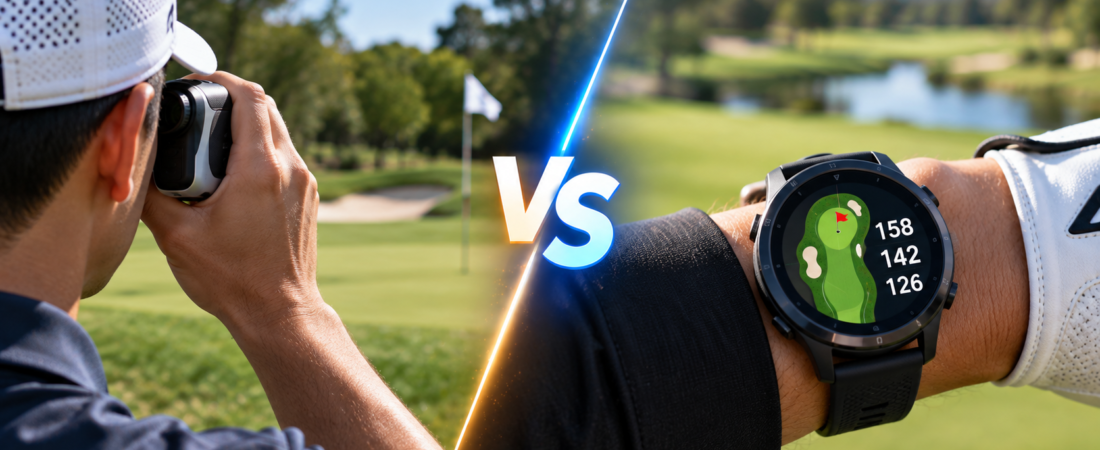
Golf is a game of distance.
You may hit the perfect shot, but if you thought the pin was 145 yards away when it was actually 158, the result probably won’t be what you expected.
That’s why distance-measuring devices have become almost standard equipment for recreational golfers.
The two most popular choices are:
Laser rangefinders and GPS golf watches.
A rangefinder gives you a precise distance to the flag or another visible target.
A GPS watch gives you distances to the green, hazards, and other important locations without requiring you to aim at anything.
Both can make club selection easier.
But they solve the problem in very different ways.
So which one should actually be in your golf bag?
Let’s compare Rangefinder vs. GPS Golf Watch.
Quick Comparison
| Rangefinder | GPS Golf Watch | |
|---|---|---|
| Pin Distance | Excellent | Good |
| Front/Middle/Back Green | Limited | Excellent |
| Hazards | Good | Excellent |
| Blind Shots | Poor | Excellent |
| Speed | Good | Excellent |
| Accuracy to Visible Target | Excellent | Very Good |
| Ease of Use | Good | Excellent |
| Score Tracking | No | Usually Yes |
| Golf Statistics | No | Often Yes |
| Battery Life | Excellent | Good |
| No Subscription Needed | Usually | Depends on Model |
| Best For | Precise approach shots | Complete round management |
The Biggest Difference: Pin vs. Green
The easiest way to understand this comparison is:
A rangefinder tells you where the flag is.
A GPS watch tells you where the green is.
That sounds like a small distinction.
On the golf course, it can completely change your decision.
Imagine you’re 155 yards from the flag.
Your rangefinder gives you:
155 yards.
Perfect.
But what if the pin is only five yards from the back edge of the green?
Now 155 doesn’t tell the entire story.
A GPS watch might show:
Front: 132 yards
Middle: 147 yards
Back: 158 yards
Suddenly you understand the shot differently.
The flag is almost at the back.
Going long is dangerous.
That information may be more valuable than knowing the exact flag distance.
Accuracy: Rangefinder Wins
For measuring a visible target, a good laser rangefinder is extremely difficult to beat.
Aim at the flag.
Press the button.
Get the number.
Many modern rangefinders can measure within roughly a yard under normal conditions.
That’s exactly what better players often want.
If you know your 8-iron carries 154 yards and the flag is 153, that precision matters.
A GPS watch is different.
It usually doesn’t know exactly where today’s hole location is unless the course or device supports more advanced pin-position features.
Instead, it gives you reference points around the green.
For exact pin distance:
Winner: Rangefinder
Front, Middle and Back: GPS Watch Wins
This may be more useful than many amateur golfers realize.
Most recreational golfers focus too heavily on the flag.
Suppose the pin is 145 yards away.
You automatically think:
“My 145-yard club.”
But the green might be:
Front: 140
Middle: 155
Back: 170
Now you know the flag is near the front.
If there’s a bunker protecting the front of the green, aiming exactly 145 may be unnecessarily aggressive.
A shot toward the middle of the green could be the smarter play.
GPS encourages this kind of course management.
Instead of thinking only about the flag, you start thinking about the entire green.
For many mid- and high-handicap golfers, that may actually lead to lower scores.
Winner: GPS Golf Watch
Blind Shots: GPS Watch Wins Easily
Here’s a situation where a laser can become almost useless.
You can’t see the target.
Maybe you’re behind a hill.
Maybe you’re playing a dogleg.
Maybe trees block your view.
Maybe the green is elevated.
A laser needs something visible to measure.
GPS doesn’t.
Because the watch already knows your location and the mapped location of the green, it can still tell you the distance.
That can be incredibly useful on unfamiliar golf courses.
Winner: GPS Golf Watch
Speed: GPS Watch Wins
A rangefinder isn’t difficult to use.
But there is a process.
Take it out.
Aim.
Find the flag.
Press the button.
Confirm the reading.
Put it away.
A GPS watch is already on your wrist.
Look down.
Distance.
Done.
That difference may only be several seconds per shot.
Over 18 holes, however, convenience adds up.
It’s especially useful when you’re walking.
You can check the distance while approaching your ball and start thinking about the shot before you even arrive.
Winner: GPS Golf Watch
Pin Hunting: Rangefinder Wins
Now imagine you have 87 yards to a tucked pin.
This is where the laser shines.
You don’t necessarily care that the center of the green is 94 yards away.
You want to know exactly where the flag is.
87 yards.
If you practice partial wedge distances, that information can directly influence the shot you choose.
Better players who control distance precisely can extract more value from exact pin measurements.
That’s why you’ll see rangefinders used by so many serious golfers.
Winner: Rangefinder
Hazards: GPS Watch Wins
Water at 220 yards.
Bunker begins at 245.
Fairway ends at 265.
Layup area at 195.
These are course-management numbers.
A rangefinder can measure many visible hazards.
But you need to identify and aim at them.
GPS devices can display several relevant distances at once.
On an unfamiliar hole, that’s a major advantage.
You may discover a bunker you couldn’t see from the tee.
Or learn that the water you thought was 250 yards away actually begins at 225.
That information can save strokes before you even swing.
Winner: GPS Golf Watch
Course Management: GPS Watch Wins
This is probably the strongest argument for GPS.
Golf isn’t simply about hitting the ball toward the flag.
Good golf involves choosing targets.
Where can you miss?
Where can’t you miss?
How far is the trouble?
How much green is behind the pin?
Where should your tee shot finish?
A GPS watch gives you more information about the shape of the hole.
That can encourage smarter decisions.
For many amateurs, better decisions may save more strokes than knowing whether the flag is 151 or 153 yards away.
Winner: GPS Golf Watch
Ease of Use: GPS Watch Wins
Once the round is started and the course is loaded, a good golf watch can be almost effortless.
Walk to the ball.
Look at your wrist.
Choose a club.
Hit.
A rangefinder requires more interaction.
That’s not a major inconvenience, but there are situations where it becomes annoying.
Rain.
Cold weather.
Cart-path-only days.
Playing quickly.
Carrying your bag.
Or simply forgetting the rangefinder in the cart.
The watch stays with you.
Winner: GPS Golf Watch
Battery Life: Rangefinder Wins
This is one area where a rangefinder is refreshingly simple.
Depending on the model, a battery can last for many rounds.
A GPS watch requires regular charging.
Some can handle multiple rounds, while others may need charging more frequently depending on screen brightness, GPS usage, smartwatch functions, and battery age.
Forget to charge it before your tee time?
Your high-tech golf assistant may become a regular watch by the back nine.
Winner: Rangefinder
Score Tracking: GPS Watch Wins Easily
A laser rangefinder generally does one primary job:
Measure distance.
A GPS golf watch can potentially do much more.
Depending on the model and ecosystem, you may be able to track:
Score.
Fairways.
Greens in regulation.
Putts.
Shot locations.
Club distances.
Round history.
Handicap-related statistics.
Some devices can even automatically detect shots or pair with club-tracking sensors.
For golfers who enjoy analyzing their game, this is a major advantage.
Winner: GPS Golf Watch
Practice Value: GPS Watch Has an Advantage
One of the best ways to improve is learning your real club distances.
Not the distance you hit that perfect 7-iron once.
Your actual on-course distances.
GPS-based shot tracking can help build a more realistic picture over time.
You may discover that the club you think carries 160 yards actually averages closer to 150.
That’s valuable information.
A rangefinder tells you the distance before the shot.
A GPS ecosystem can potentially help you understand what happened after it.
Winner: GPS Golf Watch
Slope: Rangefinder Has a Special Advantage
Many modern rangefinders include a slope function.
Instead of only measuring straight-line distance, they estimate how elevation changes affect the effective playing distance.
A 150-yard uphill shot may play longer.
A 150-yard downhill shot may play shorter.
This can be extremely useful during casual rounds and practice.
However, golfers should remember that features providing elevation-adjusted distance may not be permitted when certain competition rules are in effect.
Many tournament-oriented rangefinders therefore include a visible slope on/off switch.
Always follow the rules of the competition you’re playing.
Winner: Rangefinder
Rain and Bad Weather: It Depends
Neither device is perfect in bad conditions.
Heavy rain or fog can make laser targeting more difficult.
A watch avoids the need to aim through rain.
But wet touchscreens and soaked gloves can make watch interaction annoying too.
Most golf-specific devices are designed with outdoor use in mind, but weather resistance varies by model.
Winner: Tie
Cost: It Depends
Both categories now cover a wide price range.
You can buy relatively inexpensive laser rangefinders.
Premium models can cost several hundred dollars.
GPS watches range from basic golf-specific devices to premium smartwatches with large color displays and extensive golf features.
So there isn’t a universal winner based on purchase price alone.
But there’s another consideration:
Subscriptions.
Many rangefinders require no ongoing service.
Some GPS platforms offer most golf functionality without a subscription, while others reserve certain advanced features for paid memberships.
Before buying a GPS device, check what is included after the initial purchase.
Winner: Tie
Which Is Better for Beginners?
For a beginner, I’d lean toward the GPS watch.
Why?
Beginners generally don’t need to know that the pin is exactly 147 yards away.
Their shot dispersion is usually much larger than the difference between 145 and 150.
Knowing:
Front.
Middle.
Back.
And major hazards
may be more useful.
It encourages a beginner to aim for the center of the green rather than attack every flag.
That’s often better golf.
Winner: GPS Golf Watch
Which Is Better for Low-Handicap Golfers?
Now the rangefinder becomes more attractive.
A skilled golfer may know:
Stock wedge = 118 yards.
Three-quarter wedge = 105.
Smooth 9-iron = 137.
Full 9-iron = 143.
For that golfer, knowing the pin is exactly 139 can influence the shot.
Precision becomes more valuable when the player’s own distance control is precise.
Winner: Rangefinder
What About Tournament Golf?
This requires some care because the Rules of Golf and local competition rules matter.
Distance-measuring devices can be permitted under the Rules, but a committee can adopt a Local Rule prohibiting their use.
Certain functions — such as playing-distance adjustments for elevation or other conditions — can also be restricted during competition.
So before a tournament, don’t simply assume every feature on your device is legal.
Check the event’s rules.
For many rangefinders, that means turning Slope Mode OFF when required.
The Best Setup Might Be Both
Here’s the interesting part.
A rangefinder and GPS watch don’t necessarily compete with each other.
They complement each other extremely well.
Imagine an approach shot.
Your watch says:
Front: 142
Middle: 156
Back: 169
Then you laser the flag:
148 yards.
Now you know exactly what you’re dealing with.
The pin is toward the front.
You have plenty of green behind it.
You know both the precise target and the surrounding context.
That’s better information than either device gives you alone.
It’s one reason serious golfers sometimes carry both.
But Do You Really Need Both?
Probably not.
Most recreational golfers can play perfectly well with one.
If you want simplicity and complete course information:
Choose GPS.
If you want exact target distances:
Choose a rangefinder.
If you play frequently and really enjoy course management and precise numbers?
Using both can make sense.
But equipment should simplify golf, not turn every shot into a math problem.
Eventually, you still have to swing the club.
Compareason Verdict
Our Pick: GPS Golf Watch — for most golfers.
The rangefinder wins the precision battle.
If the flag is 153 yards away, a good laser can tell you exactly that.
For strong players who control their distances well, that’s extremely valuable.
But for the average golfer, we think the GPS Golf Watch provides more useful information throughout an entire round.
You get front, middle, and back distances.
Hazards.
Blind-shot information.
Fast access from your wrist.
Score tracking.
And potentially useful statistics after the round.
Most importantly, GPS encourages golfers to think about the green and the hole, not just the flag.
And for many amateur players, choosing smarter targets could save more strokes than knowing the pin to the exact yard.
So our recommendation is simple:
Most golfers → GPS Golf Watch
Precision-focused golfers → Rangefinder
Serious golfers who want everything → Both
Because knowing the exact distance is useful.
Knowing what that distance actually means for the shot you’re trying to play is even better.
Compare with Reason.