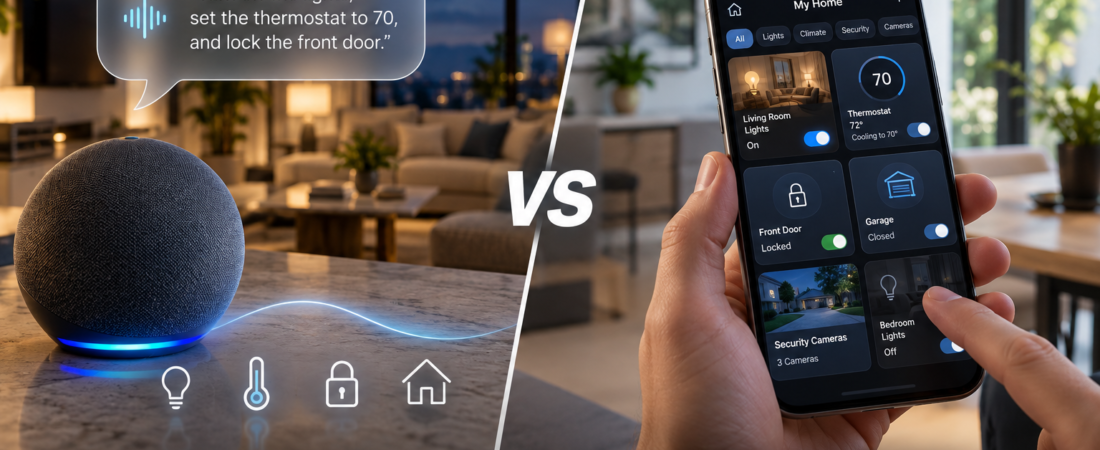
Smart homes are getting smarter — but the way we control them may be about to change.
For years, managing a connected home has meant opening an app. Want to change the thermostat? Open the app. Turn off the lights upstairs? Open another screen. Check whether the front door is locked? Find the right device and tap the right button.
AI assistants offer a different idea.
Instead of navigating menus, you simply tell an AI what you want:
“Turn off the downstairs lights, lower the temperature to 70 degrees, and make sure the front door is locked.”
In 2026, that difference is becoming increasingly important as AI platforms move beyond answering questions and toward interacting with connected devices.
So which approach is actually better for everyday smart-home control: an AI assistant or a traditional smart-home app?
Quick Comparison
| Category | AI Assistant | Smart Home App |
|---|---|---|
| Speed for Simple Tasks | ✅ Excellent | Good |
| Multiple Actions | ✅ Excellent | Average |
| Precise Control | Good | ✅ Excellent |
| Ease of Use | ✅ Excellent | Good |
| Device Overview | Average | ✅ Excellent |
| Automation Setup | Improving | ✅ Excellent |
| Troubleshooting | Average | ✅ Better |
| Natural Language | ✅ Excellent | Limited |
| Reliability | Improving | ✅ More Established |
| Future Potential | ✅ Huge | Strong |
The Biggest Difference: Conversation vs. Controls
Traditional smart-home apps are built around menus, buttons and dashboards.
AI assistants are built around intent.
That distinction sounds small, but it can completely change the experience.
With an app, you tell the system exactly what to do by navigating to the appropriate controls.
With AI, you can potentially describe the result you want.
Instead of individually adjusting five smart devices before going to bed, you might say:
“I’m going to bed.”
An advanced AI system could eventually understand that this means turning off certain lights, locking doors, adjusting the thermostat and activating nighttime settings.
That’s a fundamentally different way of interacting with a smart home.
Winner: AI Assistant
Simple Tasks: AI Is Faster
For basic commands, AI assistants have an obvious advantage.
Imagine you’re sitting on the couch and realize the kitchen lights are still on.
With an app:
Unlock phone → open app → find room → find lights → tap off.
With an AI assistant:
“Turn off the kitchen lights.”
Done.
The advantage becomes even larger when several devices are involved.
Winner: AI Assistant
Precise Control: Apps Still Win
AI is convenient, but convenience isn’t always the same thing as control.
Suppose you want to inspect every connected device in your house, change individual brightness levels, adjust schedules, rename devices or configure detailed automation rules.
A visual dashboard is often much easier.
Smart-home apps allow you to see exactly what’s happening.
You can inspect devices, settings and statuses instead of relying on the AI to correctly interpret what you meant.
For detailed configuration, the traditional app remains difficult to replace.
Winner: Smart Home App
Multiple Commands: AI Could Change Everything
This may become AI’s biggest advantage.
Traditional apps often require several separate actions.
AI can potentially combine them.
For example:
“I’m leaving for work. Turn everything off except the porch light, set the thermostat to 76, and lock the doors.”
Instead of performing several actions manually, the AI can interpret one instruction containing multiple requests.
This becomes especially useful as homes accumulate more connected devices.
Ten smart devices are manageable through an app.
Fifty devices?
Natural-language control starts making much more sense.
Winner: AI Assistant
Seeing Your Entire Home: Apps Are Better
Sometimes you don’t want to issue a command.
You simply want to know what’s happening.
A well-designed smart-home dashboard can immediately show:
- Which lights are on
- Current temperatures
- Door-lock status
- Camera status
- Connected devices
- Energy usage
- Active automations
That visual overview is difficult to replace with conversation alone.
AI can summarize the information, but a dashboard lets you inspect everything yourself.
Winner: Smart Home App
Reliability Matters More Than Convenience
Smart-home control is different from asking AI to summarize an article.
If AI misunderstands a question, you can ask again.
If it misunderstands a command involving your home, the consequences can be more significant.
You don’t want:
“Lock the front door.”
to become:
“Unlock the front door.”
That’s why smart-home AI needs extremely reliable confirmation and permission systems, particularly for security-sensitive actions.
Traditional apps have an advantage because the user explicitly presses a control.
For important actions involving locks, alarms, cameras or garage doors, direct confirmation may remain preferable.
Winner: Smart Home App
Automation: Apps Still Have the Advantage
Smart-home apps have spent years developing routines and automation systems.
You can create rules such as:
At sunset → turn porch lights on.
Or:
When nobody is home → reduce heating or cooling.
AI could eventually make creating these routines much easier.
Instead of building a rule manually, you might simply say:
“Whenever everyone leaves the house, turn off the lights and adjust the thermostat.”
That would make automation far more accessible.
But established smart-home platforms currently provide the more predictable visual environment for creating and reviewing detailed routines.
Winner: Smart Home App — for now
AI Could Make Smart Homes Easier for Everyone
One persistent problem with smart homes is complexity.
People buy connected bulbs, cameras, thermostats, speakers and plugs from different companies.
Then they end up with multiple apps.
AI has the potential to become a universal control layer sitting above those devices.
Instead of remembering which app controls which product, users could interact with one assistant.
The AI figures out the rest.
If interoperability continues improving, this could be one of the biggest changes to smart-home technology.
Privacy and Security
There’s also an important tradeoff.
An AI assistant may need access to information about your home and connected devices in order to control them effectively.
That makes permissions important.
Users should understand:
- Which devices an AI can access
- What commands it can execute
- Whether sensitive actions require confirmation
- How activity is logged
- How access can be revoked
The most convenient smart-home system isn’t necessarily the one you should give unlimited control.
For security-sensitive devices, more friction can sometimes be a good thing.
Who Should Use an AI Assistant?
AI control makes the most sense if you:
- Frequently use voice commands
- Have many smart devices
- Want faster everyday control
- Prefer natural language over menus
- Often perform several actions together
- Don’t want to navigate multiple apps
The more complicated your smart home becomes, the more valuable an intelligent control layer can become.
Who Should Use a Smart Home App?
Traditional apps remain better if you:
- Want precise control
- Frequently change detailed settings
- Prefer visual dashboards
- Manage complex automations
- Want to verify device status yourself
- Prioritize predictable controls for security-sensitive devices
Apps aren’t disappearing.
They’re likely to become the control panel behind the AI.
Our Pick: Use Both
This comparison doesn’t need a single replacement.
The two interfaces are good at different things.
Use an AI assistant for everyday commands and multi-device actions.
Use the smart-home app for setup, detailed controls, troubleshooting and security-sensitive tasks.
The future of smart homes probably isn’t AI instead of apps.
It’s AI sitting on top of the apps and devices already running your home.
In other words:
Talk to AI when you know what you want.
Open the app when you want to see exactly what’s happening.
Compare with Reason.