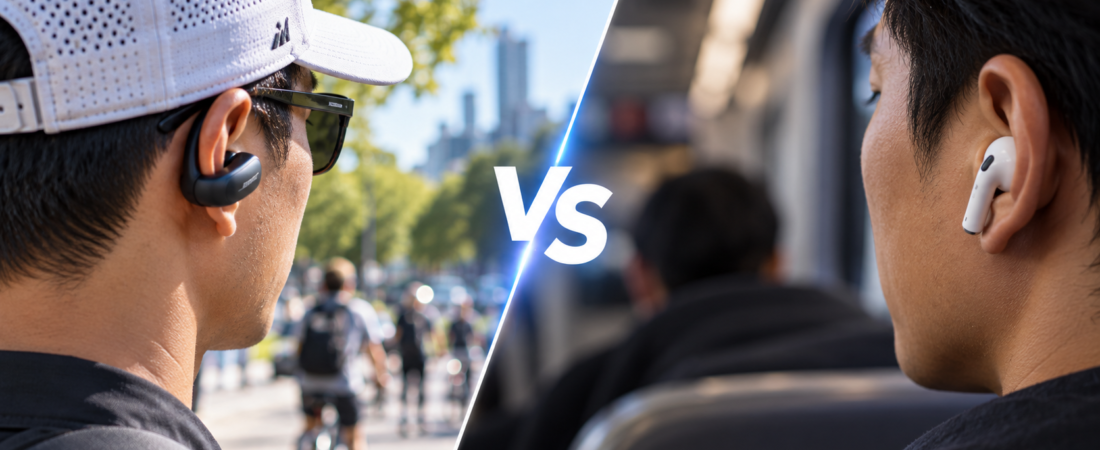
Wireless earbuds used to have one basic goal:
Put small speakers in your ears and make them sound as good as possible.
In 2026, that idea is changing.
Open-ear earbuds are becoming one of the fastest-growing alternatives to traditional in-ear earbuds. Instead of sealing your ear canal, they position the speaker near your ear while leaving the canal open.
The result is a very different listening experience.
You can listen to music, podcasts, or calls while still hearing traffic, conversations, announcements, and the world around you.
Traditional earbuds take almost the opposite approach.
They usually try to create a seal inside your ear, helping produce stronger bass, better isolation, and much more effective active noise cancellation.
So which design actually makes more sense for everyday life?
The answer depends on where you listen.
Quick Comparison
| Open-Ear Earbuds | Regular Earbuds | |
|---|---|---|
| Environmental Awareness | Excellent | Limited |
| Sound Quality | Good | Better |
| Bass | Weaker | Stronger |
| Noise Cancellation | Poor/None | Much Better |
| Long-Term Comfort | Excellent for many users | Depends on fit |
| Running & Walking | Excellent | Good |
| Office Use | Excellent | Excellent |
| Air Travel | Poor | Excellent |
| Conversations | Easy | Less natural |
| Sound Leakage | More likely | Usually lower |
| Best For | Everyday awareness | Immersive listening |
The biggest difference isn’t really technology.
It’s isolation versus awareness.
What Are Open-Ear Earbuds?
Open-ear earbuds allow audio to reach your ears without sealing the ear canal.
Many current models use small speakers positioned near the opening of the ear.
That means they’re different from traditional sealed earbuds — and they’re also not necessarily the same as bone-conduction headphones.
Most modern open-ear earbuds still send sound through the air toward your ears.
The advantage is obvious:
You can hear your music and your environment at the same time.
That’s especially useful while walking, running, working, commuting, or spending time around other people.
But leaving the ear open creates compromises too.
Round 1: Sound Quality
Winner: Regular Earbuds
Traditional earbuds still have the advantage.
Creating a seal inside the ear makes it easier to deliver powerful bass and a fuller, more immersive sound.
Open-ear designs have improved considerably, but physics still matters.
Because they don’t seal the ear canal, they generally can’t provide the same low-frequency impact or isolation as good traditional earbuds. WIRED’s testing similarly notes that open models generally sound less full, particularly in the bass.
Listen to a podcast while walking?
Open-ear audio can sound excellent.
Sit down specifically to enjoy your favorite album?
Traditional earbuds usually provide the better experience.
Winner: Regular Earbuds
Round 2: Awareness of Your Surroundings
Winner: Open-Ear Earbuds
This is the entire reason the category exists.
Imagine walking through a city while listening to a podcast.
With traditional earbuds — particularly with noise cancellation enabled — outside sounds can become dramatically quieter.
Open-ear earbuds leave the ear canal unobstructed.
You can hear:
Cars approaching.
Someone speaking to you.
Train announcements.
A bicycle coming from behind.
Your child calling you.
That’s useful for more than exercise.
It changes how earbuds fit into everyday life.
Instead of entering an audio bubble every time you put on headphones, you remain connected to your environment.
Winner: Open-Ear Earbuds
Round 3: Comfort
Winner: Open-Ear Earbuds
Ear tips aren’t comfortable for everyone.
Traditional earbuds usually rely on silicone or foam tips to create a seal inside the ear canal.
Some people can wear them for hours.
Others start feeling pressure or irritation.
Open-ear earbuds eliminate that seal.
Different designs use ear hooks, clips, or other mechanisms to position the speaker near the ear.
That’s one reason the category has become popular for extended wear.
You can listen while working and still speak naturally with people around you without constantly removing your earbuds.
Fit remains personal, of course.
An open-ear design that fits one person’s ear perfectly may not work as well for someone else.
But for people who dislike having something pushed into their ear canal, open-ear designs can be a major improvement.
Winner: Open-Ear Earbuds
Round 4: Noise Cancellation
Winner: Regular Earbuds — Easily
This isn’t close.
Good traditional earbuds can combine physical isolation with active noise cancellation.
That makes them far better for:
Airplanes.
Subways.
Busy coffee shops.
Loud offices.
Long trips.
Modern premium ANC earbuds can dramatically reduce outside noise, while open-ear earbuds intentionally allow that noise to reach you.
That’s not a defect in open-ear headphones.
It’s the design.
But if your goal is:
“I don’t want to hear anything around me.”
Regular earbuds are the obvious choice.
Winner: Regular Earbuds
Round 5: Running and Outdoor Exercise
Winner: Open-Ear Earbuds
This may be the strongest argument for open-ear audio.
Runners often want music.
But they also need environmental awareness.
Cars, bicycles, other runners, and intersections are part of the environment.
Open-ear designs let you hear those things naturally while still listening to audio.
Manufacturers are increasingly designing products specifically around this use case.
For example, Bose announced its new Sport Open Earbuds on September 17, 2026. The company is targeting runners and fitness users with a secure open design, IP54 sweat/water/dust resistance and up to seven hours of playback. They are scheduled for general availability October 1.
That tells us something important about where the industry sees open-ear audio fitting.
Exercise is becoming one of its natural homes.
Winner: Open-Ear Earbuds
Round 6: Office and Work
Winner: Open-Ear Earbuds — Slightly
Imagine working at your desk.
You want background music.
But coworkers may speak to you.
Your phone may ring.
Someone may walk into your office.
Traditional earbuds can create an awkward cycle:
Earbud in.
Someone talks.
Earbud out.
Conversation.
Earbud back in.
Open-ear earbuds remove much of that friction.
You can listen quietly while remaining aware of the room.
For remote workers who need maximum concentration, however, the opposite may be true.
If your house or office is noisy, ANC-equipped traditional earbuds can help create a quieter workspace.
So this one depends heavily on environment.
For general office awareness:
Winner: Open-Ear Earbuds — slightly.
Round 7: Travel
Winner: Regular Earbuds
Take the same open-ear earbuds onto an airplane and their biggest advantage becomes their biggest weakness.
You hear everything.
Including the engine.
And the passengers.
And the announcements.
And the baby three rows behind you.
To compensate, you may be tempted to increase the volume.
That’s exactly where traditional noise-canceling earbuds shine.
They reduce the environmental noise rather than trying to overpower it.
For frequent travelers, good ANC remains one of the most useful features wireless earbuds can offer.
Winner: Regular Earbuds
What About Transparency Mode?
This is where the comparison becomes interesting.
Many premium traditional earbuds now have excellent transparency or ambient modes.
Instead of physically leaving the ear open, microphones capture external sounds and reproduce them through the earbuds.
That lets traditional earbuds switch between two personalities:
Noise Cancellation → Block the world
and
Transparency Mode → Hear the world
Open-ear earbuds can’t really reverse that equation.
They can let sound in naturally, but they can’t suddenly create the isolation of sealed ANC earbuds.
This makes premium traditional earbuds more versatile.
But transparency mode still isn’t exactly the same as simply having your ear open.
For people who spend hours wearing earbuds, the natural awareness and pressure-free feeling of open designs can still be appealing.
The Sound-Leakage Question
There’s another tradeoff.
Open-ear earbuds direct sound toward your ear without sealing it.
That means some sound can escape.
Modern designs have become much better at controlling leakage, but at higher volumes people nearby may still hear more than they would with properly fitted traditional earbuds.
That’s worth considering in quiet environments.
Library?
Regular earbuds.
Quiet airplane cabin?
Regular earbuds.
Walking outside?
Probably irrelevant.
At your desk?
Depends how loudly you listen.
Open-Ear Technology Is Getting Better
One reason this comparison is more interesting in 2026 is that open-ear products are improving quickly.
Today, Bose announced its second-generation Ultra Open Earbuds alongside the Sport Open model.
The new Ultra model adds redesigned drivers intended to improve bass and volume, along with improved call features and up to nine hours of playback. It is scheduled to sell for $299 starting October 1.
And Bose isn’t alone.
Shokz, Soundcore, Huawei, Sony and others have all competed in the open-ear category, with current designs ranging from ear hooks to clip-on models.
Open-ear earbuds are no longer just strange-looking workout headphones.
They’re becoming a serious alternative to conventional earbuds.
Do You Actually Need to Choose?
Maybe not.
Think of earbuds like shoes.
You wouldn’t necessarily use the same shoes for running, a business meeting, and hiking.
Audio may be moving in the same direction.
Open-Ear Earbuds
Use them for:
Walking
Running
Working
Doing chores
Casual listening
Being around family
Situations where awareness matters
Regular Earbuds
Use them for:
Flying
Commuting on noisy trains
Focused music listening
Movies
Loud environments
Situations where isolation matters
For someone who uses headphones frequently, owning both styles isn’t unreasonable.
Our Pick: Open-Ear Earbuds — for Everyday Use
If the question were simply:
Which sounds better?
We’d choose regular earbuds.
If the question were:
Which is better for travel?
Regular earbuds again.
But that’s not the question.
We’re asking which is better for everyday use.
And for that, open-ear earbuds get our pick.
The ability to listen to audio while naturally remaining aware of people and activity around you makes them unusually practical for walking, working, exercising, and spending an ordinary day.
Regular earbuds remain the better all-around audio product because they offer stronger bass, better isolation, and effective noise cancellation.
But open-ear earbuds may be the better everyday companion.
The ideal solution?
Open-ear for the world around you.
Regular earbuds when you want the world to disappear.
Compare with Reason.