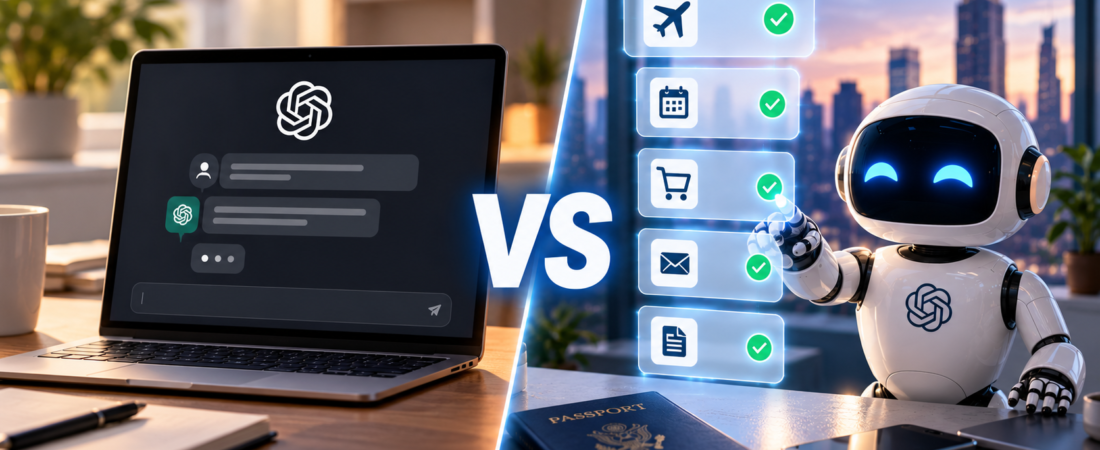
For the past few years, most people have experienced artificial intelligence in roughly the same way:
You ask a question.
AI gives you an answer.
You ask another question.
AI responds again.
That experience has already changed how millions of people search, write, learn, plan, and work.
But the next phase of AI may be very different.
Instead of simply telling you what to do, AI is increasingly being designed to do things for you.
That is the basic idea behind the AI agent.
And in 2026, the difference between an AI assistant and an AI agent is becoming increasingly important.
An AI assistant might help you find a hotel.
An AI agent could potentially search hotels, compare options, check your calendar, work within your budget, and complete parts of the booking process using connected tools.
One helps you make the decision.
The other can help execute it.
So which is actually more useful?
And could AI agents eventually change everyday life more than the AI assistants we already use?
Quick Comparison
| AI Assistant | AI Agent | |
|---|---|---|
| Main Purpose | Help you | Act for you |
| Interaction | Mostly conversational | Goal-oriented |
| User Prompts | Frequent | Less frequent |
| Multi-Step Tasks | Can help guide them | Can execute them |
| Uses External Tools | Increasingly | Core capability |
| Autonomy | Lower | Higher |
| Risk of Mistakes | Usually easier to catch | Potentially more consequential |
| Personal Data Needed | Moderate | Potentially extensive |
| Best Today For | Questions, writing, research, planning | Delegated workflows and actions |
| Biggest Advantage | Control | Automation |
The easiest way to understand the difference is:
An assistant helps you work.
An agent can perform work on your behalf.
OpenAI describes agents as systems capable of independently accomplishing tasks using models, tools, and guardrails, while Google similarly emphasizes reasoning, planning, action, and greater autonomy.
What Is an AI Assistant?
An AI assistant is the type of AI most people already understand.
You might ask:
“Summarize this email.”
“Plan a three-day trip to Miami.”
“Compare these two cars.”
“Help me write a business proposal.”
“What should I cook with these ingredients?”
The assistant analyzes your request and helps produce the answer.
Modern assistants can be extremely sophisticated. They can reason through complicated questions, analyze files, work with images, research information, and increasingly connect with outside tools.
But the user is still heavily involved.
You ask.
The AI responds.
You review.
You decide what happens next.
That interaction is powerful because you remain in control of the workflow.
What Is an AI Agent?
An AI agent takes the concept one step further.
Instead of asking:
“How should I do this?”
you increasingly say:
“Do this for me.”
An agent can break a goal into steps, decide which tools it needs, perform actions, evaluate the results, and continue working toward the goal.
OpenAI describes this type of system as one where the model manages workflow execution and dynamically selects tools while operating within defined guardrails.
Imagine saying:
“Find me a good hotel in Boston next weekend under $300 a night near downtown.”
An assistant might give you five recommendations.
An agent could potentially:
Search available hotels.
Compare prices.
Check locations.
Review your preferences.
Look at your calendar.
Narrow the choices.
And, with appropriate permission, take actions toward completing the reservation.
That’s a very different relationship with AI.
Round 1: Everyday Questions
Winner: AI Assistant
Most AI interactions don’t need an agent.
If you want to know:
“How much protein is in Greek yogurt?”
you don’t need an autonomous system operating across multiple applications.
You just need an answer.
The same applies to writing, brainstorming, explaining concepts, summarizing documents, and countless everyday questions.
Adding autonomy to these tasks doesn’t necessarily make them better.
Sometimes conversation is exactly what you want.
Winner: AI Assistant
Round 2: Complex Tasks
Winner: AI Agent
Now imagine something more complicated:
“Plan my family vacation.”
An assistant can help tremendously.
But you may still have to search flights, compare hotels, check everyone’s calendar, research activities, create an itinerary, make reservations, and keep track of confirmations.
An agent changes the goal.
Instead of helping with each individual step, it can potentially coordinate multiple steps as one workflow.
That’s where agentic AI becomes interesting.
The advantage isn’t necessarily greater intelligence.
It’s execution.
Winner: AI Agent
Round 3: Saving Time
Winner: AI Agent
Think about how many small digital chores exist in everyday life.
Cancel a subscription.
Reschedule an appointment.
Compare insurance options.
Return an online purchase.
Find a cheaper flight.
Organize receipts.
Send follow-up emails.
Research a purchase.
Individually, none of these tasks is particularly difficult.
Collectively, they consume hours.
Agents are being built specifically to attack this category of work.
A striking example arrived this month with Meta’s Muse personal agent. Recent reporting describes it handling tasks such as shopping, subscription management and potentially making phone calls on a user’s behalf.
If agents become reliable enough, this may be their biggest advantage:
They don’t just save thinking. They save time.
Winner: AI Agent
Round 4: Control
Winner: AI Assistant
More autonomy creates another problem.
What happens when the AI is wrong?
If an assistant recommends the wrong hotel, you can ignore the recommendation.
If an agent actually books the wrong hotel, the mistake becomes more serious.
If an assistant incorrectly summarizes a product, you can verify it.
If an agent buys the wrong product, money has changed hands.
That’s why agents need permissions, confirmation steps, spending limits, security controls, and clear boundaries.
Anthropic has highlighted this exact challenge: increased agent autonomy can create more opportunities to misunderstand user intent or take unintended actions.
With an assistant, the human usually remains the final decision-maker.
That’s inefficient sometimes.
But it’s also reassuring.
Winner: AI Assistant
Round 5: Privacy
Winner: AI Assistant
To become genuinely useful, an agent may need to know a lot about you.
Potentially:
Your email.
Your calendar.
Your contacts.
Your shopping history.
Your travel preferences.
Your payment information.
Your documents.
Your subscriptions.
Possibly even financial information.
Today’s Meta Muse debate illustrates the tradeoff clearly: the more areas of a user’s digital life an agent can access, the more useful it can become — but the greater the trust requirement becomes as well.
That’s very different from asking an AI assistant:
“What’s a good restaurant in Manhattan?”
The most capable agent may eventually be the AI that knows the most about you.
Whether consumers are comfortable with that remains a huge question.
Winner: AI Assistant
Round 6: Personalization
Winner: AI Agent
Now look at that same issue from the opposite direction.
The more an AI understands your preferences, schedule, routines, and priorities, the more useful it can become.
Imagine an agent that knows:
You prefer nonstop flights.
You usually choose aisle seats.
You don’t schedule meetings before 9 AM.
You prefer hotels with a gym.
You have a certain monthly travel budget.
You like playing golf when you travel.
Now say:
“Plan my Chicago trip next month.”
The AI doesn’t need you to explain everything again.
It already understands your preferences and can incorporate them into the task.
That’s where AI starts feeling less like software and more like a personal digital representative.
Winner: AI Agent
Round 7: Reliability
Winner: AI Assistant — For Now
This may be the biggest obstacle facing agents.
AI doesn’t have to be perfect to answer questions.
If you’re brainstorming names for a coffee brand, a strange suggestion doesn’t matter.
Just ignore it.
But autonomy changes the tolerance for mistakes.
If AI is:
Spending money,
Sending emails,
Changing reservations,
Managing subscriptions,
Or communicating with other people on your behalf,
then reliability becomes far more important.
Even companies building agents emphasize the importance of guardrails and handing control back to users when a system cannot safely complete a workflow.
For now, assistants have an advantage simply because their mistakes are usually easier for humans to catch before anything happens.
Winner: AI Assistant — for now.
The Biggest Change: From Prompting to Delegating
This may ultimately be the most important difference.
The first generation of consumer AI taught us to prompt.
We learned to say:
“Write this.”
“Explain that.”
“Compare these.”
“Summarize this document.”
Agents introduce a different behavior:
Delegation.
Instead of:
“Find some good flights to Los Angeles.”
the request becomes:
“Handle my trip to Los Angeles.”
Instead of:
“Write a cancellation email.”
it becomes:
“Cancel this subscription.”
Instead of:
“Compare these products.”
it could become:
“Find the best one under $500 and prepare the purchase for my approval.”
That sounds like a subtle change.
It isn’t.
OpenAI describes agentic work as shifting knowledge work away from isolated interactions toward delegated tasks that can continue independently while using tools and interacting with external environments.
Will AI Assistants Disappear?
Probably not.
In fact, the distinction may eventually become invisible.
The AI interface you talk to could function as the assistant, while specialized agents work behind the scenes.
You say:
“I need to plan a business trip.”
The assistant understands what you want.
Travel agents search flights and hotels.
A calendar agent checks availability.
Another system organizes the itinerary.
The assistant then returns with the result and asks for approval where needed.
Some enterprise AI systems are already being designed around this relationship between assistants and specialized agents.
So the future may not really be:
AI Assistant vs. AI Agent.
It may be:
AI Assistant + AI Agents.
What Could This Look Like in Everyday Life?
Imagine waking up and saying:
“Take care of everything I need to handle today.”
Your AI checks your calendar.
It notices your car service appointment conflicts with a meeting.
It finds another appointment.
It prepares the reschedule.
It notices a subscription increased in price.
It identifies a cheaper option.
It organizes three emails that require responses.
It drafts the easy ones.
It reminds you that your flight price dropped.
And it asks:
“I have five actions ready. Would you like me to proceed?”
That’s dramatically different from opening five apps and asking an AI five separate questions.
That’s the promise of agentic AI.
We’re not fully there yet.
But the direction is becoming clear.
Our Pick: AI Agent — for the Future of Everyday AI
Today, an AI assistant is still the more dependable tool for many everyday situations.
It gives you information, helps you think, writes, researches, compares, and keeps you involved in important decisions.
But if we’re asking:
Which technology has the potential to change daily life more?
Our pick is the AI Agent.
The reason is simple.
AI assistants save mental effort.
AI agents could save both mental effort and actual time.
The transition won’t happen overnight.
Agents still need better reliability, stronger privacy protections, clear permission systems, and sensible human oversight.
For high-impact actions involving money, sensitive data, or commitments, human confirmation remains especially important.
But the direction of AI is shifting.
The biggest change may not be that AI becomes dramatically better at answering our questions.
It may be that we stop asking AI how to do things —
and start asking AI to handle them for us.
The AI assistant answers.
The AI agent acts.
And that difference could define the next era of personal technology.
Compare with Reason.