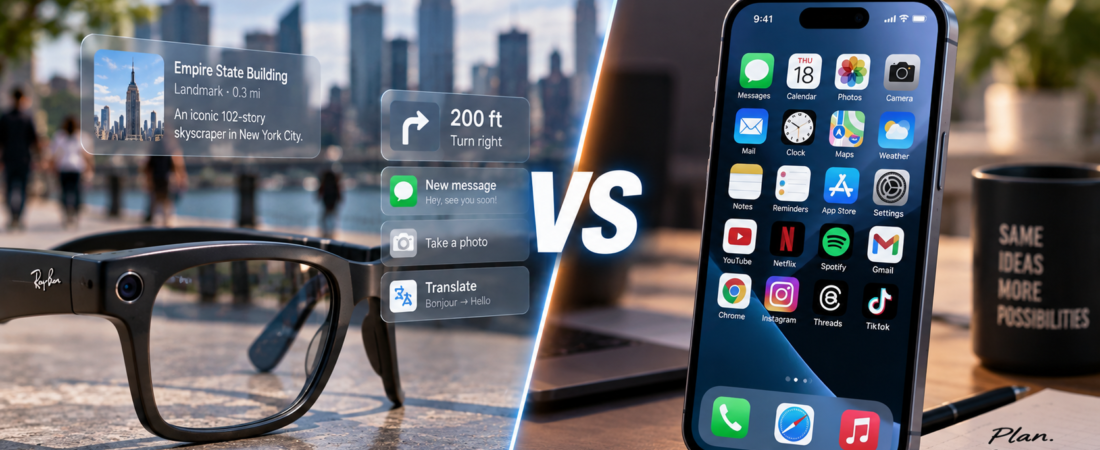
For nearly two decades, the smartphone has been the center of our digital lives.
We use it to communicate, navigate, take photos, listen to music, shop, work, search, pay, and increasingly interact with artificial intelligence.
But there’s one obvious limitation.
You have to keep taking it out of your pocket.
Smart glasses are trying to change that.
Instead of looking down at a screen, imagine simply looking at the world and asking:
“What building is that?”
“Translate this sign.”
“Take a picture.”
“Give me walking directions.”
“Read my next message.”
“Remind me what I need at the grocery store.”
AI-enabled glasses are moving closer to making those interactions possible without constantly reaching for a phone.
In 2026, the smart-glasses market is moving beyond simple camera glasses. Some devices combine cameras, microphones, speakers and AI, while more ambitious augmented-reality models are adding displays and hand controls. Snap’s new Specs, for example, use see-through displays, hand tracking and an onboard AI assistant.
So are we approaching the end of the smartphone?
Or are smart glasses simply becoming another accessory that still depends on the phone?
Let’s compare.
Quick Comparison
| Smart Glasses | Smartphone | |
|---|---|---|
| Hands-Free Use | Excellent | Limited |
| Screen Size | Limited / AR | Excellent |
| AI Interaction | Excellent potential | Excellent |
| Photography | Convenient | Better control |
| Navigation | Excellent potential | Excellent |
| Messaging | Convenient for quick tasks | Better for long conversations |
| Apps | Limited | Huge ecosystem |
| Battery Life | Major limitation | Much better |
| Privacy | Major concern | More socially understood |
| Productivity | Limited | Excellent |
| Best Feature | Always available | Does almost everything |
| Could Replace the Other? | Not yet | Still essential |
The fundamental difference is simple.
The smartphone puts computing in your hand.
Smart glasses try to put computing into your surroundings.
Round 1: Convenience
Winner: Smart Glasses
This is where glasses immediately make sense.
Think about how often you reach for your phone.
You hear a notification.
Phone comes out.
You want a picture.
Phone comes out.
You need directions.
Phone comes out.
You want to identify something.
Phone comes out.
With smart glasses, many of those interactions could happen without touching anything.
Camera-equipped AI glasses already allow users to capture photos and video, listen to audio and interact with an AI assistant hands-free. Meta says millions of people now use its AI glasses daily for activities including music, photography, video and AI access.
The smartphone is portable.
But glasses are potentially ambient.
They’re already sitting exactly where you need them.
Winner: Smart Glasses
Round 2: AI
Winner: Smart Glasses
AI may ultimately be the technology that makes smart glasses useful.
Without AI, glasses risk becoming a tiny smartphone with an inconvenient interface.
With AI, they don’t necessarily need traditional apps or menus.
You could simply ask:
“What am I looking at?”
“Where should I turn?”
“What’s on my calendar?”
“What does this sign say?”
“Remember where I parked.”
“What was the name of that restaurant?”
That creates a very different relationship with technology.
Instead of typing information into a device, the AI can potentially understand some of the context around you.
Recent smart-glasses development is increasingly heading this way. Snap’s newly announced Specs Intelligence, for example, is designed to use contextual information such as calendars and email to provide more proactive assistance.
That combination is powerful:
AI understands what you ask.
Glasses can potentially understand what you see.
Winner: Smart Glasses
Round 3: Display and Entertainment
Winner: Smartphone
Now the smartphone fights back.
Watching YouTube.
Browsing websites.
Editing photos.
Reading long articles.
Shopping.
Playing games.
Managing spreadsheets.
Scrolling through social media.
For these activities, a large touchscreen remains incredibly efficient.
Even advanced AR glasses face physical limitations.
Displays have to fit inside eyewear.
Battery capacity is limited.
Weight matters.
Brightness matters.
Field of view matters.
And controlling virtual interfaces without a touchscreen isn’t always easy.
Early testing of Snap’s new $2,195 Specs, for example, found limitations including gesture-recognition issues, reduced visibility in bright environments and a relatively constrained field of view.
Smart glasses may eventually project huge virtual displays.
But today?
The smartphone remains far easier for visual computing.
Winner: Smartphone
Round 4: Camera
Winner: Smartphone
Smart glasses have one enormous camera advantage:
They’re always ready.
You see something interesting.
You don’t need to reach into your pocket.
Just capture it.
That could be fantastic for:
Travel.
Kids.
Sports.
Pets.
Walking.
Cycling.
First-person video.
Unexpected moments.
But smartphones still offer much more deliberate photography.
You can frame the shot.
Zoom.
Choose lenses.
Review the image.
Edit it.
Control exposure.
Shoot high-quality video.
The smart-glasses camera is about capturing the moment you see.
The smartphone camera is about creating the image you want.
For serious photography, the phone still wins.
Winner: Smartphone
Round 5: Navigation
Winner: Smart Glasses
This could eventually become one of the strongest reasons to own smart glasses.
Today, walking through an unfamiliar city often looks like this:
Look at phone.
Walk.
Look at phone again.
Turn.
Check phone again.
With display-equipped glasses, navigation could theoretically appear directly in your field of view.
An arrow could show the next turn.
A restaurant could be highlighted.
A subway entrance could be identified.
Information could appear without blocking your view of the real world.
And even glasses without sophisticated AR displays can provide audio directions.
The smartphone already provides excellent navigation.
But glasses could provide it in a much more natural way.
Winner: Smart Glasses
Round 6: Communication
Winner: Smartphone
For quick communication, glasses are compelling.
“Call my wife.”
“Reply: I’ll be there in ten minutes.”
“Read my latest message.”
That’s perfect for a wearable device.
But try composing a detailed business email.
Or participating in a long group chat.
Or reviewing a document someone sends you.
The smartphone screen and keyboard are still far better suited for complex communication.
Voice can replace typing sometimes.
It doesn’t replace it everywhere.
Nobody wants to dictate a confidential business email aloud while standing in a coffee shop.
Winner: Smartphone
Round 7: Privacy
Winner: Smartphone
This is the biggest challenge facing smart glasses.
A smartphone camera is obvious.
When someone raises a phone and points it toward you, you generally understand what might be happening.
Glasses are different.
Someone can look directly at you while wearing a camera.
That creates an entirely new social problem.
Meta says its glasses use a front-facing capture LED that blinks when photos or videos are being recorded, and newer models disable the camera if the system detects that the LED has been blocked or tampered with.
But the broader concern hasn’t disappeared.
On September 18, French prosecutors and privacy regulators were reported to be increasing scrutiny of smart glasses following complaints and allegations involving people being recorded without consent.
The UK’s Information Commissioner’s Office has similarly said smart glasses create serious questions around surveillance, safety, transparency and public trust, while also recognizing their potential benefits.
This isn’t just a technical issue.
It’s a social one.
Society already understands smartphones.
We’re still deciding what rules should apply when millions of people potentially walk around wearing cameras.
Winner: Smartphone
Round 8: Battery Life
Winner: Smartphone
Smart glasses have a brutal engineering problem.
Everything has to fit into a frame sitting on your face.
Processors.
Cameras.
Microphones.
Speakers.
Wireless radios.
Displays.
Sensors.
Battery.
And the glasses still need to be light enough to wear comfortably.
A smartphone has far more physical space for a large battery.
That means smart glasses currently require compromises between capability, weight and operating time.
Until battery technology improves significantly, this remains one of the biggest reasons glasses can’t fully replace a phone.
Winner: Smartphone
Round 9: Social Interaction
Winner: It Depends
Here’s an interesting contradiction.
Smart glasses could make technology less distracting.
Instead of staring at a phone while walking down the street or sitting with friends, information could appear briefly when needed.
Snap CEO Evan Spiegel has argued that wearable computing could help people remain more engaged with the world rather than constantly looking down at screens.
That sounds great.
But there’s another possibility.
Imagine having a conversation with someone while wondering:
Are they recording me?
Are they reading notifications?
Is AI giving them answers?
Are they actually paying attention?
The smartphone is distracting.
Smart glasses could potentially make distraction invisible.
So whether glasses improve social interaction may depend heavily on how they’re designed and how people choose to use them.
Winner: It Depends
The Real Advantage: Your Eyes Become the Interface
The biggest difference between smartphones and smart glasses may not be the hardware.
It’s the interface.
Smartphones require you to tell the device what you’re interested in.
Smart glasses can potentially understand the context of what you’re already looking at.
Imagine walking through Tokyo.
You look at a restaurant sign.
“Translate that.”
You look at a building.
“What’s this?”
You see a product.
“How much does this cost online?”
You meet someone.
Later:
“Remind me what we discussed.”
This is why smart glasses and AI fit together so naturally.
The smartphone knows what you type.
Smart glasses could increasingly understand what you’re experiencing.
But Do We Actually Want Computers Watching What We See?
That’s the question the industry still has to answer.
The same capability that makes smart glasses useful also makes them uncomfortable.
A camera that helps AI understand your environment is also a camera pointed at everyone around you.
A microphone that understands your requests can also hear conversations.
AI that remembers useful information could potentially remember information other people never intended to share.
Interestingly, some manufacturers are already exploring a different approach.
RayNeo recently demonstrated camera-free smart glasses that emphasize notifications, transcription, translation and a heads-up display rather than visual recording.
That may become an important split in the market:
More capable glasses with cameras.
vs.
More privacy-conscious glasses without them.
Will Smart Glasses Replace Smartphones?
Not soon.
The smartphone is simply too useful.
It provides:
A large display.
A powerful processor.
Longer battery life.
Excellent cameras.
Millions of apps.
A keyboard.
Secure payments.
Entertainment.
Work tools.
And an interface billions of people already understand.
Smart glasses don’t need to replace all of that to succeed.
They only need to reduce how often we need to pull out the phone.
And that’s a much more realistic goal.
Our Pick: Smartphone — for Now
For everyday life in 2026, our pick is still the Smartphone.
It remains dramatically more versatile.
You can work on it, communicate, watch video, shop, navigate, take excellent photos, manage finances and access an enormous ecosystem of applications.
Smart glasses aren’t ready to replace that.
But this comparison has an unusual ending.
Because the more interesting product may actually be the one that loses today.
Smart glasses are beginning to solve something smartphones never really solved:
How to access computing without constantly looking at a screen.
Add AI, cameras, displays, voice interaction and contextual awareness, and glasses start becoming much more than another wearable.
They become a possible new interface for computing.
So the smartphone wins today.
But the long-term question isn’t necessarily whether smart glasses can do everything a smartphone does.
It’s whether they can make us reach for our phones less often.
If that happens, the transition may be gradual.
First, your phone stays in your pocket more often.
Then some apps become unnecessary.
Then the glasses handle more of your everyday interactions.
And one day, we may realize the smartphone is no longer the center of personal computing.
For now:
Smartphone for everything.
Smart glasses for what’s right in front of you.
Compare with Reason.