For years, carbohydrates have been one of nutrition’s favorite villains.
Bread makes you gain weight.
Pasta spikes your blood sugar.
Rice is empty calories.
Cut carbs if you want to get lean.
And for many people, low-carb diets really do work.
Reduce bread, sweets, chips, sugary drinks, and desserts, and calorie intake often drops along with them.
But there’s a problem with saying simply:
“Carbs are bad.”
An apple is mostly carbohydrate.
So are beans.
Oatmeal.
Lentils.
Sweet potatoes.
Brown rice.
Bananas.
Whole grains.
These foods don’t behave like soda, candy, or highly processed snacks simply because they all contain carbohydrates.
That raises a much more useful question:
Is the problem carbohydrates — or the type of carbohydrates we’re eating?
Recent research has added another interesting piece to that debate. A small randomized crossover trial involving adults ages 60 to 70 compared a whole-food, plant-based diet that was relatively high in carbohydrates with a lower-carbohydrate diet containing more animal foods. The higher-carbohydrate diet improved several metabolic measures and was associated with changes in some biological-aging markers.
The study was short and small, so it doesn’t prove that high-carb eating slows aging.
But it highlights an important distinction.
A diet can be high in carbohydrates without being high in junk food.
So which approach makes more sense?
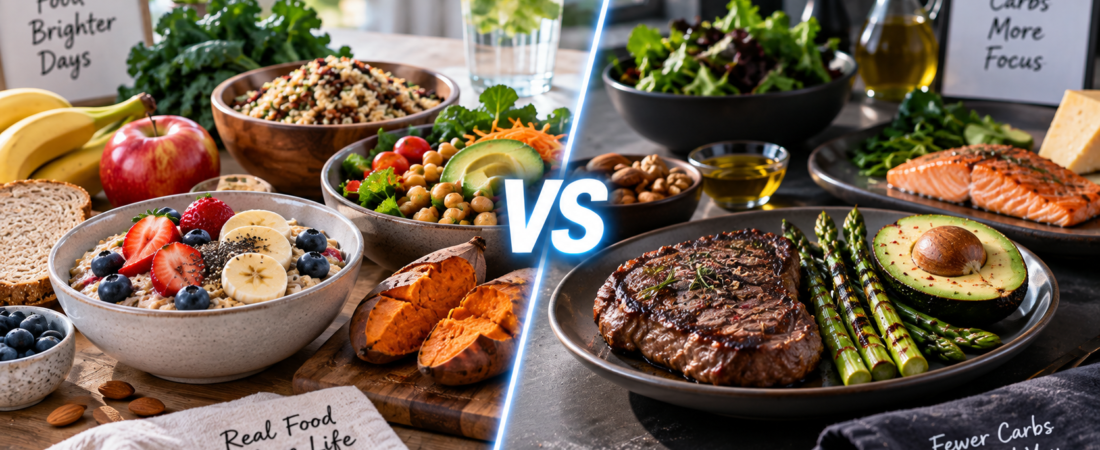
High-carb whole foods or a low-carb diet?
Let’s compare.
Quick Comparison
| High-Carb Whole Foods | Low-Carb Diet | |
|---|---|---|
| Carbohydrate Intake | Higher | Lower |
| Fiber | Usually High | Depends |
| Fruits & Whole Grains | Easy to Include | Often Limited |
| Blood Sugar Control | Depends on Food & Person | Often Helpful |
| Initial Weight Loss | Moderate | Often Faster |
| Exercise Fuel | Excellent | Can Require Adaptation |
| Food Variety | High | More Restricted |
| Protein | Requires Planning | Usually Easy |
| Sustainability | Good for Many | Depends on Preference |
| Biggest Strength | Food Quality & Fiber | Appetite/Carb Control |
The real comparison isn’t:
Carbs vs. no carbs.
It’s:
High-quality carbohydrates vs. carbohydrate restriction.
First: Not All Carbs Are the Same
This is the most important point in the entire comparison.
Consider these two meals.
Meal A
Oatmeal.
Blueberries.
Banana.
Walnuts.
Plain yogurt.
Meal B
Sugary cereal.
Donut.
Sweetened coffee.
Fruit-flavored drink.
Both meals may contain plenty of carbohydrates.
Nutritionally, they’re completely different.
Meal A provides:
Fiber.
Micronutrients.
Protein.
Healthy fats.
Whole or minimally processed foods.
Meal B contains considerably more refined carbohydrate and added sugar while typically providing less fiber and satiety.
Putting both into one category called “carbs” isn’t particularly useful.
Round 1: Weight Loss
Winner: Low-Carb — Initially
Low-carb diets can be extremely effective for weight loss, particularly early on.
There are several reasons.
Reducing carbohydrates can reduce stored glycogen, and glycogen is stored with water.
So some early weight loss is water.
But that’s not the whole story.
Low-carb diets can also naturally eliminate many calorie-dense foods:
Cookies.
Chips.
Pizza.
Desserts.
Sugary drinks.
Pastries.
Large portions of pasta.
For some people, higher protein and fat intake can also improve satiety.
The result?
They eat less without deliberately counting every calorie.
That’s a real advantage.
But over longer periods, adherence and overall calorie intake become increasingly important.
A diet only works if you can continue following it.
Winner: Low-Carb — especially early on
Round 2: Fiber
Winner: High-Carb Whole Foods
This one isn’t close.
Many of the best sources of dietary fiber are carbohydrate-rich plant foods:
Beans.
Lentils.
Oats.
Berries.
Apples.
Pears.
Whole grains.
Vegetables.
Chickpeas.
Sweet potatoes.
Fiber contributes to digestive health and helps with satiety. Certain types of fermentable fiber also feed gut microbes.
A well-designed low-carb diet can still contain plenty of vegetables, nuts, seeds, avocados, and other fiber-rich foods.
But the more aggressively carbohydrates are restricted, the more difficult it can become to include foods like beans, whole grains, and many fruits.
Winner: High-Carb Whole Foods
Round 3: Blood Sugar
Winner: Low-Carb — for Some People
Carbohydrates have the largest direct effect on post-meal blood glucose.
So reducing carbohydrate intake can reduce glucose excursions.
That’s one reason lower-carbohydrate diets can be useful for some people with insulin resistance or diabetes.
But again, carbohydrate quality matters.
Eating lentils isn’t metabolically identical to drinking soda.
Fiber, food structure, protein, fat, and the degree of processing can all influence digestion and glucose response.
Individual response matters as well.
Someone managing diabetes or taking glucose-lowering medication should make substantial dietary changes with appropriate medical guidance because medication needs can change.
Winner: Low-Carb — for some people
Round 4: Exercise
Winner: High-Carb Whole Foods
Carbohydrate is an efficient fuel for higher-intensity exercise.
That’s why endurance athletes have traditionally relied heavily on it.
Running.
Cycling.
Swimming.
Soccer.
Basketball.
High-volume gym training.
And walking 18 holes of golf all require energy.
The harder and longer the exercise, the more useful carbohydrate can become.
Someone doing moderate recreational exercise doesn’t need an athlete’s carbohydrate intake.
And people can train on lower-carb diets.
But for repeated high-intensity performance, carbohydrate availability can be useful.
Winner: High-Carb Whole Foods
Round 5: Hunger Control
Winner: Low-Carb — Slightly
One reason people like low-carb diets is simple:
They often don’t feel as hungry.
A breakfast built around eggs, Greek yogurt, avocado, and other protein-rich foods can be very satisfying.
Higher protein intake in particular can improve satiety.
But here’s the important distinction:
That’s not necessarily because carbohydrates are inherently hunger-producing.
A bowl of oatmeal with berries, nuts, and yogurt can also be extremely filling.
Beans and lentils combine protein with substantial fiber.
Potatoes can be surprisingly satiating when they’re not turned into fries.
So low-carb wins slightly here, but whole-food high-carb diets can also control hunger very well.
Winner: Low-Carb — slightly
Round 6: Food Variety
Winner: High-Carb Whole Foods
Strict carbohydrate restriction removes or greatly limits entire categories of food.
Fruit.
Rice.
Beans.
Pasta.
Bread.
Potatoes.
Oats.
Some dairy products.
Desserts.
That can make restaurant meals, travel, family dinners, and social situations more complicated.
A whole-food approach generally allows greater flexibility.
You can eat:
Salmon with rice.
Chicken with potatoes.
Beans with vegetables.
Oatmeal with fruit.
Whole-grain toast with eggs.
The question becomes less about eliminating a macronutrient and more about choosing better versions of it.
Winner: High-Carb Whole Foods
Round 7: Processed Food
Winner: High-Carb Whole Foods
This might actually be the hidden reason many diets work.
Consider what happens when someone says:
“I’m cutting carbs.”
They often stop eating:
Cookies.
Candy.
Cake.
Sugary cereal.
Chips.
Sweet drinks.
Pastries.
Fast-food buns.
Late-night pizza.
Then they lose weight and feel better.
It’s easy to conclude:
Carbohydrates were the problem.
But another interpretation is possible:
They dramatically reduced highly processed food.
That’s an important distinction.
If someone replaces donuts with eggs, health may improve.
But that doesn’t mean an apple was the enemy.
Winner: High-Carb Whole Foods
Round 8: Simplicity
Winner: Low-Carb
Low-carb has one practical advantage:
The rule is easy to understand.
Avoid or reduce carbohydrate-heavy foods.
No complicated nutritional analysis required.
Bread?
Limit it.
Pasta?
Limit it.
Sugar?
Limit it.
Rice?
Limit it.
For some people, clear rules are easier than moderation.
A whole-food approach requires more judgment.
Is this cereal really whole grain?
How much added sugar is in this yogurt?
Is this bread mostly refined flour?
Simple rules can make behavior easier.
Winner: Low-Carb
Round 9: Sustainability
Winner: High-Carb Whole Foods — for Most People
Could you avoid bread, rice, pasta, potatoes, beans, and most fruit for several months?
Maybe.
Could you do it for ten years?
That’s a different question.
The best diet isn’t necessarily the diet that produces the fastest change in six weeks.
It’s the one that still works several years later.
A whole-food diet can include nearly every major food category.
That makes restaurants easier.
Travel easier.
Family meals easier.
Vacations easier.
And long-term adherence potentially easier.
Some people genuinely love low-carb eating and maintain it comfortably for years.
For them, this category may be reversed.
But for the average person, flexibility has value.
Winner: High-Carb Whole Foods
What Did the Recent Study Actually Find?
This is where we need to be careful.
The recent trial involved only 104 adults between ages 60 and 70 and lasted just four weeks for each diet period. Participants consumed both diets in a randomized crossover design.
The whole-food plant-based diet obtained about 65% of energy from carbohydrates, while the lower-carbohydrate diet obtained around 17% from carbohydrates.
Researchers reported improvements in several metabolic measures during the high-carbohydrate whole-food diet and changes in certain epigenetic measures associated with biological aging.
That sounds dramatic.
But it should not be interpreted as:
Eat more carbs and reverse aging.
The study was small.
It was short.
The diets differed in more than carbohydrate content.
And biological-age biomarkers are not the same thing as demonstrating longer life or preventing disease.
The more useful takeaway is:
A diet can contain a large percentage of calories from carbohydrates and still produce favorable metabolic outcomes when those carbohydrates come primarily from whole foods.
That’s much more interesting than simply declaring one macronutrient good or bad.
The Potato Problem
A potato is a perfect example of why nutrition gets confusing.
Potato:
Carbohydrate-rich.
French fries:
Also carbohydrate-rich.
Potato chips:
Carbohydrate-rich.
But these are not equivalent foods.
A baked potato contains:
Potassium.
Vitamin C.
Fiber, especially with the skin.
Water.
And substantial satiety.
Turn it into fries and you add considerable fat and increase energy density.
Turn it into chips and it becomes extremely easy to consume large amounts quickly.
Same original ingredient.
Very different eating experience.
That’s why asking:
“How many carbs?”
sometimes tells you less than asking:
“What food are the carbs coming from?”
Low-Carb Can Still Be an Excellent Diet
None of this means low-carb eating is bad.
A healthy lower-carbohydrate diet might include:
Eggs.
Fish.
Chicken.
Greek yogurt.
Nuts.
Seeds.
Avocado.
Olive oil.
Leafy greens.
Broccoli.
Cauliflower.
Berries.
Other minimally processed foods.
That’s completely different from a diet dominated by processed meats, butter, cheese, and almost no plants.
Just as there are healthy and unhealthy high-carb diets, there can be healthier and less healthy low-carb diets.
Food quality still matters.
A Better Question Than “How Many Carbs?”
Instead of obsessing over a single macronutrient, ask:
Where are my carbohydrates coming from?
Mostly:
Vegetables?
Fruit?
Beans?
Whole grains?
Potatoes?
Oats?
Or mostly:
Soda?
Candy?
Cookies?
Pastries?
Refined snacks?
Sugary cereal?
That question may be far more useful.
The Middle Ground May Be the Best Diet of All
You don’t actually have to choose between:
65% carbohydrate
and
extremely low carbohydrate.
There is a huge middle ground.
For many people, a practical meal might simply look like:
Half the plate
Vegetables.
One quarter
Protein.
One quarter
Quality carbohydrate.
Rice.
Potatoes.
Beans.
Whole grains.
Add healthy fats where appropriate.
Fruit for dessert.
No macro obsession required.
Our Pick: High-Carb Whole Foods — With Emphasis on “Whole Foods”
For most generally healthy people, our pick is High-Carb Whole Foods over strict carbohydrate restriction.
But the important word isn’t:
High-carb.
It’s:
Whole foods.
Fruit isn’t the same as fruit-flavored candy.
Oatmeal isn’t the same as a donut.
Beans aren’t the same as chips.
A baked potato isn’t the same as french fries.
Carbohydrates aren’t a single food.
They’re a macronutrient found across an enormous range of foods.
Low-carb diets can absolutely work, especially for people who find them satisfying and sustainable, and they may be particularly useful in certain metabolic situations with appropriate professional guidance.
But you don’t necessarily need to fear carbohydrates to eat well.
A better rule might be:
Don’t eliminate carbs. Upgrade them.
Choose foods that still resemble where they came from.
Eat enough protein.
Get plenty of fiber.
Limit highly processed foods.
And choose a pattern you can realistically maintain.
Because when it comes to carbohydrates, the most important question may not be:
How much?
It may be:
From what?
Compare with Reason.