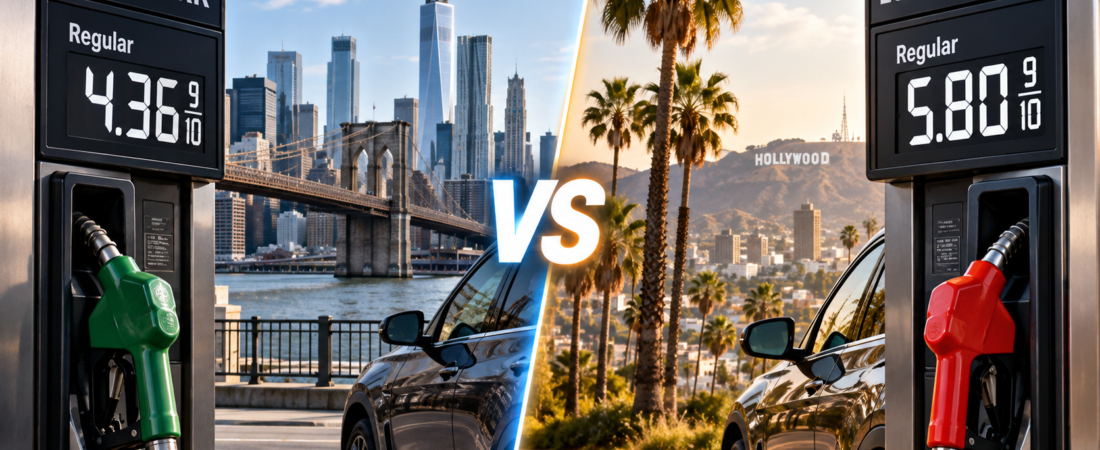
Gas prices are climbing again in 2026.
But depending on where you live, the pain at the pump can be dramatically different.
Consider two of America’s biggest cities.
According to U.S. Energy Information Administration data for the week of September 14, 2026, the average price of regular gasoline was:
New York City: $4.368 per gallon
Los Angeles: $5.805 per gallon
That’s a difference of about $1.44 per gallon.
In other words, regular gasoline in Los Angeles was roughly 33% more expensive than in New York City during the same week.
And California prices have continued moving higher. AAA’s September 19 data shows the Los Angeles–Long Beach average for regular gasoline at about $6.18 per gallon.
Same country.
Same basic product.
Very different price.
So why does gasoline cost so much more in Los Angeles?
And more importantly, how much does that difference actually cost a driver over a year?
Let’s compare.
Quick Comparison
| New York City | Los Angeles | |
|---|---|---|
| Regular Gas — Sept. 14 | $4.368 | $5.805 |
| Difference | — | +$1.437 |
| Approx. Price Premium | — | +33% |
| 15-Gallon Fill-Up | $65.52 | $87.08 |
| Difference Per Fill-Up | — | +$21.56 |
| 40 Fill-Ups Per Year | $2,620.80 | $3,483.00 |
| Annual Difference | — | +$862.20 |
Fuel-price calculations use EIA’s September 14, 2026 regular gasoline averages. Actual prices vary by station and change frequently.
Suddenly a $1.44 difference doesn’t look small.
For someone filling a 15-gallon tank 40 times a year, the difference approaches $900 annually.
And that’s before considering differences in how much people drive.
Why Is Los Angeles Gas So Expensive?
It’s tempting to explain California’s prices with one word:
Taxes.
Taxes matter.
But they don’t explain everything.
California’s gasoline market is structurally different from much of the United States.
The California Energy Commission identifies several reasons gasoline tends to cost more there, including higher taxes, a special cleaner-burning gasoline blend, environmental program costs, and an unusually isolated fuel market.
Let’s break those down.
Round 1: Taxes and Fees
Advantage: New York
California places significant taxes and environmental-related costs on gasoline.
New York drivers aren’t exactly buying cheap gasoline either.
But California’s tax and regulatory structure adds more cost to each gallon.
That means part of the difference between Los Angeles and New York exists before the gasoline even reaches your tank.
However, blaming the entire $1.44 difference on taxes would be misleading.
There are several other factors.
Advantage: New York
Round 2: California’s Special Gasoline
Advantage: New York
California doesn’t simply use the same gasoline specification as every other state.
The state requires a special cleaner-burning gasoline formulation designed to reduce air pollution.
That has environmental benefits.
But it’s also more expensive to produce.
The California Energy Commission estimates that the state’s unique gasoline specifications typically add roughly 10 to 15 cents per gallon in production costs compared with conventional gasoline.
There’s another consequence.
If California suddenly needs additional gasoline, suppliers elsewhere in the country can’t always simply send ordinary gasoline into the state.
The replacement fuel has to meet California requirements.
That limits supply flexibility.
And when supply becomes tight, limited flexibility can become expensive.
Advantage: New York
Round 3: Fuel Supply
Advantage: New York
This may be one of the biggest structural differences.
California’s fuel market is relatively isolated.
According to the California Energy Commission, there are no pipelines bringing transportation fuel into California from other states.
California primarily relies on its own refineries and marine imports when additional supply is needed.
That’s important.
Imagine a major California refinery suddenly shuts down.
Gasoline supply falls.
California can’t necessarily replace that fuel quickly by bringing gasoline through interstate pipelines.
Additional supplies may have to arrive by ship.
And that takes time.
The Energy Commission says overseas replacement supplies can take around three weeks to reach California marine terminals.
That makes California more vulnerable to temporary supply disruptions.
New York isn’t immune to fuel shortages or price spikes.
But California’s geography and fuel infrastructure can amplify problems.
Advantage: New York
Round 4: Refinery Problems
Advantage: New York
Refineries matter much more than most drivers realize.
Gasoline doesn’t come directly from an oil well to your local gas station.
Crude oil must be refined into gasoline.
California had 12 oil refineries as of January 2026, according to the California Energy Commission, with eight major facilities producing transportation fuels meeting the state’s specialized standards at that point.
When a refinery experiences:
A fire.
Maintenance.
Equipment failure.
Unexpected shutdown.
Or reduced production.
Local gasoline supply can tighten quickly.
And because California’s market is relatively isolated, replacing that missing production isn’t always easy.
That can translate into higher pump prices.
Advantage: New York
Round 5: Global Oil Prices
Winner: Tie
Here’s something both cities share.
Neither New York nor Los Angeles can escape the global price of crude oil.
Crude oil is one of the largest underlying costs of gasoline.
International conflicts, production decisions, shipping disruptions, inventories, and global demand can all affect oil prices.
EIA has noted that disruptions in Middle Eastern petroleum flows during 2026 contributed to higher and more volatile crude oil prices.
When crude oil rises, gasoline usually becomes more expensive across the country.
But California can experience an additional effect.
A global oil shock can raise the baseline price everywhere while California’s local supply constraints add another premium on top.
That’s one reason a nationwide gasoline increase doesn’t necessarily affect every state equally.
Winner: Tie — but California can feel supply shocks more severely
What Does the Difference Mean for a Real Driver?
Let’s make this practical.
Assume two drivers own identical vehicles.
Both get:
25 MPG
Both drive:
12,000 miles per year
Each driver would use approximately:
480 gallons per year
Now apply the September 14 prices.
New York City
480 × $4.368 =
$2,096.64 per year
Los Angeles
480 × $5.805 =
$2,786.40 per year
Difference:
$689.76 per year
Same car.
Same fuel economy.
Same annual mileage.
Almost $700 more per year simply because of where the driver buys gasoline.
Now imagine a large SUV getting 18 MPG.
At 12,000 miles annually, it would use roughly 667 gallons.
The same $1.437 price difference would translate into roughly:
$958 more per year.
Location suddenly becomes a meaningful part of the cost of owning a vehicle.
Fuel Economy Matters More When Gas Is Expensive
Higher gasoline prices also change the value of fuel efficiency.
Consider two vehicles.
Vehicle A
20 MPG
Vehicle B
30 MPG
Both travel 12,000 miles annually.
Vehicle A uses:
600 gallons
Vehicle B uses:
400 gallons
That’s a 200-gallon difference.
At $4.37 gasoline:
The fuel-efficiency advantage is worth roughly $874 per year.
At $5.81 gasoline:
It’s worth roughly $1,162 per year.
The vehicle didn’t become more efficient.
The economic value of its efficiency increased because gasoline became more expensive.
That’s important when comparing:
Gas vs. hybrid.
SUV vs. sedan.
Truck vs. crossover.
Or even two versions of the same vehicle.
Why California Drivers May Benefit More From Hybrids
This is where gasoline prices start affecting vehicle-buying decisions.
Suppose a conventional SUV gets:
25 MPG
And its hybrid equivalent gets:
35 MPG
At low gasoline prices, the fuel savings may take years to recover a higher hybrid purchase price.
But at $5 or $6 per gallon, the calculation changes.
Higher fuel prices shorten the potential payback period.
That’s why asking:
“Is a hybrid worth it?”
doesn’t have one universal answer.
A better question is:
“Is a hybrid worth it where I live and how much I drive?”
A driver paying Los Angeles fuel prices may reach a very different conclusion from someone paying much less elsewhere.
What About Electric Vehicles?
California’s expensive gasoline creates another interesting comparison.
Every increase in gasoline prices potentially improves the relative operating-cost case for EVs.
But electricity isn’t free either.
California also has relatively high electricity costs, and public fast charging can be substantially more expensive than charging at home.
So simply comparing:
$6 gasoline vs. electricity
isn’t enough.
You need to compare:
Miles driven.
Vehicle efficiency.
Home electricity rate.
Public charging usage.
Insurance.
Purchase price.
Depreciation.
And available incentives.
Gas prices are one piece of the ownership equation — not the entire equation.
Could Los Angeles Gas Prices Eventually Come Back Down?
Absolutely.
Gasoline prices constantly change.
Crude oil prices can fall.
Refinery production can recover.
Seasonal gasoline requirements change.
Demand can weaken.
Additional supply can arrive.
That’s why today’s $6 gasoline shouldn’t automatically be treated as the permanent price of driving in Los Angeles.
But the structural reasons California tends to be more expensive don’t disappear when oil prices fall.
California still has:
Its specialized gasoline.
Its environmental programs.
Its taxes.
Its relatively isolated fuel market.
And its dependence on a smaller network of specialized refineries.
Those characteristics help explain why California frequently remains above the national average even when gasoline prices decline nationwide.
The Bigger Money Lesson
Gasoline is a good example of something consumers often overlook:
The price of owning something depends on where you live.
A $50,000 SUV isn’t really the same financial decision everywhere.
Your location affects:
Fuel.
Insurance.
Registration.
Taxes.
Parking.
Tolls.
Maintenance labor rates.
And potentially depreciation.
The purchase price may be identical.
The ownership cost isn’t.
That’s why comparing vehicles only by MSRP can be misleading.
Our Pick: New York — for Fuel Cost
If we’re comparing only what drivers pay for gasoline, New York clearly has the advantage right now.
On September 14, regular gasoline averaged about $4.37 in New York City versus $5.81 in Los Angeles.
But the more interesting conclusion isn’t simply that Los Angeles gasoline is expensive.
It’s why.
California’s higher gasoline prices reflect a combination of global oil prices and local factors — including taxes, environmental requirements, specialized fuel standards, refinery capacity, and an isolated fuel-supply system.
And once gasoline approaches $6 per gallon, fuel economy stops being a minor specification.
It becomes a serious ownership cost.
So the next time you’re comparing two cars, don’t just ask:
“How much does the car cost?”
Ask:
“How much will this car cost to drive where I live?”
That number may tell you much more.
Compare with Reason.