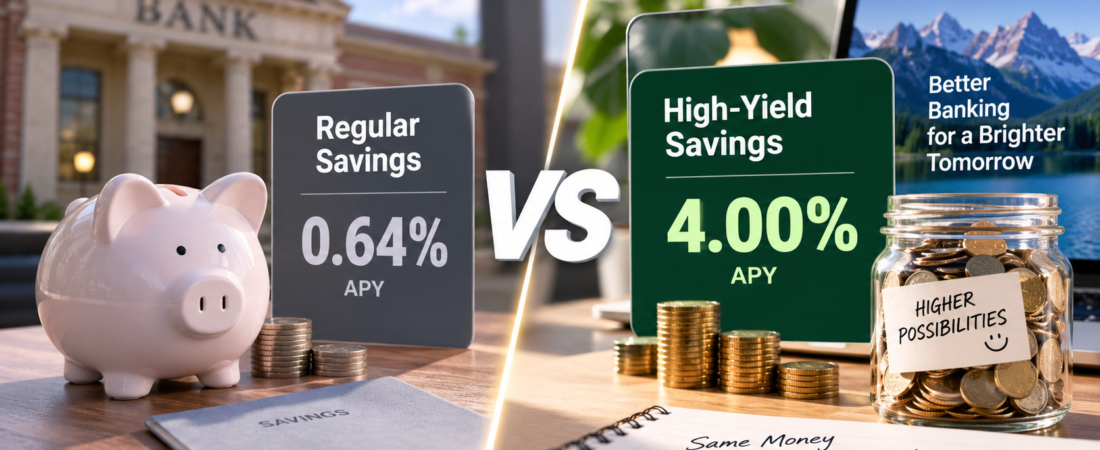
Most people know that high-yield savings accounts pay more interest than traditional savings accounts.
But the difference can look small.
0.64% vs. 4.00%.
A few percentage points.
Does it really matter?
If you have $1,000 in savings, maybe not much.
But if you have $25,000, $50,000, or $100,000 sitting in cash, the difference can quietly add up to thousands of dollars — without changing how much you save.
As of September 21, 2026, Bankrate reports that the average savings account yield is about 0.64% APY, while competitive high-yield savings accounts are paying around 4%, with some leading accounts around 4.10% APY.
So let’s forget the percentages for a moment.
Let’s look at the dollars.
Quick Comparison
| Regular Savings | High-Yield Savings | |
|---|---|---|
| Example APY | 0.64% | 4.00% |
| $10,000 After 1 Year* | ~$10,064 | ~$10,400 |
| $25,000 After 1 Year* | ~$25,160 | ~$26,000 |
| $50,000 After 1 Year* | ~$50,320 | ~$52,000 |
| $100,000 After 1 Year* | ~$100,640 | ~$104,000 |
| Access to Money | Easy | Usually Easy |
| FDIC/NCUA Protection | Available | Available |
| Rate Can Change | Yes | Yes |
*Approximate comparison using stated APYs and assuming the balance remains unchanged for one year. Actual earnings can vary as rates change.
The difference on $100,000?
About $3,360 in one year.
Same $100,000.
Different account.
What Is a High-Yield Savings Account?
A high-yield savings account, or HYSA, is still a savings account.
The biggest difference is the interest rate.
Many high-yield accounts are offered by online banks, which can operate with fewer physical branches and lower overhead than traditional brick-and-mortar banks.
That can allow them to offer significantly higher rates to depositors.
And despite the name “high-yield,” this isn’t necessarily some exotic investment.
If the account is held at an FDIC-insured bank, eligible deposits are generally insured up to $250,000 per depositor, per insured bank, per ownership category. Credit unions can have similar federal protection through the NCUA.
So you’re not comparing:
Savings vs. Stocks.
You’re comparing:
One type of savings account vs. another savings account.
$10,000: Does Switching Matter?
Let’s start small.
Regular Savings at 0.64%
Approximate annual interest:
$64
High-Yield Savings at 4.00%
Approximate annual interest:
$400
Difference:
$336 per year
That’s about:
$28 per month.
For someone with $10,000, this probably isn’t life-changing.
But $336 is still $336.
And you didn’t have to invest more money or take stock-market risk to potentially earn it.
$25,000: Now It Starts Getting Interesting
Regular Savings
Approximate annual interest:
$160
High-Yield Savings
Approximate annual interest:
$1,000
Difference:
$840 per year
Now we’re approaching $1,000.
That’s money that could cover:
A utility bill.
A few insurance payments.
Part of a vacation.
Or simply compound inside the account.
And remember:
You still have the same $25,000.
The difference is where you keep it.
$50,000: The Difference Becomes Hard to Ignore
Now imagine you’re keeping $50,000 in cash.
Maybe it’s an emergency fund plus savings for a home.
At 0.64%:
About $320 per year.
At 4%:
About $2,000 per year.
Difference:
$1,680
That’s roughly:
$140 per month.
At this point, choosing a low-paying savings account isn’t just a minor inconvenience.
There’s a meaningful opportunity cost.
$100,000: Thousands of Dollars for the Same Cash
Here’s where the math becomes especially noticeable.
$100,000 at 0.64%
Approximate interest:
$640
$100,000 at 4%
Approximate interest:
$4,000
Difference:
$3,360 per year
That’s about:
$280 per month.
And that’s without adding another dollar to the account.
Of course, savings rates can change throughout the year, so this shouldn’t be interpreted as a guaranteed future return.
But it demonstrates something important:
The interest rate on your savings matters more as your cash balance grows.
What If Your Big Bank Pays Only 0.01%?
Here’s where the difference can become even more dramatic.
Some standard savings accounts at large traditional banks can pay rates far below the national average.
Bankrate notes that some large brick-and-mortar banks offer standard savings rates around 0.01% APY.
At 0.01%, $100,000 would earn approximately:
$10 per year.
At 4%:
$4,000.
That’s nearly a:
$3,990 difference.
Now the decision looks very different.
Round 1: Interest Rate
Winner: High-Yield Savings
There’s really no contest here.
Traditional savings accounts are designed primarily as a safe place to store accessible cash.
High-yield savings accounts try to provide that same basic function while paying a more competitive rate.
Today’s leading HYSA rates are several times the national savings average.
Winner: High-Yield Savings
Round 2: Convenience
Winner: Regular Savings — Sometimes
This is where traditional banks can fight back.
Imagine you already have:
Checking.
Credit cards.
Mortgage.
Business accounts.
ATM access.
And your local branch
all at the same bank.
Keeping savings there can be incredibly convenient.
You open one app and everything is visible.
Some online high-yield banks may require transferring money between institutions, and transfers can sometimes take time.
Bankrate, for example, notes that transfer availability at some online savings providers can take several days.
If convenience is your top priority, your existing bank may still have an advantage.
Winner: Regular Savings
Round 3: Access to Your Money
Winner: Tie
A high-yield savings account is not the same as a CD.
With a CD, you’re generally agreeing to keep money deposited for a specific term, and early withdrawals can trigger penalties.
A savings account is designed to remain liquid.
That makes an HYSA particularly useful for money such as:
Emergency funds.
Future home down payments.
Tax reserves.
Vacation savings.
Car purchases.
Or other short-term goals.
You can earn interest while keeping the money accessible.
Winner: Tie
Round 4: Guaranteed Rate
Winner: Neither
This is important.
Savings-account APYs are generally variable.
A bank offering 4% today does not promise that it will pay 4% for the next five years.
Rates can rise.
Rates can fall.
Banks can change their APYs.
The Federal Reserve recently raised its federal-funds target range by 0.25 percentage point to 3.75%–4.00%, but a Fed move doesn’t require every bank to adjust savings rates by exactly the same amount.
If you specifically want to lock in a rate, a CD may deserve consideration instead.
That’s a different comparison.
Round 5: Emergency Fund
Winner: High-Yield Savings
This may be one of the best uses of an HYSA.
Emergency money should generally be:
Safe.
Accessible.
Separate from everyday spending.
You probably don’t want your emergency fund heavily exposed to stock-market volatility.
But leaving a large emergency fund earning almost nothing creates another problem.
A high-yield savings account can provide a middle ground:
Liquidity + interest.
That combination is difficult for a standard low-yield savings account to beat.
Winner: High-Yield Savings
Why Are High-Yield Accounts Often Online?
Physical banking is expensive.
Branches require:
Buildings.
Employees.
Utilities.
Security.
ATMs.
Maintenance.
Online-focused banks can operate with less physical infrastructure.
That doesn’t automatically mean every online bank will offer a great rate.
But the business model can make higher deposit rates easier to offer.
That’s one reason you’ll often see competitive savings rates from banks you’ve never seen on a street corner.
But Don’t Chase APY Blindly
Suppose one account pays:
4.00%
and another pays:
4.10%.
On $10,000, the approximate difference over one year is only:
$10.
So constantly moving money from bank to bank for every tiny APY increase may not be worth the hassle.
Instead, compare:
APY
Monthly fees
Minimum balance requirements
Transfer speed
Withdrawal access
Customer service
FDIC or NCUA coverage
and any special conditions required to earn the advertised rate.
For example, some accounts require a minimum balance or linked checking relationship to earn their highest advertised APY.
The headline rate isn’t the only number that matters.
What About Inflation?
There’s another reason earning interest matters.
Cash doesn’t exist in a vacuum.
Inflation gradually reduces purchasing power.
If your savings earns almost nothing while prices rise, your account balance may stay intact in dollars while its real-world buying power declines.
A high-yield savings account doesn’t guarantee that you’ll beat inflation.
But earning a competitive rate can help reduce the gap.
That’s much better than voluntarily earning almost zero on money you’re going to keep in cash anyway.
When Regular Savings Still Makes Sense
High-yield savings isn’t automatically better for every dollar.
A regular savings account can still make sense if:
You keep only a small amount there.
You need instant transfers to checking.
You regularly use a physical branch.
Your existing bank already offers a competitive APY.
Or simplicity matters more to you than a relatively small amount of additional interest.
Imagine you keep only $1,000 in savings.
The difference between 0.64% and 4% is roughly:
$33.60 per year.
You may decide convenience is worth more than $34.
That’s reasonable.
Now change that balance to:
$100,000.
The conversation becomes very different.
The Bigger Your Cash Balance, the More APY Matters
Here’s perhaps the easiest way to think about it:
| Savings Balance | Approx. Extra Interest at 4% vs. 0.64% |
|---|---|
| $1,000 | $34/year |
| $10,000 | $336/year |
| $25,000 | $840/year |
| $50,000 | $1,680/year |
| $100,000 | $3,360/year |
| $200,000 | $6,720/year |
These are simplified one-year comparisons using constant APYs.
But they reveal the basic principle.
For someone with $1,000, optimizing a savings rate probably shouldn’t consume much time.
For someone holding $100,000 or $200,000 in cash?
It deserves attention.
Our Pick: High-Yield Savings — for Most Cash Savers
For most people keeping meaningful cash reserves, high-yield savings wins.
Not because it does something radically different from a traditional savings account.
That’s precisely the point.
You’re still keeping cash.
You’re still maintaining liquidity.
You can still choose a federally insured institution.
But your money may earn significantly more interest.
At today’s approximate rates, $100,000 earning 4% instead of 0.64% represents around:
$3,360 more interest over one year.
You don’t need to work additional hours for it.
You don’t need to pick a winning stock.
You don’t need to take normal stock-market risk.
You simply need to pay attention to what your bank is paying you.
The mistake isn’t necessarily keeping money in savings.
The mistake may be keeping a large amount of savings somewhere that barely pays you for it.
Compare with Reason.