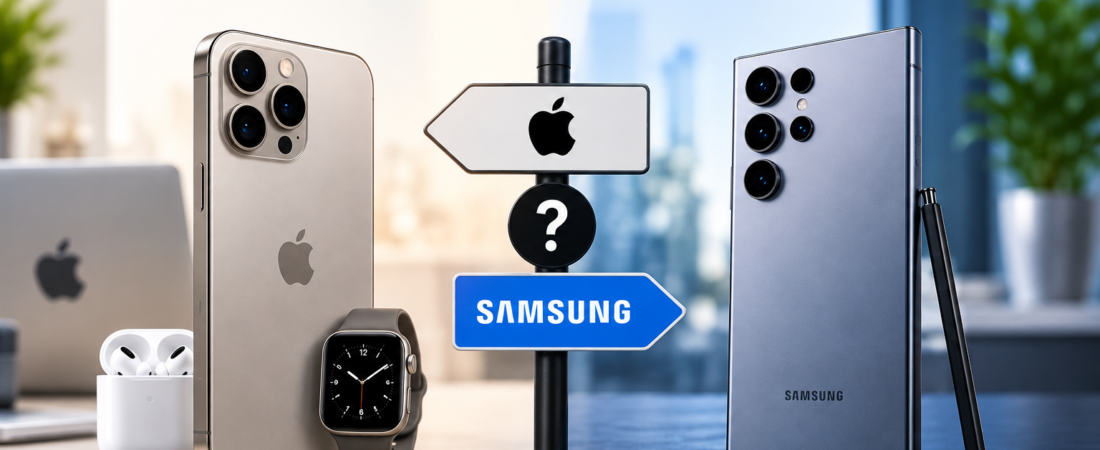
For years, switching from an iPhone to a Samsung Galaxy phone sounded simple in theory but complicated in practice.
Your photos might transfer. Your contacts probably would. But what about your messages, passwords, eSIM, Apple Watch, AirPods, iCloud, and all the little settings you have accumulated over the years?
That friction has been one of Apple’s biggest advantages.
In 2026, however, switching is becoming much easier.
Samsung recently upgraded Smart Switch with One UI 9, allowing compatible iPhone users to begin transferring data simply by scanning a QR code. Samsung says the system can now transfer more types of information, including passwords and passkeys, call history, accessibility settings, and supported eSIM information, in addition to photos, contacts, calendars, messages, apps, and other data.
Apple has also improved cross-platform transfers. On compatible devices, iPhone users can transfer data and supported eSIMs directly to Android during setup.
So the question is changing.
It is no longer simply:
“Can I switch from iPhone to Samsung?”
The better question is:
“Now that switching is easier, is there actually a good reason to leave the iPhone?”
Let’s compare.
Quick Comparison
| Category | Switch to Samsung | Stay with iPhone |
|---|---|---|
| Data Transfer | Much easier than before | No transfer needed |
| Ecosystem | More flexible | Excellent Apple integration |
| Customization | Excellent | More controlled |
| AI Features | Major focus | Rapidly improving |
| Apple Watch Integration | Lost | Excellent |
| Mac Integration | Limited | Excellent |
| Windows Integration | Strong | More limited |
| Hardware Choices | Excellent | Simpler lineup |
| Learning Curve | Moderate | None |
| Best For | Users wanting flexibility | Existing Apple ecosystem users |
1. Switching Is Much Easier Than It Used to Be
This may be the biggest change in 2026.
Samsung’s Smart Switch has existed for years, but One UI 9 reduces one of the most annoying parts of changing platforms.
On supported new Galaxy devices, users can scan a QR code with their iPhone and begin the transfer without separately installing Smart Switch on the iPhone.
Samsung says transferable information can include:
- Photos and videos
- Contacts
- Messages
- Calendars
- Apps
- Passwords and passkeys
- Call history
- Accessibility settings
- Supported eSIM information
That does not mean every piece of data from every third-party app will move perfectly. Some apps still require you to sign in again, and certain app-specific information may remain tied to Apple’s ecosystem.
But compared with switching phones several years ago, the process is significantly less intimidating.
Winner: Samsung
Not because staying with an iPhone is difficult, but because the biggest historical obstacle to leaving the iPhone has become much smaller.
2. The Apple Ecosystem Is Still the Hardest Thing to Leave
Moving your photos is one thing.
Moving your digital life is another.
If you own only an iPhone, switching to Galaxy may be relatively painless.
But imagine you own:
- iPhone
- Apple Watch
- AirPods
- MacBook
- iPad
- Apple TV
Now the decision becomes much more complicated.
Apple’s products are designed to work together. Features such as AirDrop, iCloud synchronization, shared passwords, Continuity, device handoff, and Apple Watch integration can make the entire ecosystem feel like one large device.
Replacing the iPhone may break parts of that experience.
The Apple Watch is particularly important. If it is central to your fitness, notifications, payments, and daily routine, moving to Samsung may eventually mean replacing your watch too.
Suddenly, a $1,000 phone switch can become a much larger ecosystem switch.
Winner: Staying with iPhone
3. Samsung Gives You More Freedom
Samsung’s biggest advantage may not be one specific specification.
It is choice.
Galaxy users generally have more control over home-screen layouts, default apps, multitasking, file management, interface customization, and how the phone behaves.
Samsung also offers dramatically different hardware formats.
You can choose a traditional Galaxy S flagship, a large Ultra model, or a foldable Galaxy Z device.
Apple offers multiple iPhone sizes and configurations, but the overall experience remains intentionally controlled.
Neither approach is inherently better.
Some users want their phone to simply work consistently.
Others want their phone to work their way.
For the second group, Samsung is compelling.
Winner: Samsung
4. What About AI?
AI is becoming one of the biggest smartphone battlegrounds.
Samsung has pushed Galaxy AI deeply into its devices, while Apple continues expanding Apple Intelligence and Siri AI.
Apple’s newest iPhone 18 Pro lineup runs iOS 27 and introduces the next generation of Apple Intelligence and Siri AI. Apple positions the system around personal context, privacy, and deeper integration with the iPhone experience.
The important point for buyers is that AI alone probably should not determine which ecosystem you choose.
Many popular AI services increasingly work across platforms.
ChatGPT, Gemini, and other cloud-based AI tools are not necessarily reasons to buy one particular phone.
The more important differences will be the AI features integrated directly into the operating system — things such as photo editing, search, translation, voice assistance, messaging, and automation.
For now, this category depends heavily on which specific features you actually use.
Winner: Tie
5. Samsung Works Especially Well If You Use Windows
This is where the decision can flip quickly.
A Mac user has a strong reason to stay with iPhone.
A Windows PC user does not have the same lock-in.
Samsung phones can integrate well with Windows PCs, and Android generally provides more flexibility for moving files and working across different hardware brands.
If your technology setup looks something like:
Windows laptop + Google services + Spotify + Gmail + Galaxy
switching away from iPhone may be surprisingly easy.
But if your setup is:
MacBook + Apple Watch + AirPods + iCloud + iPhone
staying with Apple makes considerably more sense.
The phone itself is only one part of the decision.
Winner: Depends on Your Computer
6. Messaging Is Less of a Barrier Than Before
Messaging used to be one of the strongest social reasons not to leave the iPhone, especially in the United States.
That barrier has weakened.
Modern cross-platform messaging standards such as RCS improve communication between iPhone and Android users, including richer messaging features and better media sharing than traditional SMS/MMS.
Samsung specifically highlights improved cross-platform communication and sharing as part of its current switching strategy.
That does not make iMessage irrelevant.
Apple users who rely heavily on iMessage and FaceTime may still prefer staying inside Apple’s ecosystem.
But switching to Android no longer feels as isolated as it once did.
Winner: Tie
7. AirPods Are Easier to Leave Than Apple Watch
If you own AirPods, don’t automatically assume you need new earbuds.
AirPods can still function as Bluetooth headphones with non-Apple devices, although some Apple-specific integration and convenience features may be reduced.
Apple Watch is different.
It is much more closely tied to the iPhone.
That creates an interesting hierarchy when considering switching.
An iPhone owner with only AirPods has relatively little ecosystem friction.
An iPhone owner with AirPods, Apple Watch, MacBook, iPad, and paid iCloud storage has considerably more.
This is why the number of Apple products you own may matter more than the specifications of your next phone.
Winner: Staying with iPhone for Apple Watch Users
8. Don’t Switch Just Because Samsung Has One Better Feature
This is an easy mistake.
Maybe Samsung has a camera feature you like.
Maybe you prefer its display.
Maybe Galaxy AI has a feature unavailable on your current iPhone.
Those can be good reasons to consider switching — but they should not automatically be enough.
Changing ecosystems creates friction.
You’ll need to learn a new interface, reorganize apps, sign back into services, adjust settings, and possibly replace accessories.
Before switching, ask a better question:
What problem with my iPhone am I trying to solve?
If you cannot answer that clearly, switching may simply replace a familiar phone with an unfamiliar one.
9. But Don’t Stay with iPhone Just Because You’ve Always Had One
The opposite mistake is equally common.
Some people have owned iPhones for ten years and assume switching would be impossible.
That is increasingly outdated.
Data-transfer tools are improving on both sides. Apple itself now documents direct transfer of data and supported eSIMs from iPhone to compatible Android devices, while Samsung has expanded Smart Switch.
If you genuinely prefer Samsung’s hardware, customization, multitasking, foldables, or broader device flexibility, ecosystem inertia should not automatically stop you.
Technology should serve your needs.
You shouldn’t have to serve your ecosystem.
Who Should Switch to Samsung?
Switching makes the most sense if you:
- Prefer Android customization.
- Want foldable hardware or more device choices.
- Primarily use a Windows PC.
- Depend heavily on Google services.
- Don’t own many other Apple devices.
- Want more control over how your phone operates.
- Have a specific Galaxy feature you know you will use.
For these users, the transition is easier in 2026 than it was several years ago.
Who Should Stay with iPhone?
Staying with iPhone makes more sense if you:
- Own an Apple Watch.
- Use a Mac every day.
- Have multiple Apple devices.
- Depend heavily on iCloud.
- Frequently use AirDrop and other Apple continuity features.
- Are satisfied with your current phone.
- Don’t have a specific reason to change.
There is value in familiarity.
Switching simply for the sake of switching rarely produces a meaningful improvement.
The Most Important Question Isn’t Samsung vs. Apple
Smartphone comparisons usually focus on cameras, processors, displays, and batteries.
Those things matter.
But when deciding whether to leave an ecosystem, another factor may matter more:
How deeply invested are you in everything surrounding the phone?
A person with an iPhone and a Windows laptop is making a very different decision from someone with an iPhone, Apple Watch, MacBook, iPad, AirPods, and years of iCloud usage.
That is why there is no universal answer.
The deeper you are inside Apple’s ecosystem, the more valuable staying becomes.
The more platform-independent your digital life is, the easier Samsung becomes to consider.
Our Pick: Stay with iPhone — Unless You Have a Clear Reason to Switch
For an existing iPhone owner who is happy with the phone and heavily invested in Apple products, staying with iPhone is the more practical choice.
The ecosystem remains one of Apple’s biggest strengths, and switching simply because another phone has slightly better specifications rarely justifies replacing the conveniences you already use every day.
But 2026 changes one important part of the equation.
Switching itself is no longer the reason to stay.
Samsung’s improved Smart Switch and broader cross-platform compatibility have removed much of the technical friction that once made leaving iPhone intimidating.
So if you prefer Galaxy hardware, customization, foldables, Windows integration, or Samsung’s approach to AI, switching is now a much more realistic option.
The decision is no longer:
“Can I leave iPhone?”
It is:
“Is there something on the other side worth leaving for?”
Compare with Reason.