Weight-loss medications have changed dramatically in just a few years.
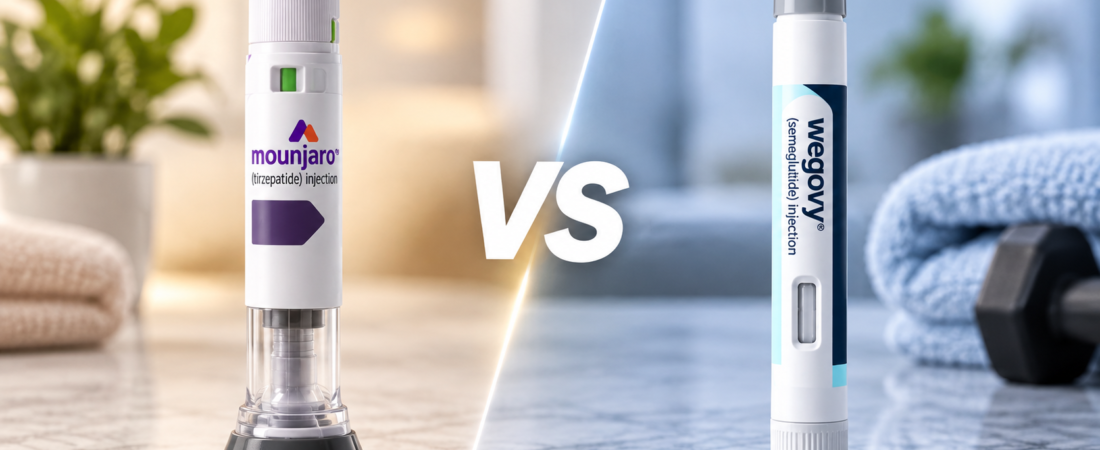
Two names that frequently come up are Mounjaro and Wegovy. Both are once-weekly injectable medications associated with substantial weight loss, and both affect hormones involved in appetite and metabolism.
But they are not the same drug — and technically, they are not direct equivalents.
Mounjaro contains tirzepatide, while Wegovy contains semaglutide. More importantly, in the United States, Mounjaro is FDA-approved to improve blood sugar control in adults with type 2 diabetes. Tirzepatide is marketed separately as Zepbound for chronic weight management. Wegovy, meanwhile, is FDA-approved for long-term weight management in eligible patients.
So why compare Mounjaro and Wegovy?
Because many people searching for weight-loss medications know tirzepatide by the Mounjaro name, and the underlying question is usually:
How does tirzepatide compare with semaglutide for weight loss?
We now have unusually strong evidence to help answer that question — including a head-to-head randomized trial.
Here’s what you need to know.
Quick Comparison
| Mounjaro | Wegovy | |
|---|---|---|
| Active Ingredient | Tirzepatide | Semaglutide |
| Drug Targets | GIP + GLP-1 | GLP-1 |
| Injection | Once weekly | Once weekly |
| U.S. Mounjaro Indication | Type 2 diabetes | — |
| U.S. Weight-Management Brand | Zepbound | Wegovy |
| Weight-Loss Evidence | Very strong | Very strong |
| Cardiovascular Indication | Depends on tirzepatide product/indication | Yes, in certain adults |
| Common Issues | Mainly gastrointestinal | Mainly gastrointestinal |
The most important distinction is therefore not simply Mounjaro vs. Wegovy.
It is really tirzepatide vs. semaglutide.
1. How Do Mounjaro and Wegovy Work?
Both medications influence hormones involved in appetite, digestion, and blood sugar regulation.
But they work differently.
Wegovy: GLP-1
Semaglutide, the active ingredient in Wegovy, is a GLP-1 receptor agonist.
GLP-1 medications can reduce appetite and increase feelings of fullness, which can make it easier for some people to consume fewer calories.
Mounjaro: GIP + GLP-1
Tirzepatide works on two receptors:
GIP + GLP-1
This dual mechanism is one of the major differences between the medications.
That does not automatically mean that every person taking tirzepatide will lose more weight.
But large clinical trials — including a direct comparison — have shown greater average weight reduction with tirzepatide.
Difference: Tirzepatide uses a dual GIP/GLP-1 mechanism.
2. Which Produced More Weight Loss?
This is where the comparison becomes particularly interesting.
Earlier trials studied each drug separately.
In the STEP 1 trial, adults with overweight or obesity without diabetes who received semaglutide 2.4 mg had an average body-weight reduction of about 14.9% after 68 weeks, compared with 2.4% with placebo.
In the SURMOUNT-1 trial, tirzepatide produced average weight reductions of approximately:
- 15.0% at 5 mg
- 19.5% at 10 mg
- 20.9% at 15 mg
after 72 weeks, compared with 3.1% with placebo.
However, comparing separate trials can be misleading because the participants and study designs may differ.
Fortunately, researchers have now compared the two medications directly.
3. Tirzepatide vs. Semaglutide: The Head-to-Head Trial
The SURMOUNT-5 trial provides one of the most useful comparisons available.
Researchers randomly assigned adults with obesity but without type 2 diabetes to receive the maximum tolerated dose of either tirzepatide or semaglutide for 72 weeks.
Tirzepatide was given at 10 mg or 15 mg, while semaglutide was given at 1.7 mg or 2.4 mg.
The study found that tirzepatide produced a greater average reduction in body weight and waist circumference than semaglutide.
That is important because this wasn’t simply a comparison between numbers from two unrelated trials.
It was a randomized, head-to-head study.
Weight-Loss Advantage: Tirzepatide
On average, the direct clinical evidence favors tirzepatide for weight reduction.
But averages don’t tell you what will happen to an individual patient.
Response, tolerability, medical history, dose, adherence, insurance coverage, and other factors can all affect real-world results.
4. Does That Mean Mounjaro Is the Better Weight-Loss Drug?
This is where terminology matters.
If someone does not have type 2 diabetes and is seeking medication specifically for chronic weight management, a U.S. clinician would generally be comparing the appropriate FDA-approved weight-management products.
For tirzepatide, that’s Zepbound.
For semaglutide, that’s Wegovy.
Mounjaro and Zepbound contain the same active ingredient — tirzepatide — but they are different branded products with different FDA-approved indications.
So saying simply that “Mounjaro is better than Wegovy for weight loss” misses an important regulatory distinction.
A more accurate statement is:
In a direct obesity trial, tirzepatide produced greater average weight loss than semaglutide.
5. Wegovy Has Another Important Advantage: Cardiovascular Evidence
Weight loss isn’t the only reason these medications may be prescribed.
In 2024, the FDA approved Wegovy for another major indication: reducing the risk of cardiovascular death, heart attack, and stroke in adults with established cardiovascular disease who also have obesity or overweight.
That matters.
A person choosing a medication should not necessarily focus exclusively on which one produces the largest number on the scale.
Medical history can change the decision substantially.
Someone with established cardiovascular disease, for example, may have considerations that are very different from someone primarily seeking weight management.
Important Advantage: Wegovy has an FDA-approved cardiovascular risk-reduction indication for certain adults.
6. What About Side Effects?
Both drugs commonly cause gastrointestinal side effects.
These can include symptoms such as:
- Nausea
- Diarrhea
- Vomiting
- Constipation
- Abdominal discomfort
The direct SURMOUNT-5 trial reported gastrointestinal adverse events as the most common side effects with both medications.
This is one reason doses are generally increased gradually rather than starting immediately at the highest dose.
More weight loss does not necessarily make a medication the better choice for an individual if that person cannot tolerate it.
Tolerability matters.
7. Both Require More Than Just Taking a Shot
It is easy to look at the dramatic weight-loss percentages in clinical trials and think these medications work independently of everything else.
That’s not how the studies or FDA indications are structured.
FDA-approved weight-management medications are used alongside lifestyle measures such as reduced-calorie eating and increased physical activity.
There is another practical issue:
These medications are generally intended as treatments for chronic disease rather than quick, temporary diet tools.
Stopping treatment can affect weight maintenance, which is something patients should discuss with their healthcare professional before beginning therapy.
8. Cost and Insurance Could Change the Decision
For many Americans, the most important difference may not be pharmacology.
It may be insurance.
Coverage for anti-obesity medications varies considerably between health plans, employers, and individual circumstances.
A medication that looks ideal clinically may become unrealistic if another appropriate option has substantially better insurance coverage.
The relevant comparison is therefore not simply:
Which medication has the higher list price?
It is:
What will this medication actually cost me under my insurance plan?
That can vary dramatically from one patient to another.
Before starting treatment, patients may want to verify coverage, prior-authorization requirements, deductibles, and expected out-of-pocket costs directly with their insurer and pharmacy.
9. Mounjaro vs. Wegovy for Diabetes
This comparison changes again for someone with type 2 diabetes.
Mounjaro is FDA-approved specifically to improve blood sugar control in adults with type 2 diabetes, in addition to diet and exercise.
And tirzepatide has demonstrated strong glucose-lowering effects.
In an earlier head-to-head trial involving people with type 2 diabetes, tirzepatide produced greater reductions in HbA1c and body weight than the semaglutide dose studied in that trial.
But that trial should not be confused with the obesity-focused SURMOUNT-5 study.
The populations, doses, and clinical questions were different.
That distinction matters when interpreting headlines about which medication “works better.”
10. Who Might Discuss Tirzepatide With Their Doctor?
Tirzepatide may be worth discussing when substantial weight reduction is an important treatment goal and the patient meets the appropriate criteria for treatment.
The head-to-head obesity evidence showing greater average weight reduction than semaglutide makes tirzepatide particularly notable.
For weight management specifically, the relevant U.S. brand is Zepbound rather than Mounjaro.
The decision still depends on individual medical history, contraindications, side effects, other medications, insurance coverage, and clinician judgment.
11. Who Might Discuss Wegovy With Their Doctor?
Wegovy remains a highly effective obesity medication.
Its clinical evidence includes substantial average weight reduction, and it also carries an FDA-approved indication for reducing major cardiovascular events in certain adults with established cardiovascular disease and overweight or obesity.
That means the medication with the largest average weight-loss percentage is not automatically the right medication for every patient.
The treatment goal matters.
The Biggest Mistake: Choosing Only by Weight-Loss Percentage
It is tempting to turn this comparison into one number:
Which drug causes more weight loss?
For that specific question, the direct trial gives us useful evidence favoring tirzepatide on average.
But medical decisions are more complicated.
The better questions include:
What condition is being treated?
Does the patient have diabetes?
Does the patient have established cardiovascular disease?
Which medication is medically appropriate?
Which one can the patient tolerate?
Which one will insurance cover?
A few additional percentage points of average weight loss may be less important than finding a treatment that is appropriate, tolerable, affordable, and sustainable.
Bottom Line
Mounjaro and Wegovy are often discussed as competing weight-loss medications, but that comparison needs context.
Mounjaro = tirzepatide, FDA-approved for type 2 diabetes.
Zepbound = tirzepatide, FDA-approved for chronic weight management.
Wegovy = semaglutide, FDA-approved for chronic weight management and, in certain adults, cardiovascular risk reduction.
When researchers directly compared tirzepatide with semaglutide in adults with obesity without diabetes, tirzepatide produced greater average weight reduction over 72 weeks.
But that does not make one medication universally better for everyone.
The most appropriate treatment depends on the patient’s diagnosis, medical history, treatment goals, side-effect tolerance, coverage, and clinician’s assessment.
For someone researching these medications in 2026, the most useful takeaway may be simple:
Don’t compare brand names alone. Compare the active drugs, approved uses, clinical evidence, risks, and your individual medical situation.
Compare with Reason.
This article is for general informational purposes and is not a substitute for medical advice, diagnosis, or treatment. Prescription medication decisions should be made with a qualified healthcare professional.