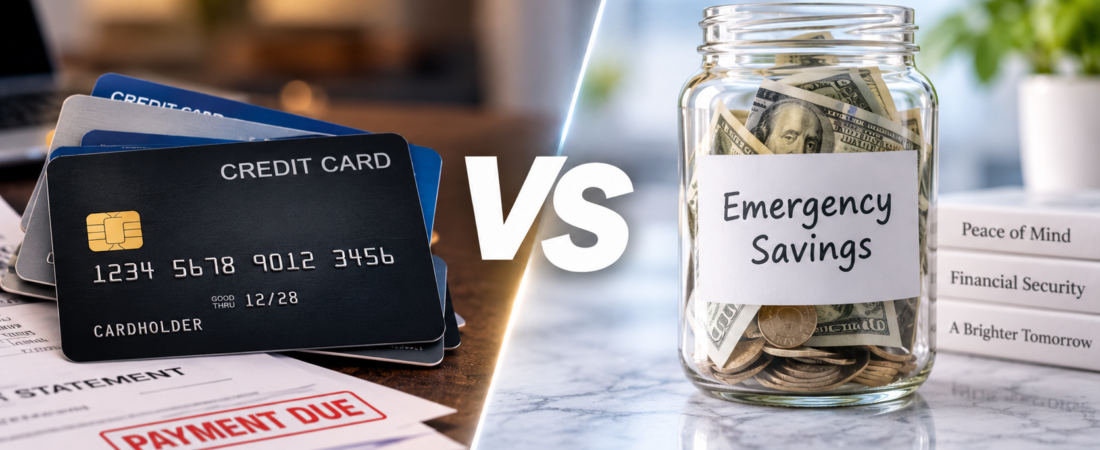
Imagine you have $10,000 sitting in a high-yield savings account.
It feels good.
That money is your safety net. If your car breaks down, your refrigerator dies, or you suddenly lose income, you have cash available.
But there is one problem.
You also have $10,000 in credit card debt charging nearly 20% interest.
Should you keep the savings because emergencies happen?
Or should you use the money to eliminate the credit card balance?
This is one of the most common personal-finance dilemmas — and in 2026, the math has become especially interesting.
As of September 2026, Bankrate reports the average U.S. credit card interest rate at 19.56%. Competitive high-yield savings accounts, meanwhile, are paying roughly 4% APY, with some offers somewhat higher.
So purely mathematically, paying down high-interest credit card debt has a major advantage.
But draining your emergency fund to zero can create another problem.
Let’s compare both strategies.
Quick Comparison
| Pay Credit Card Debt | Keep Emergency Savings | |
|---|---|---|
| Financial Return | Potentially very high | Around 4% with competitive HYSA |
| Reduces Interest Expense | Yes | No |
| Provides Emergency Cash | Less | Yes |
| Improves Monthly Cash Flow | Potentially | No immediate change |
| Protects Against New Debt | Indirectly | Yes |
| Best For | High-interest balances | Financial emergencies |
| Main Risk | Having too little cash | Continuing expensive debt |
The answer isn’t necessarily choosing one and ignoring the other.
For many households, the best strategy is:
Keep a smaller emergency cushion, then aggressively attack high-interest credit card debt.
Here’s why.
1. Start With the Math
Suppose you have:
$10,000 in savings earning 4%
and
$10,000 in credit card debt costing 19.56%.
Ignoring compounding details for a simple illustration:
Your savings might earn roughly:
$400 per year
Meanwhile, $10,000 carried for a year at 19.56% would represent roughly:
$1,956 in annual interest at that rate
before considering payments, compounding, fees, or changing balances.
That’s a gap of approximately:
$1,556.
You are effectively earning around 4% on one side while paying nearly 20% on the other.
Mathematically, that’s difficult to justify.
2. A High-Yield Savings Account Doesn’t Beat Credit Card Interest
High-yield savings accounts are excellent places for emergency money.
Current competitive accounts around 4% APY are dramatically better than leaving large amounts of cash in a traditional savings account paying very little.
But 4% is still nowhere close to approximately 20%.
Consider $20,000.
At 4% APY:
$20,000 → about $800 in annual interest
At 19.56%:
$20,000 → roughly $3,912 in annual interest at that rate
Again, this is simplified because real credit-card balances change as payments and purchases occur.
But the basic relationship is clear.
A savings account generally cannot outrun high-interest credit card debt.
Math Winner: Paying Credit Card Debt
3. So Why Not Empty Your Savings Account?
Because personal finance isn’t only mathematics.
Suppose you have:
$10,000 savings
$10,000 credit card debt
You take all $10,000 and pay off the card.
Great.
Your credit card balance is now:
$0.
But your bank balance is also:
$0.
Two weeks later, your car needs a $2,500 repair.
Where does the money come from?
Potentially the same credit card you just paid off.
Now you are back in debt.
This is exactly why emergency savings exist.
The Consumer Financial Protection Bureau describes an emergency fund as a cash reserve for unplanned expenses such as car repairs, home repairs, medical bills, or loss of income. It also notes that without savings, even a relatively small financial shock can turn into debt.
Safety Winner: Emergency Savings
4. The Better Strategy: Don’t Think All or Nothing
You don’t necessarily have to choose between:
$10,000 savings + $10,000 debt
and
$0 savings + $0 debt.
There is a middle ground.
Imagine instead that you keep:
$3,000 as an emergency cushion
and use:
$7,000 to pay down the credit card.
Now your situation becomes:
Emergency savings: $3,000
Credit card debt: $3,000
You still have money available for unexpected expenses.
But you’ve eliminated 70% of the expensive debt.
That’s often a much more balanced position.
The appropriate cushion depends on your circumstances — job stability, household expenses, insurance coverage, family obligations, access to other cash, and the types of emergencies you’re likely to encounter.
There is no universal dollar amount.
5. Why a Small Emergency Fund Still Matters
Consider two people.
Person A
Savings: $0
Credit card debt: $0
Person B
Savings: $3,000
Credit card debt: $3,000
At first glance, Person A looks financially stronger because there is no debt.
But imagine both suddenly need a $2,000 home repair.
Person A may have to borrow the entire $2,000.
Person B can potentially pay cash.
That’s the value of liquidity.
Emergency savings aren’t primarily an investment.
They are financial insurance against needing expensive debt again.
6. What If Your Credit Card Has a 0% Promotional APR?
Now the comparison changes.
Suppose you have:
$10,000 credit card balance at 0% promotional APR
and
$10,000 earning 4% in savings.
From a purely mathematical perspective, keeping the cash temporarily can make sense because your savings is earning interest while the debt isn’t charging interest.
But there is a major catch.
The promotional period ends.
If you still have a large balance when the regular APR begins, the situation can change quickly.
So a 0% card isn’t permission to ignore the debt.
You need a realistic payoff schedule before the promotional period expires.
7. What If the Credit Card Rate Is Lower?
The interest-rate gap determines much of the answer.
If your debt costs:
5%
and your savings earns:
4%
the mathematical advantage of paying the debt is relatively small.
If your debt costs:
25%
and savings earns:
4%
the difference is enormous.
That’s why the first number you should check isn’t your credit-card balance.
It’s your APR.
Open your statement and find the actual rate you’re paying.
8. Don’t Forget Taxes on Savings Interest
There’s another small advantage to paying down debt.
Interest earned in a taxable savings account is generally taxable income.
That means a 4% APY does not necessarily translate into a full 4% after-tax return.
Paying off a 20% credit-card balance, meanwhile, prevents future interest expense on the amount repaid.
This makes the mathematical gap between high-interest debt and savings even larger for many borrowers.
9. Credit Card Minimum Payments Can Be Deceptive
Another reason high-interest credit card debt can become dangerous is that minimum payments make the debt feel manageable.
You might owe $10,000 but only be required to pay a few hundred dollars this month.
That doesn’t mean the debt is inexpensive.
Interest continues to accumulate on unpaid balances.
If you’re struggling even to make minimum payments, the CFPB recommends contacting the card issuer immediately rather than waiting until you’ve fallen further behind. Issuers may sometimes offer alternative payment arrangements.
The CFPB also warns consumers to be cautious with debt-settlement companies making promises about eliminating debt.
10. What About Investing Instead?
This creates another common question.
Why pay off a credit card charging 20% if the stock market might produce good returns?
Because the two aren’t equivalent.
A credit-card APR is a contractual cost.
Stock-market returns are uncertain.
Your investment could gain 15%.
It could also lose 20%.
Avoiding high-interest debt is fundamentally different from taking investment risk in hopes of earning a return.
For extremely high-interest consumer debt, paying it down is generally a much more straightforward financial calculation.
11. A Practical Order of Operations
Instead of thinking:
Savings OR debt?
Think in stages.
Step 1: Protect Essential Bills
Make sure housing, utilities, food, insurance, transportation, and required minimum debt payments can be covered.
Step 2: Establish a Basic Emergency Cushion
Keep enough accessible cash that a normal unexpected expense doesn’t immediately send you back to a credit card.
Step 3: Attack High-Interest Credit Card Debt
Once that basic cushion exists, direct additional cash toward expensive revolving debt.
Step 4: Rebuild a Larger Emergency Fund
After eliminating the high-interest balance, redirect the money that previously went toward credit-card payments into savings.
Step 5: Build Toward Longer-Term Goals
Once expensive debt is controlled and emergency savings are stronger, investing and other long-term financial goals become easier to pursue.
This sequence doesn’t fit every household perfectly, but it illustrates why debt repayment and emergency savings should work together rather than compete indefinitely.
12. The $10,000 Example
Let’s return to our original scenario.
You have:
$10,000 savings
$10,000 credit card debt
Suppose your savings earns 4%, while your card charges approximately 19.56%.
Option A: Keep Everything in Savings
Savings: $10,000
Debt: $10,000
You maintain excellent liquidity.
But you’re paying a much higher interest rate than you’re earning.
Option B: Use Everything to Pay Debt
Savings: $0
Debt: $0
Mathematically attractive.
But you have no cash buffer.
Option C: Keep $3,000 and Pay $7,000 Toward Debt
Savings: $3,000
Debt: $3,000
You’ve dramatically reduced your high-interest balance while preserving some emergency liquidity.
For many people, Option C represents the logic worth considering — although the appropriate emergency cushion will vary.
13. When Keeping More Cash Can Make Sense
There are situations where maintaining a larger emergency fund may deserve priority.
For example:
Someone expects a layoff.
Income is highly unpredictable.
A major medical expense may be coming.
The household has only one income.
A necessary home or vehicle repair is imminent.
Insurance deductibles are unusually high.
In these situations, liquidity becomes more valuable.
Someone with an extremely stable income and few financial obligations may reasonably feel comfortable keeping a smaller cash cushion while attacking debt aggressively.
Personal finance is personal for a reason.
14. When Paying Debt Becomes More Urgent
The case for aggressive repayment becomes stronger when:
The APR is extremely high.
The balance continues growing.
You’re making only minimum payments.
Interest charges are consuming a significant portion of monthly cash flow.
You already have enough emergency cash to handle normal unexpected expenses.
You’re still charging new purchases because existing debt consumes your income.
At that point, carrying a large savings balance while paying very high credit-card interest can become increasingly expensive.
Our Pick: Keep a Basic Emergency Cushion, Then Attack High-Interest Credit Card Debt
This isn’t a choice between being responsible and irresponsible.
Both goals are responsible.
You need emergency savings.
And you need to eliminate expensive debt.
But when credit cards are charging around 19.56% on average while competitive savings accounts are paying around 4%, the mathematics strongly favors reducing high-interest debt once you have a reasonable short-term cash buffer.
The key is not to go from:
Too much debt
to
No cash.
Keep enough emergency money to protect yourself from the next financial surprise.
Then attack the expensive balance.
Once the credit card is gone, something powerful happens:
The money that used to pay interest can start building your savings instead.
Protect yourself first. Eliminate expensive debt second. Then rebuild.
Compare with Reason.