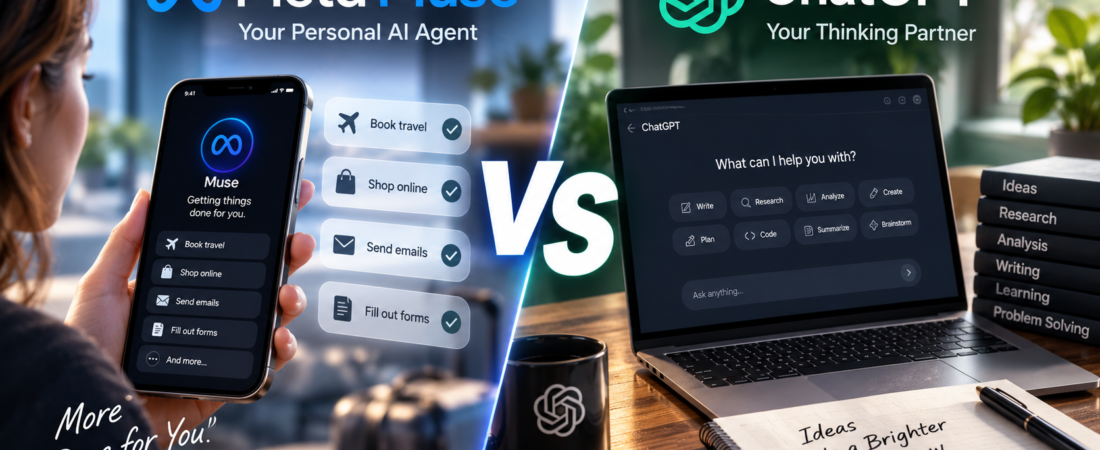
For the past few years, ChatGPT has helped define what people expect from artificial intelligence.
Ask a question.
Write an email.
Summarize a document.
Analyze a spreadsheet.
Generate an image.
Help plan a trip.
But in September 2026, Meta introduced something with a slightly different goal.
Muse doesn’t just want to answer your questions. It wants to do things for you.
Meta launched Muse on September 8 as a personal AI agent designed to work across websites and apps, use its own browser, fill out forms, book travel, send emails, make purchases, and continue working even after you close the app.
That makes the comparison with ChatGPT especially interesting.
ChatGPT has evolved far beyond a basic chatbot and can help with research, reasoning, writing, coding, files, images, and increasingly complex workflows.
Muse is approaching the same AI future from another direction:
Give the AI a task — and let it act.
So which approach is more useful?
Let’s compare.
Quick Comparison
| Meta Muse | ChatGPT | |
|---|---|---|
| General Questions | Yes | Yes |
| Writing & Brainstorming | Yes | Yes |
| Research & Analysis | Yes | Yes |
| Personal AI Agent | Core Focus | Available through agentic tools/workflows |
| Browser Actions | Yes | Yes, depending on feature/mode |
| Long-Running Tasks | Core Feature | Available in supported workflows |
| Purchases & Transactions | Major Focus | Supported in some experiences |
| Image/Multimodal AI | Meta ecosystem integration | Strong multimodal capabilities |
| Social Integration | Major Advantage | Limited compared with Meta |
| Established AI Ecosystem | Newer | Major Advantage |
The biggest difference isn’t necessarily intelligence.
It’s what each product is trying to become.
1. ChatGPT Started With Answers
ChatGPT became popular because it dramatically simplified interaction with AI.
Instead of learning complicated software, users could simply type:
“Explain this.”
“Rewrite this email.”
“Compare these products.”
“Analyze this file.”
“Help me code this.”
That conversational model changed how millions of people interact with computers.
Over time, ChatGPT expanded into images, files, web research, coding, data analysis, voice, memory, and more complex task execution.
Its strength is breadth.
You can start with almost nothing more than an idea and use AI to turn it into research, writing, analysis, code, images, or a plan.
For knowledge work, that’s extremely powerful.
2. Muse Starts With Actions
Muse’s philosophy is slightly different.
Meta describes Muse as a personal AI agent.
Instead of simply telling you how to accomplish something, Muse is designed to potentially accomplish parts of it for you.
Meta says Muse can open its own browser, fill out forms, send emails, book travel, and complete transactions. It can also continue working after the user closes the app and return when it needs approval for a sensitive action.
Imagine saying:
“Find me a good hotel in Miami for next weekend within my budget.”
A traditional chatbot might:
Research hotels.
Compare prices.
Explain the differences.
Provide recommendations.
An AI agent attempts to go further:
Research.
Compare.
Navigate websites.
Fill in information.
Potentially prepare or complete the reservation after receiving permission.
That last step is the important difference.
Chatbots help you decide.
Agents increasingly help you execute.
3. Muse’s Secret Weapon: A Computer of Its Own
One of the most interesting things about Muse isn’t the chatbot interface.
It’s what runs behind it.
Meta says every Muse operates through a dedicated Muse Secure VM, essentially a secure virtual computer containing its own browser.
That allows the AI to interact with websites more like a person using a computer.
According to Meta, the system can keep working on longer tasks even when the user isn’t actively using the app.
This architecture matters because many useful tasks don’t have convenient APIs.
Sometimes an AI needs to navigate an ordinary website.
Click something.
Enter information.
Wait for another page.
Continue.
That starts making AI feel less like a search box and more like a digital worker.
Agentic Work Advantage: Muse
4. ChatGPT’s Advantage: Breadth
Muse may have been designed around action, but ChatGPT has an enormous advantage:
It already covers an unusually broad range of work.
People use ChatGPT for:
Writing
Research
Coding
Data analysis
Document review
Image creation
Brainstorming
Education
Planning
Translation
Business work
and countless other tasks.
That breadth matters.
Most people don’t spend their entire day booking hotels or filling forms.
Sometimes you simply need to understand something.
And for that kind of work, the quality of the conversation, reasoning, research tools, file handling, and creative capabilities matter enormously.
General-Purpose AI Advantage: ChatGPT
5. What About Everyday Personal Tasks?
This is where Muse becomes especially interesting.
Meta isn’t positioning Muse only as an AI for office workers.
The company describes examples involving things like:
Planning events.
Managing travel.
Selling a car.
Shopping.
Handling schedules.
Managing longer-term personal goals.
Muse can also remember relevant information users have shared and use that context when making future suggestions.
And Meta has something few AI companies can match:
A gigantic existing consumer ecosystem.
Facebook.
Instagram.
WhatsApp.
Messenger.
AI glasses.
Muse is already designed to work through its own app and WhatsApp, with additional integration expected across Meta’s ecosystem.
That could eventually make the AI feel less like a separate tool and more like something embedded into everyday digital life.
Everyday Social Ecosystem Advantage: Muse
6. What About Work?
For serious knowledge work, ChatGPT remains extremely compelling.
Imagine you’re analyzing whether to buy or lease a car.
You might ask AI to:
Research current financing rates.
Analyze a spreadsheet.
Calculate total ownership costs.
Compare depreciation.
Read PDFs.
Create a decision table.
Draft questions for a dealer.
Turn everything into a report.
This is where a broad AI workspace can be more useful than an agent optimized primarily around completing transactions.
The future probably won’t be “thinking AI” versus “acting AI.”
The strongest products will increasingly do both.
But today, the distinction still helps explain why these products can feel different.
Knowledge Work Advantage: ChatGPT
7. Shopping Could Become a Major Battleground
Shopping may be one of the biggest opportunities for AI agents.
Instead of searching through dozens of product pages, an AI could potentially:
Understand what you need.
Compare products.
Check prices.
Read reviews.
Find discounts.
Place an order.
Monitor delivery.
Handle a return.
Meta has built transaction capabilities directly into Muse.
Its launch announcement says Muse can use Stripe’s Link for checkout, with one-time-use payment credentials designed to prevent the agent from seeing a user’s actual card details.
This is a much bigger change than simply asking AI:
“What’s the best laptop under $1,000?”
The future question may become:
“Find the right laptop under $1,000 and buy it.”
That’s a fundamentally different relationship with AI.
8. But AI Agents Introduce New Risks
The more an AI can do, the more mistakes matter.
If an AI gives you a mediocre restaurant recommendation, the consequences are small.
If an AI:
Sends the wrong email.
Books the wrong flight.
Purchases the wrong product.
Uses private information incorrectly.
Or misunderstands financial instructions.
the consequences can be much larger.
That’s why permissions and transparency become increasingly important.
Meta says Muse asks for user approval before sensitive actions such as sending an email or making a purchase, provides an audit trail, and lets users choose which apps it can access.
Still, this is a new category of consumer software.
And the risks aren’t theoretical.
Reuters reported on September 22 that Meta is testing a human-concierge component for some Muse phone calls, an experiment that has raised internal privacy concerns about humans potentially encountering sensitive information. Meta says the feature is still being tested and would require transparency before public rollout.
That highlights an important rule for any AI agent:
The more access you give an AI, the more carefully you should understand what it can access and what requires your approval.
9. Muse Is Already Getting Attention
Muse isn’t just another experimental AI launch.
It has attracted significant early consumer and investor attention.
Reuters reported on September 22 that Muse had reached 2.8 million downloads in the U.S. and Canada during its first 12 days, while Meta’s stock had risen more than 20% since the product’s debut.
Another analysis of early mobile adoption found Muse ahead of ChatGPT’s comparable early mobile-launch period in the U.S. and Canada, although the comparison has important limitations because the two products launched under different circumstances and distribution strategies.
So those numbers shouldn’t be interpreted as proof that Muse has already “beaten ChatGPT.”
But they do show something important:
Consumers appear interested in AI that does more than chat.
10. Which Is Better for Writing?
ChatGPT
Writing is one of ChatGPT’s most established use cases.
Articles, emails, outlines, scripts, brainstorming, rewriting, summaries, and structured documents all fit naturally into its conversational workflow.
Muse can certainly help generate content.
But if your primary reason for using AI is writing and knowledge work, ChatGPT’s mature general-purpose environment is a major advantage.
11. Which Is Better for Research?
ChatGPT has the stronger case for research-oriented work.
The ability to ask follow-up questions, synthesize information, work with files, analyze data, and build structured answers makes it particularly useful when the objective isn’t merely finding information but understanding it.
Muse’s strengths become more apparent when research needs to transition into an action.
For example:
Research several hotels.
Compare them.
Then actually begin booking one.
That’s where agentic AI changes the workflow.
12. Which Is Better for Completing Tasks?
This is where Muse’s design is particularly compelling.
Meta built the product around delegating work.
Muse can maintain a task after the user leaves, use a browser, interact with services, and return when it needs approval.
That means the ideal Muse interaction may not be:
“Give me information.”
It may be:
“Take care of this.”
That distinction could become enormously important over the next few years.
13. Which Is Better for Privacy?
There isn’t a simple winner.
Meta has put significant emphasis on Muse’s security architecture.
The company says users choose which apps Muse connects to, credentials are kept in secure storage, sensitive actions require approval, interactions can be excluded from model training, and Muse conversations and VM data aren’t shared with Meta’s advertising systems.
Those are meaningful safeguards.
But any agent that can access email, websites, payments, or personal accounts creates a different privacy and security profile from a chatbot that has limited access.
The safest rule is simple:
Give any AI only the access it actually needs.
14. The Bigger Question: Assistant vs. Agent
The most interesting part of Muse vs. ChatGPT isn’t really Meta versus OpenAI.
It’s the shift from:
AI assistant
to
AI agent.
The first generation of mainstream generative AI answered questions.
The next generation is increasingly being designed to:
Research.
Plan.
Decide.
Navigate.
Communicate.
Purchase.
And execute.
Eventually, the distinction between assistants and agents may disappear.
The best AI systems will probably combine both.
But Muse makes that transition especially visible.
Our Pick: ChatGPT for General AI — Muse for Delegating Everyday Tasks
For most people who want one AI for research, writing, analysis, brainstorming, files, coding, and creative work, ChatGPT remains the more broadly useful choice.
Muse becomes particularly interesting when the goal changes from:
“Help me figure this out.”
to:
“Handle this for me.”
Its dedicated browser environment, long-running tasks, transaction capabilities, and integration with Meta’s enormous consumer ecosystem give it a different kind of potential.
And that’s why this comparison may look very different a year from now.
The AI race is no longer just about who gives the best answer.
It’s increasingly about:
Who can actually get the job done?
Compare with Reason.