Rivian R2 vs Tesla Model Y: Has Tesla Finally Met Its Match?
Rivian R2 vs Tesla Model Y may be one of the most important electric SUV comparisons in America.
For years, the Tesla Model Y has been the obvious benchmark.
It is relatively affordable, efficient, fast, spacious, easy to charge on road trips, and backed by one of the most mature EV ecosystems in the country.
Competitors have come and gone.
But the Rivian R2 feels different.
Instead of trying to build another futuristic crossover that simply copies Tesla’s formula, Rivian has shrunk much of the adventurous personality of the R1S into a smaller and substantially less expensive SUV.
And now the comparison is becoming real.
Rivian’s R2 Premium starts at $53,990, offers an EPA-estimated 330 miles of range, dual-motor all-wheel drive, 450 horsepower and a claimed 0–60 mph time of 4.6 seconds. The less expensive R2 Standard is scheduled for 2027 at $44,990 with an estimated 275 miles of range. Rivian
Tesla, meanwhile, continues to make the Model Y difficult to beat on price. Its current U.S. offers show the Model Y Rear-Wheel Drive at $41,630 including order and destination fees, before incentives, taxes and other fees. Tesla is also currently advertising promotional financing as low as 1.99% APR for qualified Model Y buyers. Tesla
So has Rivian finally built a serious Model Y alternative?
Let’s compare.
Rivian R2 vs Tesla Model Y at a Glance
| Rivian R2 | Tesla Model Y | |
|---|---|---|
| Entry point | $44,990 Standard | Lower-priced entry model available now |
| $44,990 R2 availability | 2027 | Available now |
| R2 Premium | $53,990 | Multiple trims |
| R2 Premium range | 330 miles EPA est. | Varies by trim |
| Drivetrain | RWD / AWD depending trim | RWD / AWD depending trim |
| Character | Rugged SUV | Road-focused crossover |
| Charging connector | NACS | NACS |
| Supercharger access | Yes | Native Tesla network |
| Interior approach | Traditional/adventure-oriented | Minimalist |
| Software | Rivian ecosystem | Mature Tesla ecosystem |
The biggest difference isn’t really range or acceleration.
It’s philosophy.
The R2 Actually Looks Like an SUV
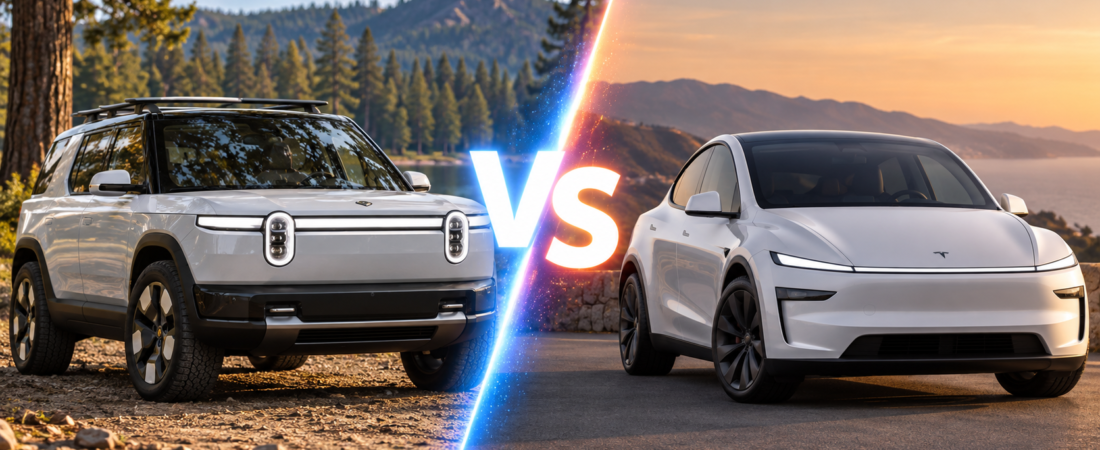
Put the two vehicles next to each other and their personalities are obvious.
The Model Y has a low nose, curved roofline and aerodynamic crossover shape.
The R2 is more upright.
It looks like a smaller R1S.
That means the Rivian communicates:
SUV first, EV second.
Tesla communicates:
EV first, crossover second.
Neither approach is inherently better.
But buyers who have avoided the Model Y because they don’t love its rounded shape suddenly have a very credible alternative.
The $44,990 R2 Needs an Asterisk
This is important.
Rivian prominently advertises the R2 as:
Starting at $44,990.
But Rivian’s current product page says the R2 Standard arrives in 2027. It has a single-motor rear-wheel-drive layout, 275 miles of estimated range, 350 horsepower and a 5.9-second 0–60 mph time. Rivian
The R2 Premium arriving earlier is much more expensive:
$53,990.
It brings dual-motor AWD, 450 horsepower, 330 miles of EPA-estimated range and a claimed 4.6-second 0–60 mph time. Rivian
That changes the comparison substantially.
Someone shopping right now shouldn’t automatically think:
R2 = $45K.
The affordable R2 is part of the story, but it isn’t the whole story yet.
Tesla Still Has the Price Advantage
This is where Tesla remains extremely difficult to attack.
Tesla’s current U.S. Model Y offer lists the Rear-Wheel Drive model at a $41,630 starting purchase price including order and destination fees before incentives, taxes and other charges. Tesla
That’s significantly below the R2 Premium.
And Tesla frequently changes financing, lease and inventory offers.
As of early October 2026, Tesla is advertising 1.99% APR financing for up to 72 months for qualified buyers on several Model Y trims. Tesla
Purchase price matters.
But financing can make the real-world difference even larger.
R2 Has Something Tesla Can’t Easily Copy
Character.
That’s subjective, but important.
The Model Y is designed to be an extremely efficient everyday EV.
The R2 is designed around Rivian’s outdoor identity.
Its more upright body, adventure-focused design and practical touches make it feel like something you might genuinely want to take camping.
Rivian even gives the R2 Premium features such as a rear drop glass, tow hooks and its signature flashlight, along with heated and ventilated front seats and heated rear seats. Rivian
For some buyers, those are small details.
For others, they’re exactly why the R2 is interesting.
Model Y Wins on Proven Experience
The Model Y has another advantage that no specification sheet can fully capture:
time.
Tesla has built Model Ys at enormous scale.
The charging experience is established.
Service infrastructure exists.
Accessories are everywhere.
Owners understand the vehicle.
Independent repair shops increasingly understand Teslas.
Used values are easy to research.
Insurance data is plentiful.
R2 buyers are buying into a much newer vehicle platform.
That doesn’t mean the Rivian will be unreliable.
It means there’s more uncertainty.
Early adopters have to accept that.
The Charging Gap Has Shrunk Dramatically
A few years ago, recommending a non-Tesla EV for long-distance travel came with an obvious warning:
Tesla’s Supercharger network.
That distinction is much smaller now.
The R2 uses the North American Charging Standard connector, meaning the charging experience isn’t defined by the old CCS-versus-Tesla divide.
Tesla still has an ecosystem advantage because its vehicles, software and Supercharger network were designed together.
But access to the charging network is no longer the automatic reason to eliminate Rivian.
That’s a huge change.
Software May Be Tesla’s Biggest Advantage
Tesla’s software remains one of the strongest reasons to buy a Model Y.
The phone app, route planning, charging integration, frequent software updates and vehicle interface all operate as one ecosystem.
And Tesla continues to push Full Self-Driving (Supervised) as a major part of the ownership experience.
Rivian is pursuing its own autonomy strategy, including its optional Autonomy+ system on R2. Rivian
But buyers shouldn’t compare these systems based simply on the existence of an option.
Tesla has years of real-world development behind its driver-assistance platform.
Rivian still has something to prove.
Rivian May Have the Better Interior for Traditional Car Buyers
Tesla’s interior is famous for removing things.
Buttons disappear.
Controls move onto the touchscreen.
The cabin becomes extremely clean.
Some people love it.
Others never get used to it.
Rivian’s interior still feels modern and software-driven, but the overall design has more visual warmth and traditional SUV personality.
The R2 Premium adds wood accents, premium audio and heated and ventilated front seats. Rivian
If you’ve sat in a Model Y and thought:
“This feels too minimal.”
the R2 may immediately make more sense.
Model Y Is Probably the Better Efficiency Machine
Tesla has spent years optimizing:
aerodynamics,
motors,
battery management,
software,
manufacturing,
and charging.
That experience matters.
Rivian’s more upright design gives it visual character and potentially useful SUV proportions, but aerodynamic efficiency generally rewards smoother shapes.
The Model Y was built around that philosophy.
The R2 accepts some compromises in pursuit of a more traditional SUV shape.
R2 May Be the More Interesting Second Car
Here’s an unusual way to think about this comparison.
If your household already owns an EV or efficient commuter vehicle, the R2 becomes especially appealing.
Why?
Because it offers something different.
It can be the EV you want to:
take skiing,
load with equipment,
drive to a trail,
camp with,
or simply own because it doesn’t look like every other aerodynamic crossover.
The Model Y is arguably the more rational appliance.
The R2 may be the vehicle you become more emotionally attached to.
What About Resale Value?
This is impossible to know with confidence yet.
The R2 is too new.
Tesla has a large used-car market, which provides far more data.
But that also creates heavy used supply.
Tesla’s frequent pricing changes historically affected used values as well.
Rivian has less volume, but the long-term demand for a mass-market R2 remains uncertain.
I wouldn’t choose either vehicle primarily because of predicted resale value.
There are too many variables.
Who Should Buy the Model Y?
Choose the Tesla if your priorities are:
lower entry price,
proven EV experience,
mature software,
simple road-trip charging,
strong efficiency,
frequent software improvements,
and the least complicated transition into EV ownership.
The Model Y remains difficult to beat as a rational all-around EV.
Who Should Buy the R2?
Choose the Rivian if you value:
traditional SUV styling,
more personality,
adventure-oriented design,
a warmer interior,
Rivian’s outdoor identity,
and simply owning something different.
The R2 Premium also provides a compelling 330-mile EPA-estimated range and dual-motor AWD configuration. Rivian
Rivian R2 vs Tesla Model Y: The Verdict
The R2 doesn’t make the Model Y obsolete.
In fact, Tesla’s aggressive pricing makes the Model Y look even stronger when you compare actual dollars.
But that’s not why the R2 matters.
For years, many electric crossovers tried to beat Tesla by offering:
more luxury,
more buttons,
or a different badge.
Rivian is attacking from another direction.
It’s offering an EV with a genuinely different personality.
If you want the rational choice, the Model Y remains extremely difficult to beat.
If you want your electric SUV to feel more like an actual SUV, the R2 may finally be the Tesla alternative people have been waiting for.
And when the $44,990 R2 Standard arrives in 2027, this comparison could become even more competitive.
For now, Rivian R2 vs Tesla Model Y is less about finding a new king of EVs.
It’s about the Model Y finally facing a competitor that doesn’t need to imitate it.
Compare with Reason.