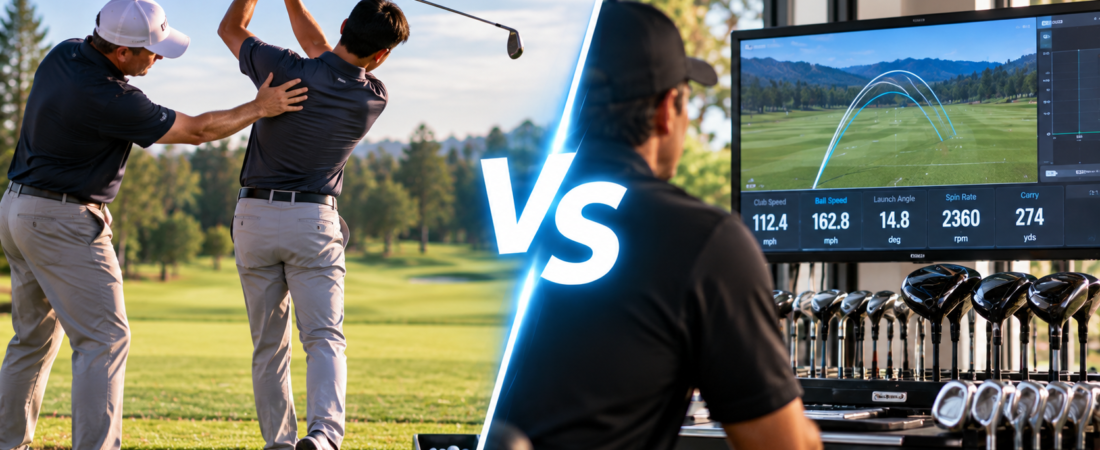
Golf lessons vs club fitting is a surprisingly difficult decision when you have a limited budget and want to improve your game.
Imagine you have $500 to spend on golf.
You could book several lessons with a qualified instructor and work on your swing.
Or you could schedule a professional club fitting and potentially put that money toward equipment that better matches the swing you already have.
Both can help.
But they solve completely different problems.
Lessons try to improve the golfer. A fitting tries to optimize the equipment for the golfer.
So where should your first $500 go?
Golf Lessons vs Club Fitting at a Glance
| Comparison | Golf Lessons | Club Fitting |
|---|---|---|
| Primary goal | Improve technique | Optimize equipment |
| Changes your swing | Yes | No |
| Identifies equipment problems | Sometimes | Yes |
| Uses launch-monitor data | Often | Usually |
| Can improve short game | Yes | No |
| Can improve course management | Yes | No |
| Helps choose shafts/lofts | Limited | Yes |
| May require new equipment | No | Possibly |
| Long-term benefit | Potentially significant | Depends on current equipment |
| Best for | Swing/skill problems | Equipment-fit problems |
The most important question isn’t which service is better.
It’s what is actually holding your game back.
What Golf Lessons Actually Fix
A golf lesson focuses primarily on you.
A coach can evaluate fundamentals such as:
- Grip
- Setup
- Alignment
- Posture
- Swing path
- Clubface control
- Contact
- Ball flight
- Short game
- Putting
- Course strategy
Modern instruction can also incorporate video and launch-monitor data. PGA-listed instruction offerings, for example, include lessons using systems such as TrackMan to measure ball speed, launch, spin and other performance information. PGA Tour
The important difference is that the coach uses that information to help change what you’re doing.
If you’re slicing because your clubface is consistently open to the path, buying a different driver may reduce the problem somewhat.
But it doesn’t necessarily fix the underlying swing pattern.
A good instructor can identify why the pattern exists and give you drills to change it.
What a Club Fitting Actually Fixes
A club fitting approaches the problem from the opposite direction.
Instead of changing your swing, the fitter tries to find equipment that works better with it.
Depending on the club being fitted, that can involve testing variables such as:
- Clubhead
- Loft
- Lie angle
- Shaft model
- Shaft flex
- Shaft weight
- Club length
- Grip
- Launch
- Spin
- Ball speed
- Carry distance
- Dispersion
PGA fitting descriptions specifically reference evaluating length, loft, lie, shaft and grip while using launch-monitor data to determine an appropriate configuration. PGA Tour
That’s valuable information.
A golfer could have a perfectly reasonable swing but be using equipment that makes consistent golf harder than it needs to be.
The $500 Question
Let’s say you have exactly $500 available for golf improvement.
What could that money buy?
Lesson pricing varies significantly by instructor and location. Current PGA Coach listings illustrate that individual instruction can range from around $100 to $200 or more per session, while fitting prices also vary by scope and facility. PGA Tour
So $500 might buy several lessons.
A fitting itself could consume a smaller portion of that budget—but the recommended equipment could cost considerably more.
That’s an important distinction.
A $150 lesson costs $150.
A $150 driver fitting might eventually lead you toward a several-hundred-dollar driver.
So when comparing the two, don’t compare only the appointment price.
Compare the total likely spending that follows it.
When Golf Lessons Should Probably Come First
Consider a golfer who struggles with:
Fat shots.
Thin shots.
Slices.
Hooks.
Topped shots.
Poor contact.
Inconsistent setup.
Difficulty controlling distance.
Buying properly fitted equipment can help around the edges, but equipment can’t completely compensate for inconsistent delivery of the club.
If your swing changes significantly from shot to shot, a fitter may also have difficulty identifying the ideal equipment configuration.
One swing produces one set of numbers.
The next swing produces something completely different.
In that situation, developing a more repeatable motion first can make a later fitting more useful.
Beginners Have an Especially Strong Case for Lessons
A beginner may be tempted to get professionally fitted immediately.
There are situations where that makes sense—particularly if the golfer is unusually tall, short, strong or has other physical characteristics that make standard equipment unsuitable.
But for many beginners, the swing is changing rapidly.
A golfer might start with a very slow swing speed and add significant speed after learning better mechanics.
Setup can change.
Delivery can change.
Ball flight can change.
Even preferences can change.
Spending heavily to optimize equipment around a swing that may look completely different six months later can be premature.
Lessons can establish the fundamentals first.
Then the golfer can get fitted around a more repeatable swing.
When Club Fitting Should Come First
Now consider a different golfer.
They’ve played for years.
Their handicap is relatively stable.
Contact is reasonably consistent.
But their driver launches too high and spins excessively.
Or their irons consistently start left despite reasonably good swings.
Or there are strange distance gaps between clubs.
That’s where fitting becomes much more interesting.
Equipment specifications can influence launch, spin, trajectory, distance and dispersion.
A professional fitting can determine whether the equipment itself is contributing to the problem.
The PGA of America Coaching Center describes club fitting as matching clubs to a player’s swing, while fitting services commonly evaluate both club specifications and ball-flight data. PGA Tour
If your swing is already repeatable, optimizing the equipment around it can produce meaningful results without rebuilding your technique.
Your Driver Is a Good Example
Driver fitting demonstrates why this decision isn’t always simple.
Suppose you consistently hit the center of the face but produce too much spin.
A lesson might help change your delivery.
But the problem could also involve:
- Too much loft
- An unsuitable shaft
- Incorrect head configuration
- Poor launch conditions for your speed
A fitting can test those variables relatively quickly.
Now consider another golfer who hits one drive off the heel, another off the toe, one with an open face and the next with a closed face.
Testing ten different shafts probably isn’t the first solution.
The swing needs more consistency.
Same club. Different problem.
Irons Can Reveal Equipment Problems Too
Iron fitting goes beyond finding the shaft that feels best.
Length and lie angle can matter.
So can shaft weight, flex, loft configuration and distance gapping.
If your equipment is poorly matched to your body and delivery, you may subconsciously make compensations.
But again, fitting works best when the fitter has a reasonably consistent pattern to evaluate.
A repeatable miss is useful information.
Random misses are much harder to diagnose.
Lessons Can Improve More Than the Full Swing
This is one reason lessons can offer particularly broad value.
A club fitting primarily addresses equipment.
A golf coach can work on parts of the game where buying new clubs may accomplish very little.
For example:
- Chipping
- Pitching
- Bunker play
- Putting
- Distance control
- Pre-shot routine
- Course management
PGA coaching programs explicitly include full swing, short game and on-course instruction among their offerings. PGA Tour
If you’re losing six shots per round from poor wedges and three-putts, changing your driver shaft isn’t addressing the biggest scoring problem.
But Lessons Can’t Fix Badly Fitted Equipment
There is another side to the argument.
A golfer shouldn’t spend months learning to compensate for equipment that is clearly inappropriate.
Imagine someone playing clubs that are significantly too long or too short.
Or an iron setup with lie angles that are poorly matched to the golfer.
Or a driver configuration producing clearly inefficient launch conditions.
Instruction may help the golfer adapt.
But adaptation isn’t necessarily the ideal solution.
Sometimes the equipment really is part of the problem.
That’s why the strongest coaches and fitters don’t necessarily view instruction and fitting as competitors.
They can complement each other.
The Smartest $500 Strategy May Be a Combination
You don’t necessarily have to put the entire $500 into one side.
For many golfers, a better approach could be:
Step 1: Get a swing evaluation or lesson.
Ask the instructor to identify the biggest limitations in your game.
Then ask a simple question:
“Do you see anything in my equipment that may be working against me?”
If the answer is no, continue investing in instruction and practice.
If the instructor sees an obvious equipment issue, schedule a targeted fitting.
This approach reduces the chance of buying equipment to solve a technique problem—or spending months fixing your swing around unsuitable equipment.
Don’t Automatically Buy Clubs After a Fitting
This point can save golfers a lot of money.
A fitting doesn’t necessarily mean you need an entirely new bag.
You may discover that your current equipment is already close to ideal.
Perhaps the driver only needs a loft adjustment.
Maybe your irons need lie-angle adjustments.
Perhaps your current head works well but another shaft produces better results.
Or maybe the fitting confirms that your equipment isn’t the reason you’re struggling.
That information alone can be valuable.
You can stop wondering whether your clubs are the problem and focus on improving your technique.
Lessons vs Buying More Equipment
Golfers love equipment because buying something new is easy.
Changing a swing is difficult.
But new equipment can’t automatically create better fundamentals.
Before spending another $500 on clubs, ask yourself:
Do I know exactly what problem this purchase is supposed to solve?
If the answer is simply “I want to hit it better,” instruction may reveal far more than another equipment purchase.
If the answer is specific—“my driver spin is consistently too high even with centered contact”—then fitting becomes much more compelling.
Related Compareason Guide
If you’re also deciding how to spend your golf budget away from lessons, see our Rangefinder vs GPS Golf Watch comparison to determine which on-course technology better fits your game.
Golf Lessons vs Club Fitting: Where Should Your First $500 Go?
When comparing golf lessons vs club fitting, start by identifying whether your biggest limitation is the golfer or the equipment.
If you’re a beginner, your contact is inconsistent, or you don’t understand why the ball is doing what it’s doing, instruction can address the underlying problem.
If you’re an experienced golfer with a repeatable swing but questionable launch conditions, distance gaps or equipment specifications, a professional fitting can be extremely useful.
And if you’re unsure?
Start with an evaluation from a qualified golf professional.
A professional who can assess both your swing and your equipment can help identify where the first dollar is likely to have the greatest effect.
The goal isn’t to choose between coaching and equipment forever.
It’s to spend your first $500 on the problem that actually needs fixing.
Compare with Reason.