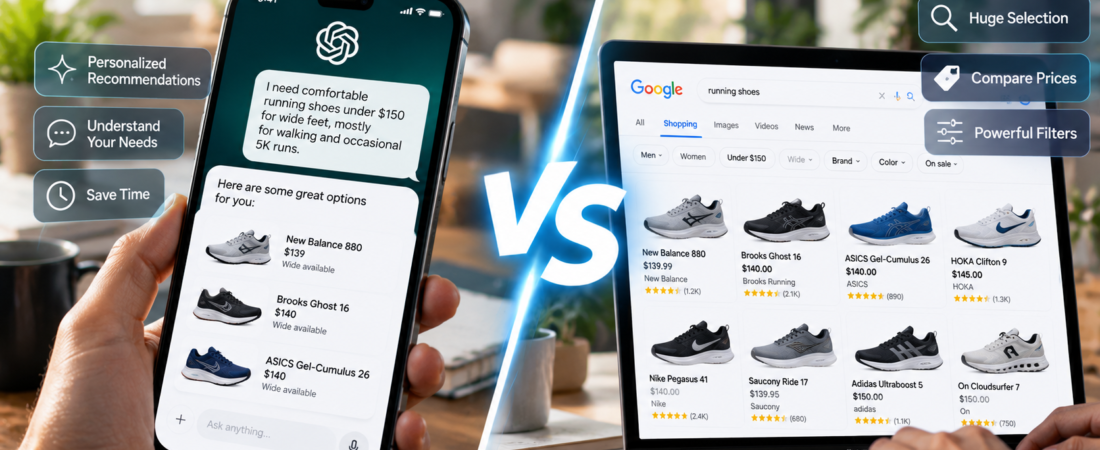
AI shopping vs Google Shopping is becoming a real choice for consumers who want help deciding what to buy online.
Until recently, online shopping usually started with a search box.
You typed something like “best running shoes under $150,” opened several products, compared reviews and prices, and eventually made a decision.
AI is changing that process.
Instead of searching through dozens of products yourself, you can describe exactly what you want to an AI assistant:
“I need comfortable running shoes under $150 for wide feet, mostly for walking and occasional 5K runs.”
The AI can potentially narrow hundreds of options into a short list.
That sounds much easier.
But is it actually better than using Google Shopping and comparing products yourself?
The answer depends on what you’re buying—and how much control you want over the decision.
AI Shopping vs Google Shopping at a Glance
| Comparison | AI Shopping | Google Shopping |
|---|---|---|
| Best for | Narrowing choices | Browsing products |
| Search style | Conversation | Search/filter |
| Personalized questions | Excellent | Improving rapidly |
| Product selection | Curated shortlist | Very large |
| Price comparison | Good | Excellent |
| Visual browsing | Good | Excellent |
| Complex requirements | Excellent | Good |
| Current availability | Depends on AI/data | Strong |
| Discovering alternatives | Excellent | Excellent |
| Research effort | Lower | Higher |
| User control | Moderate | High |
| Best overall use | Decision assistance | Product/price discovery |
The biggest difference is simple:
Google Shopping helps you search. AI shopping helps you decide.
What Is AI Shopping?
AI shopping uses conversational artificial intelligence to help identify, compare and sometimes purchase products.
Instead of figuring out the perfect keywords, you describe your situation naturally.
For example:
“I need a laptop for email, Microsoft Office and web browsing. I want a 15-inch screen, at least 256GB storage and I don’t want to spend more than $500.”
A traditional product search may return hundreds of laptops.
An AI assistant can potentially analyze those requirements and reduce the list to several reasonable choices.
This behavior is quickly becoming mainstream.
NielsenIQ reported in September 2026 that 51% of U.S. consumers surveyed had used at least one AI-powered tool to assist with shopping during the previous month. AI-powered product recommendations were the most commonly reported use at 20%, followed by personal shopping assistants at 16%.
That suggests AI isn’t just changing search.
It’s beginning to influence the entire buying decision.
What Google Shopping Does Differently
Google Shopping traditionally approaches the problem from the product side.
Search for a product and Google can show:
- Product listings
- Retailers
- Prices
- Reviews
- Images
- Availability
- Deals
- Different models or variations
That scale is difficult to match.
Google says its Shopping Graph now contains more than 60 billion product listings, and Google shopping activity occurs more than a billion times per day.
That makes Google particularly powerful when you already know roughly what you want.
Suppose you’ve decided to buy a specific pair of headphones.
At that point you may not need an AI assistant explaining headphones.
You want to know:
Who has them cheapest right now?
That’s where traditional shopping search remains extremely useful.
AI Shopping Is Better at Understanding the Problem
Imagine you’re buying a stroller.
You don’t necessarily know which model you want.
You know your situation:
- You live in an apartment.
- Your trunk is small.
- You frequently walk on uneven sidewalks.
- You need something easy to fold.
- Your budget is $500.
Those aren’t really product keywords.
They’re requirements.
Conversational AI is particularly useful here because you can explain the entire situation and continue refining it.
You might ask:
“Which of those is easiest to carry upstairs?”
Then:
“Remove anything over 20 pounds.”
Then:
“Which remaining model has the largest storage basket?”
Instead of repeatedly starting new searches, the conversation can continue from your existing requirements.
That’s one of AI shopping’s biggest advantages.
Google Shopping Is Better When You Want to Browse
Sometimes you don’t want an algorithm to reduce your choices.
You want to see them.
Fashion is a good example.
If you’re looking for a jacket, appearance may matter more than specifications.
Seeing 30 jackets might actually be more useful than receiving three AI recommendations.
Google has invested heavily in visual shopping for exactly this reason.
Its shopping experiences combine product listings with images, pricing, reviews, availability and other product information from the Shopping Graph.
For visually driven purchases, browsing remains valuable.
AI may understand your description.
But sometimes you don’t know what you like until you see it.
AI Shopping Can Save Enormous Research Time
Consider buying a robot vacuum.
You might care about:
- Carpet performance
- Hardwood performance
- Pet hair
- Object avoidance
- Mopping
- Self-emptying
- Navigation
- Replacement parts
- Noise
- Price
Researching all of that manually could require opening multiple reviews and product pages.
AI can potentially summarize those differences quickly.
Instead of reading ten articles, you might ask:
“Compare these three robot vacuums specifically for a house with hardwood floors, two rugs and a dog.”
That ability to reorganize information around your specific use case is something conventional shopping interfaces struggle to do as efficiently.
But AI Recommendations Have a Weakness
AI can simplify research so much that users may stop verifying information.
That’s risky.
Prices change.
Inventory changes.
Product specifications change.
New models replace old ones.
Reviews reveal issues that specification sheets don’t show.
And AI-generated answers can occasionally misunderstand or provide outdated product information.
So even if AI helps you choose the product, you should still verify important details before purchasing.
Check:
- Current price
- Exact model number
- Seller
- Warranty
- Return policy
- Shipping
- Product specifications
AI can narrow the field.
The retailer should confirm the transaction details.
Google Has One Huge Advantage: Fresh Product Data
Shopping information changes constantly.
Google’s Shopping Graph was designed specifically around that problem.
Google has previously said billions of product listings in its Shopping Graph are refreshed every hour, helping it surface current pricing, availability and retailer information.
That’s particularly valuable when price matters.
Imagine an AI assistant recommends Product A because it appears to cost $199.
But today Product B is on sale for $149.
That changes the decision.
For price-sensitive purchases, checking live shopping results before buying remains important.
The Difference Is Already Starting to Disappear
Here’s where this comparison gets interesting.
Google itself is becoming an AI shopping platform.
Google has integrated Gemini-powered conversational shopping into AI Mode, allowing users to describe what they’re looking for naturally while Google uses its Shopping Graph to surface relevant products.
And in 2026, Google introduced Universal Cart, designed to work across Search and Gemini while helping shoppers track products, price changes, availability and purchasing options.
So the future probably isn’t:
AI or Google Shopping.
It’s more likely:
AI layered on top of enormous real-time shopping databases.
That combination could be much more powerful than either approach alone.
AI Is Better for Complicated Purchases
The more complicated the purchase, the more useful conversational AI becomes.
Consider buying a laptop.
You might care about:
- Screen size
- Battery life
- Weight
- Processor
- Storage
- Gaming performance
- Operating system
- Price
Traditional shopping filters can handle some of those.
But they can’t always answer:
“Which one is best for someone who mainly uses email and documents but occasionally edits photos and wants the laptop to last five years?”
AI can reason around that broader question.
That’s why AI shopping is particularly useful during the research phase.
Google Shopping Is Better When Price Is the Main Question
Now imagine you’ve already chosen the laptop.
You know the exact model.
Your question is no longer:
Which laptop should I buy?
It’s:
Where should I buy it?
Google Shopping becomes much more useful here.
You can compare sellers, prices and purchasing options.
The product decision has already been made.
Now you’re optimizing the transaction.
What About Reviews?
Neither approach should completely replace independent reviews.
AI can summarize review patterns.
Google can surface ratings and reviews.
But reviews often reveal details that don’t appear in product specifications.
For example:
- A refrigerator may be unusually loud.
- Shoes may run small.
- A laptop’s fan may become noisy.
- A golf rangefinder may struggle in fog.
- A vacuum may frequently get stuck under furniture.
Those are real-world ownership details.
For expensive purchases, a strong process may involve all three:
AI → product search → independent reviews.
Use AI to narrow the choices.
Use Google Shopping to verify products and prices.
Then read trusted professional and owner reviews before spending the money.
Which One Is Faster?
For complicated research:
AI shopping usually feels faster.
You can describe everything you need in one conversation.
For straightforward purchases:
Google Shopping may actually be faster.
If you already know you need a specific coffee maker, typing the model and comparing sellers takes seconds.
Using AI to research something you’ve already chosen simply adds another step.
Which One Gives You More Control?
Google Shopping generally gives the shopper more direct control.
You can browse dozens of products and make your own comparisons.
AI intentionally removes some of that work.
That’s the benefit—but also the trade-off.
An AI assistant may narrow 100 possibilities to five.
That saves time.
But what if product number 17 would have been perfect for you?
The quality of AI shopping depends partly on how well the system understands your request and how complete its product information is.
The Best Strategy May Be Using Both
For many purchases, AI shopping vs Google Shopping doesn’t need to be an either-or decision.
The two tools are strongest at different stages.
A practical shopping process could look like this:
Step 1 — Ask AI what you should consider.
Learn which features actually matter.
Step 2 — Ask AI to narrow the choices.
Create a shortlist of three to five products.
Step 3 — Search those products on Google Shopping.
Verify current pricing and sellers.
Step 4 — Check independent reviews.
Look for real-world problems that specifications may miss.
Step 5 — Buy from the retailer that gives you the best combination of price, warranty and return policy.
This uses AI for what it does well without blindly trusting it with the entire purchase.
A Bigger Change Is Happening
AI shopping isn’t simply another shopping website.
It represents a change in how people interact with product information.
Traditional online shopping asks the consumer to search, filter, compare and decide.
AI increasingly performs some of those steps for the consumer.
And the shift is moving quickly enough that retailers are beginning to measure AI-driven discovery and purchases as a distinct shopping channel. NIQ and Similarweb announced new agentic-commerce measurement efforts in September 2026 specifically to track this changing behavior.
For a comparison-shopping site like Compareason, that’s particularly interesting.
The internet isn’t running out of choices.
Consumers may actually have too many choices.
The next generation of shopping tools will compete over who can help people make sense of them fastest.
Related Compareason Guide
If you want to see how this same shift is changing everyday information search, read our AI Search vs Google Search comparison.
AI Shopping vs Google Shopping: Which Should You Use?
The difference between AI shopping vs Google Shopping ultimately comes down to where you are in the buying process.
Use conversational AI when you don’t know exactly what to buy and need help understanding your options.
Use Google Shopping when you know what you’re looking for and want to browse products, compare sellers or check current prices.
And for expensive purchases, using both may be the strongest approach.
Let AI reduce the complexity.
Then use live product data and independent reviews to verify the decision before you spend your money.
Compare with Reason.