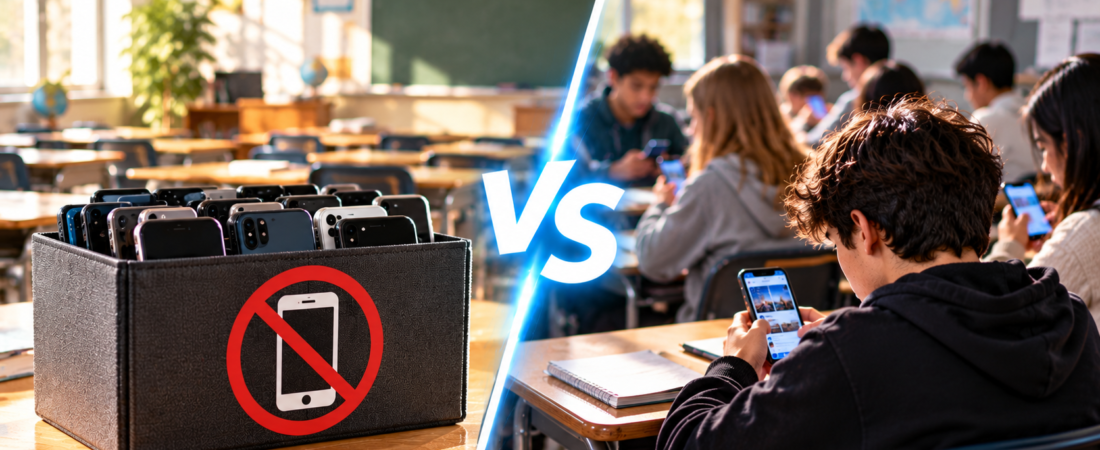
Phone-free school vs smartphones at school has become one of the biggest debates in education.
For years, smartphones gradually became part of everyday school life.
Students used them to text parents, check schedules, take photos of assignments, listen to music, look up information and communicate with friends.
But schools across the United States are increasingly moving in the opposite direction.
Some require phones to stay in backpacks.
Others use lockers or locking pouches.
And some prohibit student cellphone use from the first bell until dismissal.
As of July 2026, at least 39 states and the District of Columbia required school districts to ban or restrict student cellphone use in some form.
Why the sudden change?
Supporters argue that removing phones reduces distraction, improves classroom behavior and encourages students to interact with each other again.
Opponents raise a different set of concerns.
What if parents need to contact their children?
What happens during an emergency?
And shouldn’t students eventually learn how to use technology responsibly rather than simply having it removed?
The answer isn’t as simple as “phones are bad” or “phones are useful.”
Phone-Free School vs Smartphones at School at a Glance
| Comparison | Phone-Free School | Smartphones Allowed |
|---|---|---|
| Classroom distractions | Lower | Higher risk |
| Parent communication | Less immediate | Very easy |
| Student social interaction | Potentially higher | Can shift online |
| Access to information | School devices/resources | Immediate |
| Emergency contact | Through school systems | Direct |
| Enforcement required | High | Lower |
| Digital responsibility | Less practice during school | More opportunity |
| Cheating concerns | Lower | Higher risk |
| Teacher interruptions | Potentially lower | Potentially higher |
| Student preference | Generally lower | Generally higher |
The fundamental question is whether smartphones are primarily useful tools that need rules or distractions that shouldn’t be present during school at all.
Why Schools Are Removing Phones
The smartphone is unusually good at capturing attention.
Messages arrive.
Social-media notifications appear.
Games are always available.
Videos are one tap away.
Even if a student doesn’t actively use the phone, knowing that something may be happening on it can compete for attention.
Teachers then face a problem that didn’t exist at the same scale 20 years ago.
They aren’t only competing with other students for attention.
They’re competing with the entire internet.
Education Week reported in April 2026 that 95% of educators surveyed said their school or district had an official policy restricting cellphone access during school hours. The survey included 596 teachers and school and district leaders.
The debate has therefore moved beyond whether schools should have phone rules.
Increasingly, the question is how restrictive those rules should be.
Classroom-Only Restrictions Are One Option
One approach is relatively simple:
Phones are prohibited during class but allowed during lunch and between periods.
This attempts to solve the biggest distraction problem without completely separating students from their devices.
Students can still check messages between classes.
They can contact parents during lunch.
And teachers don’t have to compete with smartphones during instruction.
Public opinion strongly supports this type of restriction.
A Pew Research Center survey conducted in May and June 2026 found that 77% of U.S. adults supported banning cellphone use during class for middle and high school students, while 18% opposed it.
But support changes when the restriction becomes more aggressive.
Bell-to-Bell Phone Bans Are Much More Controversial
A bell-to-bell policy generally means the phone isn’t available throughout the school day.
Not during class.
Not between classes.
Not during lunch.
Pew found that only 48% of U.S. adults supported an all-day ban, while 43% opposed one.
That’s still a major change from 2024, when only 36% supported all-day bans.
But it shows something important.
Many adults appear comfortable removing phones from classrooms without necessarily wanting them removed for the entire day.
That distinction matters.
Students See the Issue Very Differently
Ask teenagers and the numbers change dramatically.
A Pew survey of U.S. teens ages 13 to 17 found that 41% supported classroom cellphone bans, while 51% opposed them.
For all-day restrictions, support fell to just 17%, while 73% opposed them.
That’s an enormous gap between adult and student opinion.
And it isn’t difficult to understand why.
Adults often view smartphones primarily through the problems they create in school.
Students experience the device as part of their social and practical life.
For many teenagers, their phone isn’t simply entertainment.
It’s also their calendar, camera, music player, communication system, map and connection to family and friends.
The Strongest Argument for Phone-Free Schools: Attention
Imagine trying to learn algebra while your phone is sitting beside you.
You receive a message.
You don’t open it.
But now you’re wondering what it says.
Another notification appears.
Then someone sends a video.
The teacher is explaining the next problem while part of your attention remains somewhere else.
Removing the phone eliminates that decision entirely.
There’s nothing to check.
Nothing to ignore.
Nothing buzzing in your pocket.
This is why many educators see phone restrictions as an instructional issue rather than simply a discipline issue.
Education Week has reported emerging research and educator experiences pointing to improved attention, behavior and face-to-face interaction when phones are restricted.
Social Interaction May Change Too
Walk through a school cafeteria where smartphones are freely available and you may see groups of students sitting together while looking at separate screens.
Take the phones away and something has to fill that time.
Students talk.
They play games.
They walk around.
They interact.
That doesn’t mean every student suddenly becomes more social.
For some students, a smartphone can actually make uncomfortable social situations easier.
But phone-free environments create more opportunities for face-to-face interaction simply because the digital alternative is unavailable.
This is one reason supporters argue that the benefits of restrictions may extend beyond academic performance.
What About Parents Contacting Their Children?
This is probably the strongest practical argument against all-day bans.
Parents have become accustomed to immediate communication.
A schedule changes?
Text.
Pickup location changes?
Text.
Child feels sick?
Text.
With an all-day phone restriction, that direct communication may disappear.
Parents may instead need to contact the school office.
Students may need permission to access their phones.
For routine communication, that’s clearly less convenient.
Pew’s earlier research found that opponents of school cellphone bans frequently cited the need for parents to reach their children when necessary.
But supporters argue that schools successfully handled parent-child communication long before every student carried a smartphone.
Emergencies Make the Question Harder
Parents may naturally think:
“What if something happens at school?”
Having direct access to a child feels reassuring.
But emergency communication is more complicated than simply having a phone available.
During a serious incident, schools may need students to follow specific instructions, remain quiet, evacuate or shelter in place.
Large numbers of students simultaneously calling or messaging can also create confusion.
At the same time, parents understandably value the ability to communicate directly with their children.
This isn’t a concern that can be dismissed with a simple rule.
Schools implementing phone restrictions need a clear answer to:
How will families communicate during emergencies?
That policy should be explained before an emergency occurs.
Smartphones Can Be Educational Tools
Phones aren’t useless in a classroom.
Teachers can use them for:
- Research
- Calculators
- Polls
- Photos
- Videos
- Educational apps
- Translation
- Timers
- QR codes
For some classrooms, allowing controlled smartphone use may be more practical than banning the device completely.
But there’s a counterargument.
Most schools already provide other technology.
Chromebooks, laptops and tablets can perform many educational tasks without bringing every student’s social-media accounts, messages and entertainment apps into the lesson.
And the broader backlash is now beginning to extend beyond personal phones. Some states and districts are reconsidering the amount of screen time created by school-issued devices as well.
So the debate may eventually become bigger than smartphones.
It may become a debate over how much technology belongs in school at all.
What About Teaching Digital Responsibility?
This is one of the strongest philosophical arguments for allowing smartphones.
Students will eventually enter universities and workplaces where nobody locks their phone in a pouch.
They’ll have to learn self-control.
They’ll need to decide when checking a phone is appropriate.
They’ll need to manage distractions themselves.
From this perspective, banning phones doesn’t teach responsible technology use.
It simply removes the temptation.
Some school leaders have made exactly this argument, saying schools should retain flexibility to teach students responsible phone and social-media habits rather than relying on blanket statewide bans.
The opposing argument is that schools already regulate many distractions.
Students aren’t allowed to play video games during algebra simply because learning self-control is important.
Schools can teach digital responsibility without allowing unrestricted phone use during instruction.
Smartwatches and Smart Glasses Complicate Everything
Removing smartphones may no longer solve the entire problem.
Students increasingly have:
Smartwatches.
Wireless earbuds.
And now AI-enabled smart glasses.
In September 2026, Education Week reported that several school districts had expanded their policies to address AI smart glasses and other personal digital communication devices.
That creates an interesting future problem.
What exactly counts as a phone?
If a student can receive messages through a watch or ask AI questions through glasses, restricting only smartphones may become increasingly ineffective.
Schools may eventually regulate personal connected devices rather than individual product categories.
Enforcement May Matter More Than the Rule
A school can have the strictest cellphone policy in the country.
But if teachers enforce it differently, students quickly learn where the rule matters and where it doesn’t.
One teacher confiscates phones immediately.
Another gives warnings.
Another ignores them.
That inconsistency can create conflict between teachers and students.
Education Week’s 2026 educator survey found substantial variation in how cellphone policies were implemented and enforced, even though restrictions were widespread.
A simpler rule may therefore work better than a complicated one.
Everyone needs to understand:
Where the phone goes.
When it can be used.
What happens if the rule is broken.
And how parents reach students.
What Might a Reasonable Middle Ground Look Like?
For many schools, the most workable policy may sit between unrestricted smartphones and a total prohibition.
For example:
During class: phones away.
Between classes: limited use.
Lunch: permitted.
Teacher-directed activity: permitted when specifically needed.
Emergency: established school procedure.
This removes the device during the period when attention matters most while preserving some student independence.
But other schools may find bell-to-bell restrictions easier to enforce because there are fewer exceptions.
Different environments may require different solutions.
Phone-Free School vs Smartphones: What Does the Evidence Actually Tell Us?
The current trend toward restrictions is clear.
The evidence about every possible long-term effect is less settled.
Policies vary.
Schools vary.
Students vary.
And many of the most restrictive policies are relatively new.
That makes it difficult to claim that one specific policy will automatically improve grades, mental health or social behavior everywhere.
Public opinion shouldn’t be confused with scientific evidence either.
The fact that 77% of adults support classroom restrictions tells us the policy is popular—not that every educational outcome has been proven.
The most defensible conclusion right now is narrower:
Smartphones create a meaningful distraction-management problem for schools, and increasingly schools are responding by restricting access.
How far those restrictions should go remains an open question.
The Most Important Difference May Be Class vs Entire Day
This distinction gets lost in the debate.
There are really two questions:
Should students use smartphones during instruction?
And:
Should students have access to smartphones anywhere during the school day?
Those aren’t the same policy.
Public opinion reflects that distinction.
In 2026, 77% of adults supported classroom bans, compared with 48% supporting all-day bans.
Teenagers make the distinction even more strongly.
Only 17% supported all-day restrictions.
That suggests the most difficult debate isn’t about TikTok during math class.
It’s about what happens during lunch, hallways and other non-instructional periods.
Phone-Free School vs Smartphones at School: The Bottom Line
When comparing phone-free school vs smartphones at school, each approach solves one problem while creating another.
Restricting smartphones can reduce a major source of classroom distraction and may encourage more face-to-face interaction.
Allowing phones gives students immediate communication, convenient tools and opportunities to learn how to manage technology responsibly.
The evidence and public opinion currently provide stronger support for restricting phones during instruction than for assuming that every student should be disconnected for the entire school day.
And the technology isn’t standing still.
Smartwatches, earbuds and AI glasses mean schools may soon have to think beyond smartphones entirely.
The long-term question may therefore become less about whether schools should ban phones and more about when students should—and shouldn’t—have access to connected technology while learning.
Compare with Reason.