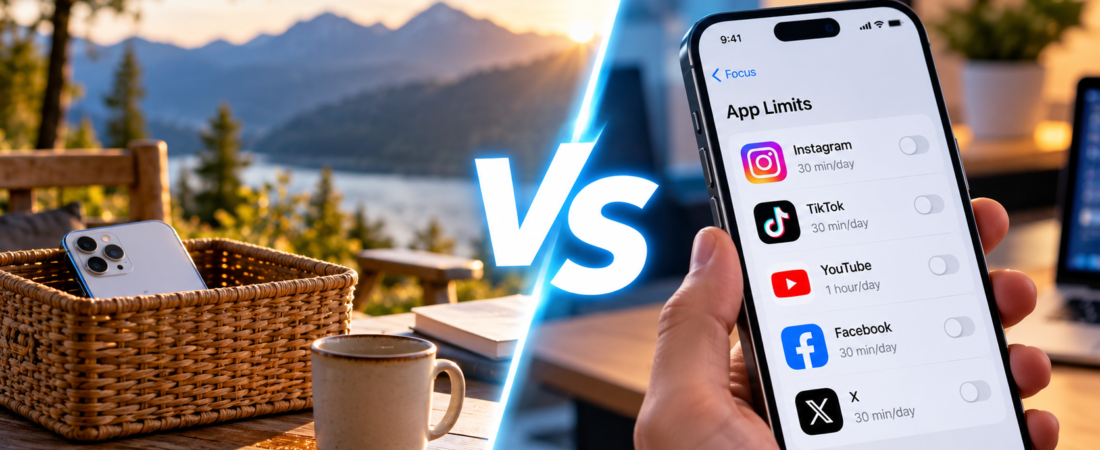
Most people who want to spend less time on their phones eventually try one of two strategies: step away from the phone almost completely for a while, or use technology to control technology.
That is the basic difference in the digital detox vs app blockers debate.
A digital detox might mean deleting social media apps, turning off mobile internet, leaving your phone in another room, or spending an entire weekend with minimal smartphone access.
App blockers take a less dramatic approach. Instead of giving up your smartphone, you create friction around the apps that consume the most time. Social media might be blocked after 30 minutes. Instagram may require a pause before opening. Certain apps might become inaccessible during work hours or after bedtime.
Both approaches have the same goal: less mindless screen time.
But they try to get there in very different ways.
So which one actually works better?
Digital Detox vs App Blockers at a Glance
| Digital Detox | App Blockers | |
|---|---|---|
| Main strategy | Temporarily disconnect | Restrict specific apps |
| Difficulty | High | Low to moderate |
| Immediate impact | Potentially large | Usually gradual |
| Phone still usable | Limited | Yes |
| Best for | Breaking strong habits | Everyday control |
| Work compatibility | Can be difficult | Usually easy |
| Long-term sustainability | Depends on habits afterward | Potentially easier |
| Requires self-control | High before starting | Moderate |
| Biggest advantage | Creates a clean break | Fits normal life |
| Biggest weakness | Easy to return to old habits | Easy to override |
The important distinction is that one method tries to remove temptation, while the other tries to manage temptation.
That difference matters more than it might seem.
What Is a Digital Detox?
“Digital detox” can describe many different things.
At the extreme end, someone might stop using smartphones, tablets, social media, and entertainment screens for several days.
More commonly, people simply remove the most distracting parts of their digital life.
For example:
- No social media for a week
- No smartphone after 8 p.m.
- No mobile internet for a weekend
- Leaving the phone outside the bedroom
- Using calls and texts but eliminating apps and browsing
One randomized experiment published in 2025 tested an unusually strong version of this idea. Participants blocked mobile internet — including Wi-Fi and cellular data — on their smartphones for two weeks while calls and texts remained available.
Average daily smartphone use among the intervention group fell substantially during the restriction period, and researchers reported improvements in subjective well-being, mental health and sustained attention. PubMed Central (PMC)
Another randomized trial asked university students to reduce smartphone use to no more than two hours per day for three weeks. Researchers reported improvements in stress, sleep quality, well-being and depressive symptoms compared with the control group. PubMed
That sounds like a strong argument for detoxing.
But there is a catch.
The Biggest Problem With Digital Detoxes
A digital detox can work extremely well while you are doing it.
The harder question is what happens afterward.
In the three-week screen-time study, smartphone use increased quickly once the intervention ended and was moving back toward participants’ original levels by follow-up. PubMed
Compliance can also be difficult.
In the two-week mobile-internet experiment, 467 people initially agreed to participate, but only 119 met the researchers’ predefined standard for consistently keeping the block active. PubMed Central (PMC)
That reveals an important distinction.
Effectiveness and sustainability are not necessarily the same thing.
Going from four or five hours of smartphone use to almost none may produce a dramatic short-term change.
But smartphones are also used for navigation, banking, work, messaging, authentication, photos, calendars and countless other everyday tasks.
Eventually, most people have to reconnect.
The real test is whether the detox changes their behavior after they return.
What Are App Blockers?
App blockers take almost the opposite approach.
Instead of removing the smartphone from your life, they target specific behaviors.
An app blocker might:
- Set a daily limit for Instagram
- Block TikTok during work hours
- Add a delay before opening YouTube
- Prevent access to distracting apps after midnight
- Ask whether you really want to open an app
- Temporarily lock selected apps
- Track how often you attempt to open them
Apple and Android already include basic screen-time controls, while specialized apps can add much stronger restrictions.
The interesting part is that a blocker doesn’t necessarily have to make an app impossible to use.
Sometimes a little friction is enough.
Why a Few Seconds of Friction Can Matter
Think about how often you intentionally decide:
“I would now like to spend 23 minutes scrolling through short videos.”
Probably not very often.
Instead, you unlock your phone, tap an app almost automatically and suddenly realize that much more time has passed than expected.
That automatic behavior is exactly what some app-blocking systems try to interrupt.
A field experiment involving 280 participants studied an intervention that inserted a short pause when users attempted to open selected apps.
During the six-week study, participants increasingly abandoned attempts to open targeted apps, and attempted openings declined over time. The researchers reported a 57% reduction in actual openings of targeted apps by the end of the intervention period. PubMed Central (PMC)
That’s an interesting result because the phone wasn’t taken away.
The intervention simply interrupted the habit loop.
App Blockers Don’t Always Work Perfectly
There is an obvious weakness, though.
You know the password.
You can increase the limit.
You can tap “Ignore.”
You can uninstall the blocker.
And if you repeatedly override restrictions, the blocker becomes little more than a notification.
Research on apps designed to reduce smartphone use has produced mixed results. A review examining different interventions found evidence supporting strategies such as app limits, grayscale displays and combinations of techniques, but the overall evidence varied considerably between studies. PubMed Central (PMC)
More recent research continues to show that targeted interventions can reduce usage without necessarily solving every aspect of problematic smartphone behavior. One randomized trial, for example, found an intervention reduced daily use of participants’ most problematic app by roughly 29 minutes, although it did not significantly improve every measured outcome. PubMed Central (PMC)
So installing an app blocker isn’t magic.
Its value depends heavily on how it is configured — and whether you actually respect the limits.
Which Reduces Screen Time More?
For a dramatic short-term reduction, a strict digital detox has an obvious structural advantage.
If Instagram, YouTube, TikTok and mobile browsing are unavailable, you can’t spend three hours using them.
App blockers usually create smaller restrictions.
But the better question may be:
Which method still works three months later?
And here the answer becomes less obvious.
A detox can reset your relationship with your phone, but it eventually ends.
An app blocker can theoretically remain active indefinitely.
That makes the comparison similar to a crash diet versus changing how you eat every day.
The more extreme strategy can produce the bigger immediate change. The less disruptive strategy may be easier to integrate into ordinary life.
That does not mean app blockers are automatically superior long term — current research does not justify such a broad conclusion.
It means sustainability should be part of the comparison.
Which Is Better for Work?
For most people with smartphone-dependent jobs, app blockers are easier.
A complete detox can create practical problems when your phone is needed for:
- Slack or Teams
- Two-factor authentication
- Navigation
- Customer communication
- Banking
- Calendar alerts
Selective blocking solves much of that problem.
You can block Instagram and TikTok while keeping Gmail, Maps and Messages available.
A full detox makes more sense when you actually have the opportunity to disconnect — a vacation, weekend or intentionally scheduled break.
Which Is Better Before Bed?
This is an area where the two strategies can effectively become the same thing.
You don’t necessarily need to detox for an entire weekend.
You could create a daily mini-detox.
For example:
10 p.m. to 7 a.m.: social media, news and entertainment apps unavailable.
The phone still works for calls, alarms and emergencies.
This combines one of the strongest characteristics of both approaches: the clear boundary of a detox with the repeatability of an app blocker.
What About Simply Using Willpower?
You can certainly try.
But smartphones are unusually good at creating cues.
Notifications appear. Icons display badges. Content refreshes continuously. Short-form video supplies another piece of content with a single swipe.
Removing some of those cues can help.
Earlier randomized research testing a combination of strategies — including disabling nonessential notifications, using grayscale and creating other forms of friction — found reductions in screen time and problematic smartphone use, with some improvements in sleep quality. PubMed Central (PMC)
The lesson isn’t necessarily that everyone needs another app.
It’s that changing the environment can be easier than repeatedly making the same decision.
Who Should Try a Digital Detox?
A short digital detox may make sense if your phone use feels completely automatic.
If you constantly reach for your phone during meals, conversations, work and even brief moments of boredom, temporarily removing access can reveal how often the habit occurs.
It can also answer a useful question:
What do I actually miss when the phone isn’t available?
Maybe it’s messaging.
Maybe it’s music.
Maybe it’s Maps.
Or maybe what you thought was essential was simply habitual scrolling.
A detox can help separate useful smartphone functions from compulsive ones.
Who Should Try an App Blocker?
App blockers may fit people who already know exactly where their time disappears.
If your screen-time report says:
Instagram: 1 hour 12 minutes
TikTok: 1 hour 38 minutes
YouTube: 52 minutes
you probably don’t need to eliminate your entire smartphone.
You have three specific problems to address.
A blocker allows you to target those apps while leaving everything else untouched.
That precision is its biggest advantage.
The Most Practical Strategy May Be Both
Digital detox vs app blockers doesn’t necessarily have to be an either-or decision.
The two methods can serve different purposes.
A short detox can establish a reset.
Then app limits can maintain the new behavior.
For example:
Weekend: remove social media completely.
Monday onward: restore the apps but impose strict daily limits.
Evenings: automatically block distracting apps.
Bedroom: charge the phone somewhere other than beside the bed.
That creates a system instead of relying on a single intervention.
And systems are important because the research points to a recurring problem: reducing smartphone use can produce benefits, but maintaining the reduction is difficult. PubMed Central (PMC)
Digital Detox vs App Blockers: Which Should You Choose?
Choose a digital detox if you want a strong reset and are willing to tolerate the inconvenience of temporarily disconnecting.
Choose app blockers if you need your smartphone every day but want tighter control over a few particularly distracting apps.
And if you’ve repeatedly tried limits only to ignore them, a short detox followed by stronger app restrictions may be worth testing.
The goal doesn’t have to be using your smartphone as little as possible.
A better goal is making the time you spend on it intentional.
Compare with Reason.