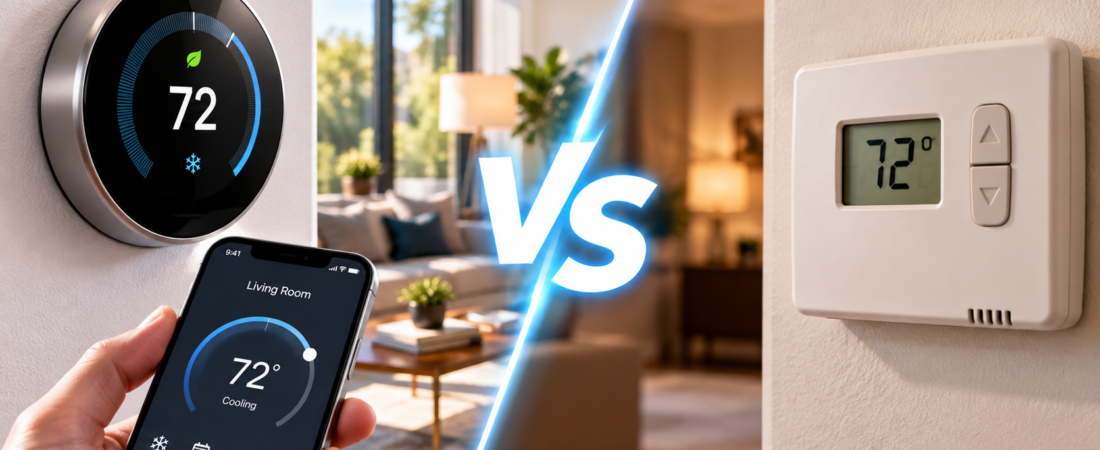
Smart thermostats promise to make your home more comfortable, more convenient and — most importantly — cheaper to heat and cool.
But there is an obvious question.
Does a smart thermostat actually save enough money to justify buying one?
After all, a regular thermostat can already do the most important job: set the temperature.
If you are disciplined about turning the heat down when you leave home and raising the air-conditioning temperature when you are away, you might wonder why you need Wi-Fi, an app, occupancy sensors or algorithms controlling your HVAC system.
That makes the smart thermostat vs regular thermostat comparison more interesting than it first appears.
The biggest advantage of a smart thermostat isn’t that it can choose a magical temperature that dramatically lowers your energy bill.
It’s that it can automate the temperature adjustments many people forget to make.
And because heating and cooling account for a large portion of household energy costs, small improvements can add up over time. ENERGY STAR says nearly half of the average American household’s annual energy bill goes toward heating and cooling. ENERGY STAR
So let’s look at whether paying more for a smart thermostat actually makes financial sense.
Smart Thermostat vs Regular Thermostat at a Glance
| Smart Thermostat | Regular Thermostat | |
|---|---|---|
| Controls temperature | Yes | Yes |
| Wi-Fi connection | Usually | No |
| Smartphone control | Yes | No |
| Automatic scheduling | Yes | Limited or none |
| Learns routines | Some models | No |
| Occupancy detection | Some models | No |
| Geofencing | Some models | No |
| Energy reports | Often | No |
| Upfront cost | Higher | Lower |
| Potential energy savings | Higher for many households | Depends on user behavior |
| Installation complexity | Moderate | Usually simple |
| Best for | Automation and convenience | Simplicity and low cost |
At its core, both devices control the same HVAC equipment.
The difference is how much work you have to do yourself.
What Does a Smart Thermostat Actually Do?
A smart thermostat connects your home’s heating and cooling system to software.
That allows features such as:
- Remote temperature control
- Automatic scheduling
- Occupancy detection
- Geofencing
- Vacation modes
- Energy-use reports
- Automatic software updates
- Learning your temperature preferences
Some models can detect when nobody is home and automatically reduce heating or cooling.
Others use your phone’s location.
Leave the house and the thermostat can adjust the temperature.
Start heading home and it can begin returning the house to your preferred setting.
ENERGY STAR identifies remote control, geofencing, learning capabilities and automatic updates among the common features available on certified smart thermostats. ENERGY STAR
A regular thermostat generally waits for you to make those decisions.
That distinction is where most potential savings come from.
How Much Can a Smart Thermostat Actually Save?
This is where the comparison becomes measurable.
According to ENERGY STAR, certified smart thermostats save an average of approximately 8% on heating and cooling bills, or roughly $50 per year for an average household. ENERGY STAR
Households with particularly high heating and cooling costs — or homes that remain empty for significant portions of the day — may save approximately $100 per year. ENERGY STAR
That may not sound dramatic.
But consider the economics.
Suppose a smart thermostat costs $150.
If it saves:
$50 per year → about 3 years to recover the purchase price
If it saves:
$100 per year → about 1.5 years
After that, continued savings could theoretically offset the original cost.
Of course, actual savings vary considerably.
Climate, HVAC equipment, insulation, house size, temperature preferences and how often someone is home can all affect the result.
ENERGY STAR specifically cautions that savings vary by climate, comfort preferences, occupancy and HVAC equipment. ENERGY STAR
So $50 should be treated as an average — not a guaranteed rebate from your utility company.
Why Does Automation Save Money?
Imagine two homes.
Both owners prefer 72°F while they’re home.
Home A: Regular Thermostat
The homeowner leaves for work at 8 a.m.
The thermostat stays at 72°F.
At 5:30 p.m., the homeowner returns.
The house has been maintained at the preferred temperature for nearly ten hours even though nobody was there.
Home B: Smart Thermostat
The homeowner leaves.
The thermostat recognizes that the house is empty and allows the temperature to drift into a more energy-efficient range.
Before the homeowner returns, it begins restoring the preferred temperature.
Both people experience roughly the same comfort while they’re home.
But Home B may have spent fewer hours actively heating or cooling an empty house.
That is the basic idea behind smart thermostat savings.
But Couldn’t You Do That With a Regular Thermostat?
Absolutely.
And this is the biggest argument against paying extra for a smart thermostat.
If you consistently adjust your regular thermostat every time you:
- Leave home
- Go to sleep
- Wake up
- Return home
- Go on vacation
then the savings advantage of a smart thermostat may shrink considerably.
The smart thermostat doesn’t create cheap electricity or make your furnace fundamentally more efficient.
It mostly improves control.
That means the comparison isn’t simply:
Smart technology vs old technology.
It is also:
Automation vs human consistency.
If you’re extremely disciplined, you may already be doing manually what the smart thermostat would automate.
What About a Programmable Thermostat?
There is actually a third category.
Traditional programmable thermostats allow you to create schedules.
For example:
6:30 a.m. — 70°F
8:00 a.m. — 64°F
5:00 p.m. — 70°F
10:30 p.m. — 65°F
For someone with a predictable schedule, this can work very well.
The problem is that life isn’t always predictable.
You work from home Tuesday.
Your spouse comes home early Wednesday.
The kids have no school Friday.
You leave for vacation Saturday morning.
A fixed schedule doesn’t necessarily know any of that.
ENERGY STAR notes that programmable thermostats rely on static user programming, while smart thermostats can automatically adapt using preferences, occupancy and indoor or outdoor temperature information. ENERGY STAR
That’s one reason smart thermostats can be more practical than traditional programmable models.
Smart Thermostats May Be Most Valuable When Nobody Is Home
Consider two different households.
Household #1
Someone works from home.
Another family member is retired.
Someone is almost always inside.
Household #2
Everyone leaves around 8 a.m.
Nobody returns until around 5 or 6 p.m.
Household #2 potentially has a much larger opportunity to reduce unnecessary heating and cooling.
That’s consistent with ENERGY STAR guidance, which says homes that are unoccupied much of the day can potentially save around $100 annually with a certified smart thermostat. ENERGY STAR
The more often your house sits empty, the more useful automation can become.
Climate Matters Too
A thermostat in San Diego doesn’t face the same workload as one in Minnesota.
If you live somewhere with mild temperatures and rarely run your HVAC system, there isn’t much energy consumption for a smart thermostat to optimize.
But if your furnace runs constantly during winter or your air conditioner works hard throughout summer, small percentage improvements can translate into larger dollar savings.
That means smart thermostat economics tend to become more attractive when heating and cooling costs are already high.
Convenience Has Value Too
Energy savings aren’t the only benefit.
Imagine lying in bed and realizing the house feels too warm.
With a regular thermostat:
Get up. Walk downstairs. Change it.
With a smart thermostat:
Open your phone.
That sounds trivial until you multiply it across years.
Remote access can also be genuinely useful.
Suppose you’re at the airport and suddenly realize you forgot to change the thermostat before a week-long vacation.
With a smart thermostat, you can adjust it immediately from your phone.
ENERGY STAR specifically lists remote temperature control as one of the primary benefits of connected thermostats. ENERGY STAR
Energy Reports Can Reveal Problems
Some smart thermostats provide information about how long your HVAC system runs.
That can make unusual patterns easier to notice.
If your air conditioner suddenly begins running much longer than usual, something may have changed.
Maybe the weather is unusually hot.
But it could also be:
- A dirty air filter
- An open window
- Poor insulation
- A mechanical problem
- Someone changing the temperature excessively
A traditional thermostat doesn’t usually give you much information.
It simply displays the temperature.
A smart thermostat can provide another layer of visibility into how the system is being used.
But a Smart Thermostat Cannot Fix an Inefficient House
This is important.
A $200 thermostat cannot compensate for major structural energy problems.
If your attic has poor insulation, your windows leak air and your ductwork loses conditioned air, your HVAC system may still run constantly.
In fact, ENERGY STAR says sealing and insulating ducts can improve HVAC efficiency substantially — in some situations by as much as 20%. ENERGY STAR
So homeowners shouldn’t think:
Smart thermostat = energy-efficient home.
The thermostat is one component.
Insulation, air sealing, HVAC maintenance and the efficiency of the heating and cooling equipment can matter much more.
What About Installation?
Regular thermostats are usually simple.
Smart thermostats can be more complicated.
Many require continuous electrical power.
That often means using a C-wire, or common wire, from the HVAC system.
ENERGY STAR notes that many smart thermostats rely on a C-wire, although some models can work without one or use an adapter. ENERGY STAR
Compatibility can also become an issue with:
- Heat pumps
- Multi-stage HVAC systems
- Zoned systems
- Boilers
- High-efficiency equipment
- Proprietary HVAC controls
So don’t buy a smart thermostat simply because it looks compatible with the hole in your wall.
Check your HVAC system first.
For some high-efficiency systems, ENERGY STAR recommends considering a controller from the same manufacturer. ENERGY STAR
What Does a Smart Thermostat Cost?
ENERGY STAR says smart thermostats can range roughly from $50 to $300, depending on features. ENERGY STAR
But the sticker price isn’t always what you’ll actually pay.
Utilities in many areas offer rebates or discounts for qualifying ENERGY STAR models. ENERGY STAR
That can dramatically change the math.
Imagine a $150 thermostat with a $75 utility rebate.
Your effective cost becomes $75.
At $50 in annual energy savings, the theoretical payback period becomes roughly:
18 months.
That’s much easier to justify.
So before buying one, checking your local utility’s rebate program may be just as important as comparing thermostat models.
When a Regular Thermostat Makes More Sense
Smart isn’t automatically better for everyone.
A basic thermostat may still be the better fit if:
- Someone is home most of the day
- You rarely use heating or air conditioning
- You already adjust temperatures consistently
- Your HVAC system has compatibility issues
- You don’t want another connected device
- You prefer simple controls
- You’re renting temporarily
- The potential energy savings are very small
There is also something appealing about a device that does one job and doesn’t need Wi-Fi.
Set the temperature.
Done.
When a Smart Thermostat Makes More Sense
A smart thermostat becomes more attractive when:
- Your home is empty for long periods
- You frequently forget to adjust temperatures
- Your schedule changes
- Heating and cooling bills are high
- You travel frequently
- You want remote control
- You want energy-use information
- Your utility offers a rebate
In those situations, automation can solve a real problem rather than simply adding another gadget to your home.
Smart Thermostat vs Regular Thermostat: Which Should You Choose?
The answer depends less on how “smart” you want your home to be and more on how you currently use your HVAC system.
If you already manage temperatures carefully and your heating and cooling costs are low, a regular thermostat can continue doing the job perfectly well.
If you regularly heat or cool an empty house, forget to adjust the thermostat or have high HVAC bills, a smart thermostat has more opportunity to save money.
ENERGY STAR’s average estimate of about 8% savings on heating and cooling costs suggests that the financial benefit is real — but usually gradual rather than dramatic. ENERGY STAR
And that’s probably the most useful way to think about this comparison.
A smart thermostat isn’t necessarily a revolutionary home upgrade.
It’s an automation tool that can prevent small amounts of wasted energy every day.
Over several years, those small savings can become meaningful.
Compare with Reason.