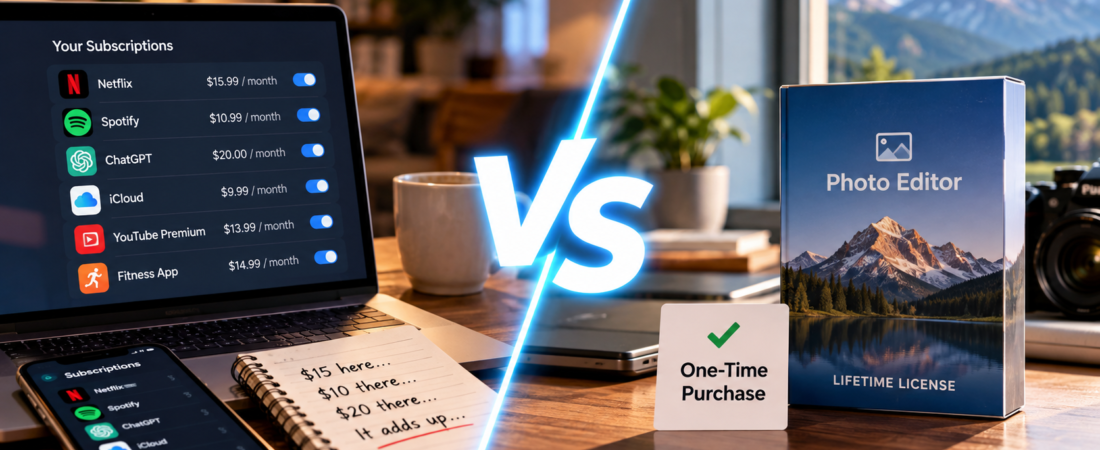
A $9.99 monthly subscription doesn’t feel expensive.
Neither does $14.99.
Even $19.99 can seem reasonable if you use the service regularly.
But subscriptions have changed the way we pay for almost everything.
Movies. Music. Software. Cloud storage. Fitness. News. Security cameras. Productivity tools. AI services. Even features inside cars and household products can now come with recurring fees.
Individually, each payment may look small.
Together, they can become a significant permanent expense.
That raises an interesting question in the subscriptions vs buying once comparison:
Is paying a small amount every month actually better than paying a larger amount upfront and owning something?
The answer depends heavily on how long you use it.
And that’s exactly why subscription pricing can be difficult to evaluate.
Subscriptions vs Buying Once at a Glance
| Subscription | Buy Once | |
|---|---|---|
| Upfront cost | Low | Higher |
| Monthly payment | Yes | No |
| Long-term cost | Can keep increasing | Usually fixed |
| Ownership | Usually no | Usually yes |
| Updates | Often included | Varies |
| Easy to cancel | Usually | Not applicable |
| Best for short-term use | Often | Usually not |
| Best for long-term use | Depends | Often |
| Switching flexibility | High | Lower |
| Risk | Paying indefinitely | Paying upfront and not using it |
The fundamental difference is simple.
With a one-time purchase, the cost eventually stops.
With a subscription, the cost usually continues for as long as you want access.
That sounds obvious.
But over several years, the difference can become surprisingly large.
Why Subscriptions Feel Cheap
Subscription pricing changes how we perceive cost.
Compare these two offers:
Option A: $240
Option B: $9.99 per month
Which feels cheaper?
For many people, Option B.
But after two years:
$9.99 × 24 = $239.76
After three years:
$9.99 × 36 = $359.64
After five years:
$9.99 × 60 = $599.40
The $9.99 payment never changed.
What changed was time.
That’s the central problem with subscription economics.
Monthly pricing encourages us to think about affordability today rather than total cost over the entire period we plan to use something.
The $20 Subscription Test
Let’s use another simple example.
Imagine a software product gives you two choices.
Subscription
$20 per month
Lifetime Purchase
$300 once
At first, $20 seems dramatically cheaper.
But:
1 year: $240
2 years: $480
3 years: $720
5 years: $1,200
The break-even point is:
$300 ÷ $20 = 15 months
If you use the software for six months, the subscription wins financially.
If you use it for five years, the one-time purchase costs dramatically less.
So before subscribing, one useful question is:
How long do I realistically expect to use this?
Subscriptions Are Still Growing
Recurring payments are not disappearing.
Recent Bank of America Institute analysis found that average subscription spending per household increased 7.7% year over year in July 2026, faster than overall card spending.
The analysis also found particularly strong growth in reading and information subscriptions, a category that now includes many AI services.
That makes sense.
Subscription models have expanded far beyond entertainment.
A household might now pay monthly for:
- Video streaming
- Music
- Cloud storage
- AI tools
- Software
- Fitness apps
- Meal services
- News
- Gaming
- Security systems
No individual subscription needs to be expensive for the total to become substantial.
What Does a Typical Subscription Stack Look Like?
Imagine a household paying:
Video streaming: $18/month
Second streaming service: $11/month
Music: $12/month
Cloud storage: $10/month
AI service: $20/month
Fitness app: $15/month
News: $10/month
Software: $15/month
Total:
$111 per month
That becomes:
$1,332 per year
Over five years:
$6,660
And that’s assuming none of the services increase their prices.
This doesn’t mean the household is wasting $6,660.
If those services are used frequently and provide real value, the spending may be completely reasonable.
The important point is that small recurring expenses can become large long-term commitments.
Buying Once Has a Psychological Problem Too
Subscriptions aren’t the only pricing model that can waste money.
One-time purchases create their own trap.
Suppose you pay $400 for professional software because buying it seems cheaper than paying $20 every month.
Then you use it twice.
You didn’t save money.
You spent $400 on something you barely needed.
A subscription can actually be financially superior when you’re uncertain about long-term use.
Pay $20 for two months.
Realize you don’t need it.
Cancel.
Total cost:
$40
That’s much better than spending $400 upfront.
So buying once only becomes cheaper if you actually continue using the product long enough to reach the break-even point.
The Break-Even Formula
Fortunately, there’s an easy way to compare the two.
Take:
One-Time Purchase Price ÷ Monthly Subscription Price
The answer gives you an approximate break-even point in months.
For example:
One-time price: $240
Subscription: $12/month
$240 ÷ $12 = 20 months
If you expect to use it for less than 20 months, the subscription may cost less.
If you expect to use it much longer than 20 months, buying once may become cheaper.
It’s not a perfect formula because subscriptions may include updates, support or new features.
But it’s an excellent starting point.
Subscriptions Have One Huge Advantage: Updates
Software demonstrates why subscriptions can sometimes make sense.
Under the traditional model, you might buy:
Version 1 for $300.
Three years later, Version 2 arrives.
Upgrade: another $150.
Eventually, the software becomes outdated or unsupported.
With a subscription, updates are usually included.
That means you’re not simply renting the same product forever.
You may be paying for continuous development, cloud infrastructure, new features and technical support.
This is especially relevant for services that require ongoing computing resources.
Cloud storage can’t realistically be sold once forever because storing your files continues to cost the provider money.
The same is true for many AI services.
Every request consumes computing resources.
In those situations, recurring pricing has an economic reason beyond simply generating recurring revenue.
Physical Products Are Different
Subscription logic becomes more questionable when applied to physical products.
Imagine paying monthly to access a feature already physically installed inside something you own.
Consumers may reasonably ask:
If the hardware is already in my product, why am I still paying to use it?
This debate has appeared in the automotive industry as manufacturers experiment with subscriptions for connected services and optional vehicle features.
The economics feel different from Netflix or cloud storage.
Netflix continuously provides new content.
Cloud storage continuously stores data.
But a physical component may already be sitting inside the product you purchased.
That distinction can affect whether consumers perceive the subscription as useful service or unnecessary recurring cost.
Streaming Shows Both Sides of the Argument
Streaming is one of the clearest examples of why subscriptions became popular.
Before streaming, someone might buy:
DVDs
Blu-rays
CDs
Digital albums
Each purchase provided ownership of a limited amount of content.
A streaming subscription can provide access to enormous libraries for one monthly payment.
If you constantly watch different movies and listen to different music, buying everything individually would be impractical.
In that situation, subscriptions can offer tremendous value.
But the calculation changes if you only repeatedly watch a handful of movies.
You could theoretically spend hundreds of dollars over several years maintaining access to content you could have purchased for much less.
Convenience has value.
But convenience also has a price.
Subscriptions Make Switching Easier
Ownership creates commitment.
Suppose you spend $600 on a piece of software.
Six months later, a competitor releases something better.
Switching hurts because you’ve already invested $600.
With a monthly subscription, you can often cancel one service and start another.
That flexibility is valuable in fast-changing categories such as:
- AI tools
- Productivity software
- Fitness apps
- Streaming
- Digital services
If the market changes quickly, renting access can sometimes be smarter than making a large upfront commitment.
But Cancellation Is the Entire Game
The financial advantage of subscriptions depends on one important behavior:
You actually have to cancel them when you stop using them.
That’s where many people fail.
A $10 subscription you use every day may be excellent value.
A $10 subscription you forgot about for 18 months cost you:
$180
for almost nothing.
Bank of America’s subscription analysis noted that households continue adding new subscription categories even as consumers also cancel services, highlighting how recurring spending can shift rather than simply disappear.
That makes subscription management almost as important as subscription pricing.
The Annual Subscription Can Be the Middle Ground
Many services offer:
$15/month
or
$120/year
The annual plan reduces the effective monthly price from $15 to $10.
If you already know you’ll use the service for the full year, that’s a substantial discount.
But there is a trade-off.
Pay monthly and you can cancel next month.
Pay annually and your money is already committed.
So annual subscriptions make the most sense for services you already use consistently — not ones you’re trying for the first time.
Watch Out for Subscription Price Increases
Another difference between ownership and subscription pricing is control.
If you buy something for $300, your purchase price doesn’t suddenly become $350 next year.
Subscriptions can change.
$9.99 becomes $11.99.
Then $13.99.
Eventually $15.99.
A $2 increase doesn’t feel dramatic.
But across several services and several years, repeated increases can materially change household spending.
That’s another reason long-term subscription costs are difficult to predict.
The monthly price you start with may not be the monthly price you’re paying three years later.
AI Makes This Comparison Even More Relevant
AI is creating a new category of recurring expenses.
Someone might pay for:
An AI assistant.
An AI image generator.
An AI coding tool.
An AI research tool.
An AI productivity service.
Individually, each subscription might seem reasonable.
Together, they can easily become another $50, $100 or more per month.
Bank of America Institute specifically identified AI-related services as a contributor to growth in information and reading subscription spending in 2026.
That means subscription management may become more important, not less.
Calculate Cost Per Use
Another useful way to evaluate subscriptions is:
Monthly Cost ÷ Number of Uses
Suppose your gym app costs:
$20/month
and you use it:
20 times per month
Cost per use:
$1
That’s excellent.
But if you use it once:
$20 per use
Now the value looks very different.
The same calculation works for streaming, software, AI tools and memberships.
A subscription doesn’t become expensive simply because it has a monthly fee.
It becomes expensive when the cost is high relative to how much value you actually receive.
Who Should Choose a Subscription?
Subscriptions can make sense when:
- You need something temporarily
- The upfront purchase price is very high
- You want continuous updates
- You value cloud services or ongoing content
- The product changes rapidly
- You want flexibility to switch
- You’re unsure whether you’ll use it long term
- You use the service frequently
For something you use every day, a subscription can be one of the best values in your budget.
Who Should Buy Once?
Buying once becomes more attractive when:
- You expect to use the product for years
- The subscription has a short break-even period
- Updates aren’t important
- The product works offline
- You dislike recurring bills
- The purchased version can remain useful for a long time
- You want ownership
- Subscription prices are likely to rise
The longer the expected ownership period, the more important the comparison becomes.
The Subscription Audit
One of the easiest financial exercises you can do takes about 15 minutes.
Open your credit-card and bank statements.
Find every recurring payment.
Then ask three questions:
Did I use this during the last 30 days?
Would I sign up for it again today at this price?
Is there a one-time purchase that could replace it?
That second question is particularly useful.
Forget that you’re already subscribed.
Imagine the service disappeared today.
Would you immediately pay to restore it?
If the answer is no, the subscription may not be providing enough value to justify continuing it.
Subscriptions vs Buying Once: Which Costs More?
There isn’t a universal winner.
A subscription can be cheaper when you only need something temporarily, want constant updates or need a service that has ongoing operating costs.
Buying once can be dramatically cheaper when you use the same product for years.
The easiest mistake is looking only at the monthly price.
Instead, calculate:
Monthly price × expected months of use
Then compare that number with the purchase price.
A $15 subscription doesn’t sound expensive.
But over five years:
$15 × 60 = $900
If the alternative costs $250 once, that changes the decision.
The real question isn’t:
“Can I afford $15 per month?”
It’s:
“What will this cost me for as long as I expect to use it?”
That’s the number worth comparing.
Compare with Reason.