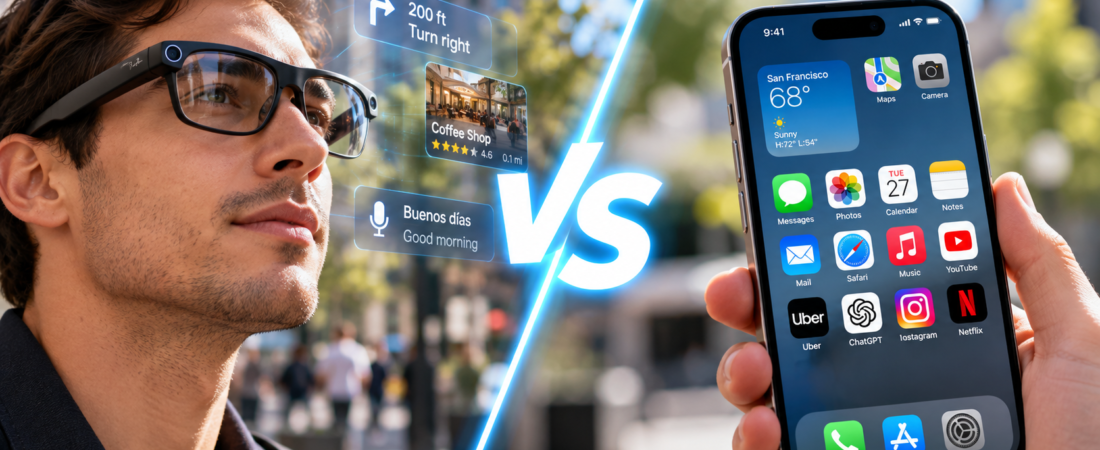
For nearly two decades, the smartphone has been the center of our digital lives.
We use it to communicate, navigate, take photos, shop, pay bills, watch videos, search the internet and increasingly interact with AI.
But technology companies are now experimenting with a different idea.
What if you didn’t have to pull a screen out of your pocket at all?
AI-powered smart glasses can already take photos, play music, answer questions, translate languages and provide information about what the wearer is seeing. More advanced AR glasses can place digital information directly into the user’s field of view.
That raises a much bigger question in the smart glasses vs smartphone comparison:
Could smart glasses eventually replace the smartphone?
The answer in 2026 is probably not.
But for the first time, the idea no longer sounds completely unrealistic.
Smart Glasses vs Smartphone at a Glance
| Smart Glasses | Smartphone | |
|---|---|---|
| Hands-free use | Excellent | Limited |
| Large display | Limited or none | Excellent |
| Camera | Yes on many models | Yes |
| AI assistant | Increasingly important | Excellent |
| Navigation | Growing capability | Excellent |
| Messaging | Limited | Excellent |
| Apps | Limited ecosystem | Massive ecosystem |
| Battery life | Major challenge | Usually all-day |
| Privacy concerns | Significant | Significant but familiar |
| Typing | Difficult | Easy |
| Entertainment | Limited | Excellent |
| Social acceptance | Improving | Universal |
| Phone replacement today | No | — |
The smartphone still wins most traditional computing tasks.
But smart glasses are beginning to compete in a different way.
Instead of making you look down at a screen, they try to bring computing into whatever you’re already doing.
Why Smart Glasses Are Suddenly Becoming Important
Smart glasses have existed for years.
What’s changed is AI.
Earlier smart glasses often felt like smartphones with most of the useful features removed.
They could take pictures.
Play music.
Maybe display simple information.
But generative AI gives glasses something much more interesting:
context.
A camera can see what you’re seeing.
Microphones can hear what you’re asking.
AI can interpret both.
That creates interactions that are difficult to reproduce naturally on a phone.
You could look at a building and ask:
“What is that?”
Look at a restaurant menu and ask:
“Which of these dishes contains the most protein?”
Look at a sign in another language and ask:
“Translate this.”
Or look at an object and ask:
“How do I fix this?”
The glasses don’t necessarily need you to describe the situation.
They can potentially see the context themselves.
Counterpoint describes this as one of the fundamental advantages of AI glasses: hands-free, contextual computing that can understand what the wearer sees and hears. Counterpoint Research
That’s something a smartphone can do too — but usually only after you take it out, unlock it, open an app and point the camera.
The Market Is Growing Very Quickly
This isn’t just a concept anymore.
Counterpoint Research reported that global AI-glasses shipments increased 263% year over year in the first half of 2026. Counterpoint Research
But one detail is particularly important.
About 96% of those shipments were display-less AI glasses. Counterpoint Research
In other words, the products succeeding today generally aren’t trying to place a miniature smartphone screen directly in front of your eyes.
They’re closer to normal glasses equipped with combinations of:
- Cameras
- Microphones
- Speakers
- AI
- Voice control
- Wireless connectivity
That tells us something important about where the technology currently stands.
The successful smart-glasses formula in 2026 is largely:
Make normal glasses smarter.
Not:
Shrink the entire smartphone into your lenses.
Smartphones Still Have a Huge Advantage: The Screen
Think about everything you do on your phone that requires a screen.
Reading an article.
Editing a spreadsheet.
Watching YouTube.
Scrolling through photos.
Shopping.
Typing an email.
Comparing hotel prices.
Using banking apps.
Editing a video.
Playing a game.
Smart glasses struggle with many of these tasks.
Display-less glasses obviously cannot show traditional visual interfaces at all.
AR glasses with displays can show information, but they still face challenges involving field of view, brightness, optics, weight, heat, battery life and interface design.
That means the smartphone’s rectangular screen remains extremely useful.
It’s difficult to replace a device that can instantly become:
A keyboard.
A television.
A camera monitor.
A map.
A calculator.
A book.
A payment terminal.
A gaming system.
Smart glasses don’t yet reproduce that flexibility.
But Glasses Have One Advantage Phones Can’t Easily Match
They are already pointed where you’re looking.
That’s more important than it sounds.
Imagine walking through an unfamiliar city.
Smartphone
Take phone out.
Unlock it.
Open Maps.
Look down.
Look up.
Walk.
Look down again.
Smart Glasses
Look ahead.
Directions appear or are spoken while you continue walking.
The second interaction is potentially much more natural.
This is why navigation, translation and contextual AI are particularly promising smart-glasses applications.
Computing becomes part of your environment instead of something that temporarily removes your attention from it.
AI Could Reduce the Need for Apps
Smartphones are built around apps.
Want an Uber?
Open Uber.
Need directions?
Open Maps.
Want music?
Open Spotify.
Need weather?
Open a weather app.
AI assistants are beginning to challenge that model.
Instead of deciding which app to use, you tell the AI what you want.
For example:
“Find an Italian restaurant nearby with outdoor seating and make a reservation for four at 7:30.”
If an AI agent can eventually complete that request across services, the user may not need to interact directly with several apps.
This matters for smart glasses.
Typing, tapping and navigating menus are awkward without a touchscreen.
But talking to an AI assistant is natural.
That means increasingly capable AI could remove one of the biggest disadvantages of screenless devices.
The future smart-glasses interface may not look like an iPhone floating in front of your face.
It may be mostly conversational.
Smartphones Still Win Communication
Now try writing a detailed email.
Or replying to ten text messages.
Or reviewing a PDF.
Voice dictation helps, but speaking every message aloud isn’t practical.
Imagine standing in an airport saying:
“Tell my accountant that the second-quarter numbers need to be revised before Friday…”
Everyone nearby can hear you.
Sometimes a private touchscreen and keyboard are simply better.
Smartphones offer privacy of interaction that voice-controlled glasses don’t always provide.
This is one reason phones are unlikely to disappear simply because voice AI improves.
Battery Life Is a Major Problem
A smartphone has a relatively large battery.
Glasses don’t.
They have to remain:
Light.
Comfortable.
Cool.
Thin.
And wearable for hours.
Now add:
Cameras.
Microphones.
Wireless radios.
AI processing.
Speakers.
Displays.
Sensors.
Every feature consumes power.
Advanced AR glasses face particularly difficult battery constraints. Counterpoint noted that Snap’s 2026 Specs target around four hours of mixed use, illustrating the challenge facing more computationally intensive eyewear. Counterpoint Research
Four hours might be impressive for the technology.
But it isn’t enough to replace something you expect to carry from breakfast until bedtime.
The Privacy Problem Is Much Bigger Than With Phones
Someone holding a smartphone camera toward you is obvious.
Someone wearing glasses isn’t.
That’s a fundamental difference.
Camera-equipped smart glasses can potentially capture photos, video and audio while appearing similar to ordinary eyewear.
Reuters reported this month that privacy concerns surrounding AI wearables are drawing increasing scrutiny internationally, with regulators, workplaces and other institutions examining how camera-equipped glasses should be handled. Reuters
Australia has even considered restrictions on smart glasses in government buildings, while other institutions have introduced their own limitations. Reuters
This isn’t a minor technical problem.
It could become one of the biggest barriers to widespread adoption.
Camera-Free Glasses May Be Part of the Answer
Interestingly, the industry may already be adapting.
Reuters reported in September that Meta was planning camera-free smart glasses, according to The Information, as privacy concerns around camera-equipped eyewear increase. Reuters
That creates another possible category:
AI glasses without cameras.
They could still potentially provide:
Music.
Calls.
Notifications.
AI voice assistance.
Directions.
Reminders.
Calendar information.
But they would remove the constant concern that someone nearby might be recording.
That could make smart glasses much more socially acceptable in offices, schools and public spaces.
The trade-off is obvious: without a camera, AI loses the ability to understand what you’re looking at.
Smart Glasses Could Replace Some Phone Moments Before They Replace Phones
This may be the most realistic way to think about the transition.
Smartwatches didn’t replace smartphones.
But they replaced certain smartphone interactions.
Checking the time.
Reading a notification.
Starting a workout.
Changing a song.
Seeing who’s calling.
Smart glasses could do something similar on a larger scale.
Instead of replacing your phone entirely, they could eliminate dozens of moments when you would normally reach for it.
For example:
Navigation: glasses.
Quick photo: glasses.
Translation: glasses.
Music: glasses.
AI question: glasses.
Notification: glasses.
Phone call: glasses.
But:
Long email: smartphone.
Banking: smartphone.
Shopping: smartphone.
Video: smartphone.
Complex apps: smartphone.
That scenario seems much more plausible than throwing away the smartphone tomorrow.
Smart Glasses May Eventually Change What a Phone Is
There’s another possibility.
The smartphone might not disappear.
The screen might.
Imagine the computing components remaining in your pocket while the glasses become the primary interface.
Your pocket device could provide:
- Battery
- Cellular connectivity
- Processing
- Storage
- Security
The glasses could provide:
- Camera
- Microphones
- Speakers
- Display
- AI interface
In that scenario, today’s smartphone gradually becomes a computing hub rather than something you constantly hold.
We’re already seeing experiments in this direction.
Some emerging AR systems rely on external compute units, while prototypes have explored direct cellular connectivity for glasses. Counterpoint highlighted both approaches at CES and AWE in 2026. Counterpoint Research
That may ultimately be more realistic than fitting everything inside the glasses themselves.
The App Ecosystem Is Still a Huge Barrier
Even if smart glasses become technically excellent, smartphones have another advantage:
Millions of apps and services were built around them.
Consumers already know how to use the interface.
Developers know how to build for it.
Businesses know how to support it.
Replacing that ecosystem is incredibly difficult.
This is why platforms may matter more than individual glasses.
Google, for example, can potentially connect glasses with Maps, Gmail, Calendar, Photos, YouTube and other existing services through Android XR.
Counterpoint argues that this broader service ecosystem could significantly expand the usefulness of AI glasses. Counterpoint Research
The future smart-glasses battle may therefore look less like:
Which glasses have the best camera?
and more like:
Which ecosystem works best around your eyes?
What Smart Glasses Already Do Better
There are several situations where smart glasses already have a natural advantage.
Capturing What You See
No need to hold a camera.
Hands-Free AI
Ask questions while working, walking or cooking.
Translation
Potentially hear or see translations while interacting with someone.
Navigation
Keep your eyes forward instead of repeatedly checking a phone.
Audio
Listen without traditional headphones in some designs.
Contextual Assistance
AI can potentially understand the physical environment around you.
These aren’t gimmicks.
They’re genuine advantages created by the form factor.
What Smartphones Still Do Much Better
The smartphone remains dramatically better for:
Long-form reading
A larger, private display matters.
Typing
Touch keyboards aren’t perfect, but they’re far better than speaking everything aloud.
Video
Nobody wants to watch every movie projected onto lightweight glasses — at least not with today’s technology.
Banking and payments
Phones already have mature security and authentication systems.
Apps
The ecosystem is enormous.
Battery life
Phones have much more physical room for batteries.
Social acceptance
Nobody wonders whether your phone is secretly recording simply because it’s sitting in your pocket.
Smart glasses still need to solve several of these problems before they can realistically become the primary computing device.
Smart Glasses vs Smartphone: What Happens Next?
The most important number may not be the 263% growth rate.
It’s the 96%.
Almost all AI glasses shipped during the first half of 2026 were still display-less models. Counterpoint Research
That suggests the industry has found an early use case for AI glasses — but not yet a complete smartphone replacement.
Today’s winning formula appears to be:
glasses + audio + camera + AI
rather than:
smartphone screen on your face.
The next stage will likely depend on whether companies can add useful displays without making glasses heavy, expensive or socially awkward.
Battery technology needs to improve.
Interfaces need to improve.
Privacy safeguards need to become clearer.
AI agents need to become more capable.
And developers need compelling reasons to build for the platform.
Could Smart Glasses Actually Replace Your Phone?
In 2026, smart glasses are better viewed as a companion to the smartphone than a replacement for it.
But that doesn’t mean they need to replace the phone to become important.
If glasses eliminate even half of the reasons you currently pull your smartphone from your pocket, your relationship with the phone changes dramatically.
You might still own one.
You just might not look at it nearly as often.
And that may be the first real step toward a post-smartphone world.
Compare with Reason.