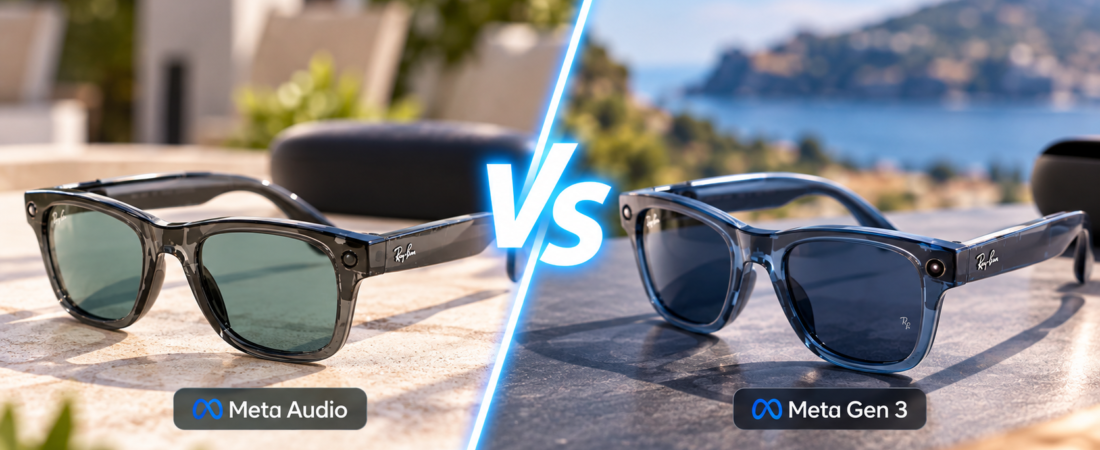
Smart glasses have usually followed a simple formula:
Take normal-looking glasses and add more technology.
More cameras.
More sensors.
More AI.
More features.
But Meta’s newest Ray-Ban glasses take an unusual step in the opposite direction.
They remove the camera entirely.
The new Ray-Ban Meta Audio starts at $349 and focuses on open-ear audio, calls and hands-free AI. Next to it sits the new Ray-Ban Meta Gen 3, starting at $449, with a 12MP camera capable of recording 3K video. About Facebook
That creates a surprisingly interesting buying decision.
Save $100, get longer battery life and wear glasses that can’t photograph anyone.
Or spend another $100 and get the feature that makes smart glasses much more visually capable.
In the Ray-Ban Meta Audio vs Meta Gen 3 comparison, the question isn’t simply whether a camera is useful.
It’s whether you actually want a camera on your face.
Ray-Ban Meta Audio vs Meta Gen 3 at a Glance
| Ray-Ban Meta Audio | Ray-Ban Meta Gen 3 | |
|---|---|---|
| Starting price | $349 | $449 |
| Camera | No | 12MP |
| Video | No | Up to 3K |
| Battery | Up to 12 hours | Up to 9 hours |
| AI | Meta AI / Muse | Meta AI / Muse |
| Music | Yes | Yes |
| Calls | Yes | Yes |
| Open-ear audio | Yes | Yes |
| Photo/video capture | No | Yes |
| Styles | Clubmaster, Burbank | Aviator, Zena, Wayfarer |
| Color/lens combinations | 23 | 27 |
| Best advantage | Simplicity & battery | Camera & visual AI potential |
The price difference is exactly:
$100.
That’s small enough to make the decision interesting.
If the Gen 3 were $800, choosing the Audio model would be easy for many people.
But at $349 versus $449, you’re essentially deciding whether a camera is worth another $100 — and the compromises that come with it.
What Exactly Is Ray-Ban Meta Audio?
Ray-Ban Meta Audio is Meta’s first Ray-Ban audio-glasses model.
Unlike previous Ray-Ban Meta glasses, there is no camera.
Meta says the glasses weigh just 43 grams, making them its lightest and slimmest AI glasses yet. They come in two frame styles — Clubmaster and Burbank — with 23 color and lens combinations. About Facebook
They can still:
Play music.
Play podcasts.
Make calls.
Interact with Meta AI.
Use Meta’s Muse personal AI agent.
And provide hands-free voice interaction.
Meta rates them for up to 12 hours on a single charge, with up to another 48 hours from the charging case. About Facebook
Preorders started at $349, with shipping scheduled for October 13. About Facebook
In other words, think of them less like a camera strapped to your glasses and more like:
AI-powered open-ear headphones disguised as Ray-Bans.
That’s a very different product idea.
What Does the Extra $100 Get You With Gen 3?
Ray-Ban Meta Gen 3 starts at $449.
The biggest difference is obvious.
The camera.
Gen 3 includes a 12MP camera capable of recording 3K Ultra HD video. About Facebook
That means you can look at something and capture it without reaching for your phone.
See your child doing something funny?
Record it.
Walking through an interesting city?
Take a photo.
Riding a bike?
Capture your perspective.
Cooking?
Record what your hands are doing.
That hands-free first-person perspective is one of the strongest arguments for camera-equipped smart glasses.
And it isn’t something Meta Audio can reproduce.
No software update can add a camera that physically isn’t there.
The Camera Is About More Than Photos
There’s another important reason cameras matter on AI glasses.
AI can potentially understand what you’re looking at.
Without a camera, you can ask:
“What’s the weather today?”
“What’s on my calendar?”
“Play some music.”
With camera-equipped glasses, the interaction can become contextual.
You can potentially ask questions about the environment around you.
That opens the door to tasks such as:
Identifying objects.
Reading signs.
Understanding landmarks.
Getting information about something you’re looking at.
Remembering visual information.
Assisting with real-world tasks.
This is arguably where AI glasses become fundamentally different from earbuds.
Without a camera, Meta Audio can hear you.
With a camera, Gen 3 can potentially help AI understand part of what you see.
But Removing the Camera Has Real Advantages
Normally, removing a major feature sounds like a downgrade.
Here, it creates several advantages.
The first is battery life.
Meta Audio:
Up to 12 hours
Gen 3:
Up to 9 hours
That’s a three-hour difference based on Meta’s ratings. About Facebook
In percentage terms, the Audio model’s stated battery life is roughly 33% longer.
For something designed to be worn all day, three additional hours can matter more than it would on a device you occasionally use.
The Glasses Can Also Become Lighter
Cameras require:
Camera modules.
Electronics.
Power.
Physical space.
Remove those components and the product can become simpler.
Meta Audio weighs 43 grams, and Meta describes it as its lightest and slimmest AI glasses design yet. About Facebook
The Verge reported that removing the cameras allowed Meta to redesign the glasses and move electronics out of the front frame, helping create thinner arms and a more conventional appearance. The Verge
That’s important.
Smart glasses aren’t like smartphones.
A phone can weigh 20 grams more and you may barely care.
Glasses sit directly on:
Your nose.
Your ears.
Your face.
For hours.
Small differences in weight and balance can become much more noticeable.
And Then There’s Privacy
This may be the biggest reason Meta Audio exists.
Camera glasses create an unusual social problem.
You know whether you’re taking a photo.
The person standing in front of you may not.
Ray-Ban Meta camera glasses include a recording indicator LED designed to signal when photos or video are being captured. Meta says Gen 3 continues to use a built-in LED for this purpose. About Facebook
But that doesn’t completely eliminate discomfort.
The Verge noted that camera-equipped smart glasses have faced public criticism over wearable surveillance and recording concerns. The Verge
With Meta Audio, the camera question disappears.
There isn’t a hidden camera.
There isn’t a visible camera.
There isn’t a camera at all.
That could make a significant difference in:
Offices.
Meetings.
Restaurants.
Schools.
Social gatherings.
And ordinary conversations.
People may simply feel more comfortable around them.
Camera-Free Doesn’t Mean Privacy-Free
There’s an important distinction, though.
Removing the camera does not turn Meta Audio into ordinary glasses.
They still have microphones.
They still interact with AI.
They still process voice requests.
The Verge reported Meta’s explanation that the Audio glasses listen for a wake word and begin processing once activated, similar in concept to other voice-assistant devices. The Verge
So:
Camera-free ≠ technology-free.
Someone particularly concerned about wearable AI and microphones may still have questions.
But eliminating continuous visual capture capability removes one of the most obvious concerns surrounding camera glasses.
Meta Audio Could Be Easier to Wear at Work
Imagine you’re sitting across from a client.
You’re wearing Gen 3.
The client notices a camera on your glasses.
Even if you’re not recording, they may wonder:
“Is that thing recording me?”
Now imagine Meta Audio.
No camera exists.
That ambiguity disappears.
This could make camera-free smart glasses particularly interesting for people who want:
Music.
Calls.
AI.
Notifications.
Voice assistance.
without making everyone around them think about recording.
The absence of a feature can itself become a feature.
But You’ll Miss the Camera at Exactly the Wrong Moment
Now imagine walking through Central Park.
Something unexpected happens.
Your child hits a great golf shot.
Your dog does something ridiculous.
You see an amazing sunset.
With Gen 3:
“Take a video.”
Done.
With Meta Audio:
Reach into pocket.
Find phone.
Unlock phone.
Open camera.
Point phone.
Maybe the moment is already gone.
That’s the fundamental advantage of wearable cameras.
They’re already positioned approximately where you’re looking.
For spontaneous moments, that’s difficult for a phone to match.
The $100 Difference Is Smaller Than It Looks
Consider the prices:
Meta Audio: $349
Gen 3: $449
Difference:
$100
Percentage increase:
$100 ÷ $349 ≈ 29%
So Gen 3 costs roughly 29% more at starting price.
In return, you get a 12MP camera and 3K video capability.
But you give up some rated battery life and the simplicity of a camera-free design.
This isn’t a normal:
Cheap version vs expensive version
comparison.
Each product has an advantage the other can’t fully replicate.
Gen 3 gives you vision.
Audio gives you simplicity.
Meta Audio vs AirPods May Be the More Interesting Comparison
There’s another way to look at Meta Audio.
Maybe its real competitor isn’t Gen 3.
Maybe it’s wireless earbuds.
Both can provide:
Music.
Podcasts.
Calls.
Voice assistants.
Hands-free interaction.
But Meta Audio moves the speakers into something you may already wear every day.
You don’t put earbuds inside your ears.
Your ears remain open to the environment.
And if you need prescription glasses anyway, the device could potentially combine something necessary with something technological.
That makes Meta Audio an unusual product category:
glasses + headphones + AI assistant
without trying to become a camera.
Muse Makes Both Models More Interesting
Meta is also bringing its new personal AI agent, Muse, to its AI glasses lineup.
Meta describes Muse as an agent designed to help with tasks, plans and longer-term goals through hands-free interactions. About Facebook
That matters because it shifts the role of smart glasses.
Older smart glasses often felt like accessories.
AI could make them interfaces.
Instead of:
Tap.
Swipe.
Open app.
Search.
Type.
you may increasingly say:
“Remind me about this later.”
“What’s next on my schedule?”
“Call Jacob.”
“Play my golf playlist.”
“Add milk to my shopping list.”
That experience doesn’t necessarily require a camera.
For many routine AI interactions, microphones and speakers may be enough.
That’s the Big Question: How Often Would You Actually Use the Camera?
Before spending the extra $100, ask yourself something very simple:
How often would I actually take photos or videos with my glasses?
If the answer is:
Every day
then Gen 3 becomes much easier to justify.
If the answer is:
Almost never
then you’re paying $100 more, accepting shorter rated battery life and wearing cameras around all day for a feature you barely use.
That’s where Meta Audio becomes surprisingly compelling.
The Styles Are Different Too
This isn’t purely a technology decision.
Meta Audio comes in:
Clubmaster
and
Burbank
with 23 color and lens combinations. About Facebook
Gen 3 offers:
Aviator
Zena
and
Wayfarer
with 27 color and lens combinations. About Facebook
That’s important because glasses are fashion products in a way smartphones aren’t.
You can hide an ugly phone inside a case.
You can’t hide ugly glasses.
They’re sitting in the middle of your face.
The frame that actually looks good on you may matter more than a specification difference.
Prescription Users Could Find Both More Interesting
Meta says the Audio glasses support a wide range of optical prescriptions. About Facebook
That’s important for adoption.
If you already need glasses all day, smart glasses don’t necessarily represent another wearable.
They can potentially replace something you’re already wearing.
That’s very different from asking someone with perfect vision to put technology on their face for eight hours.
For prescription users, comfort, weight and frame selection may therefore matter even more than camera specifications.
Who Is Ray-Ban Meta Audio For?
The Audio model makes the most sense for someone who primarily wants:
Open-ear music.
Podcasts.
Calls.
Hands-free AI.
Longer battery life.
A lighter, simpler design.
Less concern about wearing a camera in social settings.
And a $100 lower starting price.
It’s particularly interesting if you already like the idea of smart glasses but never cared about taking pictures with them.
Who Is Ray-Ban Meta Gen 3 For?
Gen 3 makes more sense if the camera is central to why you want smart glasses.
That includes:
Parents capturing moments.
Travelers.
Content creators.
Cyclists.
People who frequently take quick photos.
Anyone interested in visual AI.
Anyone who wants the glasses to understand more of the physical world around them.
For those users, the camera isn’t a bonus feature.
It’s the reason to buy smart glasses in the first place.
Ray-Ban Meta Audio vs Meta Gen 3: Is the Camera Worth $100 More?
The surprising answer is that removing the camera doesn’t necessarily make Meta Audio the inferior product.
It makes it a different product.
Ray-Ban Meta Gen 3 gives you something genuinely powerful:
A camera that’s always positioned where you’re looking, combined with AI.
But Meta Audio gives you:
Three additional hours of rated battery life.
A lighter design.
A $100 lower starting price.
And perhaps most importantly, the ability to wear AI glasses without putting a camera in front of everyone you meet. About Facebook
For people who frequently capture photos, video or use visual AI, the extra $100 may unlock the feature that defines the smart-glasses experience.
For people who mainly want music, calls and hands-free AI, removing the camera may not feel like losing something.
It may be exactly the point.
Compare with Reason.