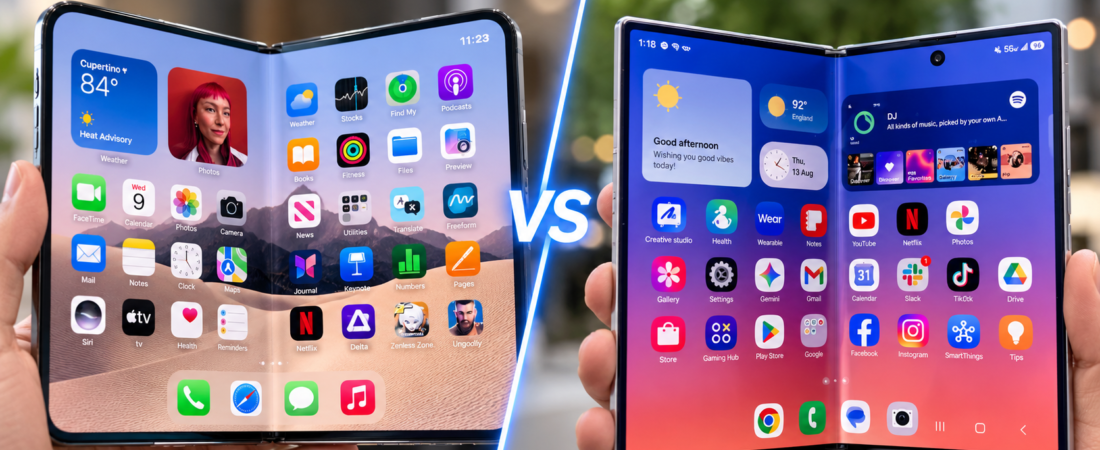
For years, the crease has been one of the easiest ways to identify a foldable phone.
Open the screen.
Tilt it toward a light.
And there it is — a line running directly through the middle of an otherwise beautiful OLED display.
Samsung has spent eight generations trying to make that line less noticeable.
Now Apple has entered the foldable market with the iPhone Duo, and it has taken a noticeably different approach to the problem.
Both the iPhone Duo and Galaxy Z Fold 8 have 7.6-inch folding OLED displays with refresh rates up to 120Hz. Apple lists up to 3,000 nits of outdoor peak brightness for the Duo, while Samsung has substantially redesigned the Fold 8’s flexible display structure to reduce its crease. Apple
On paper, both look impressive.
But specifications don’t tell you what a foldable screen actually looks — or feels — like.
So for this iPhone Duo vs Galaxy Z Fold 8 display comparison, we’re focusing heavily on something more useful:
What reviewers who have actually handled these displays are seeing.
And based on the early hands-on reports, Apple appears to have made the crease remarkably difficult to see.
But there’s an important catch.
We don’t yet know whether it will stay that way.
iPhone Duo vs Galaxy Z Fold 8 Display at a Glance
| iPhone Duo | Galaxy Z Fold 8 | |
|---|---|---|
| Inner display | 7.6-inch folding OLED | 7.6-inch Dynamic AMOLED 2X |
| Resolution | 1878 × 2670 | 1848 × 2448 |
| Refresh rate | Up to 120Hz | Up to 120Hz |
| Inner-screen finish | Nano-texture | Anti-reflective treatment |
| Crease when viewed straight on | Extremely difficult to see in early hands-on testing | Very subtle during normal use |
| Crease under reflected/direct light | Still visible | Still visible |
| Crease feel | Reviewers report it is extremely difficult to feel | Shallower than earlier Fold generations |
| Long-term crease behavior | Unknown | Some evidence of increasing visibility |
| Inner camera | Under-display | Under-display |
| Stylus | Apple Pencil (USB-C) | Depends on Samsung implementation/accessories |
Apple lists the Duo’s inner panel at 1878 × 2670 pixels and 430 ppi, while Samsung lists the Fold 8 at 1848 × 2448. Both support refresh rates up to 120Hz. Apple
Those numbers are close enough that the real-world experience comes down to much more than resolution.
And the crease is where things get interesting.
The iPhone Duo Crease Is Still There
Let’s clear up one misconception immediately.
The iPhone Duo is not crease-free.
You can see the fold.
Under certain lighting and at certain angles, the center line is visible.
MacRumors’ hands-on testing found that the crease becomes visible in particular lighting conditions, despite being unusually well hidden during normal viewing. MacRumors
So if you’ve seen photos making the Duo look like a completely rigid tablet display, don’t expect that in every environment.
It still folds.
The interesting part is how difficult Apple has made that fold to notice.
Reviewers Are Surprised by How Little They Can See It
Several early hands-on impressions have been unusually positive.
Android Authority’s Aamir Siddiqui reported that when looking at the Duo straight on, he couldn’t see the crease at all. Even from more aggressive angles, he found it difficult to spot until deliberately changing his viewing position. Android Authority
9to5Mac had a similar experience, reporting that the crease was difficult to notice from most viewing angles during its hands-on session. 9to5Mac
Tom’s Guide went a step further in describing the tactile experience: its hands-on reviewer said the crease remains visible but essentially disappears under the finger during use. Tom’s Guide
That’s an important distinction.
There are really two creases to think about:
The crease you see.
And:
The crease you feel.
Apple appears to have worked on both.
Apple’s Secret Isn’t Just the Hinge
Apple’s most interesting decision may actually be the surface of the display.
The Duo’s inner screen uses a nano-texture finish.
Apple lists both nano-texture and anti-reflective treatment in the official display specifications. Apple
This matters because a crease becomes much easier to see when light reflects off a curved surface.
Imagine shining light across a perfectly flat sheet of glass.
The reflection is relatively uniform.
Now put a small valley in the middle.
The reflection bends.
Your eye immediately notices it.
Apple’s matte-like nano-texture surface diffuses those reflections.
MacRumors found that this treatment not only reduces glare but also makes the center fold less visually obvious. MacRumors
Android Authority came to a similar conclusion after handling the phone, attributing much of the nearly invisible crease to the way the matte surface diffuses light. Android Authority
That’s clever because Apple isn’t only trying to physically flatten the crease.
It’s also making the remaining crease harder for your eyes to detect.
But the Nano-Texture Has a Trade-Off
There’s no free lunch here.
Glossy OLED displays look great partly because they’re glossy.
Colors can appear:
Deep.
Punchy.
Highly saturated.
Almost painted onto the glass.
A matte surface changes that character.
Android Authority noted that the Duo’s nano-texture display can look somewhat less punchy than a traditional glossy screen, particularly if you’re accustomed to highly reflective OLED displays. Android Authority
So Apple may have made a deliberate trade:
Slightly less glossy visual punch
in exchange for:
Lower reflections + less visible crease.
Whether you prefer that could come down to personal taste.
Samsung Has Made a Huge Improvement Too
It’s easy to look at Apple’s early results and assume Samsung hasn’t improved.
That’s not true.
The Galaxy Z Fold 8 crease is dramatically better than the creases found on earlier generations.
Samsung redesigned the folding display around what it calls Flex Titanium technology.
iFixit’s teardown found stiffer backing layers underneath the flexible OLED, with additional titanium reinforcement helping the panel return toward a flatter shape after being folded. iFixit
Tom’s Guide also found the Fold 8 crease substantially shallower than previous Galaxy Fold generations. Tom’s Guide
In normal use with content displayed on the screen, the crease can effectively disappear from your attention.
That’s important.
A crease can technically exist without meaningfully affecting the experience.
The Z Fold 8 Crease Is Most Visible Under Reflected Light
This pattern appears repeatedly in hands-on testing.
Look directly at the screen with colorful content playing:
The crease becomes difficult to notice.
Turn the phone toward a strong light source:
The fold line becomes more obvious.
Tom’s Guide found that while the Fold 8’s crease is much shallower than before, direct light can still reveal the center fold. Its anti-reflective treatment helps reduce the effect during everyday use. Tom’s Guide
iFixit’s testing also found the crease most noticeable when light reflected across the display. iFixit
This is exactly why Apple’s nano-texture approach is so interesting.
Both companies are attacking the same optical problem.
They’re just doing it somewhat differently.
What Happens When You Put Them Side by Side?
This is the comparison everyone wants.
An early side-by-side video showed the iPhone Duo and Galaxy Z Fold 8 displaying similar bright content while being moved through different viewing angles.
The Duo’s fold appeared softer in parts of the video, particularly when viewed relatively straight on.
But there is an important limitation.
The phones weren’t being tested under laboratory-controlled conditions.
Their:
Brightness.
Angle.
Height.
Lighting.
Screen finish.
were not perfectly standardized.
So the video is useful for getting an impression, but it isn’t enough to scientifically declare one crease smaller than the other. The Mac Observer
Still, the footage supports what multiple hands-on reviewers have independently reported:
The Duo’s crease is exceptionally difficult to see head-on.
What Does the Crease Feel Like?
This might actually matter more than appearance.
When you’re watching Netflix, you’re probably not running your finger repeatedly over the middle of the screen.
But when scrolling:
Your thumb crosses the fold.
When drawing:
A stylus crosses the fold.
When dragging something:
Your finger crosses the fold.
A deep crease can remind you constantly that you’re using a flexible display.
Tom’s Guide’s initial Duo hands-on impression was particularly positive here, reporting that although the crease could be seen, it essentially couldn’t be felt during interaction. Tom’s Guide
Samsung’s Fold 8 has also improved substantially in this area.
The Fold 8 crease is shallower than before and becomes easy to ignore once you’re actually using the device. Tom’s Guide
This is one of those areas where spec sheets are almost useless.
You need fingers, not numbers.
The Bigger Question Is What Happens After 10,000 Folds
And this is where Samsung currently has one major advantage:
We already have real-world Fold 8 usage data.
The iPhone Duo has only been handled for relatively short periods by journalists and reviewers.
It doesn’t officially reach customers until October 23. 9to5Mac
So nobody can credibly tell you today what its crease will look like after:
Three months.
Six months.
One year.
Thousands of folding cycles.
That’s important because foldable displays can change with use.
We’ve Already Seen the Fold 8 Crease Change
iFixit’s teardown highlighted an interesting issue.
It cited a Fold 8 reviewer who observed the crease becoming more visible after only about a week, although the change remained cosmetic.
iFixit also noted that long-term crease behavior varies considerably among foldable devices and users. iFixit
Tom’s Guide has similarly observed that additional time with the Fold 8 can make the crease more prominent than it appears when the device is brand new. Tom’s Guide
That doesn’t mean the Fold 8 display is failing.
A more visible crease and a broken screen are completely different things.
But it does illustrate why launch-day crease comparisons need caution.
The best-looking foldable on Day 1 isn’t necessarily the best-looking foldable on Day 365.
Apple Claims Its Display Structure Addresses Long-Term Deformation
Apple isn’t relying solely on nano-texture.
The Duo’s folding display uses a multi-layer structure designed to allow the layers to move as the phone folds.
MacRumors reports that Apple uses viscoelastic adhesives that allow the display layers to glide relative to one another, which could reduce the mechanical stress that contributes to permanent deformation. MacRumors
The idea is straightforward:
Instead of repeatedly forcing every display layer to bend identically at exactly the same point, allow microscopic movement between layers.
In theory, that could help prevent the center from permanently developing a deeper valley.
But right now the most important phrase is:
In theory.
We need months of independent consumer use before knowing whether Apple’s approach actually keeps the crease shallow.
Apple Pencil Makes the Crease Even More Important
There’s another reason the Duo’s display flatness matters.
Apple officially lists support for the Apple Pencil (USB-C) on the iPhone Duo. Apple
That means the folding display isn’t just for watching videos.
You could potentially:
Take notes.
Annotate documents.
Sketch.
Sign documents.
Mark up photos.
Now imagine drawing a straight line across the center of the screen.
A deep physical valley would be much more noticeable with a stylus than with your finger.
If Apple’s crease remains as subtle to the touch as early reviewers describe, Pencil support could make the Duo feel closer to a small folding iPad than a traditional foldable phone.
But again, long-term testing matters.
The Under-Display Camera Is Actually Easier to See Than the Crease
Here’s an unexpected result from early Duo testing.
Apple did such a good job hiding the crease that another display imperfection can become more noticeable:
the under-display camera.
Android Authority found the change in pixel density around the inner camera easier to detect than the actual center crease. Android Authority
That’s a strange compliment.
We’re used to asking:
“Can I see the fold?”
With the Duo, you may instead find yourself asking:
“Can I see where the camera is hiding?”
That’s how far folding displays have progressed.
Brightness Is Basically a Non-Issue
The Duo officially reaches up to 3,000 nits of outdoor peak brightness, with 1,600 nits peak HDR brightness. Apple
The Fold 8 is also designed around a very bright flagship-class AMOLED panel, with reviewers reporting a peak around the same 3,000-nit level. PhoneArena
At this level, raw peak brightness probably shouldn’t determine your purchase.
Both are designed for outdoor visibility.
The more interesting difference is how they handle reflections.
That’s where:
Apple’s nano-texture
versus
Samsung’s anti-reflective approach
becomes more noticeable in everyday use.
The Displays Also Have Slightly Different Personalities
Apple’s inner display is:
7.6 inches
1878 × 2670
430 ppi
up to 120Hz
nano-texture OLED
Samsung’s is:
7.6 inches
1848 × 2448
Dynamic AMOLED 2X
up to 120Hz. Apple
Both are extremely high-end folding displays.
Samsung’s presentation retains more of the glossy AMOLED character people associate with Galaxy phones.
Apple’s nano-texture treatment gives the Duo a more matte, low-reflection appearance.
This means choosing between them isn’t simply:
better display vs worse display.
It may be:
glossier and punchier
versus
more diffuse and reflection-resistant.
So Which Crease Looks Smaller Today?
Based on the hands-on evidence available as of September 29, 2026, the pattern is fairly consistent:
The Galaxy Z Fold 8 has made a major improvement over previous Samsung foldables. Its crease is shallower, becomes difficult to notice with content on screen, and is helped by its anti-reflective treatment. Tom’s Guide
The iPhone Duo’s crease appears even harder to detect in early hands-on use, particularly when looking directly at the display. Multiple independent reviewers have specifically commented on how difficult it is to see or feel. MacRumors
But there’s one major piece of information missing:
time.
Samsung’s screen has already been living in reviewers’ pockets.
Apple’s hasn’t.
iPhone Duo vs Galaxy Z Fold 8 Display: Which Has Less Crease?
If you’re comparing brand-new devices based on current hands-on observations, the iPhone Duo appears to hide its crease exceptionally well.
Its combination of a sophisticated folding structure and nano-texture surface makes the center fold extremely difficult to see straight on and, according to early hands-on impressions, surprisingly difficult to feel. MacRumors
The Galaxy Z Fold 8 isn’t far behind.
Samsung has significantly reduced one of the Fold family’s oldest compromises, and during normal use with the screen illuminated, reviewers often find the crease fades into the background. Tom’s Guide
But the most interesting comparison hasn’t happened yet.
Come back after Duo owners have opened and closed their phones thousands of times.
If Apple’s crease still looks this subtle six months later, that will be much more impressive than how it looks under Apple Store lights on Day 1.
For foldable displays, the best crease isn’t simply the one that’s smallest when you open the box.
It’s the one you stop noticing — and continue not noticing.
Compare with Reason.