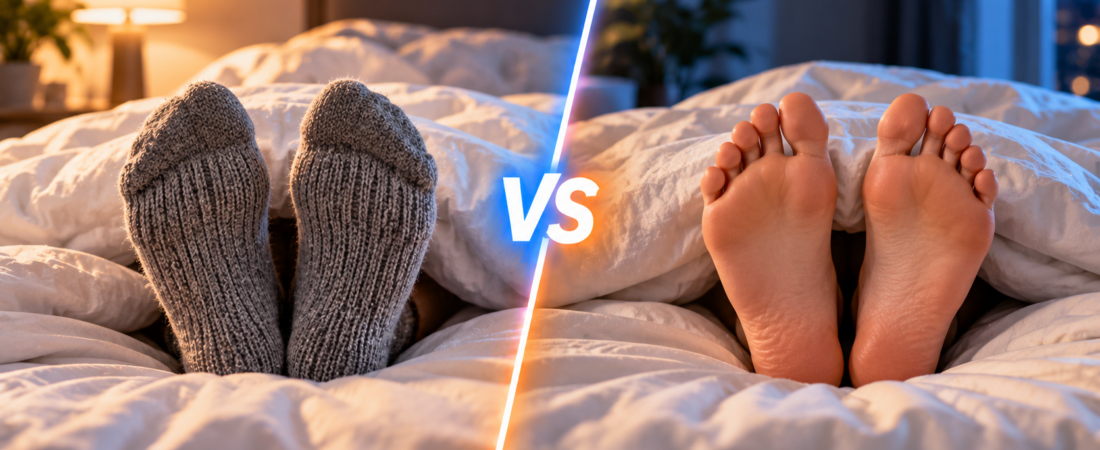
Some people can’t fall asleep with cold feet.
Others can’t imagine anything worse than wearing socks under the covers.
For such a small piece of clothing, socks can create surprisingly strong opinions at bedtime.
But the sleeping with socks vs bare feet debate isn’t only about comfort.
Your feet are involved in one of the body’s important nighttime processes:
temperature regulation.
As bedtime approaches, your body doesn’t simply become colder everywhere at once. Blood flow toward the skin — particularly the hands and feet — can increase, helping the body release heat from its core.
That process is closely associated with sleep onset.
Which leads to a surprisingly interesting question:
Could putting socks on actually help your body cool down and fall asleep faster?
Research suggests that, under certain conditions, it might.
But that doesn’t mean everyone should start sleeping in socks tonight.
Here’s what the evidence actually shows.
Sleeping With Socks vs Bare Feet at a Glance
| Sleeping With Socks | Sleeping Barefoot | |
|---|---|---|
| Keeps feet warm | Excellent | Depends on room |
| May help sleep onset | Potentially | Fine if feet are already warm |
| Good for cold sleepers | Excellent | Less comfortable |
| Good for hot sleepers | Can be uncomfortable | Usually better |
| Helps maintain foot temperature | Yes | Less |
| Risk of overheating feet | Possible | Lower |
| Moisture buildup | Possible | Lower |
| Best in winter | Often | Depends |
| Best in hot weather | Usually not | Often |
| Research advantage | Some evidence for foot warming | No clear universal disadvantage |
The important distinction is that researchers aren’t really discovering that socks themselves are magical.
They’re studying something more interesting:
warm feet.
Why Would Warm Feet Help You Sleep?
This sounds contradictory.
Most sleep advice tells us that a cooler environment is better for sleep.
So why would you intentionally warm part of your body?
Because warming your feet doesn’t necessarily mean warming your entire body.
The hands and feet are important places for heat exchange.
Before sleep, blood vessels near the skin can dilate, increasing blood flow toward the extremities.
That helps transfer heat away from the body’s core.
Researchers often describe this relationship using the difference between temperatures at the extremities and more central areas of the body.
Studies have found that warmer distal skin — particularly the hands and feet — is associated with sleep onset. PubMed
So the process is roughly:
Warm feet → increased peripheral blood flow → easier heat dissipation → falling asleep may become easier.
That’s very different from simply making your entire bedroom hotter.
There’s Actually a Study on Sleeping in Socks
One experiment looked specifically at this question.
Researchers had six healthy young men sleep for seven hours in a room kept at about 23°C, or 73°F.
They compared sleeping:
with bed socks
versus:
without socks.
When participants wore socks, their average foot temperature remained higher.
But here’s the interesting part.
The sock condition was associated with:
7.5 minutes faster sleep onset
32 minutes more total sleep
7.6 percentage points higher sleep efficiency
and fewer awakenings during the night. PubMed
At first glance, that’s a surprisingly strong result for something as simple as socks.
But there’s a major limitation.
The Study Had Only Six People
Six.
Not 600.
Not 6,000.
Six young men.
That’s nowhere near enough evidence to say:
Everyone sleeps better wearing socks.
The experiment was also conducted under controlled conditions in a relatively cool environment.
So the correct takeaway is much narrower:
There is experimental evidence suggesting that keeping the feet warm with bed socks can improve certain sleep measures in a cool environment.
That’s interesting.
But it isn’t a universal prescription.
A Newer Study Adds More Evidence
The idea hasn’t disappeared from sleep research.
A 2025 study examined 30 participants over two weeks using technical socks designed to retain warmth around the feet and investigated changes in sleep dynamics.
The researchers were specifically testing whether maintaining foot warmth could influence sleep onset and sleep quality. PubMed
That’s useful additional evidence, although the overall research base remains relatively small compared with major sleep topics such as light exposure, sleep duration or insomnia treatment.
In other words:
The sock theory isn’t just an internet sleep hack.
But it’s also not settled science.
The Real Story Is Your Body Temperature
To understand the sock effect, think about what happens before you fall asleep.
Your core body temperature begins moving downward around the sleep period.
At the same time, temperature at the skin — especially the extremities — can rise as blood vessels dilate.
Research has found that the relationship between distal and proximal skin temperatures is closely associated with sleep propensity. PubMed
Your feet effectively become part of the body’s heat-transfer system.
That’s why cold feet can be more than merely annoying.
If the blood vessels in your feet remain constricted because they’re cold, the normal heat-loss process may be less efficient.
Warm socks can help counter that.
Think of Your Feet Like Radiators
Here’s a simple way to visualize it.
Imagine your body’s core is a house.
Your hands and feet are small radiators.
When blood reaches those areas more easily, heat can move toward the skin and eventually escape into the environment.
Putting on socks initially warms the skin around your feet.
That warmth can promote peripheral vasodilation.
And paradoxically, warming your feet can be associated with the process that helps your core temperature decline.
That’s why:
cool bedroom + warm feet
is not necessarily a contradiction.
They can work together.
But Socks Don’t Have to Stay on All Night
Here’s where personal preference matters.
Maybe socks help when you first get into bed.
Twenty minutes later:
Your feet are warm.
You’re comfortable.
And now the socks feel annoying.
Take them off.
There’s no rule saying that if you use socks to warm your feet before falling asleep, you must wear them until morning.
For some people, the ideal routine may simply be:
Put on socks before bed.
Warm up.
Fall asleep.
Kick them off sometime during the night.
Your sleeping self may even take care of the last step automatically.
Bare Feet Aren’t Bad for Sleep
This is important.
Sleeping barefoot does not mean you’re sabotaging your sleep.
If your feet are already comfortably warm under the blanket, socks may add very little.
Imagine your bedroom is:
72°F.
You have a warm comforter.
Your feet aren’t cold.
You fall asleep in ten minutes.
There’s no obvious reason to introduce socks just because a small study found a benefit under specific conditions.
The goal isn’t:
warmest feet possible.
It’s:
comfortable thermal conditions that allow normal temperature regulation.
Hot Sleepers May Prefer Bare Feet
Now imagine the opposite person.
They already:
Sleep hot.
Kick off the blanket.
Flip the pillow.
Run a fan.
Stick one foot outside the comforter.
For that person, thick socks could make sleep less comfortable.
And comfort matters.
If your feet become:
Hot.
Sweaty.
Clammy.
Itchy.
Then any theoretical thermoregulation advantage may be irrelevant because you’re awake thinking about your feet.
Barefoot may be the obvious choice.
The One-Foot-Outside-the-Blanket Phenomenon
A lot of people do this without thinking about it.
Body under the comforter.
One foot sticking out.
Why?
Your feet provide an easy way to adjust your thermal environment without exposing your entire body.
Too warm?
Foot out.
Too cold?
Foot back in.
It’s essentially a primitive temperature-control system.
No thermostat required.
Sleeping barefoot gives you more freedom to use this strategy.
With thick socks on, you lose some of that rapid adjustment.
Not All Socks Are Equal
If you’re going to sleep in socks, your regular daytime socks may not be the best choice.
The 2018 study specifically used soft bed socks rather than simply telling participants to wear tight everyday socks. PubMed Central (PMC)
For sleeping, think:
Loose.
Soft.
Breathable.
Clean.
What you probably don’t want is a tight elastic band digging into your ankle for eight hours.
Nor do you want heavy socks that make your feet excessively hot.
The goal is gentle warming.
Not roasting.
Tight Socks Are a Different Question
There’s a big difference between:
Comfortable sleep socks.
And:
Tight compression around the feet or ankles.
Unless compression socks have been recommended for a specific medical reason, they shouldn’t simply be treated as interchangeable with loose bedtime socks.
The sleep research we’re discussing is about warming the feet.
Not squeezing them.
So don’t assume:
tighter = warmer = better sleep.
That’s not what the evidence shows.
What About Sweaty Feet?
This is one area where barefoot sleeping has an obvious practical advantage.
Some people naturally have sweaty feet.
Covering them all night may trap:
Heat.
Moisture.
Odor.
If that’s you, socks may simply be uncomfortable.
Breathable materials can help, but they can’t change your personal preference.
If you wake up with damp socks every morning, your body is giving you a fairly clear review of the experiment.
Clean Socks Matter
If you’re going to wear socks in bed, use clean ones.
This sounds obvious.
But don’t wear the same socks that spent ten hours:
Inside shoes.
At work.
At the gym.
Walking around the house.
and then climb directly into bed.
Have a pair specifically for sleeping.
That’s more comfortable and more hygienic.
It also keeps some of what accumulated during the day out of your bedding.
Socks May Be Most Useful in Winter
The case for sleeping in socks becomes stronger as the room gets colder.
Remember the 2018 experiment:
The room was approximately 23°C / 73°F, and researchers were specifically investigating foot warming in a cool environment. PubMed
Now imagine a winter bedroom that’s even cooler.
Your torso may feel perfectly comfortable under a comforter while your feet remain cold.
That’s exactly the situation where socks can be useful.
Instead of increasing the thermostat for the entire room, you warm the one body part bothering you.
Simple.
Summer Changes the Equation
Now it’s July.
Your bedroom is warm.
Your feet already feel hot.
Putting thick socks on because “science says socks help sleep” completely misses the point.
The mechanism isn’t about socks.
It’s about temperature.
If your feet are already warm enough to support peripheral heat loss, additional insulation may provide no advantage.
And if it makes you uncomfortable, it could be counterproductive.
This is why seasonal advice makes more sense than a universal rule.
Winter: socks may help.
Summer: barefoot may feel better.
What If Your Feet Are Always Cold?
Some people simply have colder feet than others.
If you’re lying in bed thinking:
“My body is warm, but my feet are freezing,”
socks are an extremely easy experiment.
You don’t need:
An app.
A supplement.
A wearable.
A subscription.
Or a $400 sleep device.
Put on a comfortable pair of socks.
See what happens.
If you consistently fall asleep more comfortably, you’ve learned something useful about your own sleep environment.
A Warm Foot Bath Can Do Something Similar
Socks aren’t the only way to warm your feet.
Researchers have also investigated warm foot baths before bedtime.
Studies of distal warming suggest that warming the feet before sleep can affect peripheral temperature and may influence sleep onset, although results aren’t perfectly consistent across studies. PubMed
That’s worth emphasizing.
Some experiments have found benefits.
Others have not found a meaningful difference in sleep latency.
So we shouldn’t turn foot warming into another miracle sleep hack.
The evidence is interesting, not definitive.
Age May Change the Effect
Here’s another fascinating detail.
Research examining skin temperature and sleep onset found that younger adults showed a relationship between warming the feet and faster sleep onset.
But that relationship became weaker with age.
In older adults with insomnia, foot-warming interventions did not produce the same acceleration in sleep onset seen in younger adults. PubMed
That’s another reason not to generalize a single sleep recommendation to everyone.
Sleep physiology changes.
Age matters.
Health matters.
The environment matters.
Socks Won’t Fix Bad Sleep Habits
This is probably the most important reality check.
Imagine someone:
Drinks caffeine at 8 p.m.
Scrolls on their phone until 1 a.m.
Sleeps five hours.
Keeps an inconsistent schedule.
Has a bright bedroom.
And then buys special sleep socks.
The socks aren’t the main issue.
Foot warming is a small environmental adjustment.
It doesn’t replace the fundamentals of good sleep.
Think of socks as:
fine-tuning
rather than:
repairing the engine.
There’s Also a Comfort Psychology
Sleep isn’t purely physiological.
Ritual matters.
Some people put on:
Pajamas.
Socks.
Turn down the lights.
Read.
And their brain starts associating that sequence with bedtime.
For someone else, socks create the opposite response:
“I need these things off my feet immediately.”
Both experiences are real.
The best sleep environment is one you can actually relax in.
Try a Simple Seven-Night Experiment
Instead of arguing about socks, test them.
Nights 1–3
Sleep barefoot.
Record:
Time you went to bed.
Approximate time to fall asleep.
Whether your feet felt cold.
How often you remember waking.
How rested you felt in the morning.
Nights 4–6
Wear loose, comfortable bed socks.
Record the same things.
Night 7
Choose whichever felt better.
This isn’t a scientific experiment.
But it can answer the question that actually matters:
Do socks help you?
Your bedroom isn’t a laboratory.
You don’t need population-level evidence to decide whether your feet feel more comfortable.
Who Should Try Sleeping With Socks?
Socks are worth experimenting with if:
Your feet frequently feel cold in bed.
Your bedroom is cool.
You take a long time to feel physically comfortable.
You notice that warming your feet helps you relax.
You prefer keeping the thermostat lower.
The research provides a plausible physiological reason why this could help, and at least one controlled experiment found measurable improvements in several sleep outcomes. PubMed
Who May Prefer Bare Feet?
Barefoot sleeping probably makes more sense if:
You naturally sleep hot.
Your feet sweat easily.
Socks feel restrictive.
Your feet are already comfortably warm.
You frequently stick your feet outside the blanket.
You live or sleep in a warm environment.
There’s no prize for wearing socks.
If you’re already comfortable, don’t solve a problem you don’t have.
Sleeping With Socks vs Bare Feet: Which Is Better for Sleep?
There’s no universal winner.
But there is a surprisingly good physiological case for warm feet.
Research has linked warmer extremities with the body’s normal transition toward sleep, and a small controlled study found that young men wearing bed socks in a cool room fell asleep about 7.5 minutes faster, slept 32 minutes longer, and had higher sleep efficiency than when they slept without socks. PubMed
Those numbers sound impressive.
But remember:
The study included only six participants.
So don’t interpret it as proof that everyone should sleep in socks.
Instead, the research points toward a more useful conclusion:
If cold feet are keeping you uncomfortable at night, warming them may help.
If your feet are already warm?
Bare feet may be just as comfortable — and probably more pleasant if you tend to sleep hot.
So perhaps the answer isn’t really:
Socks vs bare feet.
It’s:
Cold feet vs comfortably warm feet.
And that’s a comparison your own body can answer pretty quickly.
Compare with Reason.