You check the price of a hotel room on Monday.
It costs $189.
You look again on Friday.
Now it is $247.
A rideshare that normally costs $28 suddenly costs $52 after a concert. An airline ticket changes between searches. Even prices and discounts on shopping websites may not always stay the same.
For decades, consumers were accustomed to a relatively simple idea: a product has a price.
But online shopping is changing that assumption.
With algorithms capable of reacting to demand, inventory, timing, location, and other information almost instantly, prices can move much faster than they once did.
That raises an interesting question:
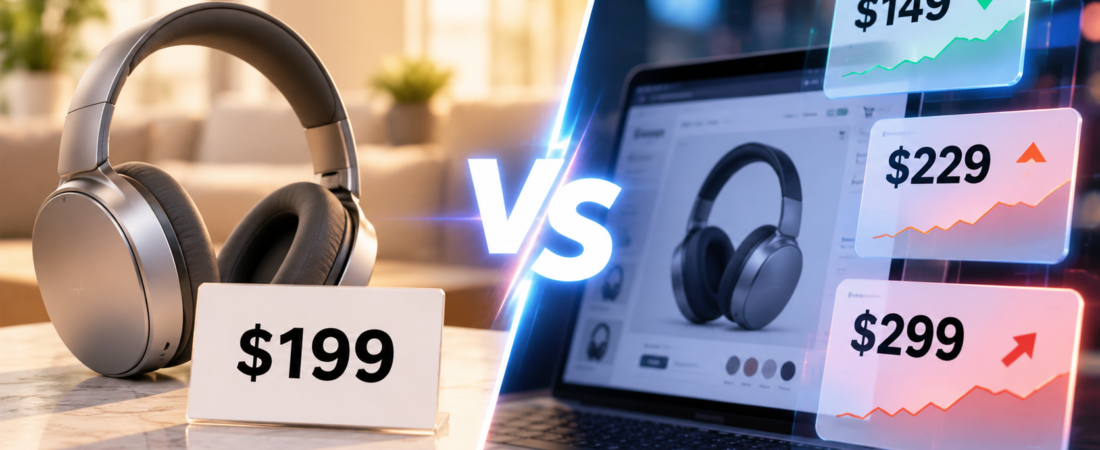
Dynamic pricing vs fixed pricing — are changing prices actually costing consumers more, or can they sometimes help you pay less?
The answer is more complicated than it might seem.
Dynamic Pricing vs Fixed Pricing at a Glance
| Dynamic Pricing | Fixed Pricing | |
|---|---|---|
| Price changes frequently | Yes | Usually no |
| Responds to demand | Often | Rarely |
| Can offer off-peak bargains | Yes | Less likely |
| Price predictability | Lower | Higher |
| Rewards flexible shoppers | Often | Not necessarily |
| Risk of paying more during high demand | Higher | Lower |
| Easy to compare prices | Sometimes difficult | Usually easier |
| Common examples | Flights, hotels, rideshare | Many retail products and services |
The biggest difference isn’t necessarily which system has the lower price.
It’s when the price is determined.
What Is Fixed Pricing?
Fixed pricing is the familiar model.
A business determines what something costs and displays that price to customers.
A $40 product costs $40 whether you check it at 10 a.m. or 8 p.m.
The price can still change eventually because of inflation, sales, promotions, inventory, or other business decisions.
But it generally doesn’t continuously respond to short-term changes in demand.
That makes fixed pricing relatively easy for consumers to understand.
You know what something costs.
You can compare it with another store.
And you don’t necessarily feel pressure to purchase immediately because the algorithm might change the price five minutes later.
That predictability has real value.
What Is Dynamic Pricing?
Dynamic pricing works differently.
Instead of maintaining one relatively stable price, a business can adjust prices as market conditions change.
Those conditions might include:
- Demand
- Remaining inventory
- Time of day
- Day of the week
- Season
- Local events
- Competitor prices
- How close you are to the date of service
Dynamic pricing is particularly common where inventory expires.
An empty hotel room tonight cannot be sold tomorrow.
Neither can an empty seat on a flight that has already departed.
That gives businesses a strong incentive to adjust prices depending on how much demand exists at a particular moment.
Air travel, hotels and ride-hailing are among the sectors where this type of pricing is commonly used. GOV.UK
Dynamic Pricing Isn’t Always Bad for Consumers
When people hear “dynamic pricing,” they often think:
The company raises the price when I need something.
That can happen.
But there is another side to dynamic pricing.
Prices can move down as well as up.
Imagine a hotel with 100 rooms.
If only 40 rooms have been booked for tomorrow night, the hotel might lower prices to attract additional customers.
A flexible traveler could benefit.
The same idea applies to flights.
Someone willing to fly Tuesday afternoon instead of Friday evening may find a substantially cheaper fare.
The UK’s Competition and Markets Authority has noted that consumers who understand how prices change and have flexibility may sometimes benefit from lower prices under dynamic pricing. GOV.UK
So dynamic pricing doesn’t automatically mean:
higher prices.
It means:
variable prices.
Whether that helps you depends partly on when and how you buy.
The $200 Hotel Example
Consider a simple example.
Suppose a hotel using fixed pricing charges:
$200 per night
throughout the week.
A hotel using dynamic pricing might charge:
| Night | Dynamic Price |
|---|---|
| Monday | $155 |
| Tuesday | $165 |
| Wednesday | $185 |
| Thursday | $210 |
| Friday | $285 |
| Saturday | $310 |
| Sunday | $175 |
Average dynamic price:
about $212
But that average doesn’t tell the whole story.
A Monday traveler pays:
$45 less than the fixed price.
A Saturday traveler pays:
$110 more.
Dynamic pricing can therefore reward flexibility while making peak-time purchases considerably more expensive.
Where Dynamic Pricing Becomes More Controversial
There’s an important distinction that consumers should understand.
Dynamic pricing is not necessarily personalized pricing.
Suppose everyone requesting a rideshare after a stadium concert sees higher prices because thousands of people are requesting cars simultaneously.
That’s primarily demand-based dynamic pricing.
But imagine two people looking at the same product at the same time and receiving different prices because a system believes one of them is willing to pay more.
That’s a different issue.
It moves toward personalized pricing.
And that distinction is becoming increasingly important.
Personalized Pricing Goes Much Further
Personalized pricing can use information about an individual consumer to influence the price or offer that person sees.
The Federal Trade Commission describes personalized pricing as using personal data to set prices according to what a business believes an individual consumer is willing to spend. Federal Trade Commission
That data could potentially involve things such as:
- Location
- Browsing activity
- Shopping history
- Demographic information
- Previous purchases
- Online behavior
The FTC’s earlier surveillance-pricing study found that pricing intermediaries can use detailed consumer information and behavior to help retailers tailor prices, promotions, or the products consumers see. Federal Trade Commission
This creates a fundamentally different question.
Dynamic pricing asks:
What should we charge right now?
Personalized pricing can ask:
What should we charge this particular customer?
Those aren’t the same thing.
Could Two People Eventually See Different Prices?
Technology increasingly makes that possible.
In its surveillance-pricing work, the FTC examined intermediaries that provide algorithmic pricing tools to retailers.
The agency reported that available inputs could include information such as location, demographics, browsing behavior, shopping history, and even detailed interactions with websites. Federal Trade Commission
That does not mean every retailer is currently giving every shopper an individualized price.
It also doesn’t mean every changing online price is based on your personal information.
A price might simply have changed because inventory or demand changed.
But the technology capable of more individualized pricing exists, which is one reason regulators are paying attention.
In August 2026, the FTC proposed an enforcement policy statement specifically addressing personalized pricing and disclosure of personal-data use. Federal Trade Commission
Why Fixed Pricing Feels Fairer
Imagine two customers standing next to each other in a store.
They pick up identical bottles of water.
One customer pays $2.
The other pays $3.50.
Most people would immediately ask:
Why?
With fixed pricing, that question rarely arises.
Everyone sees the same shelf price.
Online shopping makes the situation less visible.
Two consumers may never know whether they received the same offer.
That lack of visibility is one reason personalized and surveillance pricing have attracted regulatory attention.
Fixed pricing offers something consumers often underestimate:
transparency.
But Fixed Pricing Has Its Own Disadvantage
Fixed pricing isn’t automatically cheaper either.
Suppose a business knows demand fluctuates dramatically.
With a fixed price, it might set the price high enough to protect itself during busy periods.
That could mean customers shopping during quiet periods never receive the discounts that dynamic pricing could provide.
Consider airline seats.
If every seat on a flight had one fixed price regardless of demand, airlines would lose one of their main tools for filling otherwise empty seats.
Dynamic pricing allows businesses to discount unused capacity.
That’s why flexible travelers can sometimes benefit substantially.
The Biggest Advantage of Dynamic Pricing: Flexibility
Dynamic pricing can favor consumers who control when they buy.
Think about:
- Traveling midweek instead of Friday
- Booking hotels outside major events
- Using rideshare before or after peak demand
- Waiting for lower-demand periods
- Comparing several dates before booking
In these situations, dynamic pricing can create opportunities that fixed pricing doesn’t.
You aren’t simply shopping for a product.
You’re shopping for the right time to buy it.
The Biggest Disadvantage: Urgency
Dynamic prices also create uncertainty.
If a hotel costs $180 right now, you may wonder:
Will it be $230 tonight?
That uncertainty can encourage people to buy sooner.
Sometimes that urgency is justified.
Inventory really may be disappearing.
But consumers should be careful not to assume every changing price means they must immediately purchase.
Price volatility can make rational comparison shopping harder.
Can Incognito Mode Get You a Lower Price?
This is one of the most common pieces of online-shopping advice.
People often suggest:
- Clearing cookies
- Using private browsing
- Switching devices
- Using a VPN
The theory is that websites recognize your interest and increase prices because they know you want the product.
The reality is less simple.
A changing price does not prove that a company identified you personally.
Prices can change because of demand, inventory, timing, market conditions, or other shoppers purchasing the same inventory.
At the same time, regulators have documented that sophisticated pricing systems can potentially use consumer-related information in determining prices and promotions. Federal Trade Commission
So private browsing may limit some tracking, but it shouldn’t be treated as a guaranteed discount strategy.
A better strategy is simply to compare prices across time and sellers.
Dynamic Pricing Can Change How We Shop
Fixed pricing encourages product comparison.
You ask:
Store A or Store B?
Dynamic pricing adds another dimension.
Now you may need to ask:
Store A or Store B — and when?
That makes comparison more complicated.
For expensive purchases such as:
- Flights
- Hotels
- Rental cars
- Event tickets
checking prices on multiple days can sometimes be just as important as comparing different sellers.
A Simple Strategy for Consumers
You don’t need to understand the pricing algorithm.
You just need to avoid letting the algorithm control your decision.
For purchases with dynamic prices, consider three questions:
1. Can I change the timing?
If yes, compare different dates or times.
2. Can I compare another seller?
A rapidly changing price matters less when multiple alternatives exist.
3. Do I actually need to buy right now?
Don’t let a changing price automatically create urgency.
For larger purchases, even taking screenshots of prices over several days can help reveal whether a price is genuinely unusual.
So Which One Actually Costs More?
There isn’t a universal winner.
Dynamic pricing can cost more during peak demand and less during weak demand.
Fixed pricing provides greater predictability but may eliminate some opportunities for off-peak bargains.
The more important distinction may therefore be the type of shopper you are.
If your schedule is flexible, dynamic pricing can work in your favor.
If you must travel or purchase at a specific high-demand moment, it can work against you.
And if prices begin changing based not just on market conditions but on what a company knows about you, the comparison becomes less about dynamic pricing and more about personalized pricing.
That distinction is likely to become increasingly important as online pricing systems become more sophisticated.
The next time a price changes while you’re shopping, don’t immediately assume you’re being charged more.
But don’t assume the price you’re seeing is permanent either.
Compare the product.
Compare the seller.
And increasingly, compare the timing of the price itself.
Compare with Reason.