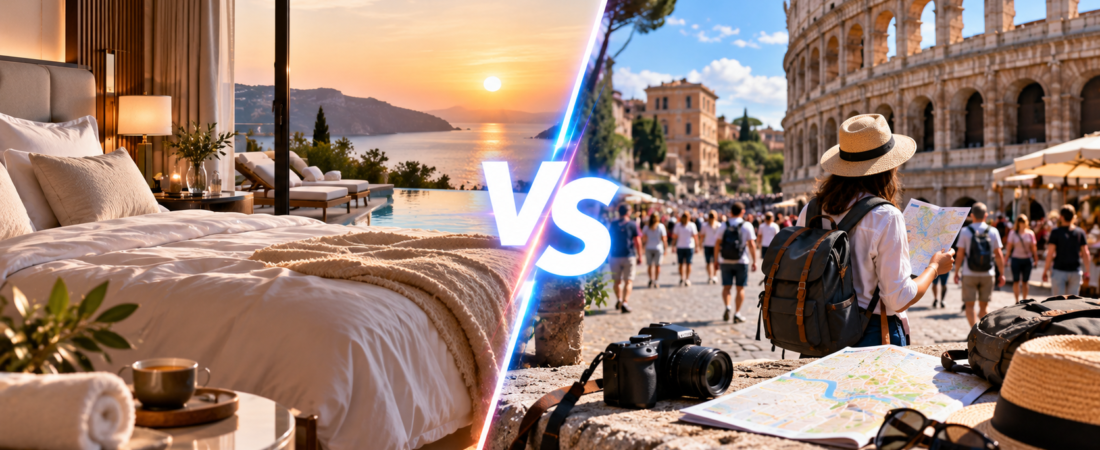
You take a week off because you’re exhausted.
Then you wake up at 5 a.m. for a flight.
You walk 20,000 steps sightseeing.
You stay out late for dinner.
You change hotels.
You squeeze five attractions into three days.
And when you finally get home, you need another vacation.
Sound familiar?
For decades, vacations have been built around one idea:
Do as much as possible while you’re there.
But a very different type of trip is becoming more popular.
It’s called a sleepcation.
Instead of building a vacation around sightseeing, restaurants and activities, a sleepcation is designed around something much simpler:
rest.
Hotels and resorts are increasingly offering sleep-focused experiences featuring premium bedding, blackout rooms, quieter environments, wellness treatments and programs designed around better sleep. The broader wellness-tourism market has also continued growing as travelers increasingly incorporate health and recovery into their trips.
But that raises an interesting question.
If you’re already taking time away from work, is it really better to spend your vacation sleeping?
Let’s compare a sleepcation vs regular vacation to see which one may actually leave you feeling more rested when you return home.
Sleepcation vs Regular Vacation at a Glance
| Sleepcation | Regular Vacation | |
|---|---|---|
| Primary goal | Rest and recovery | Experiences and sightseeing |
| Daily schedule | Light | Often busy |
| Sleep opportunity | High | Varies |
| Activities | Limited | Usually more |
| Planning required | Low to moderate | Moderate to high |
| Physical activity | Usually lower | Often higher |
| New experiences | Fewer | More |
| Chance of returning physically rested | Potentially higher | Depends heavily on itinerary |
| Best for | Recovery | Exploration and memories |
The biggest difference isn’t really the destination.
It’s the purpose of the trip.
What Exactly Is a Sleepcation?
A sleepcation is essentially a vacation where quality rest becomes one of the main activities.
That doesn’t necessarily mean staying in bed for three days.
You might still:
have dinner,
get a massage,
walk around town,
sit by the pool,
read,
or visit a nearby attraction.
The difference is that those activities don’t control the schedule.
Sleep does.
Instead of waking up at 6:30 a.m. because you booked a tour, you might wake up naturally.
Instead of returning to the hotel at midnight, you might be in bed at 10 p.m.
Instead of changing cities every two days, you stay in one place.
The goal isn’t maximizing what you see.
It’s minimizing what you have to do.
Why Regular Vacations Can Be Surprisingly Exhausting
A vacation sounds restful because you’re not working.
But work isn’t the only thing that makes us tired.
Travel itself can create physical and mental demands.
Think about a typical trip.
Before leaving, you:
research destinations,
compare hotels,
book flights,
pack,
arrange transportation,
and finish work before your departure.
Then the trip begins.
Now you have:
airports,
security lines,
unfamiliar beds,
different meal times,
navigation,
reservations,
crowds,
walking,
and possibly jet lag.
Even enjoyable activities require energy.
A vacation can therefore eliminate work stress while replacing it with travel stress.
That doesn’t make vacations bad.
It simply means vacation and rest aren’t automatically the same thing.
The Vacation Schedule Problem
Imagine you’re spending three days in Rome.
You’ve traveled thousands of miles.
Naturally, you want to see everything.
So the itinerary becomes:
8:00 a.m. Breakfast
9:00 a.m. Colosseum
11:30 a.m. Roman Forum
1:30 p.m. Lunch
3:00 p.m. Vatican
6:30 p.m. Back to hotel
8:00 p.m. Dinner
10:30 p.m. Drinks
Midnight Back to hotel
That’s an incredible day.
But it’s not necessarily a restful day.
Do that for four or five days and you may return home with amazing photographs — and a serious desire to sleep.
A sleepcation reverses the priorities.
The schedule might be:
Wake up naturally.
Breakfast.
Pool.
Lunch.
Nap.
Walk.
Dinner.
Sleep.
From a sightseeing perspective, that looks almost wasteful.
From a recovery perspective, that’s exactly the point.
Sleep Debt Doesn’t Disappear Because You’re on Vacation
If you’ve been consistently sleeping too little, one long night of sleep doesn’t necessarily erase the effects immediately.
The National Heart, Lung, and Blood Institute notes that regularly losing sleep creates what is often called sleep debt, and while extra sleep can help, relying on catch-up sleep isn’t a substitute for consistently getting enough sleep.
That’s an important distinction for sleepcations.
A three-day sleepcation shouldn’t be viewed as:
“I’ll sleep five hours every night for six months and fix everything this weekend.”
That’s not the idea.
The potential benefit is different.
Removing alarms, late-night obligations and overloaded schedules may give your body an opportunity to return to a more natural sleep pattern.
And perhaps more importantly, it can show you what adequate rest actually feels like.
Hotels Are Starting to Treat Sleep as an Amenity
Hotels traditionally competed on:
location,
restaurants,
pools,
views,
and room size.
Increasingly, some are also competing on sleep.
Sleep-focused hotel offerings can include:
blackout curtains,
soundproofing,
premium mattresses,
pillow menus,
temperature controls,
sleep-oriented wellness treatments,
and quieter room environments.
Some luxury properties have gone even further with sleep programs and technology designed to monitor or improve the sleeping environment.
That’s a fascinating change in hospitality.
The hotel room itself used to be where you slept between activities.
With sleep tourism, the room can become part of the destination.
But There’s a Problem With Sleepcations
Here’s the obvious question:
Why spend hundreds of dollars on a hotel just to sleep?
It’s a fair criticism.
Suppose a three-night hotel stay costs:
$300 per night.
That’s $900 before:
transportation,
food,
taxes,
or resort fees.
You could theoretically stay home, turn off your phone and sleep in your own bed for free.
Financially, a home-based rest weekend is difficult to beat.
So the value of a sleepcation isn’t simply access to a mattress.
It’s separation from normal life.
At home, you see:
laundry,
email,
dishes,
unfinished projects,
yard work,
and all the little tasks you’ve been postponing.
At a hotel, those reminders disappear.
Sometimes changing the environment makes doing nothing easier.
Regular Vacations Offer Something Sleepcations Can’t
Rest isn’t the only reason people travel.
We travel to experience things.
New food.
Different cultures.
Mountains.
Beaches.
Museums.
Architecture.
Family experiences.
Adventure.
A perfectly rested weekend at a resort might leave you physically refreshed.
But a busy week exploring Japan might give you memories you talk about for 20 years.
That’s why asking whether a sleepcation is “better” than a regular vacation misses part of the point.
They provide different kinds of value.
One emphasizes recovery.
The other emphasizes experience.
Mental Recovery Isn’t Always the Same as Physical Rest
There’s another interesting complication.
Sometimes doing something completely different from your normal routine can feel mentally restorative even when it’s physically tiring.
You might walk 15 miles around Paris and feel exhausted at night.
But you’re not thinking about:
meetings,
deadlines,
email,
or household responsibilities.
That psychological separation from work can itself be valuable.
Research on vacations has found benefits for well-being, although those effects can fade after people return to their normal routines.
So measuring vacation recovery purely by hours slept would be too simplistic.
You can be physically tired and mentally refreshed at the same time.
The First Day of Vacation Is Often Not Very Restful
Consider what happens on travel day.
You wake up earlier than normal.
Drive to the airport.
Park.
Go through security.
Wait.
Fly.
Collect luggage.
Find transportation.
Check into the hotel.
Unpack.
By the time you’re finally sitting down, you’ve spent most of the day managing logistics.
Now consider the return trip.
The same process happens again.
That means a three-night vacation may contain:
one travel day,
two actual vacation days,
and another travel day.
If your primary goal is rest, long-distance travel can consume a surprisingly large percentage of your available recovery time.
That’s one reason sleepcations may work particularly well close to home.
You don’t necessarily need to fly somewhere.
A hotel 30–60 minutes away may provide the environmental change without consuming a day getting there.
The Three-Night Test
Let’s compare two hypothetical three-night trips.
Regular Vacation
Flight: 3 hours
Airport/travel time: 5 hours each direction
Sightseeing: 8 hours/day
Average sleep: 6.5 hours
Activities: 3–4 per day
Sleepcation
Drive: 45 minutes
No airport
Activities: 1–2 per day
Average sleep opportunity: 8–9 hours
No alarm
Long periods with no scheduled activity
Which person returns more physically rested?
The sleepcation has an obvious structural advantage.
But ask:
Who experienced more?
Now the traditional vacation has the advantage.
That’s the trade-off.
Sleepcation vs Staycation
These two ideas sound similar but aren’t exactly the same.
A staycation means taking vacation time without traveling far, often staying at home or exploring your local area.
A sleepcation specifically makes rest and sleep a central goal.
You could combine them.
For example:
Book a hotel 30 minutes from home for two nights.
No flights.
No sightseeing itinerary.
No alarm.
Pool, dinner, sleep.
That might actually be one of the most efficient forms of recovery travel because you eliminate much of the logistical stress that normally accompanies a vacation.
Couples May Discover an Unexpected Problem
Sleep preferences differ.
One person wants:
68°F,
total darkness,
silence,
and bed at 10 p.m.
The other wants:
72°F,
TV playing,
curtains slightly open,
and midnight bedtime.
A sleep-focused trip can suddenly expose those differences.
That’s another reason hotel sleep amenities can matter.
Separate blankets, adjustable room temperatures, pillow options and larger beds can make sleeping away from home more comfortable.
But there’s no guarantee.
For some people, the best mattress in the world doesn’t matter.
They simply sleep better in their own bed.
The “First-Night Effect”
Sleeping somewhere unfamiliar can itself make sleep more difficult.
Research has documented what’s often called the first-night effect, where sleep can be different or disrupted during the first night in a new environment.
That’s slightly ironic for sleep tourism.
You may book a hotel specifically to sleep better — and sleep worse the first night because you’re in a hotel.
For that reason, a one-night sleepcation may not be ideal for everyone.
Two or three nights could make more sense because your body gets time to adjust to the environment.
What About Parents?
For parents, a sleepcation can mean something very different.
Imagine a couple getting:
one hotel room,
one night,
no children,
no early-morning schedule,
and no household chores.
The destination may barely matter.
The value isn’t tourism.
It’s uninterrupted recovery.
In that situation, even a hotel 15 minutes from home could feel dramatically different from a traditional family vacation.
Because let’s face it:
Traveling with children can be wonderful.
It is not always relaxing.
Which Trip Gives You Better Value?
That depends on what you’re buying.
Suppose both trips cost $1,500.
A traditional vacation might provide:
five attractions,
multiple restaurants,
new experiences,
hundreds of photos,
and a packed itinerary.
A sleepcation might provide:
three excellent nights of sleep,
a massage,
quiet meals,
pool time,
and almost no schedule.
If you measure value by activities per dollar, the traditional vacation probably looks better.
If you measure value by recovery per dollar, the sleepcation may look better.
Same price.
Different product.
There’s a Third Option: The 80/20 Vacation
You don’t actually have to choose between doing everything and doing nothing.
A more balanced vacation could combine both ideas.
For example:
Day 1: Travel + rest
Day 2: Sightseeing
Day 3: Sightseeing
Day 4: Nothing scheduled
Day 5: One activity + dinner
Day 6: Rest
Day 7: Travel home
Instead of filling every available hour, intentionally leave perhaps 20% of the trip empty.
No reservations.
No tickets.
No obligation to “make the most of the day.”
That might provide much of the recovery benefit of a sleepcation without sacrificing the experiences that make travel memorable.
Sleepcation vs Regular Vacation: Which Leaves You More Rested?
If the primary goal is physical recovery, a properly designed sleepcation has a structural advantage.
You can eliminate:
early flights,
packed itineraries,
late dinners,
constant walking,
and pressure to see everything.
But that doesn’t automatically make it a better vacation.
Regular vacations offer exploration, adventure and shared experiences that a sleep-focused trip intentionally gives up.
The more useful question may therefore be:
Why are you taking this vacation?
If your answer is:
“I want to see Italy.”
Go see Italy.
Walk all day.
Eat dinner at 10 p.m.
Take the photos.
You can sleep when you get home.
But if your answer is:
“I’m exhausted and I need a break.”
Maybe the solution isn’t another packed itinerary.
Maybe the most luxurious thing you can put on your vacation schedule is something that costs nothing at all:
Nothing.
Compare with Reason.