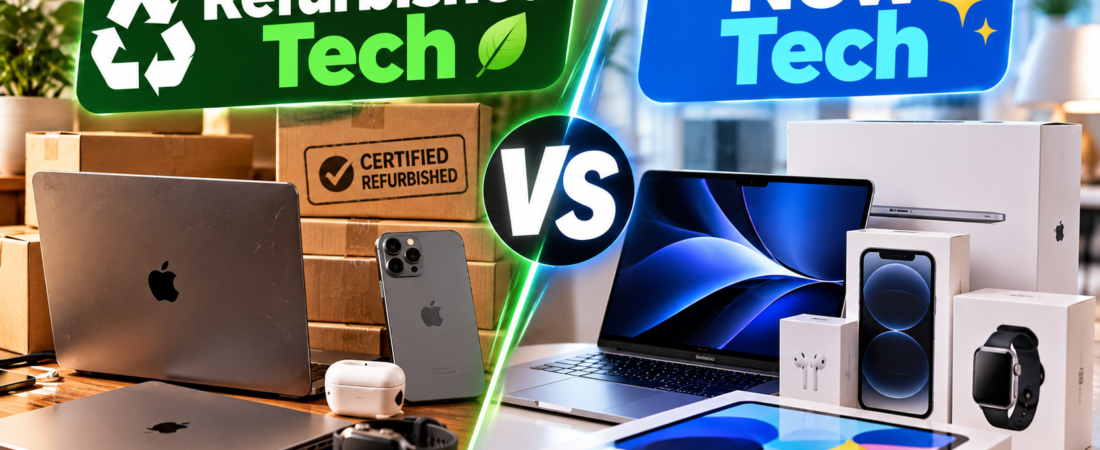
Buying a new phone, laptop, tablet, or TV used to feel like the obvious choice.
You paid more, but you got a brand-new product, a full warranty, a fresh battery, and fewer questions about how the device had been treated before it reached you.
That distinction is becoming less clear.
Certified refurbished technology has become a much more organized market, with manufacturers and major retailers testing devices, grading their condition, replacing defective parts, offering warranties, and selling them at discounts compared with new products.
Consumers are noticing.
A 2026 NIQ consumer survey found that around half of consumers would consider refurbished technology or appliances when the product comes from a trusted source and includes a warranty. For smartphones specifically, 53% said they were very or somewhat likely to consider refurbished. NIQ
So the question is no longer simply:
Would you buy something used?
It is:
Refurbished tech vs new tech — how much is “brand new” actually worth?
Refurbished Tech vs New Tech at a Glance
| Refurbished Tech | New Tech | |
|---|---|---|
| Purchase price | Usually lower | Usually higher |
| Condition | Varies by program | Brand new |
| Warranty | Depends heavily on seller | Standard manufacturer warranty |
| Battery | May vary | New |
| Cosmetic condition | May show wear | New |
| Latest models | Less consistent | Widest selection |
| Configuration choices | Limited inventory | Usually more choices |
| Environmental impact | Extends device life | Requires new production |
| Resale value | Lower starting cost | Usually higher resale price |
| Biggest advantage | Value | Certainty |
The key word here is certified.
Buying a random used phone from a stranger is very different from buying a device that has gone through an established refurbishment program.
That difference matters.
Refurbished Does Not Simply Mean Used
This is probably the biggest misconception about refurbished electronics.
A used product may simply be sold in its existing condition.
A properly refurbished product should go through some form of inspection, testing, repair, cleaning, or certification before being resold.
But there is no single universal refurbishment standard.
That means the words “refurbished,” “renewed,” and “certified refurbished” can represent very different products depending on who is selling them.
Apple provides a good example of a tightly controlled program.
Apple says its Certified Refurbished products undergo full functional testing and are cleaned and inspected. Replacement parts are genuine Apple parts when needed, and refurbished iOS devices receive a new battery and outer shell. Apple also includes its standard one-year limited warranty. Apple
That’s very different from simply buying a secondhand device.
How Much Can You Actually Save?
Savings are the main reason most people consider refurbished products.
NIQ’s 2026 survey found that 57% of consumers interested in refurbished products cited price as a motivation.
Another 40% liked the possibility of buying a better model than they could otherwise afford. NIQ
That’s an important point.
Refurbished doesn’t necessarily mean:
Buy the same product for less.
It can also mean:
Buy a better product for the same budget.
Imagine you have $700 to spend on a laptop.
Your options might be:
New:
A current entry-level model.
Refurbished:
A higher-tier model with more storage, a better display, or stronger performance.
For many shoppers, that may be the more interesting comparison.
The Discount Isn’t Always Huge
Refurbished products aren’t automatically bargains.
Apple, for example, advertises savings of up to 15% on its Certified Refurbished products. Apple
That’s useful, but it also means the difference between refurbished and new can sometimes be relatively small.
Suppose a new laptop costs:
$1,000
and the certified refurbished version costs:
$900.
You save $100.
Is that enough?
Maybe.
But if a retailer puts the brand-new version on sale for $929 during Prime Day or Black Friday, suddenly the refurbished option becomes much less compelling.
That’s why refurbished shopping requires one extra step:
Always compare the refurbished price against the current street price of the new product — not just its original MSRP.
Warranty May Matter More Than Cosmetic Condition
A tiny scratch on the bottom of a laptop probably won’t affect your experience.
A failing battery will.
That’s why warranty, testing, returns, and battery condition should usually matter more than whether the device looks absolutely perfect.
Consumers appear to think similarly.
When NIQ asked what would make shoppers more willing to buy refurbished technology, the top response was a strong warranty at 51%.
Other important factors included:
- meaningful discount versus new — 42%
- easy returns — 40%
- certified testing — 39% NIQ
In other words, shoppers don’t necessarily require a product to be untouched.
They want the risk reduced.
Battery Health Is a Big Deal
Battery-powered electronics deserve extra attention.
Phones, laptops, tablets, smartwatches, earbuds, and cordless appliances all contain batteries that degrade over time.
A refurbished device could look almost perfect while having significantly more battery wear than a new one.
This is where refurbishment programs can differ substantially.
Apple says refurbished iOS devices receive a new battery and outer shell. Apple
Amazon Renewed uses a different system. Its current guidelines say Renewed Premium devices with batteries should exceed 90% of original battery life, while Excellent, Good, and Acceptable conditions specify more than 80%. Amazon DigPRJ Survey
Neither approach automatically makes one purchase better.
But it demonstrates why you shouldn’t compare refurbished products based on price alone.
Ask:
What battery condition am I actually getting?
Cosmetic Grades Can Save You More
This is where refurbished shopping gets interesting.
Some buyers want a device that looks new.
Others don’t care about a few scratches if the device works perfectly.
Amazon Renewed, for example, currently separates products into conditions including Premium, Excellent, Good, and Acceptable.
The cosmetic expectations vary between those grades, while products are expected to remain functional. Amazon DigPRJ Survey
That creates another buying strategy:
Pay less for cosmetic imperfections that don’t affect performance.
For a laptop that spends most of its life on a desk, a small scratch on the bottom may have virtually zero practical importance.
For a phone you’re going to put inside a case anyway, minor wear may matter even less.
New Tech Still Has One Huge Advantage: Certainty
There is a reason people continue buying new.
It’s simple.
You know what you’re getting.
The product hasn’t had a previous owner.
The battery hasn’t accumulated cycles.
The screen hasn’t been used.
You generally have the full range of colors, storage options, configurations, and accessories available.
And if the product has just launched, refurbished inventory may not exist yet.
That certainty has value.
The question is how much you’re willing to pay for it.
Refurbished Inventory Is Less Predictable
New products are usually easier to configure exactly the way you want.
Refurbished inventory depends on what becomes available.
Apple explicitly notes that refurbished supplies are limited, and specific configurations can disappear from inventory. Apple
You might find the laptop you want but only with:
- too much storage
- the wrong color
- a different memory configuration
- a larger screen
- a smaller screen
That can lead to a strange problem.
You start shopping refurbished to save money, then spend more because the only available configuration has upgrades you didn’t originally need.
Which Products Make the Most Sense Refurbished?
Not every technology category carries the same risk.
Smartphones
Phones can be excellent refurbished purchases when battery condition, warranty, carrier compatibility, and repair history are clear.
The savings can be meaningful because premium smartphones depreciate relatively quickly.
But battery condition is critical.
Laptops
Laptops may be one of the strongest refurbished categories.
A previous-generation premium laptop can still provide years of useful performance while costing less than a current model.
Again, check battery condition and warranty.
Tablets
Tablets can also work well refurbished because many buyers don’t need the newest processor generation.
If your main uses are streaming, browsing, reading, email, or light productivity, a previous-generation device may already be more powerful than necessary.
TVs
TVs require a little more caution.
Shipping damage, panel defects, dead pixels, backlight problems, and difficult returns can make a bargain less attractive.
A strong return policy becomes especially important.
Earbuds
This category may make some buyers uncomfortable.
Even if earbuds are cleaned and tested, some shoppers simply prefer new products that are worn directly in or around the ears.
The price difference needs to justify that trade-off for you.
Refurbished Can Also Reduce Environmental Impact
There’s another argument that has nothing to do with your wallet.
Keeping an existing device in use longer can reduce the need for a completely new product.
NIQ found that 30% of consumers considering refurbished products cited reduced environmental impact as a motivation. NIQ
Apple similarly promotes refurbished products as a way to extend device life and lower overall environmental impact. Apple
That doesn’t mean buying refurbished has zero environmental impact.
Products still need testing, replacement parts, packaging, warehousing, and shipping.
But extending the useful life of existing electronics can reduce waste compared with prematurely replacing functional devices.
When Buying New Makes More Sense
There are several situations where the extra cost of new technology is easier to justify.
Buy new when:
- you want a newly released product
- the refurbished discount is small
- battery longevity is extremely important
- you need a specific configuration
- you plan to keep the product for many years
- you’re uncomfortable with cosmetic wear
- the refurbished seller has a weak warranty or return policy
There’s also one situation people overlook:
A major sale can erase the refurbished advantage.
If a $999 new device falls to $799 during Black Friday while the refurbished version costs $749, saving another $50 may no longer justify the compromises.
Always compare real prices on the day you buy.
When Refurbished Makes More Sense
Refurbished becomes much more attractive when:
- the discount is substantial
- the seller is reputable
- warranty coverage is strong
- returns are easy
- battery condition is documented
- the product is only one or two generations old
- cosmetic condition isn’t important to you
The strongest refurbished purchase isn’t necessarily the cheapest device.
It’s often a premium device that has depreciated enough to become affordable while remaining technologically relevant.
The $1,000 Question
Imagine two laptops.
Laptop A — New
Price: $1,000
Latest generation
New battery
Full warranty
Perfect condition
Laptop B — Certified Refurbished
Price: $750
Previous generation
Tested and certified
Good battery condition
Warranty included
Minor cosmetic wear possible
The refurbished laptop saves $250.
Over four years, that’s roughly $62.50 per year in savings.
Now imagine the refurbished laptop costs $930 instead.
The decision changes completely.
You’re only saving $70.
At that point, paying slightly more for a brand-new device may be easier to justify.
This illustrates the most important rule in refurbished tech vs new tech:
There is no magic percentage — but the discount needs to be large enough to compensate for the additional uncertainty.
Is Buying New Still Worth It?
Yes — but not automatically.
Buying new still gives you the cleanest ownership experience: untouched hardware, a fresh battery, maximum configuration choice, predictable warranty coverage, and access to the latest products.
But certified refurbished technology has become a much more credible alternative.
Manufacturer-backed programs can provide testing, warranties, replacement parts, and meaningful savings. And broader consumer data suggests that shoppers are increasingly willing to consider refurbished products when those protections are present. NIQ
The decision therefore shouldn’t be:
New is better than refurbished.
It should be:
How much am I paying for the advantages of buying new?
If new costs only slightly more, the extra certainty may be worth it.
If a certified refurbished product saves hundreds of dollars while providing a strong warranty, documented battery condition, and an easy return policy, paying full price simply because the box has never been opened becomes much harder to justify.
Don’t shop by label.
Compare the actual product, warranty, battery, condition, and price.
Compare with Reason.