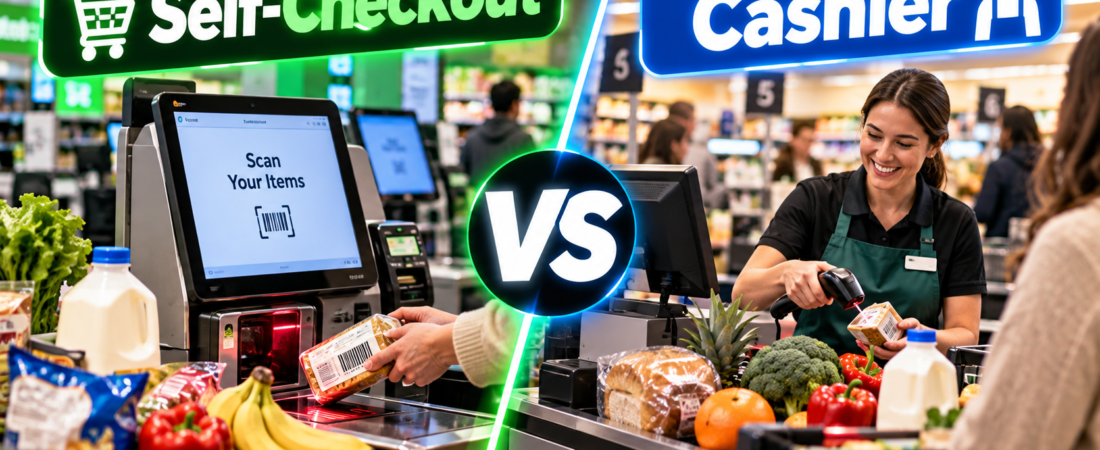
Self-checkout was supposed to make shopping faster.
Instead of waiting behind a long line of customers, you scan your own groceries, pay, bag everything, and leave.
Simple.
Except sometimes it isn’t.
You scan a bottle of wine and need an employee.
You can’t find the right type of apple.
The machine says there is an unexpected item in the bagging area.
A coupon doesn’t scan.
Or the person ahead of you has an entire cart full of groceries and is learning the machine one barcode at a time.
Suddenly, the cashier lane you avoided is moving faster than you are.
That raises a surprisingly difficult question:
Self-checkout vs cashier — are you really saving time?
The answer depends on something retailers rarely put on the sign above the machines:
How much are you buying, what are you buying, and how good are you at doing the cashier’s job yourself?
Self-Checkout vs Cashier at a Glance
| Self-Checkout | Cashier | |
|---|---|---|
| Small purchase | Often excellent | Good |
| Full grocery cart | Can become slow | Usually easier |
| Bagging | You do it | Varies by store |
| Produce | You search/weigh | Cashier handles it |
| Alcohol | Usually needs assistance | Cashier handles verification |
| Coupons | Can require assistance | Usually easier |
| Human interaction | Minimal | More |
| Technical problems | You may need help | Employee handles system |
| Control | High | Lower |
| Best for | A few simple items | Larger or complicated purchases |
Self-checkout’s biggest advantage isn’t necessarily scanning speed.
It’s control.
You can choose an open machine, scan at your own pace, organize your bags the way you want, and avoid waiting for a cashier.
But control only saves time when the transaction stays simple.
Americans Are Almost Exactly Split
If self-checkout were obviously better, consumer preference shouldn’t be close.
It is.
In an April 2026 YouGov survey of 5,991 U.S. adults, respondents were asked which option they would choose if self-checkout and cashier-assisted checkout had equal lines.
The result:
Self-checkout: 46%
Cashier: 44%
Not sure: 10% YouGov
That’s remarkably close.
And it makes sense.
The two systems are good at different things.
Buying a sandwich and a drink isn’t the same checkout problem as buying $250 worth of groceries.
Yet stores often offer the same two solutions for both.
When Self-Checkout Really Is Faster
Imagine you’re buying four items:
- milk
- cereal
- toothpaste
- bananas
There are six self-checkout machines and only one cashier lane.
This is exactly where self-checkout shines.
You don’t need to wait for the customer ahead of you to unload a cart.
You can walk directly to an available machine, scan your items, pay, and leave.
For simple purchases, the system can eliminate one of the biggest sources of checkout delay:
the line itself.
And multiple self-checkout machines can process several customers at the same time.
That’s a meaningful advantage.
But Scanning Isn’t the Whole Job
Here’s what makes the comparison interesting.
At a traditional checkout, the cashier is doing much of the work.
At self-checkout, you are.
You may need to:
- Scan each product.
- Find produce in the system.
- Weigh produce.
- Enter quantities.
- Bag the groceries.
- Scan loyalty cards.
- Apply coupons.
- Select payment.
- Resolve errors.
One individual task doesn’t take very long.
But multiply those tasks across 40 or 50 products and the difference becomes noticeable.
This is one reason the question isn’t simply whether the machine scans quickly.
The real question is:
Who can complete the entire transaction more efficiently — you or an experienced cashier?
For a large grocery order, the answer may be the cashier.
The Produce Problem
Produce is where self-checkout can quickly lose its advantage.
A box of cereal has a barcode.
An apple may not.
Now you need to find:
Produce → Apples → Gala
Or maybe:
Produce → Apples → Honeycrisp
Then weigh them.
Then repeat the process for onions.
Then avocados.
Then bananas.
An experienced grocery cashier may already know common produce codes or navigate the system much faster.
Self-checkout turns that expertise into your responsibility.
And errors aren’t always intentional. A major 2026 University of Leicester study found that self-checkout losses can result from theft and honest mistakes involving awkward products, unfamiliar interfaces, and difficult barcodes. University of Leicester
Then Comes the Employee Intervention
This is the moment that can destroy the time advantage.
“Please wait for assistance.”
Maybe you’re buying alcohol.
Maybe an item scanned twice.
Maybe the scale doesn’t agree with what you placed in the bag.
Maybe a security check was triggered.
Maybe your coupon won’t work.
Now you’re standing at a machine waiting for the same thing self-checkout was designed to reduce:
an employee.
Recent reporting describes technical glitches and repeated prompts as major sources of shopper frustration with self-checkout. The Washington Post
One employee may also be supervising several machines.
If two or three customers need assistance simultaneously, the supposedly automated checkout suddenly develops its own line.
Full Cart? The Math Changes
This is probably the easiest rule to remember.
The more items you have, the less obvious the self-checkout advantage becomes.
With five items, scanning them yourself is easy.
With 50 items, you have to:
scan,
bag,
reorganize,
find produce,
make space,
move bags,
and continue scanning.
A cashier station is physically designed for larger transactions.
There is more room.
The scanning process is familiar to the employee.
Some stores have a separate bagger.
And you’re free to unload the cart while the cashier begins scanning.
That allows two parts of the transaction to happen simultaneously.
At self-checkout, you’re often doing everything sequentially yourself.
Self-Checkout Has Another Advantage: Privacy
Not everyone chooses self-checkout because it’s faster.
Some people simply prefer less interaction.
You can scan your items, pay, and leave without making conversation.
For shoppers who value independence or who don’t want to feel rushed by a cashier, that can make the experience more comfortable.
Recent reporting also notes that younger and more technology-comfortable shoppers often value the control and reduced interaction of self-checkout. The Washington Post
So even if self-checkout saves only 30 seconds, it might still feel better.
And customer experience matters just as much as stopwatch time.
Cashiers Have an Advantage Machines Can’t Easily Copy
A good cashier adapts.
Your barcode doesn’t work?
The cashier knows what to do.
You have a coupon?
They handle it.
You’re buying alcohol?
They verify your age.
The produce doesn’t have a sticker?
They may recognize it immediately.
Your item is damaged?
They can call someone.
Human checkout is flexible.
Self-checkout works extremely well when everything follows the expected process.
The problems begin when something doesn’t.
Why Are Retailers Rethinking Self-Checkout?
Here’s where the story gets bigger than customer convenience.
Retailers aren’t only asking whether self-checkout is faster.
They’re asking whether it actually saves the store money.
A large 2026 study involving 39 retailers with combined annual turnover of roughly €1 trillion found that 54% of transactions were going through self-checkouts, while participating retailers saw store losses rise an average of 22% in the first year after self-checkout was introduced. University of Leicester
Those losses aren’t necessarily all shoplifting.
They can also come from missed scans, incorrect produce selections, barcode problems, and other mistakes.
That’s why some retailers are changing their approach.
Recent U.S. reporting shows some stores limiting or removing self-checkout, while others are investing in AI and computer vision designed to make the systems easier to use and harder to exploit. The Washington Post
So the future probably isn’t simply:
self-checkout replaces cashiers.
It may be:
self-checkout gets smarter while human checkout remains available.
Are You Actually Doing Free Work?
There’s another reason self-checkout creates such strong reactions.
Some shoppers don’t like the idea of doing work that an employee used to perform.
You find the products.
You push the cart.
You unload the cart.
Then you scan the products.
Then you bag them.
Then you pay.
The Washington Post recently described this as part of a broader rise in consumer “micro-labor” — small tasks that companies increasingly transfer to customers through technology. The Washington Post
That doesn’t necessarily make self-checkout bad.
Plenty of people would rather scan five products themselves than wait three minutes for someone else to do it.
But it changes the value proposition.
If you’re doing more work, the system should probably give you something in return.
Usually that’s supposed to be:
time.
Which brings us back to the original question.
The 10-Item Rule
There isn’t a universal number, but a useful practical strategy is to think of self-checkout as an express lane you operate yourself.
If you have:
1–10 straightforward items
self-checkout often makes sense.
If you have:
40+ groceries, lots of produce, coupons, alcohol, or unusual items
the cashier becomes much more attractive.
Between those extremes, look at the lines.
The important point is that the fastest option changes with the basket.
Don’t choose self-checkout automatically.
Five Items vs Fifty Items
Consider two shopping trips.
Trip A: Five Items
You have:
- shampoo
- toothpaste
- paper towels
- cereal
- milk
There are three people waiting for the cashier and two open self-checkout machines.
Self-checkout is an easy choice.
Trip B: Fifty Items
Now you have:
- a full grocery cart
- eight types of produce
- two coupons
- a bottle of wine
- several heavy items
The self-checkout area may technically have no line.
But you’re about to become the cashier, bagger, produce lookup specialist, and problem solver.
A staffed lane with two people ahead of you might still be easier — and possibly faster.
That’s why line length alone doesn’t tell you which checkout will save time.
What About Older Shoppers?
Checkout technology doesn’t affect everyone equally.
Self-checkout requires comfort with touchscreens, payment terminals, prompts, product lookup systems, and error messages.
Research has repeatedly found that interest in self-checkout tends to decline with age and with greater technological anxiety. Taylor & Francis Online
That matters because a system designed to save 60 seconds isn’t necessarily an improvement if it creates five minutes of frustration.
For some shoppers, the cashier isn’t an outdated option.
It’s the more efficient interface.
The Future May Be AI Checkout
Retailers are already trying to fix many of self-checkout’s weaknesses with computer vision and artificial intelligence.
Newer systems can help recognize produce automatically, identify scanning errors, and flag items that may have been missed.
NCR Voyix, for example, describes visual-AI systems designed to recognize produce on the scanner scale and reduce both accidental errors and deliberate misidentification. NCR
If these technologies work well, the comparison could change significantly.
Imagine placing apples on the scale and having the system recognize them automatically.
No menu.
No search.
No produce code.
At that point, self-checkout becomes less like operating a cash register and more like confirming what the system already understands.
That could eliminate one of its biggest disadvantages.
So Which One Should You Choose?
For a small, simple purchase:
Self-checkout usually makes sense.
You get control, potentially less waiting, and minimal interaction.
For a large or complicated grocery trip:
The cashier often becomes more attractive.
Produce, coupons, age-restricted items, bagging, and machine interventions can quickly erase the time you thought you were saving.
But the most interesting conclusion from the self-checkout vs cashier debate is that neither system is universally faster.
The transaction matters more than the technology.
Self-checkout works best when you’re essentially using it as an express lane.
Cashiers work best when the transaction requires experience, flexibility, or a lot of repetitive work.
So next time you reach the front of the store, don’t automatically walk toward the glowing row of machines.
Look at your cart.
Look at the lines.
Then ask yourself one question:
Do I want to wait for a cashier — or become one?
That may be the fastest way to decide.
Compare with Reason.