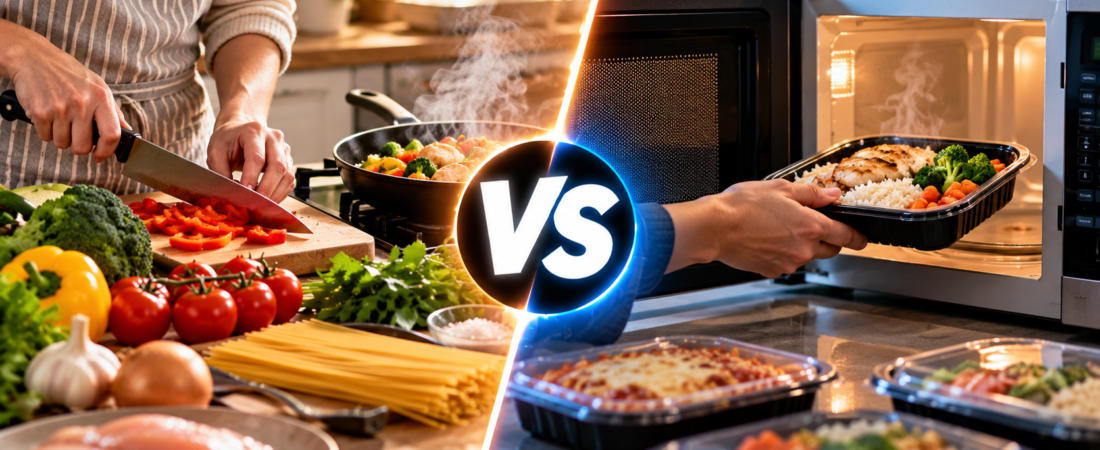
Cooking at home is supposed to save money.
That’s one of those personal-finance rules almost everyone has heard.
Buy ingredients.
Cook your own meals.
Avoid expensive prepared food.
Save money.
But modern grocery stores have complicated that equation.
You can now buy rotisserie chicken, frozen rice, pre-cut vegetables, meal kits, refrigerated pasta, microwaveable grains, prepared salads, frozen entrées, and dozens of other foods that eliminate much of the work of cooking.
They cost more than basic ingredients.
But they can also save something valuable:
time.
And there’s another problem with cooking from scratch.
Ingredients don’t always get used.
The spinach wilts.
Half the cilantro ends up in the trash.
You buy six ingredients for one recipe and never use three of them again.
So the real comparison isn’t simply:
ingredients vs prepared food.
It’s:
Cooking from scratch vs convenience meals — after time, waste, portions, and grocery costs are included, which actually saves more money?
Cooking From Scratch vs Convenience Meals at a Glance
| Cooking From Scratch | Convenience Meals | |
|---|---|---|
| Ingredient cost | Usually lower | Usually higher |
| Preparation time | Higher | Lower |
| Cleanup | More | Less |
| Food waste risk | Can be higher | Often lower |
| Portion control | Excellent | Fixed or limited |
| Ingredient control | Excellent | Lower |
| Skill required | More | Minimal |
| Variety | Nearly unlimited | Depends on store |
| Bulk cooking | Excellent | Limited |
| Best for | Regular planned meals | Busy days and small households |
At first glance, cooking from scratch still looks like the winner.
But the size of the advantage depends heavily on how efficiently you cook.
Consumers Are Still Looking for Ways to Cook at Home
Convenience food hasn’t eliminated home cooking.
If anything, rising food costs have given consumers another reason to think carefully about how they prepare meals.
The USDA’s 2026 Food Price Outlook continues to track elevated food-at-home and food-away-from-home costs, reinforcing why households are paying closer attention to grocery spending.
At the same time, 2026 shopper research points toward consumers wanting to prepare more meals themselves while still placing a high value on convenience.
That combination explains why today’s grocery cart often looks different from traditional “home cooking.”
People aren’t necessarily choosing between:
cook everything
or
cook nothing.
They’re mixing the two.
Why Cooking From Scratch Is Usually Cheaper Per Serving
Basic ingredients can be remarkably inexpensive when divided across multiple servings.
Consider a simple pasta dinner.
You might buy:
Pasta: $2
Tomato sauce: $3
Ground meat: $6
Onion: $1
Parmesan: $4
Total:
$16
Suppose that makes five servings.
That’s:
$3.20 per serving.
A refrigerated or frozen prepared pasta meal might cost $7 or $8 for a comparable individual portion.
Multiply that difference across a family and the economics become obvious.
Four homemade servings at $3.20 each:
$12.80
Four prepared meals at $7 each:
$28
That’s a substantial difference from one dinner.
But That Calculation Has a Problem
Did you actually use everything?
Maybe you only used half the onion.
Maybe the Parmesan cost $4 but you used one quarter of it.
That’s good if you’ll use the rest later.
It’s waste if you don’t.
Recipes often make cooking from scratch look cheaper because they calculate the cost of the quantity used rather than the quantity you had to purchase.
Those aren’t always the same number.
If a recipe requires one tablespoon of an ingredient sold only in an $8 container, your grocery receipt still increased by $8.
The ingredient becomes economical only if you use it again.
Food Waste Can Erase Part of the Savings
Americans throw away a significant amount of food.
USDA estimates have long placed food loss and waste at roughly 30% to 40% of the U.S. food supply.
Not all of that happens in homes, but household waste matters.
Fresh ingredients are particularly vulnerable.
Think about:
lettuce,
berries,
herbs,
avocados,
bread,
milk,
leftovers.
Buying raw ingredients doesn’t save money if a significant portion ends up in the garbage.
Convenience meals can sometimes reduce this problem because the portion has already been determined.
You buy one meal.
You eat one meal.
There’s little leftover inventory to manage.
Household Size Changes Everything
This may be the most overlooked factor in the entire comparison.
Imagine you’re cooking for a family of four.
A package of chicken.
A bag of vegetables.
Rice.
Sauce.
Those ingredients can easily become one family dinner.
Now imagine you’re cooking for one person.
You buy the same package of chicken.
The same vegetables.
The same sauce.
Suddenly you have ingredients for several meals.
That’s excellent if you’re willing to eat leftovers.
It’s less appealing if you want something different tomorrow.
This is one reason convenience foods can make more financial sense for smaller households than the sticker price suggests.
They allow you to buy exactly one portion.
Families Have a Major Advantage With Scratch Cooking
For families, the equation often flips strongly toward cooking.
The labor doesn’t increase proportionally with the number of servings.
Cooking rice for four people isn’t four times harder than cooking rice for one.
Making eight servings of chili doesn’t take eight times longer than making one serving.
That creates an economy of scale.
The more people you’re feeding, the more valuable home cooking can become.
A $30 batch of food that feeds a family twice can be incredibly efficient.
Eight $8 prepared meals would cost:
$64.
The homemade version:
$30.
Difference:
$34.
Do that several times per week and the savings become significant.
Now Put a Price on Your Time
This is where the comparison becomes uncomfortable.
Suppose cooking dinner requires:
15 minutes preparation.
30 minutes cooking.
15 minutes cleanup.
That’s one hour.
A convenience meal might require:
5 minutes.
So you saved 55 minutes.
Imagine scratch cooking saves $12 compared with convenience food.
You effectively spent 55 minutes to save:
$12.
Was that worth it?
There is no universal answer.
You shouldn’t necessarily value every non-working hour at your hourly wage.
But time still has value.
If cooking prevents you from exercising, spending time with your children, working, relaxing, or completing something important, the cheapest meal on the receipt may not have the lowest real cost.
Cleanup Is Part of Cooking
Cooking comparisons often ignore this.
The meal isn’t finished when you turn off the stove.
There may be:
a cutting board,
knife,
pan,
pot,
plates,
utensils,
countertops,
and stove.
Someone has to clean them.
A frozen meal or prepared entrée may require one tray and a fork.
That’s not a nutritional argument.
It’s a labor argument.
For busy households, reducing cleanup can be almost as valuable as reducing cooking time.
Convenience Meals Aren’t One Category
There’s also a huge difference between types of convenience food.
Consider these:
Frozen dinner
Almost completely prepared.
Rotisserie chicken
Main protein already cooked, but easy to combine with vegetables or rice.
Pre-cut vegetables
Still ingredients, but some labor has been removed.
Microwaveable rice
More expensive than dry rice, but much faster.
Meal kit
Ingredients are portioned and instructions provided, but cooking is still required.
Prepared supermarket meal
Essentially restaurant-style convenience without restaurant service.
Putting all of these into one category hides the most useful strategy.
You don’t have to buy an entire convenience meal.
You can buy convenience selectively.
The Hybrid Meal May Be the Sweet Spot
Imagine dinner is:
Rotisserie chicken.
Microwaveable rice.
Fresh salad.
You didn’t cook the chicken.
You didn’t cook the rice.
You assembled the salad.
Dinner might take ten minutes.
Now compare that with:
washing,
cutting,
seasoning,
roasting,
boiling,
and cleaning everything yourself.
The hybrid meal costs more than cooking entirely from scratch.
But it may cost far less than restaurant takeout.
That’s a very important middle ground.
The real competitor to convenience groceries often isn’t scratch cooking.
It’s ordering dinner because you’re too tired to cook.
Convenience Food Can Prevent Takeout
This is where a $10 prepared meal can actually save money.
Imagine it’s 7:30 PM.
You’re tired.
There is nothing ready to eat.
Option A:
Cook for 45 minutes.
Option B:
Order $30 of takeout.
Option C:
Heat a $9 prepared meal.
Compared with scratch cooking, Option C looks expensive.
Compared with takeout, it looks cheap.
This is why having convenience food available can function almost like financial insurance against expensive last-minute restaurant orders.
A freezer containing several easy meals may save more money than a refrigerator full of ambitious ingredients you don’t have time to cook.
Cooking Skill Has Financial Value
An experienced cook can look at:
chicken,
rice,
half an onion,
two carrots,
and leftover vegetables
and turn them into dinner.
An inexperienced cook may see unrelated ingredients and order food instead.
That’s a real economic difference.
Cooking skill helps people:
reuse leftovers,
substitute ingredients,
avoid waste,
cook without recipes,
buy what’s on sale,
and turn inexpensive ingredients into meals.
So the financial return from cooking from scratch tends to improve as your cooking ability improves.
Meal Planning Matters Even More
Scratch cooking becomes much more economical when several meals share ingredients.
Suppose Monday’s dinner uses:
chicken,
peppers,
onions,
and rice.
Tuesday uses:
rice,
onions,
eggs,
and leftover chicken.
Wednesday uses:
peppers,
onions,
beans,
and tortillas.
Now the ingredients work across multiple meals.
Food waste falls.
Cost per serving falls.
Shopping becomes more efficient.
That’s very different from selecting three unrelated recipes that each require ten unique ingredients.
The secret to cheap home cooking isn’t simply cooking.
It’s planning overlapping meals.
Batch Cooking Changes the Time Equation
Remember our earlier example where scratch cooking required an hour?
Now imagine you spend 90 minutes making six servings.
Eat one tonight.
Refrigerate two.
Freeze three.
Your average preparation time becomes:
15 minutes per serving.
That’s completely different.
Batch cooking allows scratch cooking to compete with convenience food on both:
price and time.
This is probably the strongest financial argument for home cooking.
You’re using one cooking session to create multiple future convenience meals.
Essentially, you’re manufacturing your own frozen dinners.
What About Health?
Cost isn’t the only consideration.
Cooking from scratch generally gives you much greater control over:
salt,
sugar,
fat,
portion size,
protein,
vegetables,
and overall ingredients.
Convenience food varies enormously.
Some prepared meals can be nutritionally balanced.
Others can be high in sodium or contain portions that don’t fit your needs.
The important distinction isn’t simply:
fresh = healthy
prepared = unhealthy.
Read the nutrition information.
A convenience meal that includes lean protein, vegetables, and reasonable calories may fit perfectly well into someone’s diet.
The $100 Grocery Test
Imagine two people each have $100 for several dinners.
Shopper A: Scratch Cooking
They buy:
chicken,
ground meat,
rice,
pasta,
potatoes,
vegetables,
eggs,
beans,
sauces,
and seasonings.
They cook efficiently and reuse ingredients.
They may produce a large number of servings.
Shopper B: Convenience Meals
They buy:
frozen entrées,
prepared pasta,
pre-cooked proteins,
microwaveable sides,
and prepared salads.
They produce fewer servings.
But Shopper B spends much less time preparing and cleaning.
Now add one more possibility.
Shopper A wastes $20 worth of ingredients and orders takeout twice because they don’t feel like cooking.
Suddenly the theoretical savings shrink dramatically.
The cheapest strategy isn’t the one with the cheapest ingredients.
It’s the one you can consistently follow.
When Cooking From Scratch Wins
Scratch cooking is particularly strong when:
- you’re feeding several people
- you enjoy leftovers
- you meal plan
- you batch cook
- you reuse ingredients
- you have basic cooking skills
- you have enough time
- minimizing food cost is the priority
In that situation, convenience food has a difficult time competing on price per serving.
When Convenience Meals Win
Convenience becomes more attractive when:
- you live alone
- your schedule changes constantly
- food frequently spoils in your refrigerator
- you dislike cooking
- you have limited kitchen space
- prepared food prevents restaurant orders
- saving time matters more than minimizing every dollar
And that’s an important distinction.
Convenience food doesn’t necessarily have to be cheaper than scratch cooking.
It only has to be cheaper than what you would otherwise do.
If the alternative is a $35 DoorDash order, a $9 frozen meal is doing its job.
So Which Actually Saves More Money?
On pure ingredient cost, cooking from scratch usually wins.
Especially for families, batch cooking and meal planning can produce meals at a fraction of the cost of individually prepared alternatives.
But that’s not the whole calculation.
Food waste matters.
Cleanup matters.
Household size matters.
And time matters.
Convenience meals cost more partly because someone else already performed some of the labor.
The smartest strategy may therefore be somewhere in the middle:
Cook inexpensive staples yourself.
Batch-cook foods that freeze well.
Use leftovers intentionally.
Then pay for convenience where it saves substantial time.
Buy the rotisserie chicken.
Use the pre-cut vegetables on a hectic night.
Keep a few frozen meals available.
You’re not failing at home cooking.
You’re deciding which parts of dinner are worth doing yourself.
That’s the more useful way to compare cooking from scratch vs convenience meals.
Don’t just calculate the price of the food.
Calculate the food you actually eat — and the time it takes to put it on the table.
Compare with Reason.