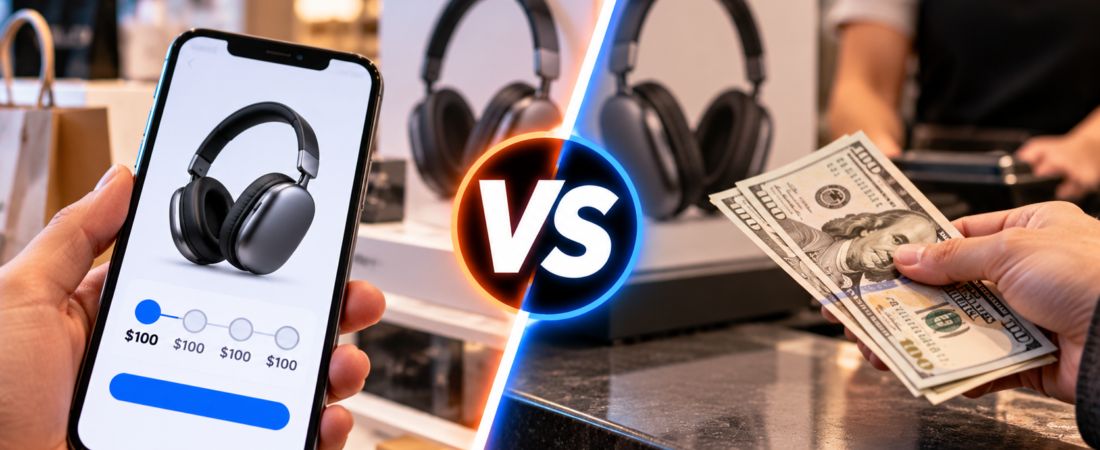
Buy now, pay later vs paying cash sounds like an easy financial decision.
Imagine you want a $400 pair of headphones.
You have two options.
Pay:
$400 today.
Or choose:
4 payments of $100.
Same product.
Same $400 total.
And if the buy now, pay later plan charges 0% interest, the second option seems almost impossible to argue against.
Why give up $400 today when you can keep most of the money in your bank account and spread the purchase across several payments?
Mathematically, that can make sense.
Psychologically, however, something very different may be happening.
The headphones no longer feel like a:
$400 purchase.
They feel like:
$100 today.
And that small change in how the price is presented may influence what you buy, how much you buy, and whether you would have made the purchase at all.
So the most important question about buy now, pay later may not be whether the interest rate is 0%.
It may be:
Does splitting the payment make spending feel cheaper than it really is?
Buy Now, Pay Later vs Paying Cash at a Glance
| Buy Now, Pay Later | Paying Cash | |
|---|---|---|
| Full cost paid today | No | Yes |
| Common short-term interest | Often 0% | None |
| Payment size | Smaller installments | Full amount |
| Spending pain | Lower upfront | Higher upfront |
| Future obligations | Yes | None |
| Budget visibility | Can become complicated | Very clear |
| Overspending risk | Potentially higher | Lower |
| Keeps cash available | Yes | No |
| Multiple purchases | Payments can stack | Limited by available cash |
| Best for | Planned cash-flow management | Strong spending control |
BNPL’s biggest advantage is obvious:
You keep more cash today.
Its biggest weakness is almost the mirror image:
You don’t feel the entire cost today.
BNPL Has Become a Mainstream Payment Method
Buy now, pay later is no longer limited to expensive electronics.
Consumers increasingly see installment options when buying:
clothes,
furniture,
travel,
electronics,
beauty products,
and everyday purchases.
The Consumer Financial Protection Bureau has documented rapid expansion of the BNPL market, particularly the common pay-in-four model in which consumers make an initial payment and then repay the remainder through several installments.
That structure is attractive because many short-term BNPL products advertise:
0% interest.
And that changes the psychology of financing.
Traditional borrowing often feels expensive.
BNPL can feel like a payment feature.
The $400 Headphone Test
Let’s go back to our headphones.
Option A: Pay Today
Price:
$400
Your bank account immediately falls by:
$400
You feel the full purchase.
Option B: Pay in Four
Price:
$400
Payment today:
$100
Remaining:
$300
You still owe exactly $400 in total.
But the decision at checkout doesn’t necessarily feel like a $400 decision.
It may feel closer to:
“Can I afford $100 today?”
Those are very different questions.
The correct question is:
“Are these headphones worth $400?”
BNPL can subtly shift attention toward:
“Can I handle the installment?”
That distinction matters.
Research Suggests BNPL Can Increase Spending
This isn’t only a theoretical concern.
Academic research has found evidence that access to BNPL can increase consumer spending.
A study published in the Journal of Marketing examining transaction data found that consumers spent more after adopting BNPL, with increases occurring through both higher purchase frequency and greater spending.
Other research has similarly examined how installment structures can reduce the psychological salience of the total purchase price.
That’s the fundamental behavioral difference.
BNPL doesn’t necessarily make the product cheaper.
It makes the payment smaller.
And consumers don’t always react to those two things in the same way.
$100 × 4 Is Still $400
This sounds ridiculously obvious.
But modern commerce increasingly encourages us to think in payments instead of prices.
A $1,200 laptop becomes:
$100/month.
A $600 purchase becomes:
4 payments of $150.
A car becomes:
$699/month.
A phone becomes:
$33/month.
A subscription becomes:
$9.99/month.
The smaller number is easier to process.
But ultimately:
$150 × 4 = $600.
The product didn’t become cheaper because the price was divided.
The timing changed.
Paying Cash Forces a Different Question
Suppose you walk into a store with:
$500 cash.
You see a $400 product.
Buying it leaves you with:
$100.
That’s noticeable.
Now imagine the store says:
Only $100 today.
Suddenly you can buy the product and still leave with $400.
But that $400 isn’t completely available anymore.
Part of it effectively belongs to future payments.
BNPL separates the purchase from the financial consequence.
Cash combines them.
The Real Danger Is Payment Stacking
One BNPL purchase may be easy to manage.
The problem begins when several overlap.
Imagine:
Headphones: $100 every two weeks
Shoes: $45 every two weeks
Furniture: $125 every two weeks
Clothes: $60 every two weeks
Each purchase looked manageable individually.
Together:
$330
may be leaving your account during the same payment period.
That’s the danger of evaluating affordability one purchase at a time.
Each checkout asks:
“Can you afford this payment?”
Your budget has to answer:
“Can I afford all of my payments?”
Cash Can’t Stack Future Payments
Cash has an extremely primitive financial feature.
When it’s gone:
it’s gone.
That sounds inconvenient.
But from a spending-control perspective, it’s powerful.
If you have $500 available for discretionary spending and spend $400:
you have $100 left.
There’s no confusion.
No future installment schedule.
No overlapping repayment dates.
No mental accounting.
Your remaining purchasing power is visible immediately.
BNPL can make available cash look larger than your true disposable cash.
But 0% Financing Can Be Financially Rational
None of this means paying cash is always better.
Suppose you need a:
$1,000 laptop
for work.
You already planned to buy it.
You have $10,000 in savings.
BNPL offers:
$250 × 4
with:
0% interest
and no fees.
From a pure cash-flow perspective, taking the 0% financing can be perfectly rational.
You retain more liquidity.
Your money stays in your account longer.
And if you were going to purchase the laptop regardless of financing, BNPL didn’t cause additional consumption.
This is the ideal BNPL user.
The financing changes:
when they pay.
It doesn’t change:
what they buy.
Here’s the Best Test
Before selecting BNPL, ask yourself:
Would I still buy this if I had to pay the entire price today?
If the answer is:
Yes
BNPL may simply be a cash-flow tool.
If the answer is:
No
stop.
That’s valuable information.
The financing may be enabling the purchase rather than merely financing it.
And that’s where 0% can become surprisingly expensive.
Zero Interest Doesn’t Mean Zero Cost
Imagine two scenarios.
Scenario A
You buy a $300 item with cash.
Total cost:
$300
Scenario B
BNPL makes a $500 version feel affordable.
You pay:
$125 × 4
Interest:
$0
Total cost:
$500
Technically, the financing was free.
Behaviorally, it cost you:
$200 more.
That’s why focusing exclusively on APR can miss the larger issue.
The most expensive part of financing may not be interest.
It may be the additional purchase it makes feel affordable.
Merchants Have a Reason to Offer BNPL
Why would retailers offer financing that sometimes charges consumers no interest?
Because payment flexibility can help convert shoppers into buyers.
BNPL providers generally earn money through combinations of merchant fees, consumer fees on certain products, interest on longer-term financing, and other arrangements depending on the provider and product.
For merchants, installment options can make expensive purchases easier for customers to accept.
That’s not necessarily sinister.
Credit cards do something similar.
Retail financing has existed for decades.
But it’s useful to remember that the payment option isn’t displayed at checkout purely for your financial benefit.
It can also help complete the sale.
BNPL Can Change What “Affordable” Means
Traditionally, affordability might mean:
I have enough money to buy this.
Increasingly, affordability means:
I can handle the monthly payment.
Those are not the same thing.
Consider a $1,000 phone.
You might reject:
$1,000
but accept:
$41.67/month for 24 months.
The second number feels dramatically smaller.
But you’re still committing $1,000 of future income.
BNPL brings that same payment-based thinking to increasingly smaller purchases.
That’s what makes it interesting — and potentially dangerous.
Paying Cash Has an Opportunity Cost Too
Cash isn’t perfect.
Suppose paying $2,000 today would significantly reduce your emergency savings.
A genuine 0% installment option might be preferable.
Keeping cash available can protect you against:
car repairs,
medical bills,
home repairs,
or another unexpected expense.
Liquidity has value.
So the goal shouldn’t be:
Always pay cash.
The goal should be:
Don’t confuse liquidity with affordability.
Having $2,000 still sitting in your checking account doesn’t mean all $2,000 is available if you’ve already committed part of it to future payments.
What About Credit Scores?
BNPL credit reporting has been evolving.
Depending on the provider, product, and credit bureau, some installment activity may be reported while other short-term products may be treated differently.
The CFPB has pushed for BNPL borrowers to receive protections similar to those associated with traditional credit products, reflecting how significant the category has become.
Consumers therefore shouldn’t assume every BNPL product behaves identically.
Before using one, check:
late-payment rules,
fees,
autopay requirements,
refund procedures,
credit reporting,
and dispute protections.
“Pay in four” describes a payment structure.
It doesn’t guarantee identical terms across providers.
Returns Can Become More Complicated
Here’s another issue people don’t think about at checkout.
You buy three items using BNPL.
Return one.
Now you have:
a merchant,
a BNPL provider,
a refund,
and an installment schedule.
Usually the process works.
But it can be less straightforward than:
buy with cash → return item → receive money.
Refund timing matters.
Upcoming payments may still be scheduled while the return is being processed.
That doesn’t make BNPL bad.
It’s simply another layer in the transaction.
Convenience at checkout can create complexity later.
The Psychological Difference Matters More Than the Math
Mathematically:
$400 today
and
$100 × 4
can equal the same amount.
Behaviorally, they aren’t necessarily equivalent.
That’s the entire point.
Humans don’t evaluate every financial decision with a spreadsheet.
We respond to:
monthly payments,
discounts,
rewards,
free shipping,
limited-time offers,
and smaller numbers.
Retailers know this.
Payment companies know this.
Consumers should know it too.
Try Removing the Installment Price
Here’s a simple trick.
When shopping online, ignore:
$37.50 × 4
Look only at:
$150 total.
Then ask:
Would I buy this for $150?
Not:
Can I afford $37.50?
Not:
Is it interest-free?
Not:
Can I pay it later?
Just:
Is this worth $150?
Make the purchase decision first.
Choose the payment method second.
That reverses the order retailers often encourage.
When BNPL Makes Sense
BNPL can be useful when:
the purchase was already planned,
you can comfortably afford the full price,
the financing truly costs 0%,
you understand the repayment schedule,
you aren’t stacking multiple plans,
and keeping cash available has value.
Used this way, BNPL is simply a financial tool.
When Paying Cash Is Better
Paying cash — or paying the full amount immediately — becomes more attractive when:
the purchase is discretionary,
you’re tempted mainly because the installment looks small,
you already have multiple BNPL payments,
your income is unpredictable,
you frequently overspend,
or you’re using future income to justify something you couldn’t comfortably buy today.
In those situations, payment friction can be useful.
The $1,000 Test
Imagine something costs:
$1,000.
BNPL says:
$250 today.
Before clicking it, mentally remove the installment option.
The product costs:
$1,000.
Would you still buy it?
If yes, then compare payment methods.
Maybe 0% BNPL is the smart choice.
If no, the financing just revealed something important.
The product wasn’t affordable enough at $1,000.
The payment plan simply made the price easier to ignore.
Buy Now, Pay Later vs Paying Cash: Which Is Better?
If you already decided to make a purchase and can comfortably afford it, 0% BNPL can be financially sensible.
You keep cash longer.
You preserve liquidity.
And you may pay no additional financing cost.
But buy now, pay later vs paying cash becomes a very different comparison when financing changes your purchasing decision.
If seeing:
$100 × 4
makes you buy something you would have rejected at:
$400
then 0% financing didn’t save you money.
It helped you spend it.
That’s why the most important number on a BNPL offer isn’t:
0% APR.
It’s the number retailers often make psychologically easier to overlook:
the total price.
Before asking whether you can afford the next payment, ask whether the purchase itself is worth the full amount.
Because four small payments can feel cheap.
But when the fourth payment clears, you still paid the entire price.
Compare with Reason.