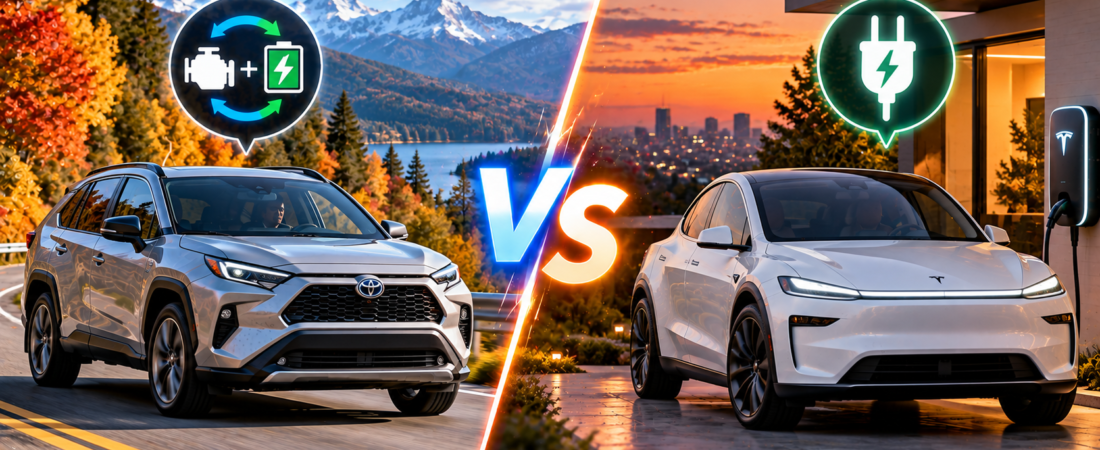
Hybrid vs EV has become one of the most important questions for anyone buying a new car.
A few years ago, the direction of the auto industry seemed obvious.
Gas cars were the present.
Electric vehicles were the future.
Hybrids were supposed to be the temporary bridge between them.
But something unexpected happened.
The bridge became extremely popular.
Automakers are expanding hybrid lineups, buyers are paying more attention to fuel economy without giving up gasoline, and many consumers who like the idea of an EV still aren’t convinced they want to live with one every day.
Meanwhile, EVs have become significantly better.
Longer range.
Faster charging.
Better charging networks.
More models.
And potentially very low running costs for owners who can charge at home.
So if you’re buying your next vehicle today, which makes more sense?
Hybrid or fully electric?
The answer increasingly depends less on the vehicle itself—and more on how you live.
Hybrid vs EV at a Glance
| Hybrid | EV | |
|---|---|---|
| Gasoline required | Yes | No |
| Home charger needed | No | Ideally |
| Long road trips | Very easy | Requires more planning |
| Daily commuting | Excellent | Excellent |
| Energy cost | Low | Potentially very low |
| Routine maintenance | More | Less |
| Cold-weather range concern | Minor | More significant |
| Refueling time | Minutes | Longer |
| Apartment living | Easy | Depends on charging |
| Driving experience | Familiar | Quiet, instant torque |
| Best use case | Flexible all-purpose vehicle | Home-charged daily driving |
On paper, EVs can look like the technological winner.
In real life, convenience can completely change the equation.
Why Hybrids Suddenly Make So Much Sense
A conventional hybrid asks almost nothing from its owner.
You don’t need to install anything in your garage.
You don’t need a charging app.
You don’t need to think about whether a hotel has chargers.
You don’t need to plan a highway stop around charging speed.
You simply drive.
The electric motor and battery reduce fuel consumption automatically, while the gasoline engine eliminates range anxiety.
That’s an unusually powerful combination.
And consumers have noticed.
Recent industry research continues to show strong interest in hybrid powertrains as buyers balance fuel economy, purchase price and charging concerns.
Hybrids aren’t necessarily winning because consumers dislike EVs.
They’re winning because they’re easy.
EVs Have One Massive Advantage: Home Charging
The EV experience changes dramatically depending on one question:
Can you charge at home?
If the answer is yes, an EV can be incredibly convenient.
You drive home.
Plug in.
Go inside.
Wake up with the battery ready for another day.
For many owners, that means they almost never need to visit a public charger during normal daily driving.
Think about how different that is from a gasoline vehicle.
A hybrid may go hundreds of miles between fill-ups.
But eventually, you still stop at a gas station.
An EV charged overnight can essentially refuel while you’re sleeping.
That’s one of the strongest arguments for going electric.
Without Home Charging, the Equation Changes
Now imagine you live in an apartment.
No dedicated charger.
No workplace charging.
You depend primarily on public fast chargers.
Suddenly the EV’s biggest convenience advantage disappears.
Instead of charging while sleeping, you may have to:
drive to a charger,
find an available stall,
plug in,
wait,
and potentially pay relatively expensive public-charging rates.
At that point, a hybrid can actually feel more convenient.
Five minutes at a gas station.
Then you’re gone.
This is why asking:
“Are EVs better than hybrids?”
isn’t quite the right question.
A better question is:
“Does my life support an EV?”
Let’s Compare a Typical Commuter
Imagine two drivers each travel:
12,000 miles per year.
Driver A owns a hybrid averaging:
45 mpg.
At $3.50 per gallon:
12,000 ÷ 45 = about 267 gallons.
Annual gasoline cost:
about $934.
Now imagine an EV averaging:
3.3 miles per kWh.
It would use roughly:
3,636 kWh per year.
At a hypothetical home electricity rate of $0.18 per kWh:
Annual electricity cost:
about $655.
Difference:
roughly $279 per year.
The EV wins.
But notice something important.
That’s not thousands of dollars.
The result also changes dramatically depending on local electricity prices, gasoline prices and how much public fast charging you use.
The EV may be cheaper to fuel.
But fuel alone shouldn’t decide a $40,000 or $50,000 vehicle purchase.
Public Fast Charging Can Change the Math
Suppose much of that charging costs:
$0.45 per kWh.
The same 3,636 kWh would cost approximately:
$1,636.
Now the EV could cost more for energy than the 45-mpg hybrid in our example.
That’s why statements such as:
“EVs are much cheaper to drive”
need context.
They can be.
Especially with inexpensive overnight home charging.
But an EV owner relying heavily on expensive DC fast charging may have a very different experience.
Where you charge matters almost as much as what you drive.
EVs Still Have a Maintenance Advantage
This is one area where EVs are fundamentally simpler.
A battery-electric vehicle doesn’t need:
engine oil,
spark plugs,
engine air filters,
or many of the routine services associated with an internal-combustion engine.
Regenerative braking can also reduce friction-brake use.
A hybrid still contains:
a gasoline engine,
an electric motor,
a battery,
a cooling system,
an exhaust system,
and a conventional fuel system.
That doesn’t mean hybrids are unreliable.
Many hybrid systems have proven extremely durable.
But mechanically, EVs eliminate a large collection of routine engine-related maintenance items.
Over a long ownership period, that simplicity has real value.
But Tires Complicate the EV Maintenance Story
EVs aren’t maintenance-free.
They’re often heavy.
They can produce substantial instant torque.
And depending on vehicle design and driving style, tire wear can become a meaningful expense.
Large EV wheels and performance-oriented tires aren’t cheap either.
So the maintenance comparison isn’t:
EV = no maintenance
versus
Hybrid = expensive maintenance.
It’s more accurately:
EV = fewer drivetrain maintenance items
while both vehicles still need tires, suspension components, cabin filters, wipers and other wear items.
Road Trips Still Favor the Hybrid
Imagine driving 700 miles in one day.
Hybrid:
Drive several hundred miles.
Stop.
Fuel for a few minutes.
Continue.
EV:
The experience depends heavily on the vehicle and charging infrastructure.
A modern long-range EV with fast charging can make the trip without much drama.
But you still need to think about:
charger locations,
battery percentage,
charging speed,
possible congestion,
weather,
and whether the charger is functioning.
This has improved enormously.
But it hasn’t disappeared.
For someone who makes two long road trips per year, that inconvenience may be irrelevant.
For someone who drives long distances every week, it may be decisive.
Cold Weather Still Matters
Battery performance is affected by temperature.
Cold weather can reduce EV range and increase energy consumption, particularly when the cabin needs significant heating.
Modern EVs increasingly use heat pumps, battery preconditioning and sophisticated thermal management to reduce the impact.
But physics still exists.
A hybrid can also lose fuel economy in winter.
The difference is that losing gasoline efficiency doesn’t create the same behavioral concern when another gas station is five minutes away.
For buyers in cold climates, winter driving deserves more attention than the advertised maximum EV range.
The 300-Mile Range Question May Be Overrated
Many shoppers say:
“I need at least 300 miles of range.”
But consider your normal day.
Maybe you drive:
18 miles to work.
18 miles home.
10 miles for errands.
Total:
46 miles.
If your EV has 280 miles of usable range and you charge at home every night, the difference between:
280 miles
and
330 miles
may barely affect your daily life.
This is one of the strange things about EV shopping.
Consumers often optimize for their rarest driving day rather than their normal driving day.
A hybrid solves that problem by giving you essentially unlimited road-trip flexibility.
An EV asks whether you really need to optimize your entire vehicle around a trip you make three times a year.
Purchase Price Still Matters More Than Fuel Savings
This is where buyers should be careful.
Suppose:
Hybrid version: $38,000
Comparable EV: $45,000
Difference:
$7,000.
Even if the EV saves:
$600 per year
in energy and maintenance, it could take many years to recover the initial difference.
Of course, real comparisons aren’t that simple.
Equipment levels differ.
Incentives differ.
Lease deals differ.
Insurance differs.
Resale values differ.
But the basic principle is important:
Don’t spend $8,000 extra to save $400 per year without doing the math.
Efficiency doesn’t automatically equal financial value.
Depreciation May Matter More Than Charging Cost
Fuel gets enormous attention because drivers see the price every week.
Depreciation is largely invisible.
But it can be one of the biggest ownership expenses.
Suppose one vehicle loses:
$15,000
in value over several years.
Another loses:
$22,000.
That $7,000 difference can overwhelm years of savings at the pump or charger.
EV resale values have been volatile as new-vehicle prices, incentives and technology have changed rapidly.
Hybrids can also depreciate, of course, but strong consumer demand has helped make many popular hybrid models attractive in the used market.
When comparing hybrid vs EV economics, don’t stop at energy costs.
Look at:
purchase price,
financing,
insurance,
maintenance,
energy,
and expected resale value.
That’s the real ownership equation.
What About Battery Replacement?
This is one of the most common EV fears.
Some buyers imagine owning an EV for eight years and suddenly receiving a gigantic battery replacement bill.
Battery degradation is real.
Battery failures are possible.
But battery packs are also designed for long service lives, and new EVs include substantial battery warranties.
The more useful question for most new-car buyers isn’t:
“Will I eventually replace the battery?”
It’s:
“How much capacity might remain when I plan to sell the car?”
Someone keeping an EV for three years faces a different risk profile from someone planning to keep it for 15.
The same logic applies to hybrids, which also contain high-voltage batteries—usually much smaller ones.
The Hybrid’s Secret Weapon Is Flexibility
A hybrid doesn’t necessarily dominate any single category.
It isn’t as electrically efficient as an EV.
It doesn’t eliminate gasoline.
It doesn’t provide the same silent EV driving experience.
But it works almost everywhere.
Apartment?
Fine.
Road trip?
Fine.
Cold weather?
Fine.
No charger?
Fine.
Forgot to plan?
Fine.
That flexibility is extremely valuable.
Especially for households with only one vehicle.
The EV’s Secret Weapon Is Daily Convenience
EV convenience is almost the opposite.
Its weakness appears on unusual days.
Its strength appears on ordinary days.
If you:
own a home,
have a garage,
drive 40 miles per day,
charge overnight,
and rarely take extremely long trips,
an EV can feel easier than a gasoline vehicle.
You don’t think about gas prices.
You don’t visit gas stations.
You don’t schedule oil changes.
You start every morning with energy available.
That’s not futuristic.
That’s practical.
One-Car Household vs Two-Car Household
This may be one of the best ways to decide.
One-car household
A hybrid is incredibly compelling.
One vehicle needs to handle:
commuting,
vacations,
emergencies,
airport trips,
winter weather,
and unexpected long drives.
Flexibility matters.
Two-car household
An EV becomes much easier to justify.
EV:
daily commuting and local driving.
Hybrid or gas vehicle:
long trips and situations where charging is inconvenient.
You don’t need every vehicle to solve every problem.
That’s an underrated advantage of a two-car household.
Who Should Buy the Hybrid?
A hybrid probably makes more sense if you:
can’t reliably charge at home,
frequently drive long distances,
live in an apartment without charging,
want one vehicle to handle everything,
don’t want to think about charging,
or simply want better fuel economy without changing your routine.
For these buyers, hybrid technology can deliver most of the practical efficiency benefit with almost no behavioral adjustment.
Who Should Buy the EV?
An EV becomes much more attractive if you:
can charge at home,
have predictable daily mileage,
rarely exceed your vehicle’s range in one day,
value quiet performance,
want fewer engine-related maintenance requirements,
or have another vehicle available for unusual trips.
For that driver, an EV isn’t inconvenient.
It may actually be more convenient than a hybrid.
Hybrid vs EV: Is Going Fully Electric Still Worth It?
So, hybrid vs EV isn’t really a battle between old technology and new technology anymore.
Both solve different problems extremely well.
The hybrid is the safer universal choice.
It gives you strong fuel economy while preserving the infrastructure and habits drivers already know.
The EV can be the better everyday vehicle—but only when charging fits naturally into your life.
That leads to a surprisingly simple conclusion.
If you can reliably charge at home and most of your driving happens within the vehicle’s daily range, going fully electric can absolutely still be worth it.
If you can’t charge at home or frequently drive unpredictable long distances, a good hybrid may currently offer the better balance.
Don’t buy the powertrain that looks best on a specification sheet.
Buy the one that creates the least friction in your actual week.
Compare with Reason.