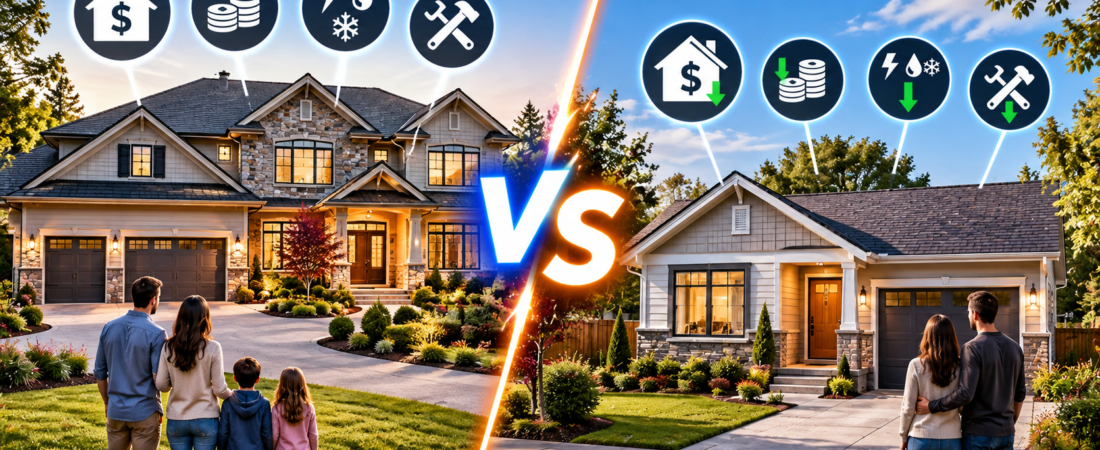
Big house vs smaller house sounds like an easy decision if you can afford both.
More bedrooms.
A larger kitchen.
A bigger garage.
A finished basement.
A home office.
A guest room.
Maybe even a theater, gym, or playroom.
If the mortgage payment fits your budget, why not buy more house?
Because the purchase price is only the beginning.
A bigger house doesn’t just cost more on closing day. It can cost more every single month you own it through mortgage interest, property taxes, insurance, utilities, maintenance, repairs, furniture, landscaping, cleaning, and renovations.
And because homes are often owned for many years, relatively small annual differences can compound into surprisingly large amounts of money.
So the real question isn’t:
“Can I afford the bigger house?”
It’s:
“Is the extra space worth everything I’ll pay for it?”
That can lead to a very different answer.
Big House vs Smaller House at a Glance
| Big House | Smaller House | |
|---|---|---|
| Purchase price | Higher | Lower |
| Mortgage payment | Higher | Lower |
| Property taxes | Usually higher | Usually lower |
| Heating/cooling | More expensive | Less expensive |
| Maintenance | More | Less |
| Furnishing cost | Higher | Lower |
| Storage | Excellent | Limited |
| Privacy | Better | Depends |
| Entertaining | Easier | More limited |
| Cleaning | More work | Easier |
| Flexibility | Excellent | Less |
| Money available elsewhere | Less | More |
The bigger house wins on space.
The smaller house often wins almost everywhere else financially.
But just how large can that difference become?
Start With a $250,000 Difference
Imagine two houses in the same general area.
House A
Purchase price: $850,000
House B
Purchase price: $600,000
The difference is:
$250,000.
Let’s assume a 20% down payment for both.
House A requires:
$170,000 down
House B requires:
$120,000 down
Before considering anything else, the larger house has already tied up an additional:
$50,000 in cash.
Now look at the mortgages.
House A:
$850,000 – $170,000 = $680,000 mortgage
House B:
$600,000 – $120,000 = $480,000 mortgage
Difference:
$200,000 borrowed.
And that’s where the real cost begins.
You Don’t Just Pay the Extra $200,000
Mortgage interest makes the difference much larger.
For a simple illustration, assume both buyers take a 30-year fixed mortgage at 6.5%.
The approximate principal-and-interest payment would be:
$680,000 mortgage
About $4,298 per month
$480,000 mortgage
About $3,034 per month
Difference:
about $1,264 per month.
That’s approximately:
$15,168 per year.
Over five years:
$75,840.
Over ten years:
$151,680.
Of course, part of those payments builds equity, so it would be wrong to call the entire difference an expense.
But the monthly cash-flow difference is very real.
And we haven’t added taxes, insurance, utilities or maintenance yet.
Property Taxes Can Magnify the Difference
Property taxes vary enormously by location, so there is no universal percentage that works everywhere.
But suppose, purely as an example, the effective property-tax burden works out to around 2% of the home’s value annually.
On an $850,000 house:
$17,000 per year
On a $600,000 house:
$12,000 per year
Difference:
$5,000 every year.
Unlike mortgage principal, property taxes don’t build equity.
You pay them year after year simply to continue owning the property.
Over ten years, ignoring changes in assessments and tax rates:
$50,000 difference.
Now combine that with the additional mortgage payment.
The bigger house is already consuming substantially more household cash flow.
Bigger Houses Cost More to Heat and Cool
This cost is easy to underestimate during a showing.
Nobody walks through a beautiful 3,800-square-foot house and thinks:
“I wonder what February costs.”
But after moving in, you will.
A larger home generally means more:
air volume to heat and cool,
windows,
exterior walls,
rooms,
HVAC demand,
and potentially multiple heating or cooling zones.
The exact difference depends heavily on:
climate,
insulation,
home age,
HVAC efficiency,
energy prices,
ceiling height,
and how you use the house.
A modern 3,500-square-foot house can sometimes be more efficient than an old 2,000-square-foot house.
So square footage alone doesn’t determine the bill.
But if two otherwise similar homes differ substantially in size, the larger one will usually require more energy.
And that bill never disappears.
Maintenance Scales With the House
There’s a popular homeownership guideline suggesting homeowners should budget roughly 1% to 4% of a home’s value per year for maintenance and repairs.
It isn’t a law.
Actual costs vary dramatically.
But it illustrates an important point.
More house generally means more things that can break.
More windows.
More flooring.
More bathrooms.
More plumbing fixtures.
More roofing.
More siding.
More appliances.
More HVAC capacity.
More rooms to paint.
Potentially more landscaping.
The difference may feel small in a normal year.
Then one year you need:
a roof,
two HVAC units,
exterior repairs,
and a water heater.
Suddenly square footage becomes expensive.
The Second HVAC System Problem
Large houses frequently have something smaller houses may not:
multiple major systems.
Maybe there are two furnaces.
Two air-conditioning units.
Multiple water heaters.
Additional electrical panels.
More garage doors.
More bathrooms.
Each individual item seems manageable.
The problem is multiplication.
A house with twice as many major components doesn’t necessarily cost exactly twice as much to maintain.
But it creates more opportunities for expensive failures.
That’s an ownership cost buyers rarely see in the listing price.
Then You Have to Fill the House
This is one of the strangest consequences of buying a large home.
Empty rooms look wrong.
So you buy things.
A guest bedroom needs:
a bed,
mattress,
nightstands,
lamps,
rug,
dresser,
and curtains.
The formal dining room needs:
a table,
chairs,
lighting,
and décor.
The basement needs:
a sectional,
TV,
tables,
maybe a bar.
The larger patio needs outdoor furniture.
The bigger walls need artwork.
The additional bedroom needs furniture even if nobody regularly sleeps there.
A larger house can quietly create thousands—or tens of thousands—of dollars in secondary spending.
The house creates the empty space.
Then the empty space creates purchases.
Renovations Get Bigger Too
Suppose you want new flooring.
At $8 per square foot installed, replacing:
1,500 square feet = $12,000
2,500 square feet = $20,000
Same material.
Same decision.
$8,000 difference.
Now apply that concept to:
painting,
roofing,
windows,
kitchen renovations,
bathrooms,
landscaping,
and cleaning.
A large house doesn’t merely cost more to purchase.
Many future projects scale with it.
Bigger Houses Can Also Consume More Time
Money isn’t the only cost.
Imagine two homes:
2,000 square feet.
3,800 square feet.
Which one takes longer to:
vacuum,
dust,
mop,
organize,
repair,
decorate,
and maintain?
You can outsource those jobs.
But then you’re converting time cost into financial cost.
A larger home may require:
a cleaning service,
landscaper,
pool service,
snow removal,
or more frequent professional maintenance.
There’s nothing wrong with paying for convenience.
But those expenses belong in the real cost of the house.
The Guest Room Question
Here’s a useful test.
Suppose your larger house includes a dedicated guest room.
How often is it occupied?
Five nights per year?
Ten?
Twenty?
Now ask:
How much did that room cost?
Not simply the furniture.
Part of the purchase price.
Mortgage interest.
Property tax.
Heating and cooling.
Insurance.
Maintenance.
Cleaning.
You may discover you’re paying thousands of dollars per year for a room used occasionally.
A hotel for visiting relatives might literally cost less.
That doesn’t mean you shouldn’t have a guest room.
It means the room has a price.
The Same Question Applies to Formal Rooms
Formal dining rooms are another good example.
Many homes contain rooms that look beautiful but aren’t heavily used.
Dining room.
Living room.
Guest room.
Bonus room.
Finished basement.
Extra office.
If your family actually uses them, fantastic.
But if several hundred square feet exist primarily because:
“It’s nice to have,”
you should understand what that convenience costs.
The most expensive square footage may be the square footage you rarely enter.
But Bigger Houses Have Real Advantages
This isn’t an argument that everyone should live in a tiny house.
Space can dramatically improve quality of life.
Imagine two parents working from home.
Three children.
Visiting grandparents.
Different sleep schedules.
Teenagers who want privacy.
A home gym that’s used five days a week.
In that household, extra square footage isn’t wasted.
It’s functional.
A larger home can provide:
privacy,
quiet,
storage,
dedicated workspaces,
better entertaining,
separation between adults and children,
room for extended family,
and flexibility as life changes.
Those benefits are difficult to express in dollars.
Sometimes they’re absolutely worth paying for.
Growing Families Need to Think Ahead
Buying too small can also be expensive.
Suppose you save money by purchasing a house that barely fits your family today.
Three years later, you need another bedroom.
Now you may face:
realtor commissions,
closing costs,
moving expenses,
new mortgage costs,
renovations,
and the disruption of moving.
Buying slightly more space than you currently need can therefore be financially sensible.
The key word is:
slightly.
Buying one additional bedroom for a planned child is different from buying 2,000 extra square feet because you might someday need it.
A Smaller House Can Buy Something More Valuable Than Space
Here’s the part buyers often miss.
Suppose the smaller house saves you:
$1,500 per month
after considering mortgage, taxes and some operating expenses.
That’s:
$18,000 per year.
What else could that money do?
Retirement contributions.
College savings.
Travel.
Investments.
Debt reduction.
Earlier retirement.
A better school district.
A shorter commute.
More financial security.
Or simply less pressure to earn more money every year.
The comparison isn’t really:
big house vs small house.
It’s:
extra square footage vs everything else that money could buy.
What If You Invested the Difference?
Let’s use a hypothetical example.
Suppose choosing the smaller house allows you to invest:
$1,000 per month.
Assume an average 7% annual return over 30 years.
The future value could be roughly:
$1.2 million.
That’s not guaranteed.
Investment returns fluctuate, taxes matter, and past performance doesn’t guarantee future results.
But the opportunity-cost principle is important.
A larger mortgage doesn’t only cost the money you spend.
It can also cost the future growth of money you could have invested elsewhere.
But Houses Appreciate Too
This is the strongest counterargument.
If property values rise, wouldn’t the more expensive house produce a larger dollar gain?
Potentially.
Suppose both homes appreciate at 3% annually.
An $850,000 home gaining 3% increases by:
$25,500
in the first year.
A $600,000 home gaining 3% increases by:
$18,000.
Difference:
$7,500.
Over long periods, that difference can compound.
So buying a larger home isn’t automatically financially foolish.
Real estate can build substantial wealth.
But there’s an important distinction.
A house is both:
an asset
and
a consumption expense.
The additional bedroom may appreciate.
But you’re also paying to finance, heat, insure, maintain and furnish it.
You have to consider both sides.
Location Can Matter More Than Size
Now imagine a different decision.
Option A
3,800-square-foot house farther away.
Option B
2,400-square-foot house closer to work, schools, restaurants and daily activities.
The larger house may provide more space.
But the smaller house might save:
commuting time,
fuel,
vehicle mileage,
and stress.
It may also sit in an area with stronger long-term housing demand.
Real estate isn’t priced by square footage alone.
Sometimes buying less house in a better location is a much smarter trade.
The Garage Test
Here’s another useful exercise.
Walk through the house you’re considering and identify every room.
For each one, ask:
How many days per week will I actually use this?
Kitchen: 7.
Primary bedroom: 7.
Family room: 7.
Office: 5.
Kids’ rooms: 7.
Guest room: maybe 0.2.
Formal dining room: maybe 0.5.
Finished basement: maybe 1.
Now look at how much of the house you’re actually using.
You may realize you don’t need a smaller house.
You need a house with a better floor plan.
A well-designed 2,500-square-foot home can sometimes feel more useful than a poorly designed 3,500-square-foot home.
The Bigger-House Trap
The dangerous question is:
“What’s the most house the bank will approve me for?”
A lender’s maximum isn’t necessarily your comfortable maximum.
The lender doesn’t know that you want to:
travel twice a year,
retire at 60,
pay for children’s college,
buy another car,
start a business,
or simply sleep well when something expensive breaks.
Being approved for a mortgage means you meet lending criteria.
It doesn’t mean the house fits your life.
Who Should Buy the Bigger House?
A bigger house can make sense if:
your family will genuinely use the space,
you plan to stay for a long time,
your income comfortably supports the carrying costs,
you need dedicated workspaces,
you regularly host family or guests,
you value privacy highly,
and buying it doesn’t prevent other major financial goals.
If the rooms are regularly used, they’re not wasted.
You’re paying for quality of life.
Who Should Buy the Smaller House?
The smaller house may be the smarter choice if:
the bigger home stretches your monthly budget,
several rooms would rarely be used,
you value travel or investing more than extra space,
you want lower maintenance,
you prefer financial flexibility,
or you’re buying more house primarily because the bank says you can.
A smaller house doesn’t necessarily mean compromising your lifestyle.
Sometimes it means protecting everything else in it.
Big House vs Smaller House: Is More Space Actually Making You Poorer?
The big house vs smaller house decision isn’t really about square footage.
It’s about what that square footage costs you over time.
A bigger house can provide genuine value:
privacy,
comfort,
storage,
flexibility,
and room for a growing family.
But unused space still has a mortgage.
It still gets taxed.
It still needs heating.
It still needs cooling.
It still needs maintenance.
And eventually, it will probably need renovation.
So before buying the largest home you can afford, ask one question:
What would I do with the money if I didn’t buy those extra 1,000 square feet?
If the answer is:
“Nothing important,”
buying the larger house may be worth every dollar.
But if the answer is:
invest,
travel,
retire earlier,
work less,
pay for college,
or simply have less financial stress,
then the smaller house may give you something more valuable than another room.
It may give you options.
Compare with Reason.