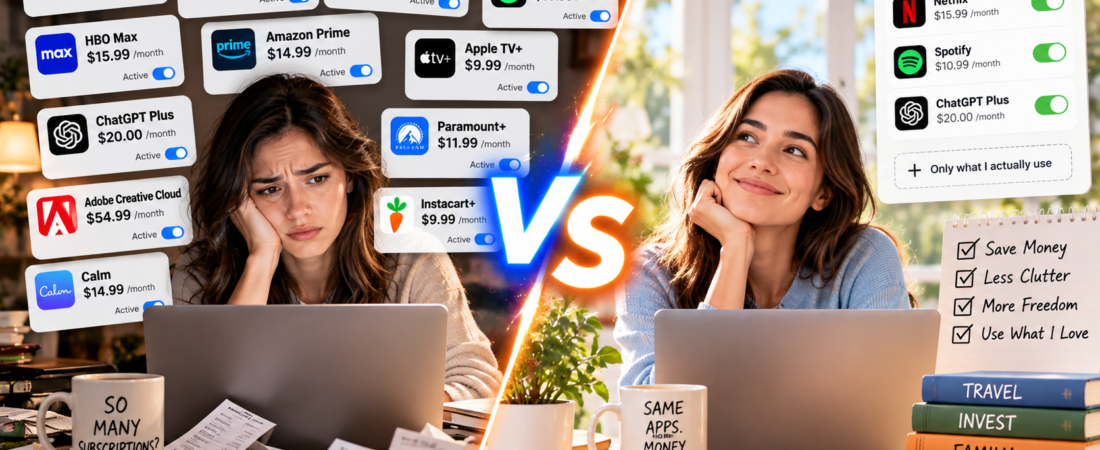
Canceling subscriptions vs keeping them may sound like a tiny personal-finance decision.
It’s only $9.99.
Or $14.99.
Maybe $5.99.
What’s another small monthly charge?
That’s exactly why subscriptions are so easy to ignore.
One streaming service doesn’t feel expensive.
Neither does one cloud-storage plan, fitness app, news subscription, AI tool, music service, food-delivery membership, meditation app, photo editor, or premium mobile app.
The problem appears when all of them quietly exist at the same time.
You may have signed up because of a free trial.
You may have needed an app for one project.
You may still use the service—but only once every few months.
Or you may have completely forgotten you’re paying for it.
The individual charges look harmless.
Together, they can become a surprisingly large annual expense.
So before asking whether another $10 subscription fits your budget, there may be a better question:
How many subscriptions are you already paying for that you wouldn’t buy again today?
Canceling Subscriptions vs Keeping Them at a Glance
| Cancel Unused Subscriptions | Keep Everything | |
|---|---|---|
| Monthly spending | Lower | Higher |
| Convenience | Some sacrifice | Maximum |
| Forgotten charges | Reduced | Easy to accumulate |
| Access to content | Less | More |
| Budget visibility | Better | Harder |
| Decision effort | Requires review | Almost none |
| Annual savings | Potentially meaningful | None |
| Best for | Intentional spending | Frequently used services |
The decision looks obvious.
If you don’t use something, cancel it.
But people don’t behave that way.
And subscription businesses know it.
The $9.99 Problem
Suppose someone asked you to spend:
$120 today
on an app you rarely use.
You might say no.
But what if the same app costs:
$9.99 per month?
That feels completely different.
Yet:
$9.99 × 12 = $119.88 per year.
The annual cost is nearly identical.
Monthly pricing changes how we perceive the purchase.
We don’t think:
“This service costs me $120.”
We think:
“It’s only ten bucks.”
That mental shift is one of the reasons subscription spending can accumulate without feeling expensive.
Now Multiply It
Imagine a household has these subscriptions:
Streaming service: $17.99
Second streaming service: $15.99
Music: $11.99
Cloud storage: $9.99
Fitness app: $14.99
Food-delivery membership: $9.99
AI subscription: $20
News subscription: $8
Photo/video app: $9.99
Miscellaneous mobile apps: $12
Total:
about $131 per month.
Annual cost:
roughly $1,572.
None of those charges looks alarming by itself.
Together, they’re a meaningful household expense.
And that’s before adding larger subscriptions such as:
cable,
internet,
cellphone plans,
software packages,
gaming memberships,
or premium financial services.
But The Real Problem Isn’t Subscriptions
Subscriptions themselves aren’t bad.
Some are excellent value.
If you use a $12 music service every day, it might be one of the cheapest forms of entertainment you buy.
If a $20 AI subscription saves you hours of work every month, canceling it to save money could actually be a bad decision.
If your family watches a streaming service every evening, $18 per month might be completely reasonable.
The problem isn’t:
“Am I paying for subscriptions?”
The better question is:
“Am I getting enough value from each one?”
Try the Re-Buy Test
This may be the simplest subscription audit possible.
Look at each recurring charge and ask:
If I didn’t already have this subscription, would I sign up for it today at the current price?
If the answer is immediately yes:
Keep it.
If the answer is:
“Maybe…”
that’s interesting.
If the answer is:
“Absolutely not…”
why are you still paying for it?
Existing subscriptions benefit from inertia.
Signing up requires a decision.
Keeping one usually requires nothing.
So we continue paying because doing nothing is easier than making another decision.
Free Trials Exploit Forgetfulness
Free trials are useful.
They’re also incredibly effective at turning temporary interest into recurring revenue.
You want to watch one show.
Start the trial.
You need a PDF tool once.
Start the trial.
Your child wants to play one game.
Start the trial.
You test a fitness app.
Start the trial.
Then life happens.
Thirty days later:
$14.99 charged.
Another month:
$14.99.
Eventually you notice.
Maybe six months later.
That’s nearly $90 spent on something you barely used.
The free trial wasn’t necessarily deceptive.
You simply forgot.
But forgetting has a price.
Annual Plans Create a Different Trap
Annual subscriptions can be excellent deals.
Paying $99 annually instead of $12 monthly saves money if you actually use the service.
But annual plans also hide the cost for longer.
You pay once.
Then forget about it.
Eleven months later, a renewal appears.
$99.
Or $149.
Or $199.
And because it only happens once per year, it can be surprisingly difficult to remember what the service even was.
The discount is only valuable if you would have kept the service anyway.
Paying $100 instead of $144 isn’t saving $44 if you barely use the product.
You spent $100.
How Much Does One Forgotten Subscription Matter?
Suppose you have an unused subscription costing:
$12.99 per month.
Annual cost:
$155.88.
Keep it for five years:
$779.40.
Again, $12.99 doesn’t feel significant.
Nearly $800 does.
Now imagine three forgotten or barely used subscriptions at similar prices.
You’re approaching:
$2,300 over five years.
Small recurring expenses become large because time multiplies them.
The “I Might Need It” Subscription
This one is particularly common.
You don’t use the service now.
But you might need it.
Someday.
Maybe.
So you keep paying.
Consider a $15-per-month service you use twice per year.
Annual cost:
$180.
If canceling and restarting takes five minutes, keeping it active for convenience may be an expensive way to avoid a tiny inconvenience.
For services that allow easy cancellation and reactivation, you don’t necessarily need permanent access.
You can subscribe when you need them.
Streaming Services Are Perfect for Rotation
Suppose your household wants access to five streaming services.
Instead of maintaining all five for 12 months, you could rotate them.
Month 1:
Service A.
Watch what you want.
Cancel.
Month 2:
Service B.
Month 3:
Service C.
Then return later when new content arrives.
This doesn’t work perfectly for every household.
Families may watch different shows simultaneously.
Sports can require specific services.
Children may have favorites.
But for many people, streaming subscriptions don’t need to be permanent.
You aren’t buying the service.
You’re buying access for a period of time.
Treat it that way.
Convenience Has Value
There’s an important counterargument.
Constantly canceling and restarting everything can become annoying.
Maybe saving $6 per month isn’t worth:
tracking renewals,
remembering passwords,
reconfiguring profiles,
redownloading content,
or explaining to the family why a service disappeared.
That’s reasonable.
Personal finance isn’t about minimizing every expense.
It’s about deciding which expenses improve your life enough to justify their cost.
The goal isn’t:
Cancel everything.
It’s:
Stop paying for things you don’t value.
Calculate Cost Per Use
Here’s another useful method.
Instead of asking what the subscription costs per month, calculate:
cost per use.
Imagine a fitness app costs:
$15 per month.
If you use it 20 times:
$0.75 per workout.
Excellent.
If you use it once:
$15 per workout.
Not so impressive.
Now consider a $20 AI service.
Use it 100 times per month:
$0.20 per use.
Use it twice:
$10 per use.
The same subscription can be either excellent or terrible value depending entirely on behavior.
The Subscription Audit
Once every few months, look through:
credit-card statements,
bank statements,
Apple subscriptions,
Google subscriptions,
PayPal recurring payments,
and any other payment accounts you regularly use.
Don’t just search for services you remember.
Search for recurring charges you don’t remember.
Those are often the interesting ones.
Then sort subscriptions mentally into three categories:
Use constantly
Keep.
Use occasionally
Evaluate.
Forgot I had this
Cancel unless there’s a compelling reason not to.
This can take less than an hour.
The savings can continue for years.
What If You Cut $75 Per Month?
Suppose an audit finds:
$15 unused fitness app
$10 delivery membership
$18 streaming service
$12 software subscription
$20 premium app
Total:
$75 per month.
Annual savings:
$900.
That’s already meaningful.
But consider the long-term opportunity cost.
If instead you invested $75 per month for 20 years and hypothetically earned an average 7% annual return, the account could grow to roughly:
$39,000.
That return isn’t guaranteed, and actual results would vary.
But it demonstrates an important point.
Recurring expenses don’t just consume today’s money.
They can consume money that could have been growing elsewhere.
The Bigger Danger: Subscription Creep
Most people don’t wake up and decide:
“I’d like $200 per month in subscriptions.”
It happens gradually.
January:
one streaming service.
March:
cloud storage.
April:
fitness app.
June:
AI tool.
August:
sports streaming.
September:
photo editing.
November:
another streaming service.
Each decision seems independent.
But your bank account sees the total.
This is subscription creep.
And because subscriptions renew automatically, spending can rise without requiring another purchase decision.
Auto-Renewal Changes the Psychology of Spending
Traditional purchases require action.
You want something.
You decide.
You pay.
Subscriptions reverse that process.
Once you’re subscribed, not spending requires action.
You have to:
remember the charge,
find the account,
locate cancellation,
decide whether you might need it,
and actually cancel.
Doing nothing means paying again.
That makes recurring revenue extremely powerful for businesses.
And potentially expensive for consumers.
Don’t Cancel High-Value Subscriptions Just to Feel Frugal
There’s another mistake.
People sometimes aggressively cut small expenses while ignoring much larger ones.
Canceling a $10 service you use every day while overpaying hundreds per month for:
housing,
insurance,
car payments,
interest,
or other major expenses
doesn’t necessarily improve your finances much.
Subscription audits should target low-value spending, not simply recurring spending.
If something makes your life significantly better and fits comfortably within your budget, keep it.
Money exists to be used.
A Better Rule: Every Subscription Has to Earn Its Renewal
Instead of automatically keeping subscriptions until you decide to cancel them, reverse the assumption.
Every few months, imagine everything expires tonight.
Which ones would you actively renew tomorrow?
Maybe:
music.
AI.
cloud storage.
one streaming service.
Everything else has to prove itself.
That simple change turns subscription spending from passive to intentional.
Canceling Can Also Reveal Whether You Actually Care
Cancel something you’re uncertain about.
Then wait.
Something interesting may happen.
You may immediately miss it.
Great.
Restart it.
Now you know it has value.
Or three months may pass and you never think about it again.
That’s even more useful information.
Cancellation doesn’t always have to be permanent.
It can be an experiment.
Who Should Keep Their Subscriptions?
Keeping a subscription makes sense when:
you use it frequently,
it saves meaningful time,
it replaces a more expensive alternative,
your family regularly uses it,
it provides important storage or services,
or canceling would create more inconvenience than the savings justify.
The cheapest lifestyle isn’t automatically the best lifestyle.
Value matters more than price alone.
Who Should Start Canceling?
A subscription deserves scrutiny if:
you forgot you had it,
you haven’t used it recently,
you signed up for one specific task,
you keep it because you “might” need it,
you have overlapping services,
or you wouldn’t buy it again today.
That last one may be the most important.
If you wouldn’t buy something today, continuing to pay for it tomorrow deserves an explanation.
Canceling Subscriptions vs Keeping Them: How Much Are You Really Losing?
The surprising thing about canceling subscriptions vs keeping them is that the decision rarely feels important.
That’s exactly why it can become expensive.
$7.99 doesn’t feel important.
$11.99 doesn’t feel important.
$19.99 doesn’t feel important.
But subscriptions don’t exist individually in your budget.
They stack.
And then they repeat.
Every month.
Every year.
The answer isn’t to declare war on subscriptions.
It’s to stop letting yesterday’s decisions automatically spend tomorrow’s money.
Open your statement.
Find every recurring charge.
Then ask:
“Would I buy this again today?”
If the answer is no, you may have just found the easiest expense in your budget to eliminate.
Compare with Reason.