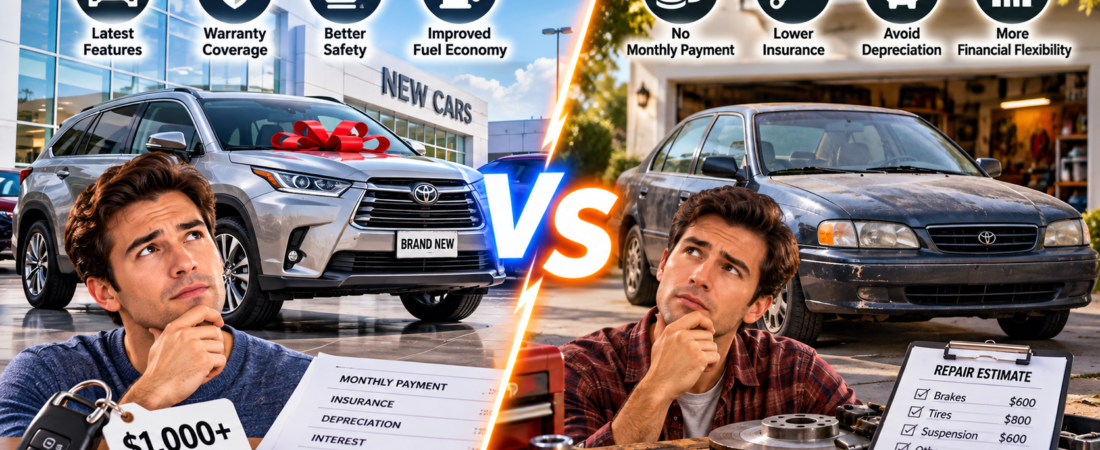
New car vs keeping your old car sounds like an easy decision when your current vehicle starts getting annoying.
The brakes need work.
The tires are getting old.
A warning light appears.
Maybe the infotainment system feels ancient compared with today’s giant screens.
Then you receive a $2,000 repair estimate and think:
“Why am I putting this much money into an old car?”
So you visit a dealership.
Suddenly that $2,000 repair bill becomes a $900 monthly payment.
And somehow the new car feels like the financially responsible choice.
But is it?
In 2026, AAA estimates that the average cost to own and operate a new vehicle is $12,863 per year, or about $1,072 per month, when depreciation, financing, fuel, insurance and other ownership expenses are included. AAA
That doesn’t automatically mean keeping an old car is cheaper.
But it does mean a big repair bill shouldn’t be compared with zero.
It should be compared with the real cost of replacing the car.
New Car vs Keeping Your Old Car at a Glance
| Buy a New Car | Keep Your Old Car | |
|---|---|---|
| Monthly payment | Usually substantial | Possibly $0 |
| Repairs | Usually lower initially | Usually higher |
| Depreciation | High | Much lower |
| Insurance | Often higher | Often lower |
| Technology | Latest | Older |
| Warranty | Strong advantage | Often expired |
| Reliability | Usually better | Depends on condition |
| Financial flexibility | Lower | Higher |
| Surprise expenses | Fewer | More likely |
| Best for | Reliability, safety, features | Minimizing total cost |
The surprising part is that the old car doesn’t have to be cheap to repair to win.
It just has to be cheaper than replacing it.
The $2,500 Repair That Feels Too Expensive
Imagine your seven-year-old SUV is paid off.
It’s worth approximately $15,000.
Then your mechanic gives you bad news.
You need:
brakes,
tires,
suspension work,
and some other maintenance.
Total:
$2,500.
That’s painful.
You could spend $2,500 fixing an old vehicle.
Or you could trade it in and buy a shiny new $50,000 SUV.
Emotionally, the new SUV may feel like you’re escaping the repair bill.
Financially, something very different just happened.
You didn’t avoid spending $2,500.
You potentially committed yourself to tens of thousands of dollars of additional vehicle cost.
Compare Annual Cost, Not Repair Cost
Suppose a replacement vehicle creates an $850 monthly payment.
That’s:
$10,200 per year.
Your old vehicle needs a $2,500 repair.
Even if you spend another $1,500 on repairs over the following year, that’s:
$4,000.
The new car payment alone would still cost:
$6,200 more during that year.
And that doesn’t include possible differences in:
insurance,
registration,
sales tax,
or depreciation.
Of course, this is only an illustration. Actual costs vary dramatically by vehicle and financing.
But it demonstrates the mistake people make.
We compare:
$2,500 repair
with:
“new car.”
Instead, compare:
$2,500 repair
with:
the total cost of owning the replacement.
The $1,000 Car Payment Is No Longer Extreme
A four-figure car payment once sounded unusual.
Not anymore.
Recent reporting indicates that more than 20% of new-car loans now carry monthly payments above $1,000, while longer loan terms have also become increasingly common. MarketWatch
That’s important because $1,000 per month becomes:
$12,000 per year.
Over five years:
$60,000.
Over seven years:
$84,000.
That doesn’t mean the vehicle itself costs $84,000—the payment includes financing and depends on down payment, trade-in and loan structure.
But it illustrates how easily a monthly number can disguise a huge long-term commitment.
Your Paid-Off Car Has a Hidden Superpower
A paid-off vehicle does something financially valuable every month.
It doesn’t send you a bill.
That sounds obvious.
But people often underestimate how powerful it is.
Suppose your old car requires an average of:
$2,400 per year
in maintenance and repairs.
That sounds terrible.
It’s $200 per month.
Now compare it with an $800 payment:
$9,600 per year.
Your “expensive” old car could require thousands of dollars in repairs and still cost less than the payments on its replacement.
This doesn’t mean you should keep a dying vehicle forever.
It means repair expenses need context.
Repairs Feel Worse Because They Arrive All at Once
There’s a psychological difference between:
$2,000 today
and:
$700 every month.
The $2,000 repair hurts.
You notice it.
You complain about it.
You remember it.
The monthly payment becomes background noise.
It automatically leaves your account.
But after three months, that $700 payment has already cost:
$2,100.
After one year:
$8,400.
The repair looked more expensive because you experienced the cost at once.
The car payment may actually be much larger—it just arrives slowly.
Depreciation Is the Expense You Never See
Here’s another reason new cars can be deceptive.
Depreciation doesn’t show up as a bill.
Nobody sends you an invoice saying:
“Your car lost $361 in value this month.”
But economically, the loss is real.
AAA’s 2025 analysis estimated average depreciation at $4,334 per year across the new vehicles in its study, making depreciation the largest ownership-cost category. AAA Newsroom
Older vehicles have already experienced much of their steep early depreciation.
That’s one reason keeping a reliable older vehicle can be financially powerful.
Its repair costs may increase.
But its depreciation may have slowed considerably.
New Cars Also Change Your Insurance Equation
Replacing an older paid-off car with a much more valuable new vehicle can affect insurance costs.
You may want or need broader coverage.
Repair costs for modern vehicles can also be substantial because of:
cameras,
radar sensors,
LED lighting,
parking sensors,
and advanced driver-assistance systems.
AAA’s 2025 study estimated average full-coverage insurance for the new vehicles it studied at $1,694 per year, although actual premiums vary enormously by driver, vehicle and location. AAA Newsroom
So don’t compare only:
old car repair vs new car payment.
Compare:
total old-car cost vs total new-car cost.
But Eventually an Old Car Really Does Become Too Expensive
Keeping your old vehicle isn’t automatically smart.
There’s a point where the equation changes.
Suppose your car has:
major transmission problems,
serious engine issues,
persistent electrical faults,
structural rust,
repeated breakdowns,
or multiple major repairs approaching at the same time.
Now the question isn’t whether one repair is worth doing.
It’s whether the vehicle is entering a cycle of continuous expensive failures.
A $3,000 repair that gives you another reliable three years may be excellent value.
A $3,000 repair followed by another $4,000 problem six months later is different.
Reliability Has a Financial Value Too
Imagine your vehicle breaks down three times per year.
Each breakdown means:
tow truck,
missed work,
rental car,
Uber rides,
rescheduled appointments,
and stress.
Those costs matter.
Someone who works from home and owns a second vehicle can tolerate an unreliable car much more easily than someone who drives 70 miles every day and absolutely must arrive at work.
So the equation isn’t simply:
repair cost < car payment.
Reliability has economic value.
Safety Can Change the Decision
There’s also a difference between keeping a five-year-old car and keeping a 20-year-old car.
Modern vehicles may offer:
automatic emergency braking,
blind-spot monitoring,
lane-departure warning,
improved crash structures,
better airbags,
and other safety technology.
You shouldn’t replace a perfectly good vehicle every few years just because a newer screen exists.
But safety improvements can eventually become a legitimate reason to upgrade.
Especially when the vehicle carries your family every day.
Don’t Confuse Maintenance With Failure
This is one of the biggest mistakes owners make.
Your car reaches 60,000 or 80,000 miles and suddenly needs:
tires,
brakes,
battery,
fluids,
belts,
spark plugs,
or suspension components.
You think:
“Everything is breaking.”
Maybe not.
Some of those items are simply normal maintenance.
A new vehicle will eventually need tires and brakes too.
Replacing a vehicle because it needs wear items can be like buying a new house because the old one needs a new water heater.
The expense is real.
But it doesn’t necessarily mean the asset is finished.
Try the 12-Month Test
Before replacing your vehicle, estimate what keeping it will realistically cost over the next 12 months.
Include:
expected repairs,
maintenance,
tires,
insurance,
registration,
fuel,
and any remaining payment.
Then estimate the same costs for the replacement.
Include:
down payment,
monthly payments,
sales tax,
insurance,
registration,
fuel or electricity,
and expected depreciation.
Now compare the totals.
That is a much more useful calculation than:
“My mechanic wants $2,000.”
What If You Invested the Payment Instead?
Suppose your current car is paid off and you decide not to replace it.
Instead, you automatically save:
$700 per month.
After one year:
$8,400.
After three years:
$25,200, even before considering investment returns.
Now something interesting happens.
Your old vehicle eventually does need replacement.
But instead of walking into the dealership with no cash and needing a huge loan, you may have accumulated a substantial down payment—or enough to buy a less expensive vehicle outright.
Keeping the old car didn’t simply save money.
It changed the financing of your next car.
The Best Time to Start a Car Payment May Be Before You Buy the Car
If your paid-off vehicle is still reliable, try making a pretend car payment.
Planning to spend $800 per month on your next vehicle?
Transfer $800 per month into savings now.
If that feels comfortable, great.
You’re building your down payment.
If it feels painful, you’ve learned something important before signing a six- or seven-year loan.
And if your old car suddenly dies?
You already have money waiting.
When Buying New Makes Sense
There are absolutely situations where replacement is the better decision.
Consider buying a newer vehicle when your current car:
is becoming genuinely unreliable,
needs repairs approaching its realistic value,
has serious safety or structural issues,
no longer fits your family’s needs,
creates significant work or transportation disruptions,
or is likely to require multiple major repairs soon.
A newer car can also provide something difficult to put into a spreadsheet:
predictability.
Warranty coverage and improved reliability can be worth paying for.
When Keeping the Old Car Usually Wins
Keeping your current vehicle deserves serious consideration when:
it’s paid off,
the engine and transmission remain healthy,
repairs are mostly normal wear items,
you drive relatively few miles,
insurance is inexpensive,
the vehicle still fits your lifestyle,
and you’re considering replacement mostly because you want something newer.
Wanting a new car isn’t wrong.
Cars are products people enjoy.
Just don’t turn a lifestyle purchase into a fake financial necessity.
New Car vs Keeping Your Old Car: The Real Question
The biggest mistake in the new car vs keeping your old car decision is asking:
“Is this old car worth spending another $2,000 on?”
Ask a different question:
“What will replacing this car cost me over the next three to five years?”
AAA’s latest 2026 analysis puts average new-vehicle ownership and operating costs at about $1,072 per month under its methodology. AAA
That makes a $2,000 repair look very different.
Sometimes the old car really is finished.
Sometimes replacing it is safer, more reliable and completely reasonable.
But sometimes the most expensive thing wrong with your old car is simply this:
You’re tired of driving it.
And that’s fine.
Just know what you’re paying to fix.
Compare with Reason.