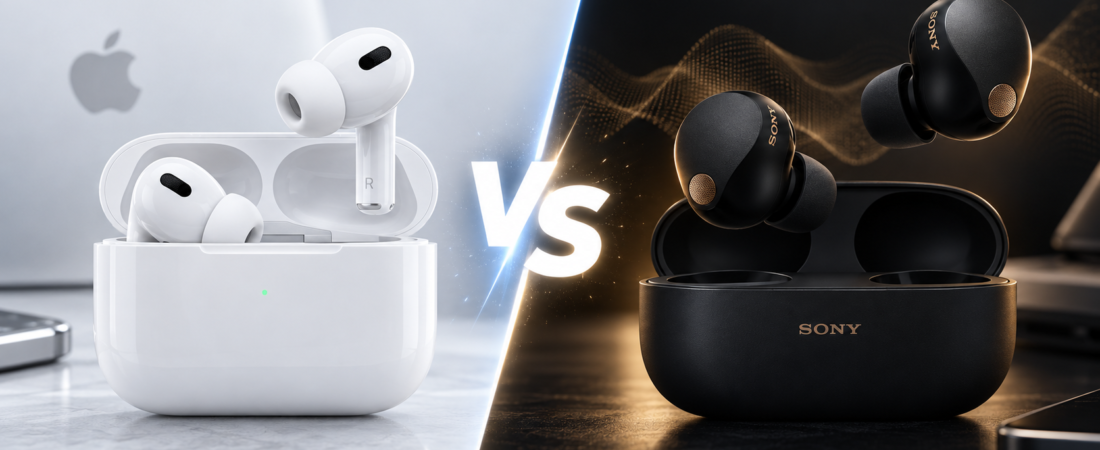
Choosing between the Apple AirPods Pro 3 and Sony WF-1000XM5 is about more than finding the earbuds with the strongest noise cancellation or the most impressive specifications.
Both offer premium sound, active noise cancellation, wireless charging, and features designed for everyday listening. But they approach the experience differently.
Apple focuses on seamless integration, intelligent listening features, hearing health, and convenience for iPhone users. Sony emphasizes customizable sound, flexible Bluetooth connectivity, and a listening experience that works across different platforms.
So which pair makes more sense for your money?
The answer depends on the devices you use, the music you enjoy, and how you plan to wear your earbuds.
AirPods Pro 3 vs Sony WF-1000XM5: At a Glance
| Feature | Apple AirPods Pro 3 | Sony WF-1000XM5 |
|---|---|---|
| Active noise cancellation | Advanced ANC with Adaptive Audio | Advanced ANC with multiple microphones and dedicated processors |
| Sound customization | Adaptive EQ, Personalized Spatial Audio | Custom EQ, DSEE Extreme, LDAC |
| Battery life with ANC | Up to 8 hours | Up to 8 hours |
| Total listening time with ANC | Up to 24 hours | Up to 24 hours |
| Bluetooth | 5.3 | 5.3 |
| Multipoint connection | Apple ecosystem automatic switching | Two-device Bluetooth multipoint |
| Water resistance | IP57 earbuds and case | IPX4 earbuds |
| Hearing health features | Hearing Test, Hearing Aid, Hearing Protection | No equivalent integrated hearing-aid feature |
| Workout heart rate tracking | Yes, with compatible devices and apps | No |
| Best compatibility | iPhone and Apple ecosystem | Android, Windows, and mixed-device setups |
| Sound adjustment | Mostly automatic | Extensive user customization |
Quick verdict: AirPods Pro 3 are the more convenient all-around choice for people invested in Apple devices. Sony WF-1000XM5 are particularly appealing to listeners who value adjustable sound and broader device flexibility.
Neither pair is automatically better for everyone.
1. Sound Quality: Natural Convenience vs Personal Control
Sound quality is one of the biggest reasons to consider premium wireless earbuds.
However, better sound is not always about stronger bass, louder volume, or support for a particular Bluetooth codec.
It is about how accurately and enjoyably your earbuds reproduce the music you listen to.
AirPods Pro 3: Balanced Sound Without Much Adjustment
Apple’s AirPods Pro 3 use a custom driver, high-dynamic-range amplifier, and Adaptive EQ to adjust audio performance.
The redesigned acoustic architecture aims to improve bass response, vocal clarity, and the sense of space in recordings.
Personalized Spatial Audio with dynamic head tracking adds another dimension when listening to compatible content.
The main advantage is simplicity.
Users do not need to spend much time adjusting settings to get a consistent listening experience.
However, Apple provides less traditional manual equalizer control than Sony.
Sony WF-1000XM5: More Control Over Your Music
Sony takes a different approach.
The WF-1000XM5 use an 8.4 mm Dynamic Driver X, DSEE Extreme processing, and support for the LDAC Bluetooth codec.
LDAC can transmit higher-bitrate audio from compatible devices, although the actual audible benefit depends on the recording, connection quality, and listening conditions.
Sony’s Sound Connect app also provides equalizer adjustments that allow users to modify the sound to their preferences.
That makes Sony particularly attractive for listeners who want to experiment with bass, vocals, and overall tonal balance.
One important limitation: iPhones do not support LDAC, so Sony’s codec advantage is more relevant to compatible Android devices.
Our take: Sony offers more sound customization and codec flexibility. Apple offers a simpler, more automated listening experience.
For most listeners, ear-tip fit and personal sound preferences may matter more than the difference between supported codecs.
2. Noise Cancellation: Which Blocks More Noise?
Both earbuds are designed to reduce background noise in environments such as airplanes, offices, public transportation, and busy streets.
But active noise cancellation is not a single performance number.
Low-frequency engine noise, conversations, keyboard sounds, and sudden high-pitched noises present different challenges.
AirPods Pro 3 Noise Cancellation
Apple redesigned the AirPods Pro 3 acoustic system and ear tips to improve passive isolation and active noise cancellation.
The earbuds also offer Adaptive Audio, which adjusts the balance between noise cancellation and environmental awareness.
Conversation Awareness can lower media volume when the user begins speaking.
This combination is particularly useful for commuters and people who regularly move between quiet and noisy environments.
Sony WF-1000XM5 Noise Cancellation
Sony uses its Integrated Processor V2, HD Noise Cancelling Processor QN2e, multiple microphones, and noise-isolating ear tips.
Its system is designed to reduce a broad range of environmental noise.
Sony also offers Adaptive Sound Control and an Ambient Sound mode, allowing users to customize how much surrounding sound they hear.
Which Has Better ANC?
Both have sophisticated noise-cancellation systems, but their manufacturer specifications do not establish a reliable head-to-head winner.
The seal created by the ear tips can substantially affect real-world performance.
A poorly fitted pair of otherwise excellent earbuds may block less noise than a properly fitted competitor.
Our take: Treat noise cancellation as a close competition until you can compare independent, standardized measurements or try both models in the same environment.
Apple may appeal more to users who prefer automatic adjustments, while Sony offers more manual control.
3. Comfort and Fit: Small Differences That Matter
Premium sound means little if the earbuds become uncomfortable after an hour.
AirPods Pro 3
Apple redesigned the shape of the AirPods Pro 3 and includes five silicone ear-tip sizes, from XXS to L.
Each earbud weighs approximately 5.55 grams.
The expanded tip selection is useful for people who struggle to find a secure seal.
The stem-style design also provides convenient physical controls, including volume swipes.
Sony WF-1000XM5
Sony uses a compact, stemless design with noise-isolating ear tips.
The earbuds weigh approximately 5.9 grams each with medium tips.
Sony’s ear-tip material can provide effective isolation, but its texture and fit may feel different from conventional silicone tips.
Some users may prefer Sony’s rounded design, while others may find Apple’s stem-style shape more comfortable.
Neither design guarantees a better fit for every ear.
Our take: Apple has a slight advantage in included tip-size variety, but comfort is highly individual. If possible, purchase from a retailer with a reasonable return policy.
4. Battery Life: Surprisingly Similar
Battery life is an important consideration for long flights, workdays, and travel.
According to their official specifications:
| Battery comparison | AirPods Pro 3 | Sony WF-1000XM5 |
|---|---|---|
| Earbuds with ANC enabled | Up to 8 hours | Up to 8 hours |
| Total with charging case, ANC enabled | Up to 24 hours | Up to 24 hours |
| Quick charging | About 1 hour from 5 minutes | About 1 hour from 3 minutes |
| USB-C charging | Yes | Yes |
| Wireless case charging | Yes | Yes |
On paper, neither product has a meaningful advantage in total ANC listening time.
Sony’s advertised quick-charge performance is slightly faster, while Apple supports MagSafe, compatible Apple Watch chargers, Qi charging, and USB-C.
Real-world battery life varies with volume, features, connection conditions, and battery age.
Our take: Battery life should not be the deciding factor for most buyers. Both offer enough advertised endurance for typical daily use.
5. iPhone vs Android: The Biggest Practical Difference
This is where the buying decision becomes much clearer.
Why AirPods Pro 3 Make Sense for iPhone Users
Apple’s biggest advantage is not necessarily its audio hardware.
It is the way AirPods work with the broader Apple ecosystem.
Features include:
- Fast setup and convenient device integration
- Automatic switching among compatible Apple devices
- Find My support and Precision Finding for the charging case
- Personalized Spatial Audio
- Siri integration
- Hearing health features on supported devices
- Heart rate sensing during compatible workouts
- Live Translation in supported languages and regions
For someone who regularly uses an iPhone, MacBook, and iPad, these conveniences can make a noticeable difference.
AirPods Pro 3 also work as Bluetooth earbuds with non-Apple devices, but some advanced features are unavailable or limited.
Why Sony WF-1000XM5 Make Sense for Android and Windows
Sony’s earbuds offer broader flexibility across platforms.
Their two-device Bluetooth multipoint capability is especially useful for people who switch between a Windows laptop and an Android phone.
Sony also supports SBC, AAC, LDAC, and LC3 Bluetooth audio formats, subject to device compatibility.
The Sound Connect app allows users to adjust sound and listening behavior.
This makes Sony a strong option for mixed-device households or people who do not want their earbuds tied closely to one ecosystem.
Our take: For an iPhone-centered setup, Apple is the easier recommendation. For Android or mixed-platform use, Sony is often the more flexible choice.
6. Calls, Meetings, and Everyday Convenience
Wireless earbuds are not used only for music.
Many people rely on them for work calls, video meetings, and conversations while walking outside.
AirPods Pro 3 offer beamforming microphones, Voice Isolation, and Apple-device integration.
Sony WF-1000XM5 use multiple microphones, bone-conduction sensing, and AI-based noise reduction to improve voice pickup.
Both are designed to separate speech from background noise.
However, call performance can vary significantly with wind, traffic, device software, and microphone placement.
Without controlled testing under identical conditions, declaring a universal call-quality winner would be misleading.
For everyday convenience, Apple’s physical stem controls may be easier for some users to operate.
Sony’s customizable touch controls may appeal to people who prefer a stemless design.
Our take: Both are suitable for regular calls. Choose based on device compatibility, control preferences, and fit rather than assuming one has consistently better microphones.
7. Fitness and Water Resistance
For people who use earbuds while running, exercising, or walking in the rain, durability matters.
AirPods Pro 3 carry an IP57 rating for both the earbuds and charging case.
Sony WF-1000XM5 earbuds carry an IPX4 rating, while the charging case is not water resistant.
IP57 provides a higher specified level of dust and water protection than IPX4, although neither rating makes the product suitable for swimming.
Apple also includes heart rate sensing for workouts, supported by compatible devices and apps.
Sony does not offer an equivalent built-in heart rate sensor.
Our take: AirPods Pro 3 are the stronger choice for buyers who prioritize workout features and environmental resistance.
That does not make Sony unsuitable for exercise, but Apple offers more fitness-specific functionality.
8. Price and Value: Is the Difference Worth Paying?
Apple lists AirPods Pro 3 at a U.S. price of $249.
Sony WF-1000XM5 launched at a higher premium price, but retail discounts can make them substantially more affordable.
Because sale prices change frequently, the actual price difference matters more than the original launch price.
Consider three scenarios.
Scenario A: Both Cost About the Same
For an iPhone user, AirPods Pro 3 offer the more compelling combination of convenience, hearing features, and ecosystem integration.
For an Android user, Sony’s codec support, equalizer, and multipoint connectivity may be more valuable.
Scenario B: Sony Is Significantly Cheaper
A substantial Sony discount can change the recommendation.
If the WF-1000XM5 cost $50 to $80 less, they may offer better value for someone who primarily wants excellent music playback and noise cancellation.
Scenario C: You Already Own Apple Devices
AirPods Pro 3 may justify a modest premium if automatic switching, Find My, hearing features, and workout tracking are useful in your daily routine.
Our take: Do not pay extra simply because one model is newer or has a more impressive feature list. Pay for the capabilities you will actually use.
9. Which Earbuds Should You Buy?
Choose AirPods Pro 3 If You:
- Use an iPhone as your primary phone
- Regularly switch between Apple devices
- Want hearing health and workout features
- Prefer automatic listening adjustments
- Value stronger rated dust and water resistance
- Want convenient integration with Find My
Choose Sony WF-1000XM5 If You:
- Use an Android phone or Windows computer
- Prefer customizable equalizer settings
- Want LDAC support with compatible devices
- Frequently connect to two Bluetooth devices
- Prefer a compact, stemless design
- Find Sony at a meaningful discount
10. Frequently Asked Questions
Are AirPods Pro 3 better than Sony WF-1000XM5?
AirPods Pro 3 are generally the more convenient choice for Apple users, while Sony WF-1000XM5 offer more audio customization and cross-platform flexibility. The better choice depends on your devices and priorities.
Which earbuds have better noise cancellation?
Both offer advanced ANC. Without directly comparable independent testing, neither can be declared the definitive winner. Ear-tip fit and environmental conditions are major factors.
Do Sony WF-1000XM5 work with iPhones?
Yes. They work with iPhones through Bluetooth and support AAC audio. However, iPhones do not support Sony’s LDAC codec.
Can AirPods Pro 3 connect to Android phones?
Yes. AirPods Pro 3 can function as Bluetooth earbuds with Android phones, but several Apple-specific features will be limited or unavailable.
Which earbuds have longer battery life?
Both advertise up to eight hours of listening with ANC enabled and up to 24 hours with their charging cases.
Are AirPods Pro 3 better for working out?
They offer IP57-rated earbuds and case, plus heart rate sensing for supported workouts. Sony WF-1000XM5 remain suitable for many workouts but have IPX4-rated earbuds and no integrated heart rate sensor.
Is Sony WF-1000XM5 still worth buying?
Yes, particularly at a discount. Its adjustable sound, multipoint connectivity, and premium audio capabilities remain attractive, especially for Android and mixed-device users.
Final Verdict: Which One Makes More Sense?
The AirPods Pro 3 and Sony WF-1000XM5 are both capable premium wireless earbuds, but they are designed around different priorities.
AirPods Pro 3 are our overall recommendation for iPhone users. Their combination of Apple integration, hearing features, workout tracking, convenient controls, and environmental resistance makes them a practical everyday choice.
Sony WF-1000XM5 are our recommendation for listeners who prioritize customization and platform flexibility. Their equalizer, LDAC support, multipoint connectivity, and potential discounts make them particularly compelling outside the Apple ecosystem.
If both cost the same and you use an iPhone, choose AirPods Pro 3.
If you use Android or regularly switch between different platforms, Sony WF-1000XM5 may make more sense.
And if Sony is heavily discounted, the value equation becomes even more interesting.
The best earbuds are not necessarily the ones with the longest feature list. They are the ones that fit your ears, your devices, and your listening habits.
Compare with Reason.