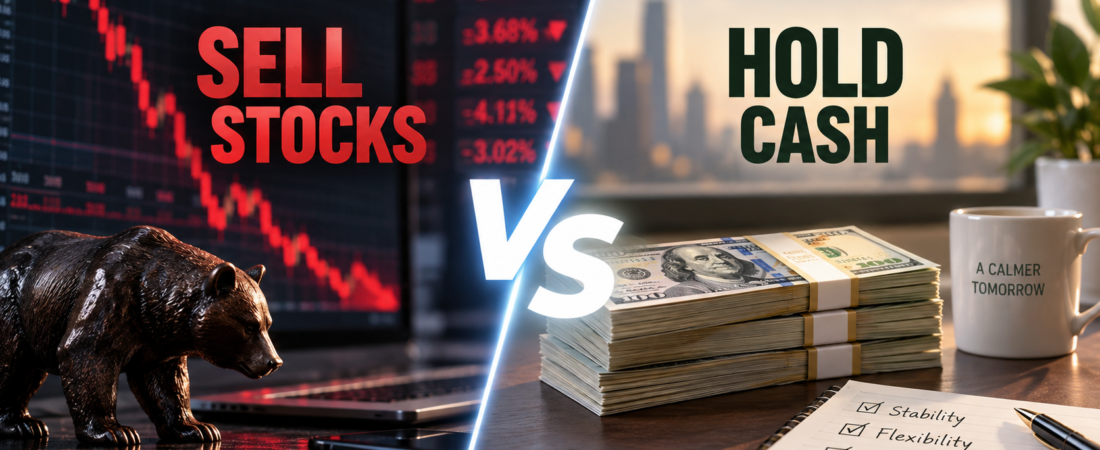
When the stock market becomes volatile, investors often face one difficult question: Should I sell my stocks and move into cash, or stay invested and wait for the market to recover?
The decision becomes even harder when headlines warn about high valuations, inflation, interest rates, economic uncertainty, or a possible recession.
Selling stocks can feel like the safest choice. Cash provides stability, reduces exposure to market declines, and offers the flexibility to invest again later.
But selling also creates another risk: missing a market recovery.
Historically, some of the stock market’s strongest days have occurred during periods of significant volatility. Investors who move entirely into cash may avoid additional losses, but they also risk missing the rebound.
So which strategy actually makes more sense?
In this comparison, we’ll examine three choices: selling stocks, holding existing investments, and moving part of a portfolio into cash. We’ll also calculate what happens to a hypothetical $100,000 portfolio under different market scenarios.
The goal isn’t to predict the next market crash. It’s to help investors make decisions based on their financial needs, investment timeline, and ability to tolerate losses.
Comparison Outline
- Selling stocks vs holding cash: Key differences
- Why investors become nervous during volatile markets
- What happens to a $100,000 portfolio during a market decline?
- The hidden risk of selling before a recovery
- When holding cash makes financial sense
- Selling everything vs reducing stock exposure
- The real cost of keeping money in cash
- How investment timelines change the decision
- Practical strategies for uncertain markets
- Frequently asked questions
- The Compareason Verdict
1. Sell Stocks or Hold Cash: Quick Comparison
Before making any investment decision, it’s important to understand what each strategy offers.
| Factor | Stay Invested in Stocks | Sell Stocks and Hold Cash |
|---|---|---|
| Short-term market risk | High | Low |
| Potential long-term growth | Higher, but uncertain | Generally lower |
| Protection from stock market declines | Limited | Stronger |
| Exposure to market recoveries | Maintained | Lost until reinvested |
| Liquidity | Generally high | Very high |
| Inflation protection | Potential over long periods | Limited |
| Emotional comfort | Depends on risk tolerance | Often greater |
| Need to time the market | No, if maintaining an allocation | Yes, if planning to buy back |
| Best suited for | Long-term investors | Short-term financial needs |
Neither strategy is universally better.
Stocks provide ownership in businesses and the opportunity for long-term growth. Cash provides liquidity and greater stability in nominal dollar terms.
The real question is how much uncertainty an investor can afford to accept.
2. Why Do Investors Become Afraid During Market Volatility?
Stock market anxiety is rarely caused by one factor.
Several concerns can appear simultaneously.
High stock valuations
When stock prices rise faster than corporate earnings, investors may worry that future returns will be disappointing.
Interest rate uncertainty
Higher interest rates can increase borrowing costs and reduce the relative attractiveness of some investments.
Economic slowdown
Concerns about unemployment, consumer spending, and corporate profits can make investors more cautious.
Geopolitical uncertainty
International conflicts, trade restrictions, and supply-chain disruptions can influence market expectations.
Recent investment gains
Investors who have experienced substantial gains may become particularly concerned about losing those profits.
These concerns can be legitimate.
However, legitimate economic risks do not automatically mean that selling stocks is the correct decision.
Markets reflect expectations about the future, not just current economic conditions.
By the time a risk becomes widely discussed, some of its potential impact may already be reflected in stock prices.
The Compareason insight: A frightening headline is not the same thing as a reliable signal to sell.
3. What Happens to a $100,000 Portfolio During a Market Decline?
Let’s examine a hypothetical investor with $100,000 invested entirely in a diversified stock portfolio.
Assume the investor has three choices:
- Remain 100% invested in stocks.
- Sell everything and move into cash.
- Move 30% into cash while keeping 70% invested.
For simplicity, assume the cash earns no interest during the immediate market decline. We’ll examine cash interest separately later.
Scenario A: The Market Falls 10%
| Strategy | Portfolio Value | Loss |
|---|---|---|
| 100% Stocks | $90,000 | -$10,000 |
| 100% Cash | $100,000 | $0 |
| 70% Stocks / 30% Cash | $93,000 | -$7,000 |
Moving 30% into cash reduces the loss by $3,000 compared with remaining fully invested.
Selling everything avoids the stock-market decline entirely, assuming the investor sold before it occurred.
Scenario B: The Market Falls 20%
| Strategy | Portfolio Value | Loss |
|---|---|---|
| 100% Stocks | $80,000 | -$20,000 |
| 100% Cash | $100,000 | $0 |
| 70% Stocks / 30% Cash | $86,000 | -$14,000 |
A 20% decline creates a much more noticeable difference.
The fully invested portfolio loses $20,000.
The balanced portfolio loses $14,000.
The all-cash portfolio avoids the decline.
Scenario C: The Market Falls 30%
| Strategy | Portfolio Value | Loss |
|---|---|---|
| 100% Stocks | $70,000 | -$30,000 |
| 100% Cash | $100,000 | $0 |
| 70% Stocks / 30% Cash | $79,000 | -$21,000 |
In this scenario, cash provides substantial downside protection.
But there’s an important problem with these calculations.
They assume the investor successfully moves into cash before the market falls.
In reality, nobody knows exactly when a market decline will begin, how severe it will become, or when prices will recover.
That uncertainty changes the entire decision.
4. The Hidden Risk of Selling Stocks: Missing the Recovery
Selling before a market decline can preserve capital.
But selling shortly before a recovery can be expensive.
Imagine an investor sells a $100,000 stock portfolio and moves entirely into cash.
Instead of falling, the market rises.
Here is what happens under different hypothetical market returns.
| Market Return | Stay Invested | Hold Cash at 0% | Difference |
|---|---|---|---|
| +5% | $105,000 | $100,000 | $5,000 |
| +10% | $110,000 | $100,000 | $10,000 |
| +20% | $120,000 | $100,000 | $20,000 |
| +30% | $130,000 | $100,000 | $30,000 |
These figures exclude dividends, taxes, and interest earned on cash.
The difference becomes particularly significant during strong recoveries.
Why Market Timing Is So Difficult
Successfully timing the market requires making two correct decisions.
First, an investor must sell before prices fall.
Second, the investor must buy back before prices recover.
Even investors who correctly anticipate a downturn may struggle with the second decision.
After a market falls 20%, fear may become even stronger.
Investors may wait for more reassuring economic news before reinvesting.
But stock prices can recover before the economic outlook feels comfortable.
The Compareason insight: Selling stocks is only half of a market-timing strategy. Knowing when to buy back is often the harder half.
5. When Holding Cash Actually Makes Sense
Cash isn’t necessarily a poor investment decision.
In some situations, holding cash is the financially responsible choice.
You Need the Money Within One or Two Years
Suppose you plan to use $80,000 for a home down payment next year.
Investing that money entirely in stocks creates substantial short-term risk.
A 25% decline would reduce the amount to $60,000.
That could delay the purchase or force you to sell investments at an unfavorable time.
For money needed soon, capital preservation may matter more than potential investment returns.
You Don’t Have an Emergency Fund
An emergency fund protects against unexpected expenses, unemployment, and financial disruptions.
Keeping several months of essential expenses in accessible savings can reduce the need to sell stocks during a downturn.
The appropriate amount depends on income stability, household obligations, and personal circumstances.
Your Portfolio Is Too Aggressive
An investor approaching retirement may discover that a portfolio heavily concentrated in stocks creates more risk than expected.
Moving part of the portfolio into cash or high-quality fixed-income investments can reduce volatility.
That is different from selling everything because of frightening headlines.
Our take: Cash is most valuable when it serves a specific financial purpose rather than an attempt to predict short-term stock prices.
6. Sell Everything or Move 20–30% Into Cash?
Many investors think they must choose between two extremes.
Either stay fully invested or sell everything.
But there is a third option: adjusting the portfolio allocation.
Consider three hypothetical portfolios.
| Portfolio | Stocks | Cash |
|---|---|---|
| Aggressive | 100% | 0% |
| Moderate | 80% | 20% |
| Defensive | 60% | 40% |
If stocks fall 25% and cash remains unchanged:
| Portfolio | Value After Decline |
|---|---|
| 100% Stocks | $75,000 |
| 80% Stocks / 20% Cash | $80,000 |
| 60% Stocks / 40% Cash | $85,000 |
The defensive portfolio experiences a smaller decline.
However, it also participates less fully in a market recovery.
If stocks instead rise 25%:
| Portfolio | Value After Increase |
|---|---|
| 100% Stocks | $125,000 |
| 80% Stocks / 20% Cash | $120,000 |
| 60% Stocks / 40% Cash | $115,000 |
This is the trade-off.
Reducing stock exposure decreases potential losses but also limits potential gains.
For some investors, that trade-off is worthwhile.
For others, especially those with long investment horizons, maintaining a higher stock allocation may make more sense.
Importantly, cash is not the only defensive asset. Bonds and other investments may serve different roles depending on the investor’s goals.
7. The Real Cost of Holding $100,000 in Cash
Cash doesn’t necessarily earn zero.
High-yield savings accounts, Treasury bills, and money market funds may provide interest income.
However, their yields change over time.
Let’s assume an investor earns 4% annually on $100,000 in cash.
After one year, the balance becomes approximately $104,000 before taxes.
Now compare three hypothetical outcomes.
| One-Year Scenario | Stocks | Cash at 4% |
|---|---|---|
| Stocks fall 20% | $80,000 | $104,000 |
| Stocks rise 5% | $105,000 | $104,000 |
| Stocks rise 15% | $115,000 | $104,000 |
Cash performs better in the declining market.
Stocks outperform in the stronger market.
But another factor matters: inflation.
Inflation Reduces Purchasing Power
Suppose inflation averages 3% while cash earns 4%.
The approximate inflation-adjusted return is only about 1%.
More precisely:
(1.04 ÷ 1.03) − 1 = 0.97%.
Cash may preserve nominal value while providing only modest growth in purchasing power.
This doesn’t make cash unsuitable.
It means cash and stocks serve different purposes.
Our take: Cash can be an excellent short-term financial tool, but holding excessive cash for decades can create a different kind of risk: insufficient long-term growth.
8. Investment Timeline: The Factor That Changes Everything
Consider three investors with the same $100,000 portfolio.
Their investment timelines are different.
Investor A: Needs the Money in One Year
This investor plans to purchase a home.
A major stock-market decline could disrupt that plan.
Better approach: Prioritize liquidity and capital preservation for the amount needed soon.
Investor B: Plans to Retire in Five Years
This investor still needs investment growth but may not be comfortable with large portfolio declines.
Better approach: Review stock exposure, fixed-income investments, cash reserves, and withdrawal plans.
A balanced allocation may be more appropriate than an all-or-nothing decision.
Investor C: Investing for the Next 20 Years
This investor has no immediate need for the money.
Short-term declines are uncomfortable but may be less important than long-term investment growth.
Better approach: Maintain a diversified allocation consistent with risk tolerance and long-term goals, rather than reacting to every market headline.
The key difference is not age alone.
It is when the money will be needed and how much loss the investor can financially and emotionally tolerate.
9. What About Selling Stocks and Buying Back After a Crash?
This strategy sounds simple.
Sell at a high price.
Wait for a decline.
Buy back at a lower price.
But let’s examine the math.
Suppose an investor sells $100,000 in stocks.
The market then rises 15% before falling 10%.
The stock portfolio would first rise to $115,000.
After a 10% decline from that level:
$115,000 × 0.90 = $103,500.
Even after the correction, stock prices remain 3.5% above the investor’s original selling point.
The investor who sold at $100,000 would need to buy back at a higher price.
This illustrates an important problem.
A market correction does not necessarily return prices to the level where an investor originally sold.
A correct prediction that stocks will eventually decline is not enough.
The timing and magnitude of the decline matter.
Taxes and transaction costs can also affect the outcome.
For taxable accounts, selling appreciated investments may trigger capital gains taxes, making the decision even more consequential.
10. A Practical Strategy for Nervous Investors
Instead of predicting the next crash, investors can use a structured decision process.
Step 1: Separate Short-Term Money From Long-Term Investments
Money needed for near-term expenses should generally not depend on stock-market performance.
Step 2: Review Portfolio Concentration
A portfolio heavily concentrated in a few technology stocks may carry substantially different risks from a broadly diversified portfolio.
Step 3: Choose an Allocation You Can Maintain
An aggressive portfolio that causes panic selling during every correction may not be appropriate.
A slightly more conservative allocation that an investor can consistently maintain may produce better real-world behavior.
Step 4: Consider Rebalancing
If stock prices have risen substantially, a portfolio may have become more stock-heavy than originally intended.
Rebalancing can restore the target allocation without requiring a prediction about the next market move.
Step 5: Make Changes Based on Goals, Not Headlines
A change in retirement timing, income stability, or spending needs can justify a portfolio adjustment.
A frightening news headline alone may not.
11. Frequently Asked Questions
Should I sell my stocks before a market crash?
There is no reliable way to know exactly when a market crash will occur. Selling may protect against losses if prices fall afterward, but it also creates the risk of missing gains and recoveries. The decision should depend on your financial needs, investment horizon, and portfolio risk.
Is cash safer than stocks?
Cash generally has lower short-term price volatility than stocks. However, inflation can reduce purchasing power, and interest rates can change. Cash held in insured bank accounts also differs from money market funds and other cash-like investments in terms of protection and risk.
What percentage of my portfolio should be in cash?
There is no universal percentage. The appropriate amount depends on emergency savings, upcoming expenses, income stability, investment timeline, and risk tolerance.
Should I sell stocks if I’m retiring soon?
Investors approaching retirement may benefit from reviewing their allocation and maintaining sufficient liquid or lower-volatility assets for near-term withdrawals. That does not necessarily mean selling all stocks.
Is it better to buy stocks during a market crash?
Lower prices can create opportunities for long-term investors, but prices may continue falling. Purchases should fit a diversified investment strategy and should not rely on accurately identifying the market bottom.
What happens if I miss the stock market recovery?
An investor who sells and remains in cash during a recovery may need to repurchase stocks at higher prices, reducing the number of shares they can buy.
Should I keep investing when the market is falling?
Investors with stable finances, adequate emergency savings, and long investment horizons may choose to continue investing according to a predetermined plan. However, market risk and personal financial circumstances should always be considered.
Can holding cash outperform stocks?
Yes, particularly during market declines or periods when stock returns are weak. However, cash has generally offered less long-term growth potential than diversified equities, and future results are uncertain.
12. The Compareason Verdict: Sell Stocks or Hold Cash?
Overall Winner for Long-Term Investors: Stay Invested According to a Diversified Plan
For investors with a long time horizon, stable finances, and no immediate need for their investment capital, selling everything because of market fear is generally not the strongest strategy.
The problem is not simply that stocks might rise after selling.
It’s that successful market timing requires predicting both the decline and the recovery.
That is extremely difficult to do consistently.
Best Choice for Short-Term Financial Needs: Hold Cash or Appropriate Low-Risk Assets
If you need money for a home purchase, tuition, emergency expenses, or other near-term obligations, protecting that money may be more important than pursuing higher returns.
Cash is not a failed investment strategy when its purpose is financial stability.
Best Middle Ground for Risk-Conscious Investors: Rebalance Instead of Panic Selling
Investors who feel uncomfortable with their current stock exposure may benefit from reducing risk through a deliberate allocation change.
For example, moving from 100% stocks to 80% stocks and 20% defensive assets can reduce exposure to market declines while preserving some participation in potential gains.
The right allocation depends on the investor’s circumstances; 80/20 is an illustration, not a universal recommendation.
The Final Decision
If your investment horizon is 10–20 years and your finances are stable, maintaining a diversified long-term investment strategy may make more sense than attempting to predict a crash.
If you need the money within one or two years, preserving capital should take priority.
If your portfolio’s volatility is causing significant anxiety, consider whether your allocation is appropriate rather than automatically selling everything.
The Compareason Verdict: Don’t let market fear make the decision for you. Let your investment timeline, financial needs, and risk tolerance determine how much you hold in stocks and how much you keep in cash.
Compare with Reason.
Disclaimer: This article is for general educational purposes only