Electricity bills are rising in many parts of the United States, and homeowners are increasingly looking for ways to reduce their long-term energy expenses.
Two popular options are rooftop solar panels and home battery storage systems.
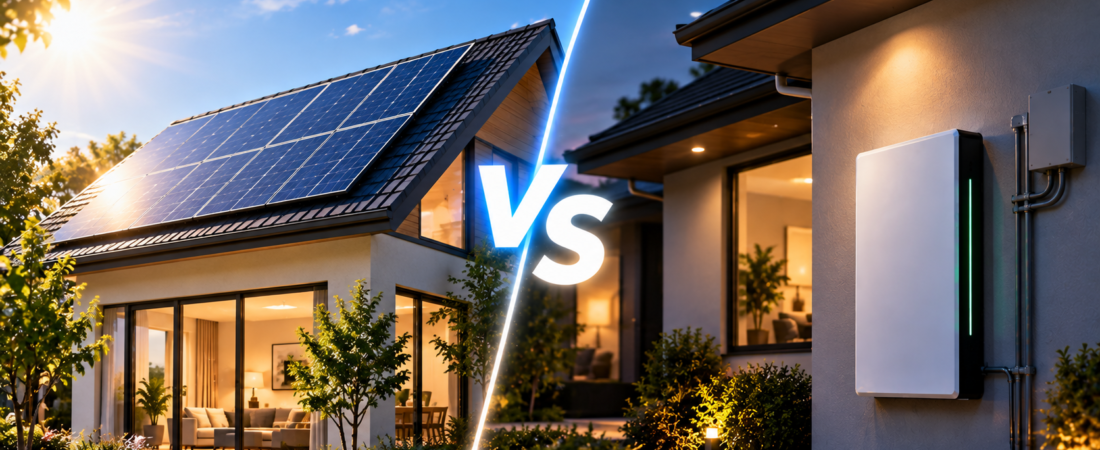
But solar panels vs home battery is not as simple as choosing between two products that do the same job.
Solar panels generate electricity. Home batteries store electricity for later use.
That distinction makes a significant difference when calculating installation costs, monthly savings, and long-term financial returns.
A $20,000 solar installation may substantially reduce electricity purchases from the grid. A $12,000 battery system may provide backup power during outages, but its financial savings depend heavily on local electricity rates and utility billing policies.
So which investment actually makes more sense?
In this comparison, we’ll examine the costs, savings potential, payback periods, and practical benefits of both technologies. We’ll also calculate hypothetical 10-year ownership scenarios to help homeowners understand when each investment is worthwhile.
Quick verdict: For homeowners primarily interested in reducing electricity bills, solar panels are generally the stronger first investment when the roof and local economics are favorable. Home batteries are more compelling when backup power, time-of-use electricity rates, or maximizing the value of existing solar generation are important.
Comparison Outline
- Solar panels vs home batteries: Key differences
- Installation costs and equipment requirements
- How much money solar panels can save
- How much money a home battery can save
- Ten-year cost comparison
- Payback periods and break-even points
- Electricity rates and utility billing policies
- Backup power during outages
- Solar panels and batteries together
- Maintenance, lifespan, and long-term value
- Which option fits different households?
- Frequently asked questions
- The Compareason Verdict
1. Solar Panels vs Home Battery: Quick Comparison
Although solar panels and batteries are often marketed together, their financial purposes are different.
| Feature | Solar Panels | Home Battery |
|---|---|---|
| Primary function | Generate electricity | Store electricity |
| Typical installed budget | $15,000–$25,000 | $8,000–$15,000 |
| Electricity generation | Yes | No |
| Energy storage | No | Yes |
| Direct bill reduction | Often substantial | Depends on rate structure |
| Backup power | Usually unavailable without additional equipment | Available with proper backup configuration |
| Typical warranty | Often 25 years for panels | Commonly 10 years |
| Best financial benefit | Reducing grid electricity purchases | Shifting energy use and backup protection |
| Main limitation | Sunlight, roof suitability, utility rules | High upfront cost and limited storage capacity |
These are illustrative U.S. residential installation budgets, not binding quotes. Actual costs depend on equipment, system size, installation complexity, location, and incentives.
The fundamental difference is simple.
Solar panels create energy savings by producing electricity. Batteries create value by changing when electricity is used and by providing stored power when needed.
That distinction explains why their financial returns can be dramatically different.
2. Installation Costs: Which Requires More Money?
Before calculating savings, homeowners need to understand what they are purchasing.
Solar Panel Installation Costs
A typical residential solar installation includes photovoltaic panels, inverters, mounting equipment, electrical components, permitting, and professional installation.
For our comparison, we’ll assume a $20,000 installed solar system.
This represents a hypothetical residential installation rather than a specific brand or system size.
The final price depends on roof condition, installation size, local labor costs, and equipment selection.
Some homeowners may also need roof repairs or electrical upgrades before installation.
Home Battery Installation Costs
A residential battery system generally includes battery modules, power electronics, monitoring equipment, and installation.
Backup power may also require a transfer switch, backup gateway, or other electrical equipment.
For our comparison, we’ll assume a complete installed battery system costs $12,000.
This could represent a battery system with approximately 10–15 kWh of usable storage, depending on the product and installation.
A battery can be installed without solar panels, but the financial benefits of a standalone battery are highly dependent on electricity pricing.
Initial Cost Comparison
| Installation | Hypothetical Cost |
|---|---|
| Solar panel system | $20,000 |
| Home battery system | $12,000 |
| Difference | $8,000 |
The battery costs $8,000 less upfront.
However, lower installation cost does not automatically mean better financial value.
The more important question is how much each system can save over time.
3. How Much Money Can Solar Panels Actually Save?
Solar panels reduce electricity purchases by generating power from sunlight.
Their financial value depends on how much electricity they produce and how much that electricity is worth under the homeowner’s utility plan.
Consider a hypothetical household with the following characteristics:
- Annual electricity consumption: 12,000 kWh
- Electricity price: $0.25 per kWh
- Annual electricity spending: $3,000
- Solar electricity generation: 9,000 kWh annually
If every kilowatt-hour of solar production effectively offsets electricity worth $0.25, the annual gross savings would be:
9,000 kWh × $0.25 = $2,250.
That sounds attractive.
But not every utility compensates homeowners equally for excess solar electricity.
Some offer favorable net-metering arrangements, while others provide much lower export credits.
To make our example more conservative, assume the solar system provides $1,800 in first-year bill savings.
That represents an effective value of $0.20 per kWh of solar generation.
Solar Savings Over Time
Under this assumption:
| Period | Cumulative Gross Savings |
|---|---|
| 1 year | $1,800 |
| 3 years | $5,400 |
| 5 years | $9,000 |
| 10 years | $18,000 |
| 15 years | $27,000 |
These figures assume constant annual savings before maintenance and equipment degradation.
Actual solar production typically changes gradually over time, and electricity rates may increase or decrease.
Our take: Solar panels can generate meaningful long-term financial savings, especially in areas with high electricity prices and favorable compensation for solar production.
However, the financial return depends on local conditions rather than panel efficiency alone.
4. How Much Money Can a Home Battery Save?
A home battery works differently.
It does not generate electricity.
Instead, it stores electricity that can be used later.
A standalone battery can charge from the electrical grid during lower-cost periods and discharge during more expensive periods, if the utility tariff and system configuration permit it.
This strategy is called time-of-use arbitrage.
Example: Charging at Night and Using Power During Peak Hours
Assume the following hypothetical electricity rates:
- Off-peak electricity: $0.12 per kWh
- Peak electricity: $0.35 per kWh
- Battery discharge efficiency: 90%
- Electricity delivered from the battery: 10 kWh per day
To deliver 10 kWh, the battery needs approximately 11.11 kWh of purchased electricity.
Charging cost:
11.11 × $0.12 = $1.33.
Value of avoiding 10 kWh of peak electricity:
10 × $0.35 = $3.50.
Daily savings:
$3.50 − $1.33 = $2.17.
If this happens 300 days per year:
$2.17 × 300 = approximately $650 annually.
This is a relatively favorable example because it assumes a substantial difference between peak and off-peak rates.
It also assumes the battery can consistently deliver the required energy and that the homeowner can shift enough consumption.
Battery degradation, financing costs, and additional operating expenses are excluded.
What If Electricity Rates Are Flat?
Now imagine the utility charges $0.20 per kWh throughout the day.
There is no cheaper charging period.
Because batteries lose some energy during charging and discharging, shifting grid electricity through a battery can actually increase total electricity consumption.
In that situation, a standalone battery may provide little or no direct bill savings.
Our take: A home battery is not automatically a money-saving device. Its financial return depends on electricity rate differences, operating rules, and how often the stored energy is used.
5. The Real Cost After 10 Years
Let’s compare both investments over a 10-year period.
We’ll use the following assumptions:
Solar Panel System
- Installed cost: $20,000
- First-year electricity savings: $1,800
- Annual solar production degradation: 0.5%
- Maintenance allowance: $100 per year
- No tax incentives included
Home Battery System
- Installed cost: $12,000
- First-year electricity savings: $650
- Annual savings decline: 1%
- Maintenance allowance: $50 per year
- No tax incentives included
These are illustrative assumptions rather than predictions for a specific property.
Ten-Year Financial Comparison
| Financial Factor | Solar Panels | Home Battery |
|---|---|---|
| Initial investment | $20,000 | $12,000 |
| Gross energy savings over 10 years | $17,600 | $6,214 |
| Maintenance over 10 years | $1,000 | $500 |
| Net operating savings | $16,600 | $5,714 |
| Initial cost minus net savings | $3,400 | $6,286 |
Figures are rounded. Neither system reaches full cost recovery within 10 years under these assumptions.
What Does This Tell Us?
Even though solar panels cost $8,000 more initially, they generate significantly greater financial savings in this example.
After 10 years, the solar system has recovered most of its initial investment through reduced electricity spending.
The battery has recovered less than half of its installation cost.
However, this comparison does not assign a dollar value to backup electricity during outages.
It also excludes financing, taxes, incentives, equipment replacement, changes in utility rates, and property resale value.
Winner for direct bill savings in this scenario: Solar panels.
6. Payback Period: Which Investment Pays for Itself Faster?
The payback period measures how long it takes for accumulated net savings to equal the original investment.
A shorter payback period generally means the homeowner recovers the upfront cost sooner.
Solar Panel Payback
Using our $20,000 installation and $1,800 first-year savings, the simple payback period before maintenance and degradation would be:
$20,000 ÷ $1,800 = 11.1 years.
Including our assumed $100 annual maintenance cost and 0.5% annual production degradation, the estimated payback period becomes approximately 12.1 years.
This assumes electricity rates and the value of solar production remain unchanged.
Home Battery Payback
Using a $12,000 installation and $650 first-year savings:
$12,000 ÷ $650 = 18.5 years.
That is the simple payback period before maintenance and degradation.
Including $50 in annual maintenance and a 1% annual decline in savings, the modeled payback extends beyond 20 years.
That may exceed the period during which the battery can deliver its original storage capacity and could extend beyond its warranty.
Why This Matters
A battery that takes more than 20 years to recover its cost may not be financially attractive if purchased solely to reduce electricity bills.
Solar panels, by contrast, often have longer performance warranties and may continue producing electricity for decades.
Our take: Under our assumptions, solar panels have a significantly stronger financial payback profile.
7. Electricity Rates Can Completely Change the Results
The location of the home is one of the most important factors.
Two homeowners with identical solar panels can experience very different savings.
Homeowner A: High Electricity Rates
Assume electricity costs $0.30 per kWh.
Generating 9,000 kWh of solar electricity could provide up to $2,700 in annual gross value if all production offsets electricity at the full retail rate.
This could make solar especially attractive.
Homeowner B: Low Electricity Rates
Assume electricity costs $0.12 per kWh.
The same 9,000 kWh would have a maximum retail offset value of $1,080.
The solar system produces the same electricity, but its financial return is much lower.
Homeowner C: Expensive Peak Electricity
Assume peak electricity costs $0.45 per kWh and off-peak electricity costs $0.10.
A home battery could become considerably more valuable because stored electricity can replace expensive peak-hour purchases.
However, utility restrictions, demand charges, and battery operating limits may affect the actual savings.
The Compareason insight: The best investment depends less on the equipment itself and more on the electricity tariff attached to the property.
8. Backup Power: Where Home Batteries Have a Major Advantage
Financial savings are not the only reason to invest in home energy technology.
Power outages can create inconvenience and financial losses.
A battery system configured for backup operation can provide electricity when the grid fails.
Depending on battery capacity and household consumption, it may power:
- Refrigerators and freezers
- Internet equipment
- Lighting
- Selected electrical outlets
- Essential medical equipment, subject to system suitability
- Some heating or cooling equipment
The exact backup duration depends on battery capacity, the appliances being powered, and system configuration.
Can Solar Panels Work During a Power Outage?
Many conventional grid-connected solar systems automatically shut down when the grid fails.
This protects utility workers and prevents unsafe electrical backfeeding.
Therefore, installing solar panels alone does not necessarily provide backup power.
Some specialized systems can supply limited electricity during outages, while solar-plus-storage systems may offer broader backup functionality.
What Is Backup Power Worth?
Suppose a homeowner experiences frequent outages that spoil refrigerated food or interrupt home-based work.
Avoiding those disruptions may have real financial value.
However, that value varies significantly between households.
A home in an area with a highly reliable electrical grid may rarely benefit from battery backup.
A home with frequent outages may benefit substantially.
Our take: Batteries have a clear advantage for backup power, but that benefit should be evaluated separately from electricity bill savings.
9. What About Installing Solar Panels and a Battery Together?
For many homeowners, the strongest overall energy system combines solar generation with battery storage.
Solar panels generate electricity during daylight hours.
The battery stores some of that electricity for use later.
This can reduce the need to purchase electricity during expensive evening hours.
It can also provide backup electricity during outages when properly configured.
Example: Solar Plus Battery
Assume:
- Solar installation: $20,000
- Battery installation: $12,000
- Combined cost: $32,000
The combined system costs more than either technology alone.
However, it may allow the homeowner to consume more solar-generated electricity instead of exporting it to the grid.
That can be valuable in areas where exported solar electricity receives a relatively low credit.
Does Adding a Battery Always Increase Savings?
Not necessarily.
If a utility provides favorable compensation for exported solar electricity, storing that electricity may offer limited additional financial benefit.
The battery also introduces conversion losses.
For example, if exporting 1 kWh earns $0.20 and buying electricity later costs $0.20, storing that energy may not create a financial advantage.
But if exporting earns only $0.05 while evening electricity costs $0.35, battery storage becomes much more attractive.
Our take: Solar-plus-storage can be an excellent solution, but homeowners should calculate the battery’s incremental savings rather than assuming that adding storage automatically improves the financial return.
10. Maintenance, Lifespan, and Long-Term Value
Solar panels and home batteries have different long-term characteristics.
Solar Panel Lifespan
Many solar panels carry performance warranties lasting approximately 25 years or longer.
Solar output generally declines gradually over time.
Inverters and other electrical components may require replacement before the panels themselves reach the end of their useful life.
Regular monitoring and occasional maintenance can help identify performance issues.
Home Battery Lifespan
Home battery systems commonly carry warranties of approximately 10 years, often with limits related to retained capacity or energy throughput.
Battery capacity gradually decreases with age and use.
A battery may remain operational after its warranty expires, but its usable storage capacity may be lower.
Which Has Better Long-Term Value?
Solar panels typically have a longer expected productive life.
That gives them more time to generate financial savings after the initial installation cost has been recovered.
Batteries provide flexibility and resilience, but their shorter warranty periods and capacity degradation can affect long-term economics.
Our take: Solar panels generally offer the stronger long-term investment profile when the primary goal is reducing electricity expenses.
11. Which Investment Makes Sense for Your Home?
Let’s examine four common situations.
Scenario A: High Electricity Bills and a Sunny Roof
Your electricity bill averages $300 per month.
Your roof receives substantial sunlight.
Your utility offers reasonable compensation for solar generation.
Better choice: Solar panels.
A properly sized solar system may reduce grid electricity purchases substantially.
Scenario B: Frequent Power Outages
Your home experiences regular outages.
You want to keep essential appliances running.
Reducing electricity bills is a secondary priority.
Better choice: Home battery.
Backup power may justify the investment even if the financial payback is relatively long.
Scenario C: Expensive Evening Electricity
Your utility charges significantly higher rates during peak evening hours.
You can charge a battery cheaply and discharge it during expensive periods.
Better choice: Potentially a home battery.
However, the exact savings should be modeled using your utility’s rate schedule and the battery’s usable capacity.
Scenario D: Long-Term Homeownership
You expect to remain in your home for 15–20 years.
Your roof is suitable for solar.
You want to reduce long-term electricity expenses.
Better choice: Solar panels first.
The longer ownership period provides more time to recover the installation cost.
A battery can be considered later if backup power or time-of-use savings justify the additional investment.
12. What About Tax Credits and Incentives?
Government incentives can significantly change the economics of home energy investments.
However, homeowners should not assume that an incentive advertised in an older article or installation quote is still available.
For U.S. homeowners, the federal Residential Clean Energy Credit under Section 25D is generally unavailable for qualifying expenditures made after December 31, 2025, following legislative changes in 2025.
Other federal programs, state incentives, local rebates, and utility programs may have different rules and eligibility requirements.
Business-owned systems can also be subject to different tax provisions from personally owned residential installations.
Before signing a contract, homeowners should verify:
- Current federal tax treatment
- State and local incentive eligibility
- Utility rebate availability
- Net-metering or export compensation rules
- Equipment and installation requirements
A tax credit should never be included in a financial projection unless the homeowner has confirmed eligibility under the applicable rules.
Our take: Incentives can materially affect payback periods, but calculations should use current rules rather than outdated assumptions.
13. Frequently Asked Questions
Are solar panels better than home batteries?
Solar panels are generally the better investment for homeowners who want to reduce electricity bills over the long term. Home batteries are more useful for backup power and shifting electricity consumption away from expensive peak hours. The better choice depends on local electricity rates, utility policies, and household priorities.
Can a home battery save money without solar panels?
Yes, but only under favorable conditions. A standalone battery can charge when electricity is inexpensive and discharge when rates are higher. However, if electricity rates remain constant throughout the day, the battery may provide little or no direct financial savings.
How long does it take for solar panels to pay for themselves?
Payback periods vary depending on installation costs, electricity prices, solar production, incentives, and utility compensation. In our hypothetical example, a $20,000 solar system reaches its estimated payback point after approximately 12.1 years.
How long does it take for a home battery to pay for itself?
In our example, a $12,000 battery generating $650 in first-year electricity savings takes more than 20 years to recover its cost after accounting for assumed maintenance and declining savings. Other electricity rate structures may produce substantially different results.
Can solar panels power a house during a blackout?
Most conventional grid-connected solar systems shut down during power outages for safety reasons. Backup operation requires compatible equipment, such as an appropriately configured inverter and battery system or specialized solar backup technology.
Is a Tesla Powerwall worth buying?
A Tesla Powerwall or similar home battery can be worthwhile for homeowners who experience frequent outages, have expensive peak electricity rates, or want greater energy independence. However, financial savings alone may not justify the installation cost in every location.
Should I install solar panels or a battery first?
For homeowners primarily interested in lowering electricity bills, solar panels are generally the more logical first investment when roof conditions and local utility rules are favorable. A battery may be the better first choice when backup power is the main priority.
Do solar panels increase home value?
Solar installations may improve property appeal and resale value, but the impact depends on location, system ownership, age, condition, and local buyer demand. Leased systems can also introduce additional considerations during a property sale.
14. The Compareason Verdict: Solar Panels vs Home Battery
Overall Winner for Saving Money: Solar Panels
For most homeowners whose primary objective is reducing long-term electricity expenses, solar panels are the stronger investment when installation conditions and utility rates are favorable.
In our hypothetical 10-year comparison:
| Financial Result | Solar Panels | Home Battery |
|---|---|---|
| Initial cost | $20,000 | $12,000 |
| Net operating savings over 10 years | $16,600 | $5,714 |
| Unrecovered investment after 10 years | $3,400 | $6,286 |
| Primary benefit | Electricity generation | Storage and backup |
Although the solar installation costs more upfront, it recovers a larger percentage of its original cost through electricity savings.
Best Choice for Backup Power: Home Battery
Home batteries provide a different kind of value.
They can help keep essential appliances running during power outages, reduce reliance on expensive peak-hour electricity, and increase the usefulness of an existing solar system.
For homeowners who frequently experience outages, those benefits may justify the cost even when the financial payback is relatively long.
Best Long-Term Energy Solution: Solar Panels Plus Battery
For homeowners with sufficient budgets, a combined solar and battery system may offer the most flexibility.
Solar panels generate electricity, while batteries store some of that energy for later use.
However, adding a battery does not automatically improve financial returns. The additional investment should be justified by backup requirements, electricity pricing, and utility export policies.
Our Final Recommendation
Choose solar panels if your main goal is reducing electricity bills and improving long-term financial returns.
Choose a home battery if reliable backup power and greater control over electricity usage matter more than the shortest payback period.
Choose solar panels plus battery storage if you want both electricity generation and backup capability, and the additional cost fits your budget.
For most cost-conscious homeowners with suitable roofs, solar panels should be evaluated first.
But before purchasing either system, compare actual installation quotes, local electricity rates, utility compensation rules, and expected ownership duration.
The best investment isn’t necessarily the most advanced technology.
It’s the system that delivers the greatest value for your specific home.
Compare with Reason.