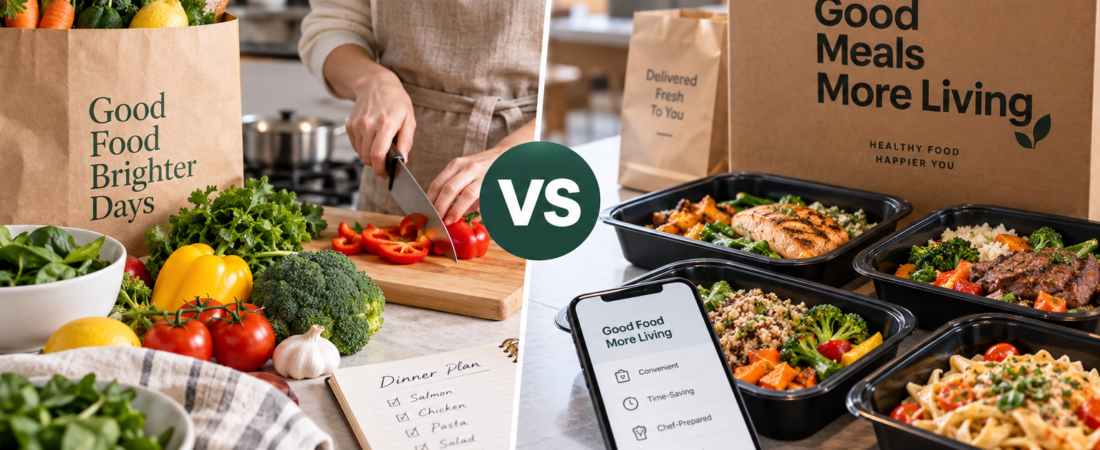
Cooking at home is widely considered one of the easiest ways to save money.
Buy groceries, prepare your meals, and avoid expensive restaurant bills.
But is cooking at home always cheaper?
Not necessarily.
For a family of four, preparing meals from groceries can provide substantial savings.
For someone living alone, however, the calculation becomes more complicated.
Fresh ingredients may spoil before they’re used. Recipes often require purchasing more food than one person needs. Cooking also requires time, electricity, water, and cleanup.
Meanwhile, meal delivery services offer convenience, predictable portions, and less preparation.
But they can also include delivery fees, service charges, tips, and higher food prices.
So which option actually costs less?
In this buying groceries vs meal delivery comparison, we’ll calculate the real cost of eating at home for different household sizes.
We’ll examine grocery spending, prepared meal delivery, ingredient waste, cooking time, and the financial value of convenience.
Most importantly, we’ll determine when paying more for convenience might actually make sense.
Quick Verdict: Grocery shopping and home cooking generally provide the lowest direct food cost, especially for larger households. However, for individuals who frequently waste ingredients or place a high value on time, prepared meal delivery may be more competitive than expected.
Comparison Outline
- Buying groceries vs meal delivery: Quick comparison
- What counts as meal delivery?
- Our cost comparison assumptions
- Cost per meal for one person
- Cost per meal for two people
- Cost per meal for a family of four
- The hidden cost of food waste
- Cooking time: What is your time worth?
- Delivery fees, subscriptions, and tipping
- Meal kits vs prepared meals vs restaurant delivery
- When meal delivery can actually make sense
- Practical ways to reduce food costs
- Frequently asked questions
- The Compareason Verdict
1. Buying Groceries vs Meal Delivery: Quick Comparison
Both options provide meals at home, but their cost structures are different.
| Factor | Buying Groceries | Meal Delivery |
|---|---|---|
| Food cost per serving | Usually lower | Usually higher |
| Preparation time | Moderate to high | Low |
| Cleanup | Required | Minimal |
| Ingredient waste | Possible | Usually lower for portioned meals |
| Portion control | Flexible | Usually predetermined |
| Menu customization | High | Depends on provider |
| Delivery fees | Usually none when shopping in person | Often additional |
| Best for | Families and frequent home cooks | Busy individuals and convenience-focused households |
The main advantage of groceries is flexibility.
You can purchase ingredients in larger quantities, cook multiple servings, and use leftovers for future meals.
Meal delivery offers a different benefit: convenience.
However, convenience comes at a price.
The Compareason Insight: The cheapest meal isn’t always the one with the lowest ingredient cost. Food waste, time, and additional fees can change the calculation.
2. What Exactly Counts as Meal Delivery?
Not all meal delivery services are the same.
For a fair comparison, we need to distinguish three categories.
Restaurant Delivery
Services such as DoorDash and Uber Eats deliver meals prepared by restaurants.
These orders may include:
- Restaurant menu prices
- Delivery fees
- Service charges
- Driver tips
- Small-order fees
Restaurant delivery is usually the most expensive option in this comparison.
Meal Kits
Meal kit services deliver pre-portioned ingredients and recipes.
Examples include HelloFresh and Blue Apron.
Customers still need to cook, but meal planning and grocery shopping are reduced.
Meal kits can also reduce unused ingredients, although packaging and delivery costs may be higher.
Prepared Meal Delivery
Prepared meal services deliver fully cooked meals that generally require only reheating.
Examples include Factor and CookUnity.
These services minimize preparation time and can make food spending more predictable.
However, individual servings may cost substantially more than home-cooked meals.
For our main financial comparison, we’ll focus on grocery cooking versus prepared meal delivery.
Restaurant delivery and meal kits will be examined separately.
3. Our Cost Comparison Assumptions
To make the numbers meaningful, we’ll use a hypothetical U.S. household budget.
Actual prices vary by location, retailer, food preferences, and service provider.
Grocery Cooking Assumptions
We’ll assume:
- Average ingredient cost: $5.00 per serving
- Additional cooking utilities: $0.30 per serving
- Food waste: Calculated separately
- Cooking labor: Excluded from the initial cash-cost comparison
The $5.00 ingredient cost represents a balanced home-prepared meal rather than a premium steak dinner or the cheapest possible meal.
Prepared Meal Delivery Assumptions
We’ll assume:
- Prepared meal price: $11.00
- Allocated delivery and service costs: $1.50
- Total delivered cost: $12.50 per serving
This is a hypothetical average, not a quote from a specific provider.
Promotions, subscriptions, order minimums, and delivery schedules can change the actual cost.
Base Cost Comparison
| Expense | Home Cooking | Prepared Meal Delivery |
|---|---|---|
| Food ingredients or meal | $5.00 | $11.00 |
| Cooking utilities | $0.30 | Included in allowance |
| Delivery/service costs | $0 | $1.50 |
| Total per serving | $5.30 | $12.50 |
At first glance, home cooking saves $7.20 per serving.
But the result changes when we account for food waste and household size.
4. One-Person Household: Is Cooking Still Cheaper?
Living alone creates unique food budgeting challenges.
Many grocery products are sold in quantities larger than one person needs.
A recipe may require only half an onion, a small amount of cream, or a portion of fresh herbs.
The remaining ingredients may spoil before they’re used.
Example: One Person Eating 20 Meals Per Month
Assume one person prepares 20 dinners at home.
Ingredient and utility costs:
20 × $5.30 = $106.
Now assume 20% of purchased food spending is wasted.
If $100 represents the value of ingredients actually consumed, the grocery purchases required to obtain that amount are:
$100 ÷ 0.80 = $125.
Add $6 in cooking utilities:
$125 + $6 = $131.
Prepared Meal Delivery
20 × $12.50 = $250.
Monthly Comparison
| Expense | Home Cooking | Prepared Meals |
|---|---|---|
| Monthly meals | 20 | 20 |
| Food and delivery costs | $125 | $250 |
| Cooking utilities | $6 | Included in allowance |
| Monthly total | $131 | $250 |
| Cost per meal | $6.55 | $12.50 |
Home cooking saves approximately $119 per month.
That’s $1,428 per year if the same pattern continues.
Even with 20% ingredient waste, groceries remain substantially cheaper under our assumptions.
Our Take: Meal delivery can reduce preparation time and waste, but groceries still win on direct cash cost for most single-person households.
5. Two-Person Household: Groceries Become More Efficient
Cooking for two people often reduces ingredient waste.
Couples can share fresh ingredients, prepare larger recipes, and use leftovers more easily.
Let’s assume a two-person household prepares 40 dinner servings per month.
Grocery Cooking
Ingredient cost:
40 × $5.00 = $200.
Assume 10% food waste.
$200 ÷ 0.90 = $222.22.
Cooking utilities:
40 × $0.30 = $12.
Total monthly grocery cooking cost:
$222.22 + $12 = $234.22.
Prepared Meal Delivery
40 × $12.50 = $500.
Monthly Comparison
| Expense | Home Cooking | Prepared Meals |
|---|---|---|
| Monthly servings | 40 | 40 |
| Ingredient/meal spending | $222.22 | $500 |
| Cooking utilities | $12 | Included in allowance |
| Monthly total | $234.22 | $500 |
| Cost per serving | $5.86 | $12.50 |
Home cooking saves approximately $265.78 per month.
That’s about $3,189 annually.
Our Take: For couples, grocery shopping becomes more cost-efficient because ingredients can be shared and used more consistently.
6. Family of Four: Home Cooking Has a Major Advantage
For larger households, the economics become even more favorable toward home cooking.
Families can purchase ingredients in larger quantities, cook multiple portions, and distribute preparation time across more servings.
Let’s assume a family of four prepares 80 dinner servings per month.
Grocery Cooking
Ingredient cost:
80 × $5.00 = $400.
Assume 5% food waste.
$400 ÷ 0.95 = $421.05.
Cooking utilities:
80 × $0.30 = $24.
Total monthly grocery cooking cost:
$421.05 + $24 = $445.05.
Prepared Meal Delivery
80 × $12.50 = $1,000.
Monthly Comparison
| Expense | Home Cooking | Prepared Meals |
|---|---|---|
| Monthly servings | 80 | 80 |
| Ingredient/meal spending | $421.05 | $1,000 |
| Cooking utilities | $24 | Included in allowance |
| Monthly total | $445.05 | $1,000 |
| Cost per serving | $5.56 | $12.50 |
Home cooking saves approximately $554.95 per month.
Over 12 months, that’s approximately $6,659.
Why Families Save More
Larger households often benefit from:
- Bulk ingredient purchases
- Shared cooking time
- More efficient use of fresh ingredients
- Fewer partially used packages
- Larger recipes
- More predictable food consumption
However, these savings depend on household habits.
Families that frequently discard leftovers or purchase excessive groceries may not achieve the same results.
Our Take: Home cooking offers a particularly strong financial advantage for families that plan meals and use ingredients efficiently.
7. The Hidden Cost of Food Waste
Food waste is one of the most underestimated household expenses.
Consumers often compare grocery receipts with meal delivery prices without accounting for ingredients that are never eaten.
But wasted groceries still cost money.
Example: A $150 Weekly Grocery Budget
Suppose a household spends $150 per week on groceries.
If 10% of that spending is wasted:
$150 × 10% = $15 per week.
Over 52 weeks:
$15 × 52 = $780.
If waste reaches 20%:
$150 × 20% = $30 per week.
Annual wasted spending becomes:
$30 × 52 = $1,560.
Annual Food Waste Cost
| Food Waste Rate | Weekly Waste | Annual Cost |
|---|---|---|
| 5% | $7.50 | $390 |
| 10% | $15 | $780 |
| 15% | $22.50 | $1,170 |
| 20% | $30 | $1,560 |
These figures assume a fixed $150 weekly grocery budget.
The calculation measures the value of wasted purchases, not the additional spending required to replace them.
Why Meal Delivery Can Reduce Waste
Prepared meals are generally portioned for individual consumption.
That reduces the risk of purchasing ingredients that remain unused.
However, prepared meals can still be wasted if customers order more than they eat or fail to consume them before expiration.
The Compareason Insight: Food waste can make grocery cooking more expensive than expected, but eliminating waste does not automatically make delivered meals cheaper.
8. Cooking Time: What Is Your Time Actually Worth?
This is where the comparison becomes more complicated.
Cooking at home costs less in direct spending.
But preparing meals requires time.
Shopping, meal planning, cooking, and cleanup can add up.
For busy professionals, that time may have substantial value.
Example: One Hour Per Day
Suppose a person spends one hour per day preparing dinner and cleaning up.
Over 20 cooking days:
20 hours per month.
Now assign a hypothetical value of $20 per hour.
20 × $20 = $400.
If the person spends $131 per month on groceries and utilities, the combined economic cost becomes:
$131 + $400 = $531.
That exceeds the $250 monthly prepared meal delivery cost in our single-person example.
But there’s an important distinction.
Time is not automatically a cash expense.
Someone who enjoys cooking may consider that hour a relaxing activity rather than lost productivity.
Someone who can use the saved time for additional paid work may view it differently.
The Break-Even Value of Time
In our one-person example:
- Home cooking: $131 per month
- Prepared meals: $250 per month
- Additional cost of delivery: $119
- Cooking time potentially saved: 20 hours
$119 ÷ 20 = $5.95 per hour.
If prepared meal delivery genuinely saves 20 hours per month, the additional cost is equivalent to approximately $5.95 per hour saved.
That could be attractive to some people.
However, delivery does not eliminate all food-related tasks, and home cooking time can be reduced through batch preparation.
Our Take: Home cooking wins on direct spending, but prepared meal delivery can offer reasonable value for people who place a high value on their time.
9. Delivery Fees, Subscriptions, and Tipping: The Costs People Forget
One of the biggest mistakes consumers make when comparing grocery shopping with meal delivery is focusing only on the advertised meal price.
A prepared meal might cost $10.99, but the final amount paid can be higher.
Depending on the service, additional expenses may include:
- Delivery fees
- Service charges
- Subscription fees
- Minimum-order requirements
- Tips
- Taxes where applicable
These costs vary considerably between restaurant delivery, meal kits, and prepared meal subscriptions.
Example: The Real Cost of a $12 Meal
Imagine ordering a restaurant meal through a delivery platform.
| Expense | Cost |
|---|---|
| Restaurant meal | $12.00 |
| Delivery fee | $2.99 |
| Service fee | $2.00 |
| Driver tip | $3.00 |
| Total delivered cost | $19.99 |
The advertised $12 meal now costs almost $20.
That’s approximately 67% more than the menu price.
This is an illustrative example, not a specific provider’s fee schedule.
What About Subscription Services?
Some delivery platforms offer monthly subscriptions that reduce certain delivery charges.
However, subscription benefits often depend on eligible merchants, minimum order amounts, and other conditions.
Suppose a subscription costs $10 per month and saves $3 on each qualifying order.
If you order twice monthly, you save $6 but pay $10.
Your net additional cost is $4.
If you order eight times monthly, the gross fee savings could reach $24, creating a potential net savings of $14 after the subscription fee.
That assumes every order qualifies and the subscription does not encourage additional spending.
Prepared Meal Subscriptions Are Different
Prepared meal subscriptions often deliver several meals together.
That allows delivery costs to be spread across multiple servings.
For example, a $12 delivery charge allocated across eight meals adds $1.50 per serving.
The same charge allocated across four meals adds $3 per serving.
Our Take: Always compare the final checkout price per serving, not the advertised meal price.
10. Meal Kits vs Prepared Meals vs Restaurant Delivery
Not all delivery services offer the same value.
The three main categories differ significantly in convenience, preparation requirements, and total cost.
Meal Kits
Meal kits deliver measured ingredients and recipes.
Customers still cook their meals, but shopping and planning are simplified.
They may reduce ingredient waste because recipes are portioned for a specific number of servings.
However, meal kits do not eliminate preparation or cleanup.
Prepared Meals
Prepared meal services provide fully cooked meals that generally require reheating.
They offer greater convenience than meal kits.
However, customers may have less control over ingredients, seasoning, and portion sizes.
Restaurant Delivery
Restaurant delivery provides the widest variety of prepared dishes.
It can also be the most expensive option because of restaurant pricing, platform fees, and tips.
Illustrative Cost Comparison
| Meal Type | Estimated Cost per Serving | Preparation Required |
|---|---|---|
| Home cooking | $5.30–$6.55 | Moderate to high |
| Meal kit | $8–$12 | Moderate |
| Prepared meal delivery | $10–$15 | Minimal |
| Restaurant delivery | $15–$25+ | Minimal |
These ranges are illustrative budgeting examples rather than verified current prices from specific providers.
The actual cost depends on location, promotions, portion sizes, service charges, and order frequency.
Which Offers the Best Value?
Home cooking generally provides the lowest direct food cost.
Meal kits offer a middle ground between grocery shopping and convenience.
Prepared meals save more time but usually cost more.
Restaurant delivery offers flexibility and variety, often at the highest total price.
The Compareason Insight: Meal kits are not necessarily cheaper than groceries, but they can be less expensive than frequent restaurant delivery.
11. When Meal Delivery Can Actually Make Financial Sense
Meal delivery is not always the cheapest option.
But there are situations where paying more for convenience may be reasonable.
Scenario A: A Busy Professional Living Alone
Imagine someone who works long hours and regularly purchases groceries that spoil before being used.
Prepared meals may reduce waste and save preparation time.
If the person can use that time for additional paid work, the financial value of convenience may be meaningful.
However, that benefit depends on whether the saved time actually creates economic value.
Scenario B: Someone Who Frequently Orders Restaurant Delivery
Suppose a person orders restaurant delivery 20 times per month.
At $20 per order:
20 × $20 = $400.
Switching to prepared meals costing $12.50 each would cost:
20 × $12.50 = $250.
That’s a monthly savings of $150.
Annualized:
$150 × 12 = $1,800.
In this situation, prepared meal delivery can be significantly cheaper than restaurant delivery.
It is still more expensive than our grocery cooking example, but it represents a practical improvement.
Scenario C: A Household With Limited Cooking Facilities
Someone living in temporary housing, a small apartment, or accommodation without a full kitchen may face additional challenges when preparing meals.
Prepared meals can reduce the need for cooking equipment, storage, and cleanup.
The convenience may justify the additional cost.
Scenario D: A Person Who Values Predictable Portions
Prepared meals can simplify portion planning and reduce the need to purchase large packages of ingredients.
However, nutritional quality varies by provider.
Consumers should compare ingredients, sodium content, calories, protein, and portion sizes rather than assuming that prepared meals are automatically healthier.
Our Take: Meal delivery makes the most sense when it replaces a more expensive habit, significantly reduces waste, or saves time that has genuine value.
12. Practical Ways to Reduce Food Costs Without Sacrificing Convenience
The smartest strategy may not involve choosing only groceries or only meal delivery.
Many households can benefit from combining both approaches.
Strategy 1: Cook in Larger Batches
Preparing several servings at once reduces the average preparation time per meal.
For example, cooking four portions of a meal may take only slightly longer than cooking one portion.
The additional servings can be refrigerated or frozen for later use.
Strategy 2: Buy Ingredients That Work Across Multiple Recipes
Choose ingredients that can be used in several meals.
For example, chicken, rice, vegetables, and basic seasonings can be combined in different ways.
This reduces the risk of purchasing specialty ingredients that are used only once.
Strategy 3: Freeze Leftovers
Freezing prepared meals can reduce food waste and provide convenient alternatives to delivery.
Proper storage and food-safety practices are important.
Strategy 4: Use Prepared Meals on Busy Days
Instead of ordering delivery every day, consider using prepared meals only when your schedule is particularly demanding.
This can reduce total spending while preserving convenience.
Strategy 5: Track Actual Food Waste
For one month, record the approximate value of food thrown away.
This can reveal whether grocery shopping habits need improvement.
Reducing waste may provide greater savings than switching grocery stores or searching for small discounts.
Strategy 6: Compare Total Weekly Spending
Instead of comparing individual meal prices, calculate your entire weekly food budget.
Include groceries, snacks, restaurant meals, delivery fees, and unused ingredients.
A household may believe it spends $100 per week on groceries while overlooking another $80 spent on delivery.
Strategy 7: Create a Hybrid Meal Plan
Consider a household that eats 20 dinners per month.
Instead of choosing one method exclusively, it could prepare 15 dinners and purchase five prepared meals.
Using our single-person grocery cost of $6.55 per serving:
15 × $6.55 = $98.25.
Five prepared meals at $12.50:
5 × $12.50 = $62.50.
Total monthly cost:
$98.25 + $62.50 = $160.75.
Compare that with:
- All home cooking: $131
- Hybrid approach: $160.75
- All prepared meal delivery: $250
| Monthly Strategy | Total Cost |
|---|---|
| 20 home-cooked meals | $131.00 |
| 15 home-cooked + 5 prepared meals | $160.75 |
| 20 prepared meals | $250.00 |
The hybrid strategy costs approximately $29.75 more than cooking every meal.
But it saves approximately $89.25 compared with using prepared meal delivery exclusively.
The hybrid calculation assumes the same effective grocery cost per serving despite cooking fewer meals; actual waste and batch efficiencies may change.
Our Take: A hybrid approach can offer a practical balance between affordability and convenience.
13. Frequently Asked Questions
Is cooking at home always cheaper than meal delivery?
Not always, but it generally has a lower direct cost per serving. Food waste, ingredient prices, household size, and cooking habits can affect the result. Meal delivery may become more attractive when convenience and time savings are particularly valuable.
Is meal delivery cheaper for one person?
Prepared meal delivery can be more competitive for single-person households because grocery portions may be larger than needed. However, under our hypothetical assumptions, home cooking remains significantly cheaper even after accounting for 20% ingredient waste.
How much can a family save by cooking at home?
In our illustrative family-of-four scenario, preparing 80 dinner servings monthly costs approximately $445, compared with $1,000 for prepared meal delivery. That represents potential savings of approximately $555 per month, or $6,659 annually.
Are meal kits cheaper than groceries?
Meal kits generally cost more per serving than carefully planned grocery shopping. However, they may reduce ingredient waste and save time on meal planning and shopping.
Is HelloFresh cheaper than grocery shopping?
It depends on the selected plan, promotions, delivery charges, and grocery alternatives. HelloFresh may offer convenience and portioned ingredients, but grocery shopping often provides a lower ingredient cost per serving.
Are prepared meals cheaper than DoorDash or Uber Eats?
They can be. Prepared meal subscriptions often spread delivery expenses across several meals, while individual restaurant delivery orders may include additional fees and tips. Actual savings depend on the services and orders being compared.
Does meal delivery reduce food waste?
Portioned prepared meals can reduce unused grocery ingredients. However, customers can still waste food if they order too many meals or fail to consume them before expiration.
How much money does meal prepping save?
Savings depend on ingredient costs, portion sizes, food waste, and the meals being replaced. Batch cooking can reduce both preparation time and spending, particularly when it replaces frequent restaurant delivery.
Is cooking at home worth the time?
For many people, yes. Home cooking generally provides substantial direct financial savings and greater control over ingredients. However, people with limited time may reasonably value the convenience of prepared meals.
Is restaurant delivery ever worth the extra money?
Yes. Restaurant delivery can provide convenience, variety, and access to meals that may be difficult to prepare at home. The decision depends on personal priorities and budget rather than price alone.
What is the cheapest way to eat healthy meals?
Planning meals around affordable ingredients, preparing larger batches, using leftovers, and reducing food waste can help lower costs. Nutritional quality depends on food choices rather than whether meals are homemade or delivered.
Should I cancel my meal delivery subscription?
Review how frequently you use the service, the total cost per serving, and how much time it saves. If meals regularly go unused or the subscription encourages unnecessary spending, reducing or canceling it may make sense.
14. The Compareason Verdict: Buying Groceries vs Meal Delivery
Overall Winner for Saving Money: Buying Groceries and Cooking at Home
For most households, buying groceries and preparing meals at home remains the more economical choice.
Our hypothetical comparison demonstrates how household size affects the results.
Monthly Cost Comparison
| Household | Home Cooking | Prepared Meal Delivery | Monthly Savings |
|---|---|---|---|
| One person | $131 | $250 | $119 |
| Two people | $234.22 | $500 | $265.78 |
| Family of four | $445.05 | $1,000 | $554.95 |
Annual Savings Comparison
| Household | Estimated Annual Savings From Home Cooking |
|---|---|
| One person | $1,428 |
| Two people | $3,189 |
| Family of four | $6,659 |
These estimates assume 20 dinner servings per person per month and the ingredient prices, waste rates, and delivery costs established earlier.
They are illustrative scenarios, not guaranteed household savings.
The financial advantage of grocery cooking becomes particularly significant for larger households.
Best Choice for Convenience: Prepared Meal Delivery
Prepared meal delivery offers substantial time savings.
It eliminates most cooking preparation, reduces the need for grocery shopping, and can make portion planning easier.
For people with demanding schedules, those benefits may justify the higher price.
However, prepared meal delivery is not automatically more economical simply because it reduces ingredient waste.
Best Choice for Reducing Restaurant Delivery Spending: Prepared Meal Subscriptions
For someone who frequently orders restaurant delivery, switching to prepared meal subscriptions may reduce spending considerably.
In our example, replacing 20 restaurant deliveries costing $20 each with prepared meals costing $12.50 saves $150 per month.
That’s $1,800 annually.
The important distinction is what the prepared meals are replacing.
Replacing expensive restaurant orders may save money.
Replacing inexpensive home-cooked meals will generally increase spending.
Best Overall Balance: A Hybrid Strategy
For many households, combining grocery cooking with occasional prepared meals provides a practical middle ground.
Cooking most meals at home preserves the majority of grocery savings.
Using prepared meals on especially busy days adds convenience without requiring a full commitment to expensive daily delivery.
Our Final Recommendation
Choose grocery shopping and home cooking if your primary goal is minimizing food expenses, especially when cooking for two or more people.
Planning meals, using leftovers, and reducing waste can make home cooking even more economical.
Choose prepared meal delivery if your schedule makes cooking difficult, you frequently waste groceries, or you currently rely on more expensive restaurant delivery.
Convenience can be valuable, but it should be evaluated alongside the actual financial cost.
Choose a hybrid approach if you want to balance savings with flexibility.
For example, cooking 75% of your meals and purchasing prepared meals for the remaining 25% can provide substantial savings compared with relying entirely on delivery.
Ultimately, the smartest choice isn’t necessarily the cheapest meal or the fastest meal.
It’s the approach that fits your household size, schedule, eating habits, and financial priorities.
The Compareason Verdict: Home cooking wins on direct cost. Prepared meal delivery wins on convenience. A thoughtful combination of both may provide the best overall value.
Compare with Reason.