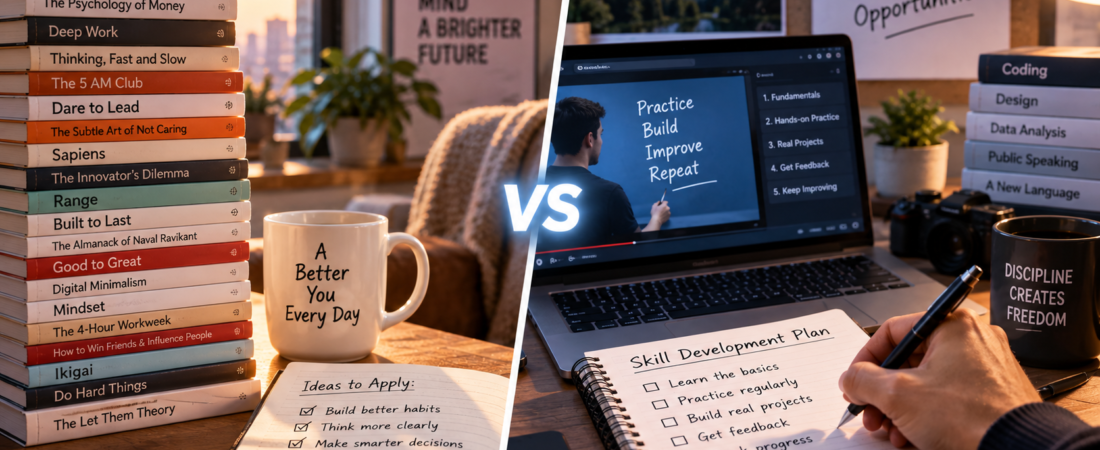
Imagine having 200 hours to invest in yourself over the next year.
You could read 20 books about business, psychology, finance, productivity, and personal development.
Or you could spend those same 200 hours learning one practical skill—coding, public speaking, graphic design, financial analysis, or a new language.
Both choices sound productive.
But which one would actually change your life more?
The answer depends on something most self-improvement advice overlooks: the difference between acquiring knowledge and developing capability.
Reading expands what you know.
Practice changes what you can do.
Yet the two are not mutually exclusive. A carefully chosen book can transform the way someone thinks, while hundreds of hours spent practicing the wrong things may produce surprisingly little progress.
In this reading books vs mastering a skill comparison, we’ll examine learning efficiency, career value, cognitive benefits, opportunity costs, and the practical results of investing 200 hours in personal development.
We’ll also calculate how much improvement or economic value a new skill would need to create to justify the time invested.
Quick Verdict: Reading widely is valuable for building knowledge, perspective, and judgment. Focused skill development is generally better when your goal is a specific, measurable capability. For many people, the strongest strategy is to combine targeted reading with deliberate practice rather than choosing one exclusively.
Comparison Outline
- Reading books vs mastering a skill: Quick comparison
- Why reading feels productive
- The difference between knowledge and capability
- The 200-hour challenge
- The Compareason Calculation: Time and opportunity cost
- Can one skill change your career?
- What reading offers that skill training cannot
- The hidden problem with mastering only one skill
- Deliberate practice vs passive learning
- The 80/20 learning strategy
- Real-world scenarios: Which choice wins?
- How to measure actual progress
- Frequently asked questions
- The Compareason Verdict
1. Reading Books vs Mastering a Skill: Quick Comparison
Reading and skill development are both forms of learning, but they serve different purposes.
Reading primarily helps people acquire information, encounter new perspectives, and develop conceptual understanding.
Skill development emphasizes applying knowledge repeatedly until performance improves.
| Factor | Reading 20 Books | Mastering One Skill |
|---|---|---|
| Primary benefit | Broad knowledge | Practical capability |
| Learning breadth | High | Usually narrower |
| Depth of expertise | Depends on reading | Potentially high |
| Measurable progress | Often difficult | Usually easier |
| Career application | Indirect or direct | Often direct |
| Creativity | Exposure to diverse ideas | Improvement through application |
| Financial return | Highly variable | Highly variable |
| Long-term flexibility | Broad perspective | Specialized capability |
| Main risk | Knowledge without action | Narrow specialization |
| Best for | Exploration and understanding | Specific performance goals |
Neither approach guarantees success.
Reading 20 books does not automatically make someone knowledgeable.
Likewise, spending 200 hours on a skill does not guarantee professional competence.
The quality of learning matters more than the quantity of time invested.
The Compareason Insight: Learning should be measured by what changes afterward—not simply by how much information you consume.
2. Why Reading Feels So Productive
Reading has become one of the most celebrated habits in personal development.
Successful entrepreneurs, investors, and business leaders often discuss the importance of books.
And there are good reasons for that.
Books provide access to ideas and experiences that would otherwise take years to encounter.
A single book may introduce readers to decades of research, professional experience, or historical knowledge.
The Value of Compressed Experience
Imagine reading a book written by someone who spent 30 years building a business.
You may gain insight into mistakes, decisions, and strategies without repeating every experience yourself.
Of course, reading about those experiences does not mean you have acquired the same practical expertise.
But it may help you avoid predictable errors.
Reading Expands Your Mental Models
Different subjects provide different ways of understanding problems.
Psychology can help explain human behavior.
Economics can help explain incentives.
History can provide context for current events.
Science can teach how evidence is evaluated.
These perspectives can become useful across many areas of life.
The Productivity Illusion
However, reading can also create a false sense of progress.
Finishing a book feels like an accomplishment.
Adding another title to a reading list provides a measurable result.
But completing a book is not the same as applying its ideas.
Someone might read five books about negotiation without ever practicing a difficult conversation.
Another person might read three books about fitness without changing their exercise routine.
Our Take: Reading is valuable, but counting completed books is a weak measure of personal growth.
3. Knowledge vs Capability: The Difference That Matters
Consider two people learning photography.
Person A reads ten books about cameras, composition, lighting, and editing.
Person B spends 100 hours taking photographs, reviewing results, and correcting mistakes.
Who becomes the better photographer?
The answer isn’t guaranteed.
Person A may develop a strong theoretical foundation.
Person B may develop better practical instincts.
But someone who combines knowledge with practice may progress more efficiently than either person alone.
Declarative Knowledge
Declarative knowledge involves knowing facts, concepts, and explanations.
For example:
“I understand what aperture, shutter speed, and ISO mean.”
Books are often effective tools for acquiring this type of knowledge.
Procedural Knowledge
Procedural knowledge involves knowing how to perform a task.
For example:
“I can adjust camera settings quickly to photograph a moving subject in difficult lighting.”
This usually requires practice and feedback.
Why the Distinction Matters
Many personal development goals require procedural knowledge.
You cannot become a confident public speaker simply by understanding public speaking theory.
You need to speak.
You cannot become a strong programmer solely by reading code.
You need to write, debug, and improve programs.
And you cannot become an effective negotiator simply by memorizing negotiation techniques.
You need experience applying them.
The Compareason Insight: Knowledge explains what to do. Capability determines whether you can actually do it.
4. The 200-Hour Challenge: Two Different Paths
Let’s imagine two people beginning the year with the same amount of free time.
Each has 200 hours available for personal development.
Option A: Read 20 Books
Assume each book requires approximately 10 hours to read.
20 books × 10 hours = 200 hours.
The reader chooses books across several subjects:
- Business
- Psychology
- Finance
- Technology
- History
- Communication
- Health
- Productivity
At the end of the year, the reader has encountered a broad collection of ideas.
But how much information will remain useful?
That depends on comprehension, memory, reflection, and application.
Option B: Develop One Skill
The second person spends 200 hours learning one practical skill.
For example, data analysis.
Their schedule might include:
| Activity | Hours |
|---|---|
| Foundational instruction | 30 |
| Guided exercises | 50 |
| Independent projects | 70 |
| Feedback and correction | 30 |
| Review and improvement | 20 |
| Total | 200 |
At the end of the year, this person may have completed several projects and developed a portfolio demonstrating their abilities.
However, 200 hours does not guarantee mastery.
The difficulty of the skill, quality of instruction, prior experience, and consistency of practice all matter.
What Does Mastery Actually Mean?
The word “mastery” can be misleading.
Some skills require thousands of hours of experience to reach expert performance.
Two hundred hours may be enough to achieve useful beginner or intermediate competence in some areas, but not professional mastery in every field.
For this comparison, we’ll define the skill-development goal as achieving a meaningful, demonstrable improvement—not becoming a world-class expert.
Our Take: The 200-hour challenge isn’t about proving that one person becomes smarter. It’s about comparing broad exposure with focused improvement.
5. The Compareason Calculation: What Is 200 Hours Really Worth?
Time is a limited resource.
Unlike money, time cannot be saved and used later.
But we can calculate the opportunity cost of spending it.
Step 1: Assign a Hypothetical Value to Time
Suppose a person values their available time at $25 per hour.
This is not necessarily their hourly wage.
It represents a personal opportunity-cost assumption.
200 hours × $25 = $5,000.
Under this assumption, both learning strategies require a $5,000 time investment.
The question becomes:
Which strategy produces more than $5,000 in value?
Step 2: The Reading Strategy
Suppose reading 20 books helps someone make better financial decisions.
Perhaps they avoid an unnecessary $2,000 purchase.
Maybe they negotiate a better contract.
Or perhaps they learn an idea that improves their career.
Those benefits could be substantial.
However, attributing a specific financial return to reading is difficult.
Books often influence decisions indirectly, and their benefits may appear years later.
Step 3: The Skill Strategy
Now suppose 200 hours of learning improves someone’s ability to perform a paid service.
After training, they earn an additional $100 per month.
Annual additional income:
$100 × 12 = $1,200.
At that rate, recovering the hypothetical $5,000 time investment would require:
$5,000 ÷ $1,200 = approximately 4.17 years.
But what if the new skill generates $500 per month?
Annual additional income:
$500 × 12 = $6,000.
The hypothetical time investment would be recovered in:
$5,000 ÷ $6,000 = approximately 0.83 years.
That’s about 10 months.
Break-Even Comparison
| Additional Monthly Income | Annual Income | Time to Recover $5,000 |
|---|---|---|
| $50 | $600 | 8.33 years |
| $100 | $1,200 | 4.17 years |
| $250 | $3,000 | 1.67 years |
| $500 | $6,000 | 0.83 years |
These calculations exclude taxes, training fees, equipment, and ongoing practice time.
They also assume the additional income begins immediately after training and remains constant.
The More Important Point
Not every skill needs to generate income to be valuable.
Learning to cook can reduce food expenses.
Learning basic home maintenance can avoid service costs.
Improving communication can strengthen relationships.
Learning a language can make travel more rewarding.
The return on learning is not always financial.
The Compareason Insight: A skill becomes financially valuable when it changes what you can produce, earn, or avoid spending—not merely when you finish learning it.
6. Can One Skill Actually Change Your Career?
A carefully selected skill can create opportunities that broad reading may not provide as directly.
Consider a professional who works in an office and frequently handles spreadsheets.
They may already understand their industry well.
But learning advanced Excel, SQL, or data visualization could improve their productivity.
Example: Saving Time at Work
Suppose learning spreadsheet automation saves an employee three hours per week.
Assume 48 working weeks per year.
3 hours × 48 weeks = 144 hours saved annually.
At an illustrative labor value of $30 per hour:
144 × $30 = $4,320.
The skill creates approximately $4,320 in annual time-value savings.
However, this is not automatically additional income for the employee. It may instead benefit their employer, reduce workload, or free time for higher-value tasks.
Career Skills With Practical Applications
Examples include:
- Data analysis
- Programming
- Public speaking
- Sales negotiation
- Graphic design
- Financial modeling
- Digital marketing
- Foreign languages
The financial value depends on demand, existing experience, and how the skill is used.
Why One Skill May Not Be Enough
A technical skill alone rarely guarantees career success.
Communication, judgment, reliability, and industry knowledge also matter.
Someone who can analyze data but cannot explain the results may struggle to influence decisions.
Someone who can communicate well but lacks technical competence may face different limitations.
Our Take: A focused skill can improve career opportunities, but its greatest value often comes from combining it with existing knowledge and experience.
7. What Reading Offers That Skill Training Cannot Easily Replace
So far, focused skill development appears attractive.
But reading provides benefits that are difficult to measure through immediate productivity or income.
Intellectual Breadth
Reading across disciplines introduces ideas that may not appear in specialized training.
A business owner reading psychology, history, and economics may develop a broader understanding of customers, organizations, and markets.
These connections can influence future decisions.
Better Questions
Skill training often focuses on answering a specific question:
“How do I perform this task?”
Reading may help people ask more fundamental questions:
“Is this the right task to perform?”
That distinction can be important.
A person can become highly efficient at doing something that provides little value.
Long-Term Perspective
Books can expose readers to experiences far beyond their own lives.
History, biography, philosophy, and literature may encourage reflection on consequences, values, and human behavior.
These benefits may not translate into immediate financial returns.
But they can influence judgment over time.
Creativity Through Unexpected Connections
Innovation sometimes emerges when ideas from different fields are combined.
A designer may find inspiration in architecture.
A business owner may apply a principle from behavioral psychology.
A programmer may discover a useful analogy in biology.
Reading broadly can increase exposure to these unexpected connections.
The Limitations of Reading
Broad knowledge does not automatically translate into practical competence.
A reader may understand dozens of productivity systems without consistently using any of them.
The value of reading increases when ideas are questioned, tested, and applied.
Our Take: Focused skills improve what you can do. Broad reading can expand what you imagine is possible.
8. The Hidden Problem With Mastering Only One Skill
Focused skill development has obvious advantages.
But concentrating exclusively on one ability can also create risks.
A person who spends hundreds of hours learning a specific technology may become highly competent at using it.
However, what happens if that technology becomes obsolete?
Or if the market no longer values that skill?
The Risk of Specialization
Consider someone who spends years mastering a particular software application.
They become extremely efficient.
They understand advanced features and can solve difficult problems.
Then a new technology arrives that automates many of those tasks.
Their expertise may still be useful, but its market value could decline.
This is particularly relevant in industries experiencing rapid technological change.
Artificial intelligence, automation, and evolving software platforms can alter which skills employers value.
Transferable vs Specialized Skills
Not all skills carry the same risk.
Some abilities are highly specialized.
Others can be applied across many industries.
| Skill Type | Examples | Transferability |
|---|---|---|
| Software-specific | One application or platform | Depends on adoption |
| Technical foundation | Programming concepts, statistics | Often broad |
| Communication | Writing, presenting, negotiation | Broad |
| Analytical thinking | Problem-solving, data interpretation | Broad |
| Creative production | Design principles, storytelling | Broad |
| Industry-specific | Specialized regulations or procedures | Depends on industry |
Learning a specialized tool can be valuable.
But understanding the principles behind that tool may provide greater long-term flexibility.
The Danger of Becoming Too Narrow
Imagine two professionals.
One is highly skilled at operating a specific software system.
The other understands the software but also studies business strategy, psychology, communication, and emerging technology.
The second professional may be better positioned to recognize changes in the industry.
That doesn’t guarantee greater success.
However, broader knowledge can help people adapt when circumstances change.
Why Reading Still Matters
Reading across disciplines can expose specialists to unfamiliar ideas.
It may help them identify new opportunities, understand industry trends, and connect their expertise with other fields.
Our Take: Specialization can create immediate value, but intellectual breadth helps protect against becoming too dependent on one narrow capability.
9. Deliberate Practice vs Passive Learning
Not all practice produces the same results.
Repeating an activity for hundreds of hours does not guarantee significant improvement.
The quality of practice matters.
What Is Deliberate Practice?
Psychologist K. Anders Ericsson and his colleagues studied expert performance and the role of structured practice.
Deliberate practice generally involves carefully designed activities intended to improve specific aspects of performance.
It often includes:
- Clearly defined improvement goals
- Tasks slightly beyond current ability
- Focused attention
- Feedback
- Repeated correction
- Progressive increases in difficulty
The concept is more demanding than simply spending time doing an activity.
Example: Learning Public Speaking
Imagine two people who each spend 100 hours practicing presentations.
Person A: Repetition Without Feedback
Person A repeatedly gives similar presentations.
They become more comfortable, but rarely evaluate their weaknesses.
Person B: Structured Improvement
Person B records presentations, studies delivery, requests feedback, and works on specific problems.
They focus separately on pacing, clarity, eye contact, and audience engagement.
Both people spend the same amount of time.
But Person B’s approach creates more opportunities for targeted improvement.
That doesn’t guarantee a particular outcome, but the practice is designed to address weaknesses rather than merely repeat familiar behavior.
Can Reading Be Active Practice?
Absolutely.
Reading becomes more active when readers:
- Predict what an author will argue
- Question the evidence
- Summarize concepts without looking
- Compare ideas with previous knowledge
- Apply principles to real problems
- Test whether conclusions hold in practice
A person reading a book about negotiation might practice the techniques in realistic conversations.
Someone studying financial analysis might recreate examples using actual data.
The boundary between reading and skill development becomes less clear when reading leads directly to application.
The Compareason Insight
Two hundred hours of deliberate practice may be more valuable than 200 hours of unfocused repetition. But 200 hours of active reading can also be more valuable than 200 hours of passive reading.
The method matters less than the quality of engagement.
10. The 80/20 Learning Strategy: Why Not Combine Both?
Perhaps the biggest weakness in the reading books vs mastering a skill debate is the assumption that you must choose only one.
What if you could use the same 200 hours more strategically?
Instead of reading 20 unrelated books or practicing one skill without guidance, combine targeted reading with practical application.
The 80/20 Learning Model
For a specific skill-development goal, consider allocating:
- 20% of learning time to reading and instruction
- 80% to practice, projects, and feedback
For 200 hours:
| Learning Activity | Hours |
|---|---|
| Reading and foundational instruction | 40 |
| Practice and real-world projects | 120 |
| Feedback and correction | 25 |
| Final assessment and reflection | 15 |
| Total | 200 |
This is a proposed planning framework, not a scientifically established ideal ratio for every skill.
Some subjects require more theoretical preparation.
Others benefit from immediate hands-on practice.
Example: Learning Photography
Spend the first 40 hours learning camera settings, lighting, composition, and editing principles.
Then spend 120 hours taking photographs in different conditions.
Use 25 hours to review images, receive feedback, and correct mistakes.
Finally, spend 15 hours evaluating progress and assembling a portfolio.
The result is a structured learning process that combines understanding with execution.
Example: Learning Financial Analysis
Read foundational material about financial statements, valuation, and spreadsheet modeling.
Then build actual models using publicly available company data.
Compare assumptions with reported results.
Review mistakes and refine the models.
The objective isn’t simply to understand financial terminology.
It’s to become capable of analyzing financial information independently.
When 80/20 Isn’t Appropriate
The ratio should change depending on the goal.
For example, studying history or philosophy may involve more reading and discussion.
Learning swimming or playing a musical instrument requires substantial physical practice.
The appropriate balance depends on the type of knowledge being developed.
Our Take: For practical skills, a combination of focused instruction and repeated application is often more useful than consuming information without practicing.
11. Real-World Scenarios: Which Choice Wins?
The better strategy depends on what you’re trying to achieve.
Let’s compare several common situations.
Scenario A: You Want a Promotion at Work
Suppose your employer values advanced spreadsheet analysis.
You could read 20 books about leadership, productivity, and business.
Or you could spend 200 hours developing advanced Excel and data analysis skills.
If your promotion depends heavily on technical competence, focused training may produce a more direct benefit.
Better Choice: Master a relevant skill.
However, if your main weakness is leadership or communication, the answer may change.
Scenario B: You Want to Become a Better Entrepreneur
Running a business requires many different abilities.
Financial management, marketing, negotiation, operations, and leadership all matter.
Reading across several disciplines may help an entrepreneur identify problems and opportunities.
But learning one high-impact skill, such as financial modeling or sales negotiation, may also create immediate value.
Better Choice: Combine broad reading with targeted skill development.
Scenario C: You Want to Improve Your Personal Finances
Reading books about investing, budgeting, and behavioral finance can improve financial understanding.
But knowledge alone may not change financial outcomes.
Creating a budget, reviewing expenses, establishing an investment plan, and maintaining consistent habits are practical skills.
Better Choice: Read selectively, then implement.
Scenario D: You Want to Learn a New Language
Reading about grammar and vocabulary is useful.
But conversational ability requires listening, speaking, feedback, and repeated practice.
Someone who spends all 200 hours reading about a language may struggle to communicate naturally.
Better Choice: Prioritize active language practice supported by reading.
Scenario E: You Want to Become More Creative
Creativity can benefit from exposure to diverse ideas.
Reading fiction, history, science, philosophy, and art criticism may provide inspiration.
However, creativity also requires producing something.
A writer needs to write.
A designer needs to design.
A musician needs to create and perform.
Better Choice: Read broadly and create regularly.
Scenario F: You Don’t Know What You Want to Learn
This is where reading may have a particularly strong advantage.
If you haven’t identified a meaningful goal, committing 200 hours to one specialized skill could be premature.
Reading across subjects can help reveal interests and opportunities.
Better Choice: Read broadly first, then choose a skill worth developing.
Scenario Comparison
| Personal Goal | Recommended Strategy |
|---|---|
| Career-specific promotion | Focused skill |
| Starting a business | Hybrid |
| Improving financial decisions | Reading + implementation |
| Learning a language | Focused practice |
| Developing creativity | Reading + creation |
| Exploring new interests | Broad reading |
| Building technical competence | Focused skill |
| Developing broader judgment | Reading across disciplines |
The important question is not whether books or skills are universally superior.
It’s whether your learning strategy matches your goal.
12. How to Measure Actual Progress
One of the biggest problems with personal development is measuring activity instead of results.
Reading 20 books is easy to count.
Completing 200 hours of practice is also easy to count.
But neither measurement proves meaningful improvement.
Measure Outcomes, Not Just Hours
Instead of asking:
“How many books did I read?”
Ask:
“What can I explain, decide, or do differently because of what I learned?”
Instead of asking:
“How many hours did I practice?”
Ask:
“What can I perform today that I couldn’t perform three months ago?”
A Practical Learning Scorecard
| Measurement | Reading Strategy | Skill Strategy |
|---|---|---|
| Activity | Books completed | Hours practiced |
| Understanding | Concepts recalled | Principles explained |
| Application | Ideas implemented | Tasks completed |
| Evidence | Decisions improved | Projects or performance |
| Long-term value | Retained knowledge | Retained capability |
The 30-Day Application Test
After finishing a book, identify one idea worth applying.
Then spend the next 30 days testing it.
For example, after reading a book about productivity, try one scheduling technique.
Track whether it actually improves your work.
For skill development, establish a measurable performance target.
Examples include:
- Delivering a presentation without relying heavily on notes
- Building a functional spreadsheet model
- Completing a basic programming project
- Holding a conversation in another language
- Producing a portfolio of photographs
The Importance of Feedback
Without feedback, people may repeat mistakes without noticing.
Feedback can come from teachers, mentors, colleagues, performance measurements, or the results of real-world projects.
The Compareason Insight: Personal development becomes meaningful when you can demonstrate a change in understanding, behavior, or performance.
13. Frequently Asked Questions
Is reading books better than learning a skill?
Neither is universally better. Reading helps build knowledge and perspective, while skill development focuses on practical capability. The better choice depends on your goals.
Can reading 20 books a year change your life?
It can. Books may introduce ideas that influence decisions, habits, and career choices. However, the number of books completed does not guarantee meaningful change.
Is 200 hours enough to master a skill?
It depends on the skill and the definition of mastery. Two hundred hours may produce meaningful competence in some areas, but advanced expertise often requires substantially more practice and experience.
Should I read more books or practice more?
If you already understand the fundamentals but struggle to perform a task, more practice may be valuable. If you lack foundational knowledge or direction, targeted reading may be the better starting point.
Does reading make you more successful?
Reading can contribute to knowledge, communication, and decision-making, but success depends on many factors. Reading alone does not guarantee career advancement or financial achievement.
What skills provide the best return on learning time?
Skills that solve valuable problems and complement existing abilities can offer strong returns. Examples may include communication, data analysis, programming, negotiation, and financial management. Their value varies by individual and market demand.
Is it better to specialize or become a generalist?
Specialization can create depth and practical expertise, while general knowledge supports adaptability and broader thinking. Many successful professionals combine deep expertise in one area with useful knowledge across several others.
Can audiobooks replace reading?
Audiobooks can be an effective way to access information, particularly during activities that allow adequate attention. Comprehension and retention depend on the material, listening conditions, and individual preferences.
How many books should I read per year?
There is no universal ideal number. Reading five carefully selected books and applying their ideas may be more valuable than finishing 30 books without meaningful reflection.
What is the fastest way to learn a new skill?
Use focused instruction, practice challenging tasks, obtain feedback, and review mistakes. Progress depends on skill complexity, prior experience, and practice quality.
Should I learn multiple skills at once?
It depends on available time and goals. Learning several related skills can be useful, but dividing attention across too many unrelated subjects may slow progress.
What is the best way to combine reading and practice?
Use reading to establish foundational understanding, then apply the ideas through projects or real-world activities. Revisit learning materials when practice reveals gaps in knowledge.
14. The Compareason Verdict: Reading 20 Books vs Mastering One Skill
Best Choice for Broad Knowledge and Perspective: Reading 20 Books
Reading across different subjects can introduce new ideas, challenge assumptions, and improve conceptual understanding.
It can also help people discover interests and identify opportunities they might otherwise overlook.
However, reading should not become a substitute for action.
A book only creates practical value when its ideas influence understanding, decisions, or behavior.
Best Choice for Measurable Practical Improvement: Developing One Skill
Focused skill development provides a clearer path toward improving a specific capability.
When supported by structured practice and feedback, it can lead to measurable progress.
For career-related skills, the benefits may include improved productivity, stronger performance, or additional income opportunities.
However, 200 hours of training does not guarantee mastery or financial returns.
The Compareason Calculation: What Does 200 Hours Buy?
Our hypothetical comparison assigns a $25 hourly opportunity cost to personal development time.
That creates a $5,000 time investment for either strategy.
| Measurement | Reading 20 Books | Developing One Skill |
|---|---|---|
| Time invested | 200 hours | 200 hours |
| Hypothetical time value | $5,000 | $5,000 |
| Primary outcome | Broader knowledge | Improved capability |
| Financial return | Difficult to isolate | Potentially measurable |
| Main limitation | Lack of application | Narrow focus |
| Best long-term benefit | Perspective and adaptability | Practical performance |
Suppose a newly developed skill generates $250 in additional monthly income.
That equals $3,000 annually.
Under our simplified assumptions, the $5,000 opportunity cost would be recovered in approximately 20 months.
But a book that helps someone avoid a major financial mistake could also create substantial value.
The difference is that skill-related outcomes are sometimes easier to measure.
Best Overall Strategy: Combine Reading With Practice
Rather than treating reading and skill development as competing activities, consider using them together.
For a 200-hour practical learning project:
- Spend 40 hours on focused reading and instruction.
- Spend 120 hours applying the knowledge.
- Spend 25 hours receiving feedback and correcting mistakes.
- Spend 15 hours reviewing progress and assessing results.
This approach provides both conceptual understanding and practical experience.
It is a suggested framework, not a guaranteed optimal formula.
Our Final Recommendation
Choose broad reading if you want to explore new ideas, improve your perspective, or discover which skills are worth developing.
Choose focused skill development if you already have a clear goal and need measurable improvement in a specific area.
Combine both if you want to build practical expertise without sacrificing intellectual breadth.
And don’t judge progress by the number of books on your shelf or the number of hours in your learning app.
Judge it by what you understand, what you can do, and how your decisions improve.
Reading can change how you see the world.
Practice can change how you interact with it.
The most meaningful personal growth often requires both.
The Compareason Verdict: Reading 20 books can expand your thinking. Developing one skill can expand your capabilities. But applying what you learn is what turns either investment into meaningful change.
Compare with Reason.