
Every golfer has heard the advice.
“Don’t swing so hard.”
“Just swing at 80%.”
“Smooth is better than fast.”
But does reducing your driver swing effort actually improve your score?
Or does it simply cost you valuable distance?
The answer is more complicated than it first appears.
A golfer who swings aggressively may hit the ball farther, leaving shorter approach shots.
A golfer who swings more smoothly may feel more controlled and produce better contact.
But neither outcome is guaranteed.
A slower swing can still miss the fairway. And a fast swing can be remarkably consistent when the golfer’s sequencing and impact conditions remain stable.
The real question is not whether swinging harder is good or bad.
It’s whether the additional distance from a faster swing creates more scoring value than the potential cost of wider dispersion and severe misses.
In this driver at 80% vs 100% swing effort comparison, we’ll examine PGA Tour driving statistics, actual professional player comments, clubhead speed, ball speed, shot dispersion, and expected strokes.
We’ll also calculate how much accuracy a golfer needs to gain before sacrificing distance becomes worthwhile.
Quick Verdict: For most golfers, the ideal driver swing is neither a deliberately slow 80% swing nor an uncontrolled maximum-effort swing. It’s the fastest repeatable swing that maintains reliable contact and manageable dispersion.
1. Driver at 80% vs 100%: Quick Comparison
| Factor | 80% Perceived Effort | 100% Perceived Effort |
|---|---|---|
| Swing sensation | Smooth, controlled | Aggressive, powerful |
| Clubhead speed | May decrease | Often higher |
| Ball speed | Depends on impact quality | Higher potential |
| Carry distance | May decrease | Higher potential |
| Centered contact | May improve for some | May deteriorate for some |
| Shot dispersion | Not automatically tighter | Not automatically wider |
| Physical demand | Potentially lower | Potentially higher |
| Best application | Controlled stock swing | Maximum-distance situations |
The key phrase is perceived effort.
An 80% effort swing does not necessarily produce 80% of maximum clubhead speed.
That’s the first misconception we need to examine.
2. The Biggest Misunderstanding: 80% Effort Is Not 80% Speed
Imagine a golfer whose maximum driver swing speed is 110 mph.
If that golfer actually reduces clubhead speed to 80% of maximum:
110 × 0.80 = 88 mph.
That’s a reduction of 22 mph.
Such a large decrease would generally cause a substantial loss of potential ball speed and distance.
But golfers don’t necessarily experience effort and speed proportionally.
A golfer may feel as though they’re swinging at 80% effort while producing 105 mph rather than 110 mph.
That’s approximately 95.5% of their maximum speed.
Two Different Definitions
80% Perceived Effort
The golfer makes a smooth, controlled swing that feels significantly less aggressive.
Actual speed might remain relatively close to maximum.
80% Measured Swing Speed
The golfer intentionally reduces clubhead speed to 80% of their measured maximum.
This creates a much larger speed reduction.
Those are fundamentally different experiments.
Why the Difference Matters
A golfer who says, “I hit my driver better at 80%,” may not actually be benefiting from a major reduction in clubhead speed.
Instead, they may be benefiting from improved tempo, sequencing, balance, or impact location.
The Compareason Insight: A smoother swing may improve performance without sacrificing much speed. That’s very different from intentionally swinging 20% slower.
3. Tony Finau: A Professional Who Talks About Swinging at 80%
One of the clearest real-world examples is Tony Finau.
Finau has discussed swinging at approximately 80–85% of his available effort during tournament golf.
In a 2020 report, he explained that he generally does not swing at maximum effort during competition. Despite that approach, he averaged just over 309 yards in driving distance during the referenced PGA Tour season.
Golf
This is a fascinating example.
Finau is known for a comparatively compact backswing and tremendous power.
Yet he doesn’t need to make a visibly maximal swing to generate elite driving distance.
What Finau’s Example Actually Proves
It demonstrates that a professional golfer can produce tremendous distance while feeling that they are holding something in reserve.
But it does not prove that his clubhead speed is exactly 80% of maximum.
His 80–85% description is a subjective assessment of effort.
Without matched measurements of his tournament swing and absolute maximum swing under comparable conditions, we cannot calculate the precise speed percentage.
What Amateurs Can Learn
Finau’s example suggests a valuable distinction.
The objective isn’t necessarily to swing slowly.
It’s to swing powerfully without losing the mechanics that make the shot repeatable.
A compact, efficient swing can generate substantial speed.
A longer, harder-looking swing doesn’t automatically produce a better result.
Our Take: Finau’s approach supports the idea of controlled aggression—not the idea that every golfer should deliberately lose 20% of their swing speed.
4. Bryson DeChambeau: The Case for Developing More Speed
At the other end of the discussion is Bryson DeChambeau.
DeChambeau has publicly emphasized speed development, physical training, and the pursuit of greater driving distance.
In a PGA Tour video, he worked on maximizing swing speed while testing different drivers and managing launch, spin, and trajectory.
YouTube
His approach highlights something that simple “swing easier” advice often overlooks.
Additional distance has real scoring value.
A longer drive can leave a shorter approach.
A shorter approach can create a better opportunity to reach the green and finish closer to the hole.
Does This Mean Maximum Effort Is Always Better?
No.
Training maximum speed and using maximum effort on every competitive tee shot are different things.
Speed training can expand a golfer’s physical capacity.
The golfer can then select a playable on-course speed based on the hole and conditions.
A player capable of swinging at 120 mph may not need to use that speed on every tee shot.
But having additional speed available can be strategically valuable.
The Important Contrast
Finau demonstrates the value of a powerful, repeatable tournament swing that feels controlled.
DeChambeau demonstrates the value of deliberately developing speed as a performance skill.
These approaches aren’t necessarily contradictory.
Both golfers are seeking efficient performance, but they emphasize different parts of the process.
The Compareason Insight: The goal should not be to choose between power and control. It should be to develop more speed while learning how much of that speed you can use reliably.
5. What PGA Tour and LPGA Tour Driving Statistics Reveal
Professional golf provides a useful reality check.
According to the R&A and USGA’s 2025 Annual Driving Distance Report, average driving distances across major tours included:
| Tour | 2025 Average Driving Distance |
|---|---|
| PGA Tour | 302.8 yards |
| Korn Ferry Tour | 308.4 yards |
| DP World Tour | 297.8 yards |
| LPGA Tour | 259.8 yards |
| Ladies European Tour | 249.3 yards |
Source: R&A / USGA, 2025 Annual Driving Distance Report.

2025
These figures show how important driving distance is at the elite level.
However, they don’t tell us what percentage of maximum effort the players use.
Driving distance is an outcome influenced by clubhead speed, impact quality, launch conditions, course conditions, and measurement methods.
Rory McIlroy: Distance and Accuracy
Published PGA Tour player statistics for Rory McIlroy include approximately:
- 123.85 mph average clubhead speed
- 330.3 yards driving distance
- 54.65% driving accuracy
The reported measurements come from different statistical samples and should not be interpreted as one matched set of drives.
PGA Tour
These numbers demonstrate that elite distance and relatively modest fairway-hit percentages can coexist.
But they do not tell us whether McIlroy would score better by swinging slower.
To answer that, we would need to compare his expected scoring outcomes at different effort levels.
Scottie Scheffler: A Different Driving Profile
Published PGA Tour statistics for Scottie Scheffler include approximately:
- 121.24 mph average clubhead speed
- 312.7 yards driving distance
- 63.94% driving accuracy
Again, these are reported tour statistics rather than a controlled swing-effort comparison.
PGA Tour
Scheffler and McIlroy illustrate that elite players can achieve success with different combinations of distance and accuracy.
What We Can and Cannot Conclude
We can conclude that substantial driving distance is common among elite players.
We cannot conclude that the longer player is always using more perceived effort.
We also cannot conclude that a higher fairway percentage automatically produces a lower score.
The cost of each miss matters.
Our Take: Professional statistics reinforce the importance of both distance and accuracy, but they do not establish a universal optimal swing-effort percentage.
6. The Compareason Calculation: What Happens When You Actually Lose 20% of Swing Speed?
Let’s build a hypothetical example.
Assume a golfer has a maximum clubhead speed of 100 mph.
At full speed, their driver carries approximately 240 yards.
For simplicity, assume carry distance scales with the square of clubhead speed when launch efficiency, impact quality, and other conditions are held constant.
This is a simplified physical model, not a launch-monitor prediction.
Speed and Distance Comparison
| Measured Speed | Clubhead Speed | Estimated Carry |
|---|---|---|
| 100% | 100 mph | 240 yards |
| 95% | 95 mph | 217 yards |
| 90% | 90 mph | 194 yards |
| 85% | 85 mph | 173 yards |
| 80% | 80 mph | 154 yards |
Hypothetical model: Carry = 240 × (speed / 100)². Real carry changes with launch, spin, impact efficiency, and environmental conditions.
Theoretical carry loss as measured speed falls
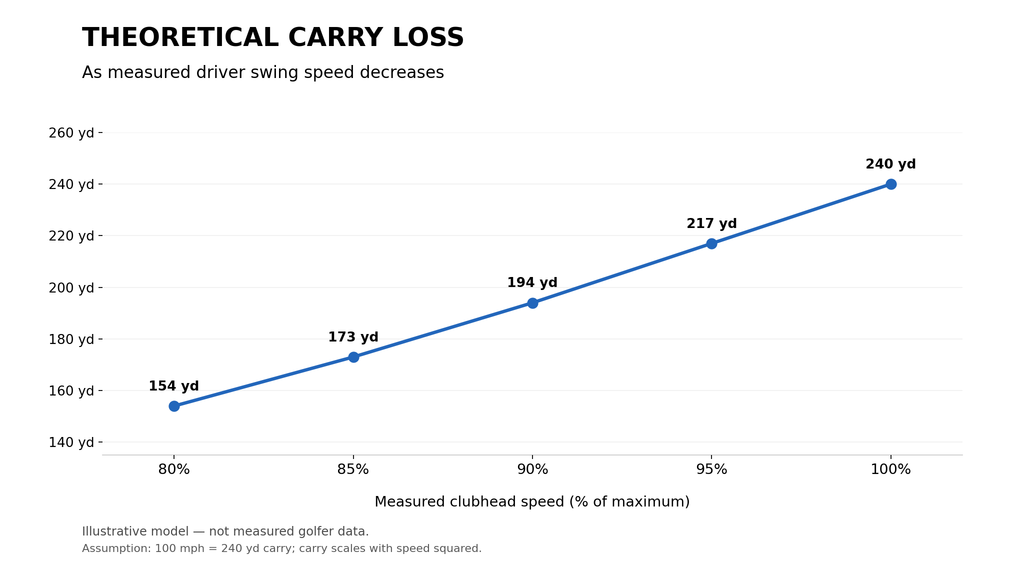
Under this model, reducing actual clubhead speed to 80% results in a loss of approximately 86 yards of carry.
That would be a major sacrifice.
However, a golfer who feels they are swinging at 80% might maintain 95% or more of their maximum speed.
This is why effort and measured speed must be separated.
A More Realistic Coaching Question
Instead of asking whether 80% effort is better than 100%, ask:
Can I reduce unnecessary tension while maintaining nearly all of my ball speed?
If the answer is yes, a smoother swing may offer an advantage.
If the answer is no, deliberately slowing down may simply leave longer approach shots.
7. Why Centered Contact Can Matter More Than Swing Effort
Clubhead speed is only part of the distance equation.
Ball speed depends heavily on how effectively the club transfers energy to the ball.
One common measurement is smash factor.
\[ \text{Smash Factor}=\frac{\text{Ball Speed}}{\text{Clubhead Speed}} \]
A golfer can swing faster but produce less ball speed if impact quality deteriorates.
Hypothetical Example
| Measurement | Controlled Swing | Aggressive Swing |
|---|---|---|
| Clubhead speed | 97 mph | 102 mph |
| Smash factor | 1.48 | 1.39 |
| Ball speed | 143.6 mph | 141.8 mph |
In this example, the controlled swing produces greater ball speed despite lower clubhead speed.
That doesn’t mean smoother swings always produce better contact.
It means faster clubhead speed is not valuable if impact efficiency deteriorates enough to offset the gain.
Why This Happens
A golfer attempting to swing harder may experience changes in:
- Strike location
- Face angle
- Club path
- Balance
- Swing sequence
- Dynamic loft
Some golfers maintain excellent control at high speed.
Others become less consistent.
The only reliable way to distinguish them is through measurement.
The Compareason Insight: Don’t judge driver performance by how hard the swing feels. Judge it by ball speed, launch conditions, distance, and dispersion.
8. Shot Dispersion: Does Swinging Easier Actually Make You Straighter?
Many golfers assume that swinging at reduced effort automatically produces straighter drives.
But that isn’t guaranteed.
A slower swing can still have an open clubface, an inconsistent path, or poor contact.
And a faster swing can produce a repeatable shot pattern.
Two Hypothetical Golfers
Golfer A swings at maximum effort and produces a 55-yard-wide landing pattern.
Golfer B swings more smoothly and produces a 35-yard-wide landing pattern.
If their driving distances are similar, Golfer B may have a meaningful advantage.
But suppose Golfer B gives up 35 yards.
Now the comparison becomes more complicated.
The shorter drives may leave significantly longer approach shots.
Why Fairway Percentage Isn’t Enough
Consider two tee shots.
Drive A travels 270 yards and finishes five yards into playable rough.
Drive B travels 235 yards and finishes in the fairway.
Drive B counts as a fairway hit.
Drive A does not.
But Drive A may still provide a better scoring opportunity because the golfer has a shorter approach.
The result depends on the lie, hazards, course conditions, and the player’s approach ability.
The More Useful Measurements
When comparing driver effort levels, measure:
- Average total distance
- Carry distance
- Shot dispersion
- Penalty frequency
- Severe recovery situations
- Expected strokes from the resulting positions
Our Take: A narrower shot pattern is valuable, but only when its scoring benefit exceeds the cost of any lost distance.
9. The Break-Even Calculation: How Much Accuracy Is 20 Yards Worth?
Now let’s calculate the most important trade-off.
Suppose a golfer has two driver strategies.
Strategy A: Controlled Swing
Average drive: 240 yards.
Strategy B: Aggressive Swing
Average drive: 260 yards.
The aggressive swing provides an additional 20 yards.
Assume both strategies produce similar ordinary rough misses, but the aggressive swing creates a higher probability of a serious miss.
Assigning Hypothetical Stroke Values
For this example, assume:
- The extra 20 yards saves 0.10 expected strokes on each drive.
- Each additional serious miss costs 1.50 strokes.
- The golfer uses driver 14 times per round.
These are illustrative assumptions, not measured PGA Tour values.
Distance Benefit
14 × 0.10 = 1.40 expected strokes saved per round.
Break-Even Penalty Risk
To erase that advantage:
1.40 ÷ 1.50 = 0.933 additional serious misses per round.
Across 14 drives:
0.933 ÷ 14 = 0.0667.
Break-even increase in serious-miss probability: approximately 6.7 percentage points.
What Does That Mean?
Suppose the controlled swing produces serious misses on 5% of drives.
Under this model, the aggressive swing could tolerate a serious-miss rate of approximately 11.7% before the assumed distance benefit disappears.
| Aggressive Swing Serious-Miss Rate | Net Expected Advantage vs Controlled Swing |
|---|---|
| 7% | 0.98 strokes |
| 9% | 0.56 strokes |
| 11.7% | Approximately even |
| 14% | Controlled swing better by 0.49 strokes |
| 17% | Controlled swing better by 1.12 strokes |
Hypothetical model: 14 × [0.10 − (p − 0.05) × 1.50]. Positive values favor the aggressive swing. Other shot outcomes are assumed equal.
The Critical Lesson
A faster swing doesn’t need to hit as many fairways to produce a better score.
But it must avoid creating too many expensive misses.
Likewise, a controlled swing doesn’t automatically win because it feels safer.
It needs to reduce scoring risk enough to compensate for any distance lost.
The Compareason Insight: The best driver speed is the one that maximizes distance while keeping the additional cost of severe misses below the value of that distance.
10. How Course Design Changes the Answer
The same golfer may benefit from different effort levels on different holes.
Wide Fairway With Little Trouble
A wide landing area provides room for a more aggressive swing.
If additional distance creates a shorter approach without substantially increasing risk, swinging faster may be advantageous.
Narrow Fairway With Out-of-Bounds
A hole with severe trouble near the landing area may reward a more controlled strategy.
But reducing swing effort isn’t necessarily the only solution.
Changing the target or choosing a shorter club may produce a better outcome.
Forced Carry Over Water
Sometimes a golfer needs a minimum carry distance to clear a hazard.
Deliberately reducing speed could make the shot more dangerous.
The correct decision may be to use a different club, select another target, or avoid the carry altogether.
Downwind Hole
A golfer may gain additional distance from favorable conditions.
But the appropriate effort depends on the landing area and whether extra distance introduces new hazards.
Into the Wind
Swinging harder can increase spin or launch inconsistencies for some golfers.
A controlled swing with suitable launch conditions may be effective.
However, the objective is not automatically to reduce clubhead speed.
It’s to optimize the flight and control of the shot.
Course Strategy Comparison
| Hole Situation | Likely Priority |
|---|---|
| Wide fairway | Distance |
| Severe trouble on both sides | Dispersion and penalty avoidance |
| Long par 5 | Distance if risk is manageable |
| Forced carry | Reliable carry distance |
| Short par 4 | Optimal next-shot position |
| Strong wind | Flight and launch control |
Our Take: The smartest driver strategy changes with the hole. Maximum effort and reduced effort are tools, not universal rules.
11. What Professional Golfers Teach Us About Swing Effort
Professional golfers offer an important lesson about driver performance.
The fastest possible swing is not necessarily the best competitive swing.
But that doesn’t mean slower is always better.
The goal is to produce as much useful speed as possible while maintaining predictable impact conditions.
Tony Finau: Controlled Power
Tony Finau is an excellent example of a golfer who generates tremendous power without appearing to swing at maximum effort.
Finau has publicly described using approximately 80–85% of his available effort during tournament play.
Yet he has consistently produced elite driving distance.
His example illustrates the difference between perceived effort and actual clubhead speed.
A golfer can feel relaxed while still producing extremely high speed.
The key is efficient movement rather than unnecessary muscular tension.
However, Finau’s comments should not be interpreted as proof that his tournament swing speed is exactly 80–85% of his maximum measured speed.
Those are different measurements.
Bryson DeChambeau: Expanding the Speed Ceiling
Bryson DeChambeau represents another approach.
He has invested heavily in developing maximum swing speed through training and technical experimentation.
The underlying idea is that increasing maximum speed creates additional distance potential.
But having more speed available doesn’t mean every competitive drive must be hit at maximum effort.
A golfer can train at very high speeds while selecting a more repeatable swing for actual play.
Rory McIlroy: Powerful but Repeatable
Rory McIlroy demonstrates how elite golfers can combine high clubhead speed with efficient sequencing.
His driver swing generates substantial speed without requiring visibly excessive movement.
However, appearance alone cannot establish how much effort he is using.
Without measured maximum-speed testing and matched tournament data, assigning a specific effort percentage would be speculation.
What About LPGA Players?
LPGA professionals provide another valuable perspective.
Many elite female players generate excellent distance through efficient sequencing, centered contact, and optimized launch conditions.
Their swings demonstrate that efficient speed production matters more than simply looking aggressive.
However, comparing PGA and LPGA driving averages does not establish which group uses a higher percentage of maximum effort.
That would require controlled measurements.
The Professional Lesson
The common principle isn’t that every professional swings at 80%.
It’s that effective driving combines speed, contact quality, and repeatability.
The correct effort level may differ substantially between players.
12. The Hidden Variable: Fatigue Over 18 Holes
A driver swing that works perfectly on the practice range may not perform the same way late in a round.
Fatigue can affect physical coordination, balance, concentration, and swing mechanics.
But the relationship isn’t identical for every golfer.
Some players maintain speed and accuracy throughout the round.
Others experience deteriorating contact or increasing dispersion.
Hypothetical Example: Early vs Late Round
Suppose a golfer uses maximum perceived effort throughout the round.
| Measurement | First 7 Drives | Last 7 Drives |
|---|---|---|
| Average clubhead speed | 103 mph | 101 mph |
| Average ball speed | 150 mph | 145 mph |
| Serious misses | 1 | 3 |
These figures are hypothetical, not measured performance data.
The example illustrates how a small reduction in clubhead speed combined with poorer contact could reduce performance.
Could a Controlled Swing Help?
Possibly.
A golfer who maintains better balance and contact with a smoother swing may experience less variation over 18 holes.
But deliberately swinging slower isn’t guaranteed to reduce fatigue or improve accuracy.
The better question is whether the golfer can maintain their normal stock swing under physical and mental pressure.
A Better Practice Method
Instead of hitting 30 consecutive drivers on the range, simulate actual playing conditions.
Hit a driver.
Then hit an iron or wedge.
Wait briefly.
Change targets.
Repeat.
This may help reveal whether your preferred effort level remains reliable when you’re not hitting the same club repeatedly.
The Compareason Insight: The best driver swing isn’t simply the one that performs well for five consecutive shots. It’s the one you can reproduce throughout an entire round.
13. Should You Swing Differently Under Pressure?
Pressure changes how golfers experience their swings.
On a wide fairway, a player may feel comfortable making an aggressive motion.
On a narrow hole with out-of-bounds, the same golfer may become tense or attempt to guide the ball.
Ironically, trying too hard to control the shot can sometimes make contact less predictable.
The Problem With Steering the Driver
A golfer who becomes afraid of missing may shorten the follow-through, decelerate, or make unnecessary swing adjustments.
These changes can affect clubface control and strike quality.
A controlled swing should not mean an incomplete or hesitant swing.
It should remain a committed athletic motion.
The Stock-Swing Principle
Under pressure, many golfers benefit from relying on a familiar swing rather than attempting a new technique.
The objective is to preserve rhythm, balance, and target commitment.
For some golfers, thinking about an 80% effort level may help reduce excessive tension.
For others, that thought may cause deceleration or poor sequencing.
Neither cue is universally correct.
The Compareason Perspective
We believe the most valuable swing under pressure is the one the golfer has practiced enough to trust.
If that swing feels like 85% effort, that’s fine.
If it feels like 95%, that’s also fine.
What matters is whether it produces predictable results.
Our Take: Don’t choose an effort percentage because it sounds safer. Choose a repeatable swing that you can commit to under pressure.
14. The Compareason 40-Drive Test: Find Your Ideal Swing Effort
How can you determine whether 80% or 100% effort produces better results for your own game?
Instead of guessing, measure it.
Step 1: Establish Your Maximum Speed
Warm up thoroughly.
Hit several drivers using your normal swing.
Then gradually increase effort while maintaining safe, balanced mechanics.
Record your highest repeatable clubhead speed.
Do not treat one unusually fast swing as your normal playing speed.
Step 2: Test Three Effort Levels
Hit 40 measured drives using the following structure.
| Swing Type | Number of Drives |
|---|---|
| 80% perceived effort | 15 |
| Normal stock swing | 15 |
| Maximum comfortable effort | 10 |
Alternate between effort levels in smaller sets to reduce fatigue and warm-up effects.
Step 3: Record the Important Numbers
Measure:
- Clubhead speed
- Ball speed
- Smash factor
- Carry distance
- Total distance
- Launch angle
- Spin rate
- Lateral dispersion
- Serious misses
A launch monitor such as TrackMan, Foresight, or another capable system can help collect these measurements.
Step 4: Compare Actual Results
Consider this hypothetical outcome.
| Measurement | 80% Effort | Stock Swing | Maximum Effort |
|---|---|---|---|
| Average clubhead speed | 96 mph | 99 mph | 103 mph |
| Average ball speed | 141 mph | 146 mph | 148 mph |
| Average carry | 225 yd | 237 yd | 242 yd |
| Serious-miss rate | 7% | 7% | 20% |
These numbers are illustrative, not results from a real test.
In this example, the stock swing produces nearly all the distance of maximum effort while avoiding a substantial increase in serious misses.
That could make it the strongest on-course option.
But a different golfer might produce equally tight dispersion at maximum effort.
For that golfer, swinging faster may be better.
Step 5: Evaluate Expected Strokes
Don’t select the winner solely by carry distance or fairway percentage.
Estimate the scoring value of the resulting drives.
A longer shot in playable rough may be better than a shorter shot in the fairway.
A slightly longer drive that frequently finishes out-of-bounds may be worse.
The key is evaluating the entire distribution of outcomes.
Step 6: Repeat the Test
Forty drives are useful for an initial comparison, but not enough to establish a reliable serious-miss probability.
For example, one severe miss among ten maximum-effort drives represents 10% of that small sample.
That percentage can change dramatically with just one additional shot.
Repeat the experiment across multiple sessions and, when possible, compare results during actual rounds.
The Compareason Insight: Your ideal driver effort is a measurable performance decision, not a universal percentage.
15. The Compareason Perspective: Stability Before Maximum Speed
At Compareason, our position is straightforward.
For most amateur golfers, the goal should be to develop the fastest repeatable driver swing—not simply the fastest possible swing.
This is an important distinction.
A golfer who swings at 100% effort may produce an impressive maximum distance.
But if that effort creates unpredictable contact or costly misses, the additional speed may not improve scoring.
At the same time, swinging at 80% effort isn’t automatically better.
If the golfer loses substantial distance without meaningfully improving dispersion, the strategy may be counterproductive.
Why We Don’t Recommend a Universal 80% Rule
The phrase “swing at 80%” can be useful as a coaching cue.
But it isn’t a precise performance measurement.
One golfer’s 80% effort may produce 98% of maximum speed.
Another golfer’s 80% effort may produce only 88%.
Their scoring outcomes could be very different.
This is why we believe the discussion should focus on actual performance rather than subjective percentages.
Our Preferred Development Sequence
For golfers trying to improve driver performance, we favor the following progression.
- Develop a repeatable stock swing.
- Improve centered contact and predictable curvature.
- Measure normal ball speed and dispersion.
- Develop additional speed through appropriate training.
- Learn how much of that speed can be used reliably on the course.
The objective is not to sacrifice speed permanently for accuracy.
It’s to improve both while controlling the risk of severe misses.
Where We Disagree With Traditional Advice
“Swing easier and you’ll hit more fairways” is too simplistic.
Some golfers improve when they reduce effort.
Others become less coordinated when they deliberately slow down.
Some golfers can swing aggressively while maintaining excellent contact.
The only meaningful conclusion comes from comparing results.
The Compareason Perspective: Stability should determine how much speed you use in competition. But improving your maximum speed remains valuable because it expands your performance potential.
16. Frequently Asked Questions
Is swinging at 80% better for driver accuracy?
Not necessarily. Some golfers improve contact and dispersion with reduced perceived effort, while others lose coordination or distance. The result depends on the individual swing.
Does an 80% effort swing produce 80% clubhead speed?
No. Perceived effort and measured speed are not directly proportional. A golfer may feel they are swinging at 80% while producing nearly full clubhead speed.
Do PGA Tour players swing at 100%?
Not always. Players may adjust effort based on the hole, club selection, conditions, and their preferred stock swing.
Does Tony Finau really swing at 80%?
Finau has publicly discussed using approximately 80–85% perceived effort in competition. That does not establish his measured clubhead speed as 80–85% of his maximum.
Is swinging harder always longer?
No. Additional clubhead speed can increase distance potential, but poor contact, launch, or spin conditions can offset that advantage.
Can swinging slower increase ball speed?
Yes, in some cases. If reduced clubhead speed produces substantially better impact efficiency, ball speed may increase.
Does a slower swing reduce slices?
Not automatically. Slice curvature depends on clubface-to-path relationship, impact location, and other factors. Reducing effort alone doesn’t guarantee a straighter shot.
Should beginners swing their driver at 80%?
Beginners generally benefit from learning balance, contact, and repeatable mechanics. A perceived 80% effort cue may help some players, but it isn’t a universal requirement.
Is distance more important than accuracy?
Both matter. Additional distance often improves approach opportunities, but severe misses and penalties can erase those gains.
Should I swing harder on wide fairways?
A wider landing area may make an aggressive swing more attractive if additional distance provides scoring value and doesn’t introduce excessive risk.
Is speed training different from swinging harder during a round?
Yes. Speed training aims to increase physical speed capacity. On-course driving requires selecting a speed and swing pattern that produce reliable scoring outcomes.
How can I find my ideal driver effort?
Compare perceived effort levels using measured clubhead speed, ball speed, carry, dispersion, and serious-miss frequency. Repeat the test over multiple sessions.
17. The Compareason Verdict: Driver at 80% vs 100% Swing Effort
Overall Winner: The Fastest Repeatable Stock Swing
If forced to choose between an uncontrolled maximum-effort swing and a smoother swing that produces nearly the same distance with substantially better consistency, we favor the controlled swing.
But that doesn’t mean 80% effort is automatically optimal.
A golfer who maintains excellent contact and dispersion at maximum effort may benefit from using that additional speed.
The deciding factor is expected scoring performance.
What Professional Golfers Teach Us
Tony Finau illustrates how a golfer can produce elite distance while describing his competitive swing as less than maximum effort.
Bryson DeChambeau demonstrates the importance of developing additional speed capacity.
Rory McIlroy and Scottie Scheffler show that elite golfers can succeed with different combinations of distance and accuracy.
None of these examples establishes a universal optimal effort percentage.
The Compareason Calculation
Our hypothetical 20-yard distance advantage produced a potential benefit of 1.40 strokes over 14 drives.
Under the assumed 1.50-stroke cost per additional serious miss, that advantage disappeared when the aggressive swing increased serious-miss probability by approximately 6.7 percentage points.
That break-even point is specific to the assumptions.
But the underlying principle is broadly useful.
Additional speed is valuable until the scoring cost of additional misses exceeds its benefit.
Best Choice for Beginners
Prioritize centered contact, balance, and a repeatable swing.
Don’t chase maximum clubhead speed before developing reasonable control.
Best Choice for Mid-Handicap Golfers
Measure whether a smoother swing actually improves dispersion.
If it preserves most of your distance and reduces severe misses, it may be your better competitive swing.
Best Choice for Low-Handicap Golfers
Develop speed while monitoring how additional effort changes ball speed, launch, and shot dispersion.
Use more aggressive swings when the hole provides sufficient room and the expected scoring benefit justifies the risk.
Best Choice for Competitive Players
Separate maximum-speed training from on-course swing selection.
Train to increase speed capacity.
Compete with the fastest swing that remains sufficiently predictable for the situation.
Our Final Recommendation
Stop asking whether every golfer should swing at 80% or 100%.
Instead, ask:
How fast can I swing while maintaining reliable contact and an acceptable pattern of misses?
That question leads to better decisions.
A golfer who can swing at 103 mph with excellent contact and predictable dispersion has no reason to slow down simply because 80% sounds safer.
A golfer who swings at 103 mph but frequently loses control may score better with a 99 mph stock swing.
The ideal speed is individual.
And it may change with the hole, weather, physical condition, and pressure.
The Compareason Verdict: Maximum speed creates distance potential. Repeatable speed creates scoring opportunities. The best driver swing is the fastest one you can trust.
Compare with Reason.