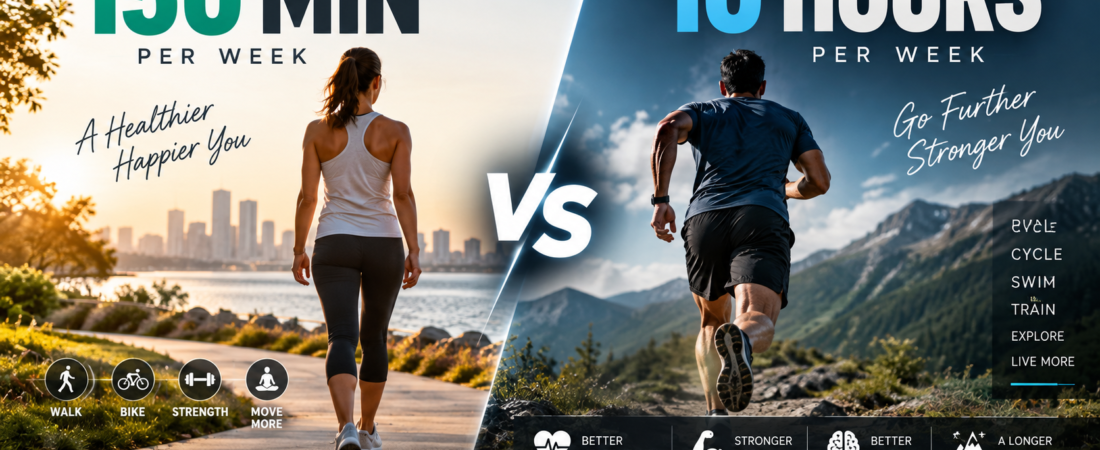
For years, one number has dominated exercise advice:
150 minutes per week.
That’s about 30 minutes of moderate exercise five days a week, and it remains the minimum target recommended for most adults by major health organizations.
But new research has raised an interesting question.
What if 150 minutes is only the beginning?
A large observational study found that people doing roughly 560 to 610 minutes of moderate-to-vigorous physical activity per week — around 9 to 10 hours — had substantially lower cardiovascular risk than people meeting only the minimum recommendation.
So should we all suddenly start exercising 10 hours every week?
Not so fast.
Let’s compare 150 minutes vs. 10 hours of weekly exercise and see what the research actually means.
Quick Comparison
| 150 Minutes/Week | 9–10 Hours/Week | |
|---|---|---|
| Daily Average | ~21 minutes | ~80–87 minutes |
| Meets Guidelines | Yes | Far exceeds them |
| Heart Benefits | Significant | Potentially greater |
| Realistic for Most People | Yes | Difficult |
| Injury/Overtraining Risk | Relatively low | Higher if poorly managed |
| Time Commitment | Moderate | High |
| Best For | Most adults | Highly active people |
| Sustainable | Usually | Depends on lifestyle |
| Our Pick | Best for most people | Best for motivated, conditioned adults |
Why 150 Minutes?
The 150-minute recommendation isn’t arbitrary.
The American Heart Association recommends that adults get at least 150 minutes of moderate-intensity aerobic activity per week, or 75 minutes of vigorous activity, or a combination of both.
Muscle-strengthening activity is also recommended at least twice per week.
Moderate exercise doesn’t necessarily mean going to the gym.
It can include:
Brisk walking.
Cycling.
Dancing.
Swimming.
Hiking.
Yard work.
The important word in the recommendation is “at least.”
150 minutes was never intended to represent the maximum amount of exercise that can benefit your health.
It’s a practical minimum target.
What Did the New Study Find?
The study examined more than 17,000 adults from the UK Biobank.
Participants wore activity trackers, underwent fitness testing, and were followed for nearly eight years.
During that period, researchers recorded more than 1,200 cardiovascular events.
People meeting the standard 150-minute target had an estimated 8–9% lower cardiovascular risk in the study.
But something interesting happened as activity increased.
People performing approximately 560–610 minutes of moderate-to-vigorous activity per week were associated with more than a 30% reduction in cardiovascular risk.
That’s roughly nine to ten hours every week.
Only about 12% of participants actually reached that activity level.
That sounds impressive.
But there’s an important catch.
Association Doesn’t Mean Causation
This was an observational study.
That means researchers observed what happened to people with different activity levels.
They did not randomly assign one group to exercise 150 minutes and another group to exercise 600 minutes for eight years.
That’s an important distinction.
People who exercise 10 hours per week may differ from less-active people in many other ways.
They may have different diets.
Different body weights.
Different incomes.
Different medical histories.
Different sleep habits.
And, importantly, different baseline fitness levels.
So the study can show an association between greater physical activity and lower cardiovascular risk, but it cannot prove that exercising exactly 600 minutes caused the entire difference.
The researchers themselves acknowledged that the study cannot establish cause and effect.
Heart Protection: 10 Hours Wins
If we’re looking strictly at the results of this particular study, higher activity levels were associated with greater cardiovascular protection.
So 10 hours wins this category.
But that doesn’t mean you need 10 hours before exercise becomes worthwhile.
Far from it.
CDC guidance emphasizes that some benefits occur with activity levels below 150 minutes, while reaching at least 150 minutes is associated with lower risk of heart disease and stroke.
Think of exercise less like an on/off switch and more like a volume dial.
Zero isn’t ideal.
A little is better.
150 minutes is better.
And additional activity may provide additional benefits.
Winner: 9–10 Hours
Time Efficiency: 150 Minutes Wins Easily
Here’s where reality enters the conversation.
Ten hours per week is a lot.
That’s roughly:
1 hour and 25 minutes every day.
For someone working full time, commuting, raising children, cooking, and handling everyday responsibilities, finding that much time can be difficult.
150 minutes is much easier.
You could do:
30 minutes × 5 days.
Or about 22 minutes every day.
You can even accumulate activity throughout your day.
A morning walk.
Walking during lunch.
Cycling.
Taking stairs.
Playing a sport.
The best exercise program isn’t necessarily the one producing the theoretically largest benefit.
It’s the one you can actually maintain.
Winner: 150 Minutes
Fitness: More Isn’t Automatically Better
Another interesting finding involved fitness level.
People with lower cardiorespiratory fitness appeared to require somewhat more activity to reach the same estimated cardiovascular-risk reduction as fitter participants.
For example, the study estimated that achieving a 20% reduction was associated with around 370 minutes per week for lower-fitness participants versus about 340 minutes for higher-fitness participants.
But there’s a practical issue here.
Someone who is currently sedentary probably shouldn’t jump immediately from zero exercise to 10 hours per week.
Their body isn’t conditioned for it.
Muscles, tendons, joints, and the cardiovascular system need time to adapt.
Gradual progression makes much more sense.
Injury Risk: 150 Minutes Wins
More exercise creates more opportunities for overuse injuries.
Running 10 hours per week isn’t the same as walking 10 hours.
Intensity matters.
Exercise type matters.
Recovery matters.
Age matters.
Fitness level matters.
Someone who gradually accumulates 10 hours through walking, golf, cycling, swimming, and strength training may tolerate it very differently from someone suddenly attempting 10 hours of hard running.
Experts commenting on the new findings have specifically cautioned against interpreting them as a reason for everyone to dramatically increase exercise volume overnight.
Winner: 150 Minutes
Weight Management: 10 Hours Has an Advantage
More physical activity generally means greater energy expenditure.
So if diet remains similar, higher activity levels can make weight management easier for some people.
But exercise isn’t a free pass to eat unlimited calories.
And people vary considerably in how much physical activity they need to maintain their weight.
The CDC notes that some individuals may need more physical activity than others for weight management.
For pure calorie expenditure, though, higher activity wins.
Winner: 9–10 Hours
Mental Health: Both Can Help
Exercise isn’t only about your heart.
Regular physical activity can support mood, sleep, cognition, and mental well-being.
And some benefits can occur after individual exercise sessions.
This is another reason why thinking only about “150 vs. 600” misses the bigger picture.
Even a 20-minute walk today may have value.
You don’t have to accumulate hundreds of minutes before your body starts benefiting.
Winner: Tie
Is 300 Minutes a Better Middle Ground?
For many people, this may be the most interesting option.
You don’t necessarily have to choose between 150 and 600 minutes.
NIH guidance notes that 300 minutes of moderate activity per week can provide additional health benefits beyond the standard 150-minute target.
That’s five hours per week.
Or roughly 43 minutes per day.
For an active person, that may be much more realistic than 10 hours.
You could accumulate it naturally:
30-minute morning walk.
Golf.
Weekend bike ride.
Strength training.
Walking instead of driving short distances.
Suddenly, five hours doesn’t sound quite as extreme.
What About Walking?
This is important because “exercise” doesn’t have to mean running or intense gym sessions.
Brisk walking counts as moderate-intensity activity for many adults.
That makes higher weekly activity levels more achievable.
Imagine someone walks 45 minutes every morning.
That’s already:
315 minutes per week.
Add a weekend round of golf, some strength training, yard work, or cycling and total weekly activity can become surprisingly high.
You may already be moving more than you think.
What If You Currently Exercise Zero Minutes?
Don’t aim for 600.
Start moving.
This is arguably the most important takeaway.
Research consistently shows that the largest practical improvement often comes from getting inactive people to become at least somewhat active.
If you’re currently doing nothing, even 10 minutes is progress.
Then 20.
Then 30.
Eventually, reaching 150 minutes becomes realistic.
After that, if you enjoy being active and your body tolerates it, you can gradually do more.
The goal shouldn’t be perfection.
It should be consistency.
So Do We Need New Exercise Guidelines?
Not yet.
The new findings are interesting, but experts aren’t throwing away the 150-minute recommendation.
The current recommendation remains a useful, achievable public-health target.
The American Heart Association still recommends at least 150 minutes of moderate aerobic activity per week and encourages increasing time, distance, or intensity for additional benefits.
The new research adds nuance.
Instead of:
“150 minutes is all you need.”
A better interpretation may be:
“150 minutes is a strong starting target, but additional activity may provide additional cardiovascular benefits.”
That’s a very different message from telling everyone they must exercise 10 hours per week.
Compareason Verdict
Our Pick: 150 Minutes — for most people.
If you’re deciding what target to build your life around, 150 minutes per week remains our pick.
It’s achievable.
It’s supported by major health guidelines.
It provides meaningful health benefits.
And it’s much easier to maintain consistently.
But here’s the important part:
Don’t treat 150 minutes as a ceiling.
If you enjoy walking, cycling, swimming, golfing, hiking, running, or working out and can safely do more, the new research suggests that higher activity levels may provide additional cardiovascular protection.
For many active adults, 300 minutes per week may be an excellent next target before worrying about reaching 600.
And if you’re currently doing nothing?
Forget 150.
Forget 600.
Start with 10 minutes.
Then do it again tomorrow.
Consistency beats an unrealistic target.
Compare with Reason.