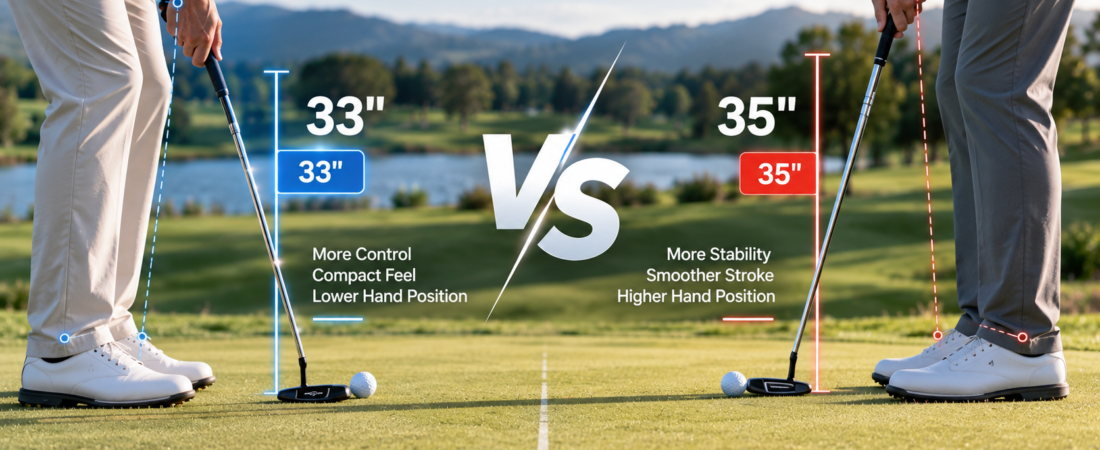
Most golfers choose a putter length based on their height.
Shorter golfers are often told to use a 33-inch putter. Taller golfers are frequently directed toward 35 inches.
But what if height isn’t the most important factor?
What if a shorter putter gives you better control over the clubface, while a longer putter makes your stroke feel smoother and more stable?
And what if the putter that feels most comfortable isn’t necessarily the one that produces the lowest score?
The difference between a 33-inch and 35-inch putter may seem small. Just two inches.
Yet those two inches can influence your posture, hand position, eye alignment, perceived head weight, stroke shape, and how the putter moves through impact.
For some golfers, a shorter putter creates a feeling of precision. They feel closer to the ball, more connected to the putter head, and more comfortable making small adjustments.
For others, a longer putter encourages a relaxed posture and a smoother pendulum-like motion. They feel less inclined to manipulate the club with their hands.
Neither sensation automatically translates into better putting.
In this 33-inch vs 35-inch putter comparison, we’ll examine the mechanical differences, PGA Tour player examples, putting accuracy, distance control, and the relationship between putter length and scoring.
We’ll also develop a practical test to determine which length actually performs better.
Quick Verdict: A 33-inch putter may suit golfers who prefer lower hand positioning and a compact, connected stroke. A 35-inch putter may suit golfers who prefer a more upright setup and a less cramped motion. But neither length inherently produces straighter putts. The winner is the length that gives you the most repeatable face delivery, solid contact, and reliable speed control.
1. 33-Inch vs 35-Inch Putter: Quick Comparison
| Factor | 33-Inch Putter | 35-Inch Putter |
|---|---|---|
| Overall length | Shorter | Longer |
| Typical hand position | Lower | Higher |
| Posture tendency | More bent over | More upright |
| Stroke sensation | Compact and connected | Potentially freer and smoother |
| Clubface manipulation | May feel easier | May feel less tempting |
| Head feel, same head | Often feels heavier | Often feels lighter |
| Starting-line accuracy | Player dependent | Player dependent |
| Distance control | Player dependent | Player dependent |
| Best fit | Lower-hand setup | Higher-hand setup |
These are tendencies, not guaranteed outcomes.
The biggest mistake would be to assume that a 33-inch putter is automatically more accurate or that a 35-inch putter automatically travels straighter.
The mechanical reality is more complicated.
2. Why Two Inches Can Change Your Entire Putting Stroke
A putter is different from a driver or an iron.
With a driver, club length directly influences the potential swing radius and clubhead speed.
With a putter, maximum speed is rarely the objective.
Instead, the goal is to control three things:
- The direction of the putter face at impact.
- The speed of the ball leaving the face.
- The consistency of contact and launch.
Putter length can influence all three indirectly through setup and movement.
What Happens With a 33-Inch Putter?
A shorter putter generally encourages the hands to sit lower, assuming the golfer grips it near the top.
This can change shoulder position, elbow bend, and the relationship between the arms and torso.
Some golfers feel that a shorter putter allows them to control the head more precisely.
The putter may feel like an extension of their arms rather than a separate object swinging beneath them.
However, this additional sense of control can become a disadvantage if the golfer starts making excessive hand adjustments.
What Happens With a 35-Inch Putter?
A longer putter may allow a more upright posture.
Some golfers find this more comfortable, particularly if they dislike bending over the ball.
The longer club can also change the feel of the stroke.
Instead of actively guiding the putter head, the golfer may feel more comfortable allowing the shoulders and arms to move together.
But a longer putter does not automatically create a pendulum stroke.
And it does not automatically reduce clubface rotation.
The Compareason Insight
The difference between 33 and 35 inches isn’t simply how long the putter is. It’s how that length changes the golfer’s relationship with the putter head.
3. Control vs Stability: The Real Debate
This is where our comparison becomes more interesting than a traditional putter fitting guide.
Many golfers describe shorter putters as easier to control.
Others describe longer putters as more stable.
Both sensations can be genuine.
But they describe different aspects of putting.
What Does Control Actually Mean?
Control can refer to several things:
- The ability to adjust face direction.
- The ability to change stroke length.
- The ability to sense the putter head.
- The ability to start the ball on the intended line.
- The ability to control distance.
A golfer might feel more capable of manipulating a 33-inch putter without actually producing better results.
In fact, too much manipulation can make putting less consistent.
What Does Stability Mean?
Stability can describe how little the putter twists during impact, how repeatable the stroke feels, or how consistently the face returns to the ball.
These are not identical properties.
A putter’s resistance to twisting is primarily related to its mass distribution and moment of inertia, rather than shaft length alone.
A longer shaft does not automatically give the head a higher moment of inertia.
The Critical Distinction
Imagine two golfers.
Golfer A uses a 33-inch putter and feels comfortable making small adjustments with the hands.
Golfer B uses a 35-inch putter and feels more comfortable allowing the putter to swing without interference.
Golfer A may perform better on short, precise putts.
Golfer B may perform better on longer putts requiring smooth rhythm.
But the reverse could also happen.
The question is whether their preferred sensations translate into measurable consistency.
Our Take: A putter that feels easier to manipulate isn’t necessarily easier to control. True control means producing the intended result repeatedly.
4. What PGA Tour Players Actually Use
Professional golfers provide some of the most interesting evidence in this debate.
But there is an important limitation.
Tour players frequently use custom-built putters. Their specifications can change, and manufacturers don’t always publish exact playing lengths.
That makes it risky to assign a length to a player based on photographs or the retail version of their putter.
Let’s separate verified equipment information from assumptions.
Scottie Scheffler: A Successful 35.5-Inch Example

Scottie Scheffler
Height: approximately 6 ft 3 in | Documented putter: 35.5 in
Scheffler switched to a TaylorMade Spider Tour X L-Neck putter in March 2024. The PGA Tour confirmed the 35.5-inch length, 3-degree loft, and 72-degree lie angle.
PGA Tour
+1
The switch was followed by an extraordinary run of tournament victories.
But the important detail isn’t simply that Scheffler used a longer putter.
He also changed the head design, alignment system, and feel.
The Spider’s higher-MOI mallet construction helped provide greater forgiveness on off-center strikes.
That improvement cannot be attributed to shaft length alone.
In fact, the PGA Tour reported that the new putter was only half an inch longer than his previous model.
This is a particularly useful case study because it shows how several small fitting changes can work together.
What About Shorter PGA Tour Players?

Brian Harman
Height: 5 ft 7 in
Harman’s height is confirmed by his PGA Tour player profile. However, I could not verify an exact current playing length from a sufficiently reliable equipment source, so we should not label his putter as 33 inches merely because he is shorter.
PGA Tour
This matters because height alone is not enough to determine putter length.
Two players of identical height can have different arm lengths, postures, grip positions, and preferred eye alignments.
What the Manufacturer Research Says
Scotty Cameron’s fitting guidance explains that golfers with lower hands may fit into shorter putters around 33 inches, while golfers with higher hands may fit into 34–35 inches or longer.
It also emphasizes that putter neck design, toe flow, and lie angle interact with hand position and stroke shape.
Scotty Cameron
The manufacturer also identifies 33, 34, and 35 inches as lengths that fit the majority of golfers during its fitting work.
Scotty Cameron
This supports a more nuanced conclusion than a height chart.
The Compareason Insight: Professional golfers don’t demonstrate that longer or shorter is universally better. They demonstrate that putter length must work with the entire putting setup.
5. Does a 35-Inch Putter Really Roll the Ball Straighter?
This is arguably the most important question in our comparison.
A longer putter may feel as though it moves on a smoother, more stable path.
But does that feeling actually produce a straighter starting line?
The Clubface Matters More Than the Visual Stroke
A putt’s initial direction is heavily influenced by the orientation of the clubface at impact.
The stroke path also matters, but a putter moving along a visually straight path can still send the ball offline if the face is misaligned.
This is why simply trying to move the putter straight back and straight through doesn’t guarantee straight putts.
Scotty Cameron’s putting guidance also notes that putters naturally travel on some degree of arc because of their lie angle and the golfer’s setup.
Titleist
A Simple Directional Calculation
Suppose the ball starts just 1 degree away from the intended line.
On a perfectly flat surface, ignoring break and other effects, the lateral deviation is approximately:
\[ \text{Deviation}=\text{Distance}\times\tan(1^\circ) \]
| Putt Length | Approximate Lateral Deviation |
|---|---|
| 3 feet | 0.63 inches |
| 6 feet | 1.26 inches |
| 10 feet | 2.09 inches |
| 20 feet | 4.19 inches |
This is a geometric illustration of a ball starting 1 degree offline, not a claim that the putter face angle always equals the launch angle.
The lesson is important.
Small differences in starting direction become increasingly consequential as putt length increases.
Where the 35-Inch Theory Makes Sense
If a longer putter allows a golfer to reduce unnecessary hand movement and return the face more consistently, it may improve starting-line accuracy.
But the benefit comes from the golfer’s improved movement—not from the extra two inches themselves.
Where the 33-Inch Theory Makes Sense
If a shorter putter gives a golfer a more connected setup and better face awareness, it may produce the same improvement.
For another player, however, the shorter putter might encourage excessive wrist activity.
Our Take: Neither 33 nor 35 inches has an inherent straight-line advantage. The better length is the one that delivers the face more consistently.
6. The Overlooked Variable: Head Weight and Swing Weight
One of the biggest problems with comparing two putters of different lengths is that they may not have the same effective weight characteristics.
This can make a golfer believe they’re testing length when they’re actually testing both length and head feel.
Why Shorter Putters Can Feel Heavier
If you shorten a putter while keeping the same head, grip, and other components, its conventional swing weight generally decreases.
That means the head can feel lighter relative to the hands.
However, manufacturers often compensate by installing heavier head weights in shorter models.
For example, Scotty Cameron’s research and design team has discussed how different head-weight configurations are used to maintain suitable balance across 33-, 34-, and 35-inch putters.
Scotty Cameron
A Common Fitting Trap
Imagine comparing:
- A 33-inch putter with a heavier head.
- A 35-inch putter with a lighter head.
The shorter putter might feel more stable because of its head weighting.
The longer putter might feel easier to accelerate because of its overall balance.
But those sensations cannot be attributed to length alone.
Two Different Tests
Real-World Buying Test: Compare the actual 33- and 35-inch models as sold, including their standard weighting.
Length-Only Test: Use matching heads, grips, and carefully controlled weighting to isolate the influence of playing length.
The second experiment is more scientifically informative.
The first is more directly relevant to choosing a putter in a golf shop.
The Compareason Insight
Before deciding that 33 inches feels better than 35 inches, make sure you’re not actually preferring a different head weight or balance.
7. Short Putts vs Long Putts: Could Different Lengths Have Different Winners?
Most putter comparisons focus on overall feel.
But putting from three feet is a different task from putting at 30 feet.
The shorter putt places a premium on starting direction.
The longer putt places greater emphasis on distance control.
This creates an interesting possibility.
What if a golfer performs better with 33 inches on short putts but better with 35 inches on long putts?
Three-Foot Putts: Face Control Is Critical
From three feet, the golfer needs relatively little stroke length.
The priority is starting the ball on the correct line with a sufficiently square face.
A golfer who feels more connected to a shorter putter may benefit from that sensation.
But a longer putter could also be effective if it reduces unwanted hand action.
Six- to Ten-Foot Putts: The Most Revealing Test
This distance range may be especially useful for comparing putter lengths.
The putts are short enough that starting-line control matters significantly, yet long enough to reveal directional errors.
In a large independent compilation of tracked PGA Tour putts, the reported make rate was 71.5% from 5–8 feet and 40.8% from 8–12 feet. These are distance bands, not exact six- or ten-foot measurements.
PropGolf
The lesson is that even elite players miss a meaningful number of putts from these distances.
Small improvements in face delivery can have real scoring value.
Twenty- to Thirty-Foot Putts: Distance Control Takes Over
From longer distances, a golfer must produce enough stroke length and speed without losing rhythm.
A golfer who feels cramped with a 33-inch putter may struggle to make a free-flowing stroke.
A 35-inch putter could help that golfer.
But if the longer club creates poor contact or inconsistent acceleration, the opposite result may occur.
The Distance-Based Hypothesis
| Distance | Main Performance Priority | What to Test |
|---|---|---|
| 3 ft | Starting direction | Face delivery |
| 6 ft | Starting direction and confidence | Make percentage |
| 10 ft | Start line and pace | Make percentage |
| 20 ft | Pace and line | Leave distance |
| 30 ft | Distance control | Three-putt risk |
These are testing priorities, not proof that one length wins at a particular distance.
8. Green Speed and Slope May Change the Preferred Feel
The same putter can feel different on slow and fast greens.
On a slow green, a golfer may need a longer stroke or greater acceleration.
On a fast green, the golfer may prefer a smaller, more controlled motion.
This raises another interesting question.
Could a shorter putter be better on fast greens while a longer putter performs better on slow greens?
Fast Greens
A golfer who tends to over-accelerate may appreciate the sensation of a compact stroke.
If a shorter putter makes it easier to regulate small movements, that may improve speed control.
But a golfer who becomes too wristy with a shorter putter could perform worse.
Slow Greens
A longer putter may allow some golfers to produce a freer, more comfortable stroke.
That could help on long uphill putts.
But the length itself does not generate additional ball speed automatically.
Sloping Putts
On a downhill putt, the golfer may prioritize delicate speed control.
On a sharply breaking putt, consistent starting direction and pace are both essential.
The preferred length should support these skills without requiring uncomfortable posture or excessive manipulation.
Our Take: Green speed and slope may expose weaknesses in a putter setup, but they do not establish a universal 33-inch or 35-inch advantage.
9. The Compareason Calculation: How Much Could Better Putting Save?
Let’s quantify the scoring difference.
Suppose a golfer uses two putters over comparable practice sessions.
The golfer makes 18 attempts from six feet per round-equivalent sample.
We will assume that misses are completed in two putts, with no three-putts.
Hypothetical Results
| Measurement | 33-Inch Putter | 35-Inch Putter |
|---|---|---|
| Six-foot make rate | 60% | 70% |
| Expected putts per attempt | 1.40 | 1.30 |
| Attempts | 18 | 18 |
| Expected total putts | 25.2 | 23.4 |
The 35-inch putter saves:
25.2 − 23.4 = 1.8 expected strokes per 18 attempts.
That is a meaningful difference.
But it is not evidence that 35 inches is generally superior. We deliberately assigned the longer putter a higher make percentage for this illustration.
Reverse the success rates and the 33-inch putter wins by the same amount.
What About Long Putts?
Now suppose the 33-inch putter leaves an average second putt of 2.5 feet from 30 feet, while the 35-inch putter leaves an average of 3.5 feet.
That one-foot difference might affect the likelihood of a three-putt.
But average leave distance alone is not sufficient to calculate the exact scoring advantage.
We would also need to know the distribution of misses, their direction, and the player’s conversion rates from those remaining distances.
The Break-Even Lesson
A putter that performs better from six feet may still lose overall if it consistently produces poor lag-putting results.
The winner should be determined by expected putts across the distances you actually face, not one isolated drill.
10. The Compareason 100-Putt Test
Here’s a practical way to compare the two lengths.
Use two putters with matching head designs, necks, grips, and loft/lie specifications wherever possible.
If their weights differ, record that difference.
The Test
| Distance | 33-Inch Attempts | 35-Inch Attempts |
|---|---|---|
| 3 feet | 10 | 10 |
| 6 feet | 10 | 10 |
| 10 feet | 10 | 10 |
| 20 feet | 10 | 10 |
| 30 feet | 10 | 10 |
| Total | 50 | 50 |
Alternate putters and starting positions rather than hitting all 50 putts with one putter first.
Use multiple hole locations and directions of break.
Record Four Measurements
- Make percentage from three, six, and ten feet.
- Average leave distance from 20 and 30 feet.
- Three-putt frequency when every putt is completed.
- Starting-line accuracy on a straight practice putt.
For a more controlled test, use a putting launch monitor or alignment gate.
Why Starting-Line Accuracy Matters
A putt can miss because of poor green reading, poor speed, or incorrect face delivery.
Those are different problems.
If you want to know whether 33 or 35 inches gives you better directional control, test straight putts separately from breaking putts.
Repeat the Experiment
One hundred putts is a useful first comparison, but it is not enough to identify small performance differences reliably.
Repeat the test across several days, using the same balls and comparable green conditions.
The Compareason Insight: The right putter length is the one that performs consistently after the novelty of a new feel has disappeared.
11. Why Your Height Should Be the Starting Point, Not the Final Answer
Height matters because it influences how a golfer reaches the ball.
But it does not fully determine putter length.
Two golfers who are both six feet tall may have very different arm lengths.
One may naturally hang their hands low.
The other may prefer a more upright posture.
The same 34-inch putter could fit them differently.
The Eye-Position Question
Scotty Cameron’s fitting guidance recommends an eye position approximately one to two inches inside the target line, rather than automatically directly above the ball.
Scotty Cameron
This isn’t the only viable putting setup, but it provides a useful fitting reference.
If a 35-inch putter forces the golfer’s eyes excessively inside the line, the length may be too great for their preferred posture.
If a 33-inch putter forces an uncomfortable bend and moves the eyes too far outside the line, it may be too short.
A Simple Fitting Check
Take your normal putting stance without worrying about the number printed on the shaft.
Let your arms hang comfortably.
Place your hands on the grip without reaching or crowding your body.
Check whether the sole sits appropriately on the ground and whether your eye position and posture are comfortable.
Then evaluate the actual stroke.
A putter that looks perfect on a height chart but produces inconsistent contact is not necessarily a good fit.
12. Can You Turn a 35-Inch Putter Into a 33-Inch Putter?
Many golfers already own a 35-inch putter.
Before purchasing another model, they may wonder whether gripping down two inches can reproduce the feel of a shorter club.
The answer is partly yes.
What Gripping Down Can Reproduce
Gripping lower effectively reduces the playing length between the hands and the head.
It may allow a lower hand position and a posture similar to using a shorter putter.
This makes it a useful preliminary fitting experiment.
What It Cannot Reproduce Exactly
The extra shaft and grip remain above the hands.
That changes mass distribution and balance compared with a putter physically shortened to 33 inches.
The grip’s taper may also mean the hands are holding a narrower section.
And a purpose-built 33-inch putter may use different head weights.
Therefore, gripping down on a 35-inch putter is a helpful experiment, but not a perfect substitute for testing a properly fitted 33-inch model.
Should You Cut Two Inches Off?
Not immediately.
First, establish that the shorter effective length improves your performance.
Then consider whether head weighting, grip size, and lie angle need adjustment.
Cutting the shaft without accounting for those variables can change the putter’s feel in ways you did not intend.
13. The Compareason Perspective: Control Is Not the Same as Consistency
At Compareason, we believe the biggest mistake golfers make when selecting a putter is confusing the feeling of control with actual consistency.
A shorter putter may feel easier to manipulate.
A longer putter may feel more stable.
But neither sensation guarantees better putting.
Why We Question the Traditional Height-Based Rule
Most conventional putter-fitting advice begins with the golfer’s height.
A shorter golfer is directed toward 33 inches.
A taller golfer is directed toward 35 inches.
Height is useful information, but it doesn’t explain how the golfer actually controls the putter.
Two golfers of the same height may have different arm lengths, hand positions, postures, and stroke preferences.
More importantly, they may respond differently to the same putter length.
The Control Paradox
Imagine a golfer using a 33-inch putter.
The shorter length makes the head feel more accessible.
The golfer feels capable of making small adjustments throughout the stroke.
That sensation can be comforting.
But it can also encourage excessive manipulation.
Now imagine the same golfer using a 35-inch putter.
The longer length may feel less responsive to small hand movements.
The golfer might allow the putter to swing more naturally.
If that produces more consistent face delivery, the longer putter could perform better.
But another golfer might experience exactly the opposite result.
Our Coaching Hypothesis
The ideal putter should give the golfer enough control to aim confidently, but not encourage unnecessary corrections during the stroke.
That balance may be different for every player.
We believe this is more important than choosing a putter solely according to height.
What We Would Prioritize in a Fitting
Instead of beginning with a height chart, we would evaluate:
- Natural posture and hand position.
- Ability to return the face consistently.
- Starting-line accuracy from short distances.
- Distance control on longer putts.
- Whether the golfer makes unnecessary adjustments during the stroke.
Only then would we determine whether 33 or 35 inches provides the better overall fit.
The Compareason Insight: The putter that feels easiest to control is not necessarily the putter that produces the most consistent results.
14. Can a 34-Inch Putter Be the Better Compromise?
So far, we’ve compared 33 and 35 inches.
But what if neither is ideal?
A 34-inch putter sits directly between the two.
For many golfers, that may provide a useful starting point.
Why 34 Inches Deserves Consideration
A golfer who feels cramped with 33 inches may benefit from a slightly longer shaft.
A golfer who struggles to position their hands comfortably with 35 inches may prefer something shorter.
Moving to 34 inches can change posture and grip position without making a full two-inch adjustment.
But the middle length isn’t automatically the best compromise.
The Problem With Choosing the Middle
Imagine a golfer who performs extremely well with 33 inches and poorly with 35 inches.
Choosing 34 inches simply because it’s between the two may be unnecessary.
Likewise, a golfer who achieves excellent consistency with 35 inches has no reason to shorten the putter without evidence of improvement.
What About Gripping Down?
Some golfers purchase a 35-inch putter and grip down one or two inches.
This allows them to experiment with a shorter effective playing length.
However, gripping down is not mechanically identical to using a properly built 33-inch putter.
The club’s overall mass, grip position, balance, and the amount of shaft extending above the hands can differ.
Still, gripping down can be a useful preliminary test before purchasing or modifying equipment.
Our Recommendation
If you’re uncertain between 33 and 35 inches, test all three lengths.
Don’t assume the middle is best.
Use actual putting performance to make the decision.
The Compareason Insight: A 34-inch putter is a useful alternative, but compromise is only valuable when it improves performance.
15. Frequently Asked Questions
Is a 33-inch putter easier to control?
It may feel easier to control for golfers who prefer a lower hand position or more compact setup. However, that sensation does not automatically produce better face control or putting accuracy.
Does a 35-inch putter roll the ball straighter?
Not inherently. Starting direction depends heavily on face orientation at impact. A longer putter may improve consistency for some golfers, but it does not automatically produce a straighter roll.
Do taller golfers always need longer putters?
No. Height is only one fitting variable. Arm length, posture, hand position, and stroke mechanics also influence the appropriate playing length.
What length putter does Scottie Scheffler use?
Scheffler’s TaylorMade Spider Tour X L-Neck putter was documented at 35.5 inches when he switched to it in 2024. Professional equipment specifications can change, so that should not be treated as a permanent specification.
Do most PGA Tour players use 35-inch putters?
Not necessarily. Tour players use a variety of lengths, including custom specifications. Historical reports have described average playing lengths shorter than 35 inches, but those figures should not be assumed to represent the current tour without updated data.
Is a shorter putter better for short putts?
Not universally. Some golfers may improve starting-line accuracy with a shorter putter, while others perform better with a longer one.
Is a longer putter better for lag putting?
It may help golfers who prefer a more upright setup or a freer stroke. However, lag-putting performance depends on distance control, contact quality, and rhythm rather than shaft length alone.
Does putter length affect swing weight?
Yes. Changing shaft length while keeping other components constant generally changes conventional swing weight. Manufacturers may compensate with different head weights.
Can I use a 35-inch putter and grip down to 33 inches?
Yes. This can be a useful way to experiment with effective playing length, although it won’t feel exactly like a purpose-built 33-inch putter.
Is 34 inches the safest choice?
Not automatically. A 34-inch putter may suit many golfers, but the correct length should be determined through fitting and performance testing.
Does green speed change which putter length is best?
Green speed can affect how a golfer experiences stroke length and distance control. However, there is no universal rule that 33 inches is better on fast greens or 35 inches on slow greens.
Should I choose putter length based on my eyes being over the ball?
Eye position is one fitting consideration, but it should not be the only one. Comfortable posture, alignment, face delivery, and stroke consistency also matter.
16. The Compareason Verdict: 33-Inch vs 35-Inch Putter
Overall Winner: The Length That Produces the Most Consistent Stroke
If the question is whether 33 inches provides better control or 35 inches provides greater stability, our conclusion is that both advantages are player-dependent.
Neither length is mechanically guaranteed to produce better putting.
Where the 33-Inch Putter May Win
A 33-inch putter may be the better choice for golfers who:
- Prefer lower hand positioning.
- Feel more connected to the putter head.
- Produce more consistent face delivery with a compact setup.
- Maintain reliable distance control without feeling cramped.
Where the 35-Inch Putter May Win
A 35-inch putter may be the better choice for golfers who:
- Prefer a more upright posture.
- Feel less inclined to manipulate the putter with their hands.
- Produce a smoother, more repeatable stroke.
- Maintain better contact and pace control with a longer setup.
What PGA Tour Players Teach Us
Scottie Scheffler’s documented 35.5-inch Spider Tour X demonstrates that a longer putter can be part of an elite putting setup.
But his success also involved head design, alignment, balance, and technique.
It would be misleading to credit his results to shaft length alone.
Likewise, the fact that other professionals prefer shorter putters does not prove that shorter is better.
Professional golfers optimize their equipment around their individual strokes.
The Compareason Calculation
Our hypothetical six-foot putting example showed that a ten-percentage-point improvement in make rate could save 1.8 expected strokes over 18 attempts.
That improvement would be meaningful.
But the calculation applies equally to either length.
The question is which putter actually produces the higher success rate for the individual golfer.
Best Choice for Short Putts
Choose the length that produces the most repeatable starting direction and face delivery.
Don’t rely only on whether the putter feels easy to aim.
Best Choice for Long Putts
Choose the length that produces consistent speed and predictable leave distances.
A comfortable, repeatable stroke is more important than the sensation of a heavier or lighter head.
Best Choice for Overall Scoring
Evaluate performance across multiple distances.
A putter that performs well from three feet but poorly from 30 feet may not be the best overall option.
Likewise, excellent lag putting cannot fully compensate for consistently missing short putts.
Our Final Recommendation
Before choosing between 33 and 35 inches, ask yourself three questions.
Which length gives me the most consistent starting line?
Which length produces better distance control?
Which length allows me to putt naturally without making unnecessary corrections?
Those questions are more valuable than a simple height chart.
For golfers who prefer the feeling of precise head control, 33 inches may be attractive.
For golfers who prefer a smoother, more stable-feeling motion, 35 inches may be preferable.
But neither sensation is sufficient evidence on its own.
Test both lengths.
Measure the results.
And choose the one that lowers your expected number of putts.
The Compareason Verdict: A shorter putter may offer a greater feeling of control. A longer putter may offer a greater feeling of stability. But the best putter length is the one that turns those feelings into repeatable performance and lower scores.
Compare with Reason.