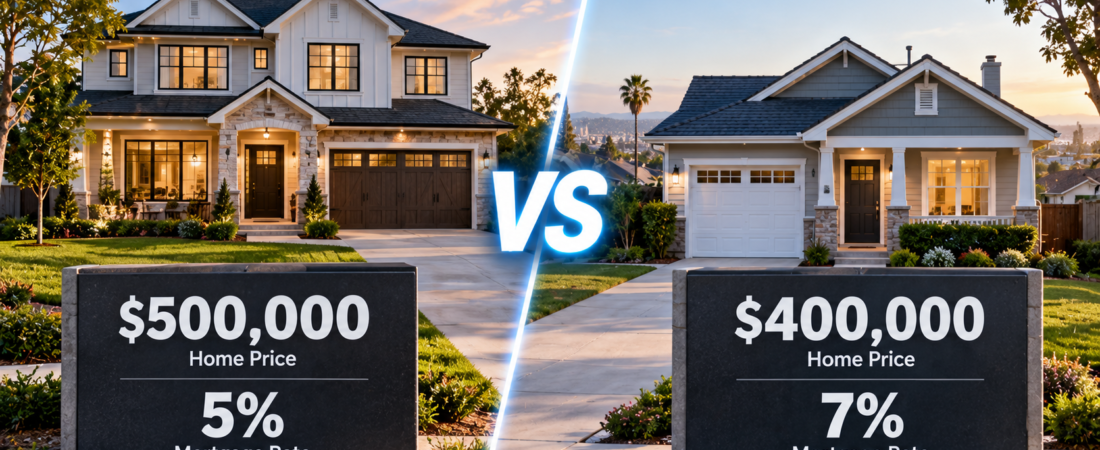
A $500,000 house is obviously more expensive than a $400,000 house.
Right?
Not necessarily — at least not when you’re looking at the monthly mortgage payment.
Mortgage rates have moved back toward 7% in 2026. Freddie Mac reported an average 30-year fixed mortgage rate of 6.95% on September 17, up from 6.76% the previous week. Mortgage News Daily’s daily index was even higher at 7.20% on September 18.
That creates an interesting question.
Suppose you could choose between:
Home A: $500,000 at 5%
or
Home B: $400,000 at 7%
Home B costs $100,000 less.
Surely its mortgage payment must be much lower.
But let’s actually do the math.
The result is surprisingly close.
Our Assumptions
To make this comparison fair, we’ll use the same financing structure for both homes:
20% down payment
30-year fixed mortgage
No points
And we’ll compare principal and interest first.
Property taxes, homeowners insurance, HOA fees, maintenance, and closing costs are excluded because they vary significantly by property and location.
Home A
Purchase price: $500,000
Down payment: $100,000
Mortgage: $400,000
Interest rate: 5%
Home B
Purchase price: $400,000
Down payment: $80,000
Mortgage: $320,000
Interest rate: 7%
Now let’s compare.
Quick Comparison
| $500K Home at 5% | $400K Home at 7% | |
|---|---|---|
| Home Price | $500,000 | $400,000 |
| 20% Down | $100,000 | $80,000 |
| Mortgage | $400,000 | $320,000 |
| Interest Rate | 5% | 7% |
| Monthly P&I | $2,147 | $2,129 |
| Monthly Difference | — | -$18 |
| Total Interest Over 30 Years | ~$373,023 | ~$446,428 |
| Total Mortgage Payments | ~$773,023 | ~$766,428 |
Figures are approximate and assume the loan remains in place for the full 30 years.
Look at the monthly payment.
$2,147 vs. $2,129.
The $400,000 house is $100,000 cheaper, yet the monthly principal-and-interest payment is only about:
$18 lower.
That’s the power of interest rates.
How Can a $100,000 Cheaper House Have Almost the Same Payment?
Because you’re not simply buying a house.
You’re also buying money.
The house has a price.
The mortgage has a price too.
And the mortgage price is the interest rate.
At 5%, borrowing $400,000 costs about:
$2,147 per month.
At 7%, borrowing only $320,000 still costs about:
$2,129 per month.
You borrowed $80,000 less.
But the higher interest rate almost completely eliminates the monthly-payment advantage.
This is why comparing home prices without comparing mortgage rates can be misleading.
Round 1: Purchase Price
Winner: $400K Home at 7%
This one is easy.
You’re paying:
$100,000 less for the property.
You also need a smaller down payment.
At 20% down:
$500K home → $100,000
$400K home → $80,000
That’s $20,000 less cash needed upfront.
If preserving cash matters, that’s a meaningful advantage.
Winner: $400K Home
Round 2: Monthly Mortgage Payment
Winner: Almost a Tie
This is where things get interesting.
Despite the $100,000 difference in home price:
$500K at 5% → $2,147/month
$400K at 7% → $2,129/month
Difference:
About $18 per month.
That’s roughly the price of lunch.
If someone told you:
“You can buy a house that’s $100,000 cheaper,”
you probably wouldn’t expect the mortgage payment to fall by only $18.
But that’s exactly what a two-percentage-point interest-rate difference can do in this example.
Winner: Technically the $400K home — but effectively a tie
Round 3: Total Interest
Winner: $500K Home at 5%
Here’s the surprising reversal.
If both mortgages lasted the entire 30 years:
The $400,000 mortgage at 5% would generate approximately:
$373,023 in interest.
The smaller $320,000 mortgage at 7% would generate approximately:
$446,428 in interest.
That’s roughly:
$73,400 more interest
on the smaller loan.
Think about that.
You borrowed $80,000 less.
Yet you could pay roughly $73,000 more in interest over the full loan term.
That’s why mortgage rates matter so much.
Winner: $500K Home at 5%
Round 4: Total Mortgage Payments
Now compare all principal and interest payments over 30 years.
$500K Home at 5%
Approximately:
$773,023
$400K Home at 7%
Approximately:
$766,428
Difference:
Only about $6,600.
Again, that’s remarkable.
One property originally cost $100,000 more.
But after financing the borrowed portion for 30 years, the difference in total mortgage payments becomes surprisingly small.
However, remember that the more expensive home also required a $20,000 larger down payment.
So this doesn’t mean the $500,000 home somehow becomes cheaper overall.
It shows how dramatically financing costs can narrow the gap.
Round 5: Cash Needed Upfront
Winner: $400K Home
This part shouldn’t be overlooked.
The cheaper house requires:
$80,000 down
instead of:
$100,000.
That’s $20,000 that could remain in:
Savings.
Emergency reserves.
Investments.
Home improvements.
Or simply your bank account.
And closing costs may also be somewhat lower on the cheaper property.
For buyers who are cash-constrained, this advantage can matter more than long-term interest calculations.
Winner: $400K Home
But There’s a Much Bigger Issue: Property Taxes
Our comparison so far only includes principal and interest.
Your actual housing payment may also include:
Property taxes.
Homeowners insurance.
HOA fees.
Mortgage insurance if applicable.
And these can dramatically change the result.
Imagine the $500,000 house also has higher property taxes.
Now its monthly cost could pull significantly ahead of the $400,000 house.
But that’s not guaranteed.
A $400,000 home in a high-tax location could potentially have higher property taxes than a $500,000 home somewhere else.
That’s why homebuyers should compare:
Total monthly housing cost
rather than just:
Mortgage payment.
What If Rates Eventually Fall?
This is where the $400K house becomes interesting.
Suppose you buy it at 7%.
Later, mortgage rates fall enough that refinancing makes financial sense.
If you can refinance the remaining balance at a meaningfully lower rate, the equation changes.
You got:
The lower purchase price.
The smaller original loan.
And potentially a lower interest rate later.
That could be a powerful combination.
But there’s an important warning:
You cannot assume refinancing will happen.
Nobody knows exactly where mortgage rates will be in two years, five years, or ten years.
Refinancing also involves:
Closing costs.
Qualification requirements.
Home equity.
Credit.
Income verification.
And whatever mortgage rates are available at that time.
So:
“I’ll buy now and refinance later”
can be a strategy.
It should not be treated as a guarantee.
You Can Refinance the Rate — Not the Purchase Price
There’s a popular argument in real estate:
“Marry the house, date the rate.”
The idea is that you can refinance an expensive mortgage later.
There is some logic behind that.
If you buy a $400,000 home at 7% and rates eventually fall, you may be able to refinance.
But if you overpay $100,000 for a house because competition was intense, refinancing can’t change what you originally paid.
That’s one reason purchase price still matters.
A high rate may eventually change.
The amount you agreed to pay for the property does not.
But Don’t Ignore Opportunity Cost
There’s another difference.
The $500K home requires an additional:
$20,000 down payment.
What could that $20,000 have done elsewhere?
It could remain invested.
It could earn interest.
It could provide an emergency fund.
It could pay down higher-interest debt.
Or it could fund improvements to the cheaper house.
Money tied up in a home has value, but it also has an opportunity cost.
That’s another reason comparing houses solely by monthly mortgage payment isn’t enough.
What About Appreciation?
Now we get to the house itself.
Suppose both homes appreciate by 3%.
A $500,000 property gaining 3% increases by:
$15,000
A $400,000 property gaining 3% increases by:
$12,000
The more expensive property gains $3,000 more in dollar value under that simple scenario.
But that doesn’t mean expensive homes automatically produce better returns.
Different:
Neighborhoods.
School districts.
Housing types.
Local economies.
Property conditions.
And supply constraints
can produce very different appreciation.
Mortgage math tells you what financing costs.
It doesn’t tell you which house will be the better investment.
The Real Lesson: Shop by Monthly Budget Carefully
Imagine your housing budget is around:
$2,150 per month for principal and interest.
At 5%, that budget supports roughly a $400,000 mortgage.
At 7%, it supports roughly a $320,000 mortgage.
That’s an enormous difference in purchasing power.
Freddie Mac itself notes that lower mortgage rates increase affordability and purchasing power, while even relatively small rate differences can meaningfully affect payments over the life of a loan.
This is why rising mortgage rates can hurt buyers even if home prices don’t rise at all.
The house doesn’t need to become more expensive.
The money used to buy it became more expensive.
Why Today’s 7% Mortgage Rate Matters
This isn’t just a hypothetical exercise.
Freddie Mac’s September 17, 2026 survey put the average 30-year fixed mortgage at:
6.95%
One week earlier:
6.76%
And a year earlier:
6.26%.
Mortgage News Daily’s daily index reached 7.20% on September 18.
So using 7% in this comparison isn’t an extreme scenario.
It’s close to the mortgage environment buyers are actually facing right now.
What Should Buyers Compare?
Before deciding one home is affordable because its listing price is lower, compare five numbers:
- Purchase price
- Down payment
- Mortgage rate
- Monthly principal and interest
- Total monthly housing cost
Then add another question:
How long do I realistically expect to own this home?
That’s important because very few homeowners keep exactly the same mortgage for 30 years.
They may:
Sell.
Move.
Refinance.
Make extra principal payments.
Or pay the mortgage off early.
The 30-year total-interest number is useful for understanding the cost of the loan, but it isn’t necessarily what you’ll actually pay.
Our Pick: The $400,000 Home — With One Big Condition
For this hypothetical comparison, the $400,000 home has the stronger starting position, even at 7%.
Not because its monthly payment is dramatically lower.
It isn’t.
It’s because you’re buying the underlying property for $100,000 less, borrowing $80,000 less, and putting $20,000 less cash down.
The 7% rate is painful.
But rates may change, and refinancing could potentially reduce that financing cost later.
The purchase price is already locked in.
However, there’s a major condition:
The cheaper house still needs to be the house you actually want.
Buying an inferior location, smaller house, worse school district, or property needing major repairs simply to save money isn’t automatically a better financial decision.
That’s why the most important lesson isn’t:
“Always buy the cheaper house.”
It’s this:
Don’t compare home prices without comparing the cost of the money used to buy them.
A $100,000 difference in price can nearly disappear from the monthly payment when mortgage rates change enough.
In our example:
$500,000 at 5% → $2,147/month
$400,000 at 7% → $2,129/month
Only about $18 separates them.
That’s what higher interest rates can do to your buying power.
And it’s why, in today’s housing market, the mortgage rate can matter almost as much as the price on the front door.
Compare with Reason.