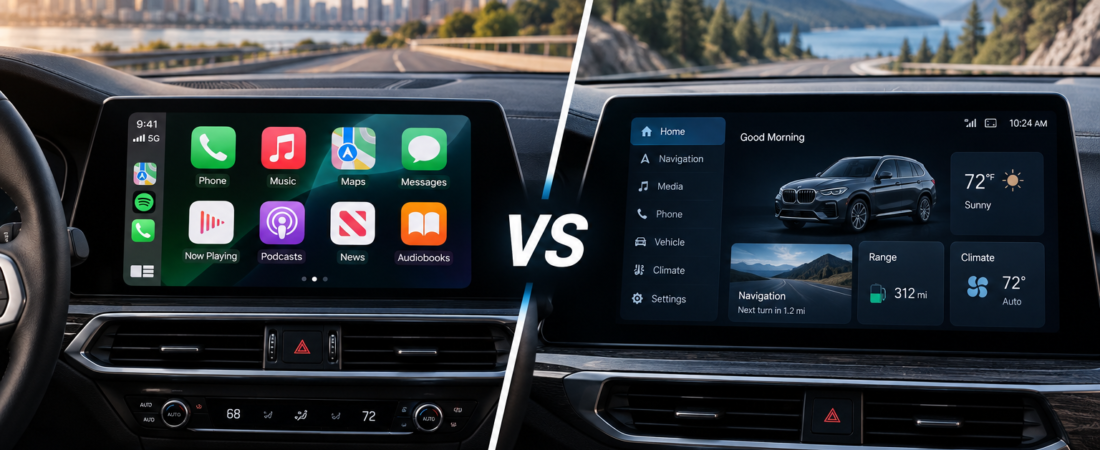
For years, Apple CarPlay has been one of the first features many iPhone users look for when buying a car.
Plug in — or connect wirelessly — and your familiar apps appear on the dashboard.
Maps. Music. Messages. Podcasts. Siri.
Simple.
But automakers are increasingly building much more sophisticated infotainment systems of their own. Modern vehicles can integrate navigation, climate controls, charging information, vehicle settings, cameras and even AI-powered features directly into the dashboard.
That creates an interesting question for drivers in 2026:
Do you still need Apple CarPlay, or is the car’s built-in system becoming better?
Let’s compare.
Quick Comparison
| Category | Apple CarPlay | Built-In System |
|---|---|---|
| Ease of Use | ✅ Excellent | Improving |
| iPhone Integration | ✅ Excellent | Good |
| Navigation | ✅ Excellent | Excellent |
| Vehicle Integration | Limited | ✅ Excellent |
| Music & Apps | ✅ Excellent | Good |
| EV Route Planning | Good | ✅ Excellent |
| Climate & Car Controls | Limited | ✅ Excellent |
| Familiar Interface | ✅ Excellent | Varies |
| Works Across Cars | ✅ Yes | No |
| No Phone Required | No | ✅ Yes |
Ease of Use: CarPlay Wins
CarPlay’s biggest advantage isn’t necessarily technology.
It’s familiarity.
If you already use an iPhone, you already understand most of the interface.
Apple Maps, Google Maps, Spotify, Apple Music, Messages and Podcasts behave similarly whether you’re using your phone or your car.
That dramatically reduces the learning curve when you get into a new vehicle.
Rental car?
Different brand?
New car?
CarPlay can make all of them feel somewhat familiar.
Built-in systems vary much more between manufacturers.
Winner: Apple CarPlay
Phone Integration: CarPlay Easily Wins
This is exactly what CarPlay was designed to do.
Your contacts, music, messages, navigation destinations and compatible apps can follow you into the vehicle.
There’s no need to recreate your digital life inside every car you drive.
If someone sends you an address, for example, it can be much easier to move from your phone to navigation through the Apple ecosystem.
For heavy iPhone users, this integration remains one of CarPlay’s strongest advantages.
Winner: Apple CarPlay
Vehicle Integration: Built-In Wins
This is where the situation reverses.
Your vehicle knows things your iPhone doesn’t.
A built-in system can potentially access:
- Battery level
- Fuel level
- Climate controls
- Seat settings
- Vehicle cameras
- Drive modes
- Tire information
- Charging status
- Driver-assistance settings
- Vehicle diagnostics
That means the native system can become much more than an entertainment screen.
It can function as the control center for the entire vehicle.
CarPlay traditionally operates more like a layer sitting on top of the car’s system.
Winner: Built-In System
Navigation: It’s Closer Than You Might Think
CarPlay gives drivers access to popular navigation apps they already know.
That is a major advantage.
Your saved destinations, recent searches and preferred navigation app are already there.
But built-in navigation has one important advantage:
It can know the car itself.
This is especially useful in electric vehicles.
A deeply integrated navigation system may know the battery’s current state of charge, expected energy consumption and charging requirements.
It can potentially calculate:
Where should I charge?
How long should I charge?
What will my battery level be when I arrive?
That’s much more sophisticated than simply calculating the fastest route.
Winner: Tie — depending on the vehicle
EV Drivers: Built-In Systems Have a Major Advantage
For gasoline vehicles, CarPlay navigation may be all many drivers need.
For EVs, the situation becomes more complicated.
Charging is part of navigation.
The vehicle may need to calculate battery consumption based on speed, weather, elevation and other factors.
Some EVs can also prepare the battery for fast charging when approaching a charger.
A deeply integrated native navigation system can coordinate these functions because it communicates directly with the vehicle.
That’s difficult for a phone-based interface to completely replicate.
Winner: Built-In System
Music and Entertainment: CarPlay Wins
For everyday entertainment, CarPlay remains difficult to beat.
Your playlists are already on your phone.
Your podcasts are already there.
Your subscriptions are already logged in.
Your listening history follows you.
You don’t need another account or another interface.
Built-in systems increasingly support popular streaming services, but CarPlay eliminates much of that duplication.
Winner: Apple CarPlay
Climate Controls: Built-In Wins
This sounds minor until you drive a vehicle that puts most controls on the touchscreen.
Temperature.
Fan speed.
Heated seats.
Ventilated seats.
Defrost.
Steering-wheel heat.
These controls are deeply connected to the vehicle.
A well-designed native interface can combine entertainment and vehicle controls into one system.
If you spend most of your time inside CarPlay but constantly need to exit it to change vehicle settings, the experience becomes less seamless.
Newer generations of smartphone-to-car integration may reduce this separation, but the degree of integration still depends heavily on the automaker and vehicle.
Winner: Built-In System
Reliability: Built-In Has One Important Advantage
CarPlay depends on communication between two devices:
Your phone and your car.
Usually, that works very well.
But drivers occasionally encounter connection problems, wireless pairing issues or temporary glitches.
A built-in system doesn’t require your phone.
Get into the car and it works.
You also don’t have to worry about whether your phone is nearby, connected or charged.
Winner: Built-In System
Updates: CarPlay Has a Clever Advantage
Cars can stay on the road for 10, 15 or even 20 years.
Technology doesn’t.
That’s historically been a major problem with built-in infotainment systems.
A dashboard that looked advanced when a car was new could feel outdated several years later.
CarPlay helps solve that problem because much of the experience comes from your phone.
Upgrade your iPhone and update iOS, and parts of your in-car experience can improve without replacing the car.
Modern vehicles increasingly receive over-the-air software updates, which helps native systems stay current as well.
But CarPlay still has an advantage because the smartphone replacement cycle is much shorter than the vehicle replacement cycle.
Winner: Apple CarPlay
Privacy and Data
Both approaches involve data.
CarPlay connects your smartphone ecosystem to your vehicle.
Built-in connected systems may communicate with automaker servers and other services.
Drivers should check what information is collected, what is stored and which permissions are enabled.
There isn’t a universal winner here because privacy practices differ between manufacturers, apps and services.
Winner: Depends on the platform and settings
The Biggest Problem With Built-In Systems
There’s one enormous variable:
The automaker.
Some native infotainment systems are excellent.
Others are frustrating.
That makes it difficult to say that built-in infotainment is universally better or worse than CarPlay.
CarPlay provides consistency.
If you know CarPlay in one vehicle, you’ll recognize it in another.
Native systems don’t have that advantage.
The Biggest Problem With CarPlay
CarPlay doesn’t completely understand your car.
It understands your phone extremely well.
That’s why the ideal system may not be one replacing the other.
The best experience could be deep integration between both.
Your smartphone provides your personal digital world.
The vehicle provides information about the machine you’re driving.
Combine the two, and the distinction between “CarPlay” and “the car’s system” becomes less important.
Who Should Choose CarPlay?
CarPlay is particularly valuable if you:
- Use an iPhone heavily
- Frequently use Apple Maps or Google Maps
- Stream music and podcasts
- Regularly switch between vehicles
- Want a familiar interface
- Keep cars for many years
- Want your digital life to follow you
For these drivers, CarPlay remains extremely useful.
Who Might Prefer the Built-In System?
A native system becomes more attractive if you:
- Drive an EV
- Frequently use vehicle-specific features
- Want deep climate integration
- Prefer not to depend on your phone
- Use integrated charging navigation
- Own a vehicle with an excellent native interface
The quality of the actual vehicle matters enormously.
Our Pick: Apple CarPlay + Built-In System
This isn’t a comparison where one system needs to disappear.
In 2026, the best solution is often having both.
Use CarPlay for your personal digital life:
Maps. Music. Messages. Apps.
Use the built-in system for the vehicle:
Climate. Battery. Charging. Cameras. Vehicle settings.
CarPlay is still difficult to beat for familiarity and smartphone integration.
But native infotainment systems are becoming increasingly important as vehicles become more software-driven.
The future may therefore be less about:
CarPlay vs. Built-In
and more about:
How well can they work together?
Compare with Reason.