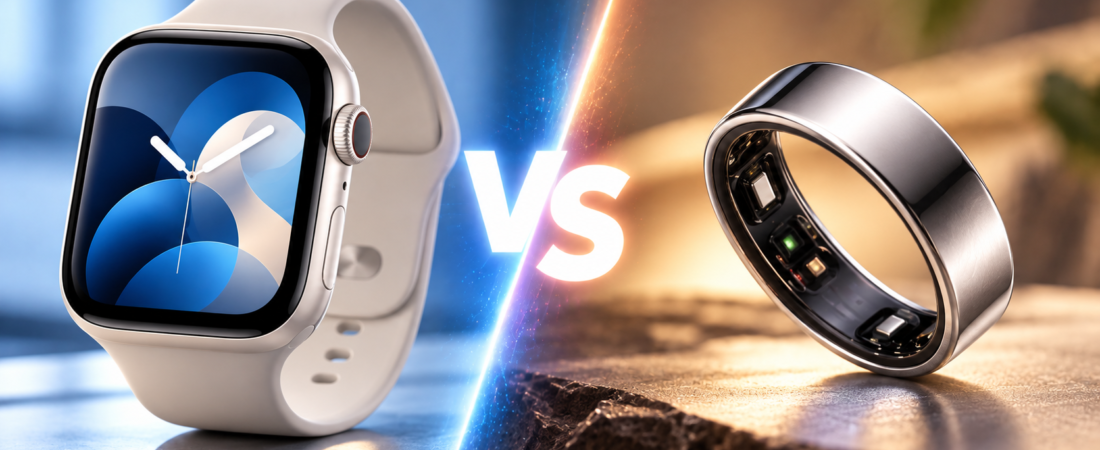
For years, the Apple Watch and Oura Ring have taken very different approaches to health tracking.
Apple put a powerful health and fitness computer on your wrist.
Oura made health tracking nearly disappear into a ring.
But with the new Apple Watch Series 12, the difference isn’t quite as clear anymore.
Apple has added more frequent heart-rate and HRV measurements and, importantly, a new Readiness Score — one of the features that helped define Oura.
Meanwhile, the Oura Ring 5 is smaller and lighter than before while continuing to focus heavily on sleep, recovery, stress and long-term health trends.
Both now start at $399.
So which one makes more sense?
Apple Watch Series 12 vs Oura Ring 5 at a Glance
| Apple Watch Series 12 | Oura Ring 5 | |
|---|---|---|
| Starting Price | $399 | $399 |
| Form | Smartwatch | Smart ring |
| Battery Life | Up to 24 hours | 6–9 days |
| Readiness Score | Yes | Yes |
| Sleep Tracking | Yes | Yes |
| Heart Rate / HRV | Yes | Yes |
| Temperature Tracking | Yes | Yes |
| Blood Oxygen | Yes* | Yes |
| ECG | Yes* | No |
| Workout Screen | Yes | No |
| Smartphone Compatibility | iPhone | iPhone & Android |
| Subscription | No | $5.99/month or $69.99/year |
*Feature availability may vary by region.
The Biggest Difference Is How You Wear Them
Before comparing sensors, this is the most important difference.
The Apple Watch Series 12 is a smartwatch.
The Oura Ring 5 is designed to feel more like jewelry.
Oura made Ring 5 about 40% smaller by volume than Ring 4. It starts at roughly 2 grams and measures just 2.28mm thick.
That matters because health tracking only works when you’re actually wearing the device.
This becomes especially important at night.
Some people simply don’t like sleeping with a watch on their wrist. A ring can be much easier to forget about.
Apple Watch, however, gives you something Oura cannot: a screen.
You can see your heart rate, start workouts, check notifications, use apps, interact with Siri, respond to messages and access information directly from your wrist.
Oura intentionally does none of that.
So the basic philosophy is different:
Apple Watch wants your attention.
Oura Ring tries to disappear.
Apple Is Coming After Oura’s Biggest Advantage
This year’s most interesting change is Readiness.
Oura has long combined sleep, activity and physiological signals into a Readiness Score designed to answer a simple question:
How ready is your body today?
Apple Watch Series 12 now provides its own readiness score.
Apple combines recent activity, training load, vitals and sleep information to estimate how prepared your body is for the day.
And unlike a score that appears once in the morning, Apple’s readiness can update during the day as new information comes in.
This significantly changes the comparison.
Previously, someone interested primarily in recovery and readiness had a strong reason to choose Oura.
That distinction is now much smaller.
Apple Watch Measures Heart Rate Much More Frequently
Series 12 introduces Apple’s new Health Sensing System.
Apple says the watch now measures background heart rate every five seconds throughout the day, including while you’re moving.
HRV can also be measured much more frequently.
That produces considerably more health data than previous Apple Watches collected in the background.
Apple says a study involving more than 1,000 participants found Series 12 delivered the most accurate heart-rate sensing among the wearables it tested.
Oura Ring 5 was one of those comparison devices.
That doesn’t mean Apple Watch automatically becomes the better health tracker for everyone.
Sensor accuracy is only one part of useful health tracking.
The quality of the insights — and whether you consistently wear the device — can matter just as much.
Oura Still Has a Huge Battery Advantage
This comparison isn’t close.
Apple rates the Series 12 for up to 24 hours of normal use or up to 38 hours in Low Power Mode.
Oura Ring 5 typically lasts 6 to 9 days.
That difference fundamentally changes how the devices are used.
Apple has improved charging enough that about 15 minutes can provide up to 12 hours of normal use, making it possible to charge while showering or getting ready.
But you still have to think about charging it regularly.
With Oura, charging becomes an occasional task rather than part of your daily routine.
For continuous sleep and recovery tracking, that is a major advantage.
Sleep Tracking: Oura’s Natural Territory
Both devices track sleep stages, duration and other overnight metrics.
But Oura was built around sleep and recovery from the beginning.
Its app combines sleep, temperature trends, resting heart rate, HRV, activity and other signals to create Sleep, Activity and Readiness scores.
It also tracks stress, resilience, cardiovascular age, cardio capacity and body-clock patterns.
Apple has steadily moved in the same direction.
Series 12 includes sleep stages, Sleep Score, Vitals, Readiness and more frequent HRV measurements.
The gap is clearly smaller than it used to be.
But there’s still a practical question:
Which device would you rather wear every night?
For many people, Oura’s tiny form factor and week-long battery life make it naturally suited to overnight tracking.
Fitness Tracking Is a Different Story
This is where Apple Watch has the clear functional advantage.
If you’re running, cycling, swimming or working out at the gym, having a display matters.
Apple Watch can show live heart rate, pace, distance, workout zones and other information while you’re exercising.
It also includes GPS and a large ecosystem of fitness apps.
Oura tracks activity and can automatically detect many activities, but there is no screen for real-time workout information.
That’s an important distinction.
Oura analyzes your body.
Apple Watch can analyze your body while also functioning as a dedicated workout device.
For serious real-time workout tracking, those aren’t the same experience.
Oura Has a Subscription
This is easy to overlook when both devices start at $399.
Apple Watch does not require a subscription to access its core health and fitness features.
Oura does.
In the U.S., Oura Membership costs $5.99 per month or $69.99 per year after the included first month for new members.
Without a membership, the ring still works, but access becomes much more limited.
You can see your three daily Oura scores — Readiness, Activity and Sleep — along with basic information, but detailed insights and much of the health experience require membership.
Over three years, the annual plan adds roughly $210 to the cost of owning the ring.
That makes the long-term price difference much larger than the identical $399 starting prices suggest.
But Apple Watch Has Another Cost
There’s another side to the price comparison.
Apple Watch requires an iPhone.
Oura Ring 5 works with both iOS and Android.
So if you already use an Android phone, this comparison becomes extremely simple.
Oura is compatible.
Apple Watch isn’t.
For iPhone users, however, both are legitimate choices.
Which One Should You Choose?
Choose Apple Watch Series 12 if:
- You want one device for health, fitness and smartwatch features
- You exercise regularly and want real-time workout data
- You want GPS on your wrist
- You want ECG and broader smartwatch health features
- You use an iPhone
- You don’t want another monthly subscription
- You want notifications, apps and communication features
Choose Oura Ring 5 if:
- Sleep and recovery are your biggest priorities
- You dislike sleeping with a watch
- You want 6–9 days of battery life
- You want something small and discreet
- You don’t need a screen
- You want health tracking without constant notifications
- You use an Android phone
The Choice Is Really Watch vs Ring
Apple Watch Series 12 has made this comparison much more interesting.
With Readiness, more frequent HRV measurements and its new Health Sensing System, Apple has moved deeper into the territory traditionally associated with Oura.
But Oura doesn’t need to become a smartwatch to compete.
Its advantage is almost the opposite.
It’s small.
It’s quiet.
It lasts nearly a week.
And it can collect health data without putting another screen on your body.
If you want a device that can track a workout, show your pace, answer a message, play music and monitor your health, Apple Watch Series 12 offers far more functionality.
If you mainly want to understand how you’re sleeping, recovering and responding to everyday life — while barely noticing the device you’re wearing — Oura Ring 5 offers a very different kind of experience.
The specifications are getting closer.
The experience isn’t.
And that’s what should decide between them.
Compare with Reason.