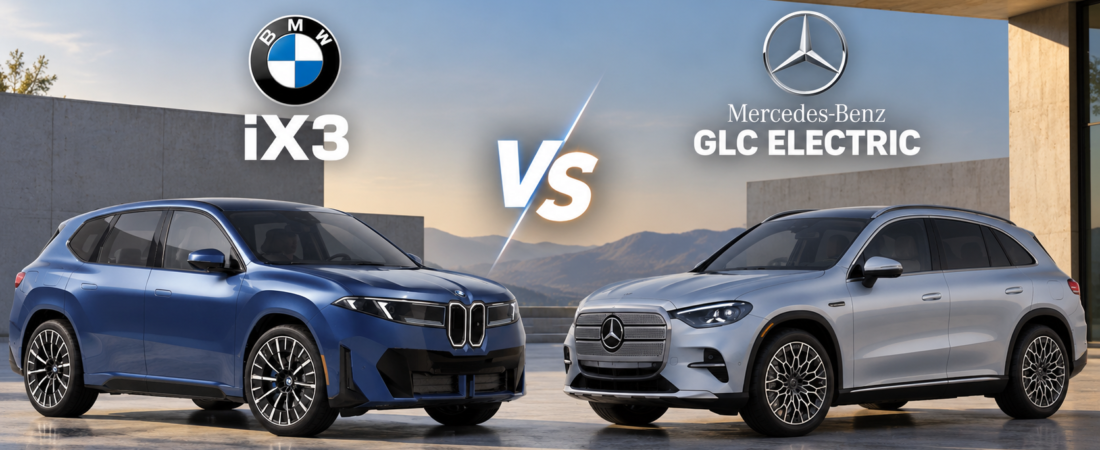
BMW iX3 vs Mercedes GLC Electric is the electric SUV battle German luxury-car buyers have been waiting for.
Not a concept-car comparison.
Not a $100,000 flagship experiment.
Two mainstream luxury SUVs.
Two established German brands.
And remarkably similar prices.
The new 2027 BMW iX3 50 xDrive starts at $61,500 plus $1,350 destination, while the 2027 Mercedes-Benz GLC 400 4MATIC Electric starts at $63,500. BMW Group Pressroom
But the specifications aren’t nearly as close.
BMW claims up to 434 miles of EPA-estimated range and DC charging at up to 400 kW.
Mercedes offers 350 miles of EPA range, 483 horsepower and DC charging at up to 330 kW. BMW Group Pressroom
On paper, BMW appears to have landed the first punch.
But buying a $60,000 luxury SUV isn’t only about a range number.
So which one would you actually want in your driveway?
BMW iX3 vs Mercedes GLC Electric at a Glance
| BMW iX3 50 xDrive | Mercedes GLC 400 4MATIC Electric | |
|---|---|---|
| Base MSRP | $61,500 | $63,500 |
| Drivetrain | AWD | AWD |
| EPA range | Up to 434 miles | 350 miles |
| Max DC charging | 400 kW | 330 kW |
| Architecture | 800V | 800V |
| Mercedes battery | — | 94 kWh usable |
| Mercedes power | — | 483 hp |
| Mercedes torque | — | 590 lb-ft |
| Infotainment | Panoramic iDrive / OS X | MB.OS / MBUX |
| U.S. arrival | 2026 | Fall 2026 |
BMW’s numbers immediately stand out.
The Range Difference Is Huge
This may be the headline.
BMW says the iX3 50 xDrive can deliver up to:
434 miles EPA.
Mercedes lists:
350 miles EPA
for the GLC 400 4MATIC Electric on its range-oriented configuration, dropping to 331 miles with all-season tires. BMW Group Pressroom
That’s an 84-mile difference between the headline figures.
In the luxury EV market, that’s enormous.
Even if real-world conditions reduce both numbers, starting with 434 miles changes how you think about an EV.
At that point, range anxiety begins to feel increasingly irrelevant for normal driving.
BMW Also Wins the Charging Numbers
The iX3 uses an 800V architecture and supports DC charging at up to:
400 kW.
Mercedes also uses an 800V system, but its maximum DC charging rate is:
330 kW.
Mercedes says the GLC can charge from 10% to 80% in approximately 22 minutes under suitable conditions. Mercedes-Benz Media
Both numbers are excellent.
This isn’t:
fast vs slow.
It’s:
extremely fast vs very fast.
Actual road-trip charging will also depend on the charging curve, battery temperature, charger capability and how long each vehicle can sustain high power.
Peak kW alone doesn’t determine the winner.
Still, BMW’s 400 kW headline is impressive.
The Price Difference Is Almost Irrelevant
BMW:
$61,500
Mercedes:
$63,500
That’s only:
$2,000.
At this price level, that shouldn’t determine the purchase.
Options could erase or reverse the difference immediately.
Instead, buyers should focus on:
range,
ride quality,
interior,
technology,
handling,
cargo space,
and personal preference.
This is unusually close to a true head-to-head comparison.
BMW Is Betting Everything on Neue Klasse
The iX3 isn’t simply another BMW converted to electric power.
It’s the first series-production vehicle based on BMW’s Neue Klasse generation. BMW Group Pressroom
That’s important.
BMW developed a new electronics architecture, new user interface, new EV technology and a fundamentally different approach to vehicle control.
One of the most interesting components is what BMW calls:
Heart of Joy.
Instead of having multiple independent controllers managing different dynamic functions, BMW’s new architecture tightly coordinates drivetrain, braking, energy recuperation and vehicle dynamics.
That sounds like marketing.
But it could matter enormously to how the vehicle feels.
BMW’s brand was built around driving.
If Neue Klasse can make an EV feel unmistakably like a BMW, that’s a significant achievement.
Mercedes Is Taking the Luxury Route
Mercedes doesn’t need to beat BMW at being BMW.
Its strength has traditionally been:
comfort,
refinement,
interior atmosphere,
quietness,
and luxury.
The GLC Electric follows that philosophy.
Standard equipment includes a 10.25-inch driver display, 14-inch central multimedia display and 14-inch digital trim panel, running Mercedes’ fourth-generation MBUX system powered by MB.OS. Mercedes-Benz Media
Mercedes also includes features such as augmented-reality head-up display, facial-recognition profile authentication, wireless Apple CarPlay and Android Auto and its electric-intelligent navigation system. Mercedes-Benz Media
BMW is trying to reinvent the driver’s interface.
Mercedes is trying to make the digital cabin feel luxurious.
The New BMW Interior Is Much More Radical
BMW’s Panoramic iDrive is one of the biggest changes in the iX3.
Rather than simply placing another giant tablet in the dashboard, BMW projects important information across a panoramic area near the base of the windshield.
The idea is to put information closer to the driver’s natural field of view.
This could become one of the defining differences between the two SUVs.
Mercedes still emphasizes large, beautiful displays.
BMW is questioning whether the traditional instrument cluster is necessary at all.
Which approach is better?
That will probably come down to personal preference.
Mercedes Has Serious Performance
Don’t mistake the GLC Electric for a slow luxury cruiser.
Mercedes lists:
483 hp
and:
590 lb-ft of torque
from its dual-motor AWD system. Mercedes-Benz Media
The drivetrain also uses a two-speed transmission and a front motor disconnect system intended to improve efficiency when front-wheel power isn’t required. Mercedes-Benz Media
That’s sophisticated engineering.
The goal isn’t simply maximum acceleration.
Mercedes is trying to balance:
performance,
range,
efficiency,
and refinement.
The Mercedes Has a Clever Suspension Advantage
The standard GLC Electric uses coil springs.
But buyers can option:
AIRMATIC air suspension with Intelligent Suspension Control.
Rear-axle steering is also available, reducing the turning circle from 39.7 feet to 36.7 feet according to Mercedes. Mercedes-Benz Media
That’s the sort of feature that can matter more in everyday ownership than another 50 horsepower.
A large luxury SUV that turns like a smaller vehicle is easier to:
park,
maneuver in cities,
navigate parking garages,
and live with every day.
BMW’s 434-Mile Range Changes Road Trips
Imagine leaving home with a full battery.
With more than 400 miles of rated range, many trips don’t require a charging stop at all.
And when you do stop, the iX3 can theoretically accept up to 400 kW at a compatible DC charger. BMW Group Pressroom
That combination matters more than either number individually.
Long range + very fast charging is what makes an EV genuinely easy to road-trip.
It’s difficult to ignore BMW’s advantage here.
Mercedes Still Has Plenty of Range
But let’s keep perspective.
350 miles is not short range.
For most Americans, it’s far more than a normal day of driving.
If you charge at home, the practical difference between 350 and 434 miles may rarely matter Monday through Friday.
That’s why buying purely from the spec sheet can be misleading.
If the Mercedes is:
quieter,
more comfortable,
more luxurious,
or simply nicer to sit in,
you may happily sacrifice 84 miles of theoretical maximum range.
Luxury buyers aren’t buying batteries.
They’re buying the entire experience.
Cargo Space Matters Too
Mercedes lists:
20.1 cubic feet
behind the rear seats and up to:
61.4 cubic feet
with the rear seats folded.
There’s also a:
4.5-cubic-foot frunk. Mercedes-Benz Media
That front storage is useful for:
charging cables,
small bags,
emergency equipment,
or items you don’t want rolling around the cargo area.
This is the kind of practical feature that makes an EV easier to live with.
Both Finally Feel Like Next-Generation EVs
This may be the most important part of the comparison.
Earlier German EVs sometimes felt like:
a BMW that happened to be electric
or:
a Mercedes that happened to be electric.
These vehicles feel more fundamental.
800V architectures.
Extremely high charging speeds.
Purpose-built software.
Long ranges.
New electronic systems.
EV-specific packaging.
This is the generation where legacy luxury brands are no longer simply reacting to Tesla.
They’re building mature EV platforms of their own.
Which One Looks Better?
Completely subjective.
But the design philosophies are different.
BMW’s iX3 introduces the Neue Klasse look, including a modern interpretation of the traditional kidney grille.
Mercedes keeps more of the familiar GLC luxury-SUV identity while adapting it to an electric platform.
Someone who wants:
“a futuristic new BMW”
may prefer the iX3.
Someone who wants:
“a Mercedes GLC, just electric and more advanced”
may prefer the GLC.
That’s a meaningful difference.
Which One Should a Tesla Owner Consider?
This comparison becomes especially interesting for someone leaving a Tesla Model Y.
BMW offers:
exceptional range,
extremely fast charging,
a more traditional luxury-car experience,
and a completely new technology platform.
Mercedes offers:
more conventional luxury,
a rich interior,
strong performance,
advanced suspension options,
and familiar premium-SUV character.
Tesla still has enormous advantages in software familiarity and charging ecosystem integration.
But the old argument that German EVs automatically require major range or charging compromises is becoming much harder to make.
Who Should Buy the BMW iX3?
Choose the iX3 if your priorities are:
maximum range,
fast charging,
driving dynamics,
new technology,
a more driver-focused personality,
and getting the newest generation of BMW engineering.
On paper, 434 miles plus 400 kW charging is difficult to argue against. BMW Group Pressroom
Who Should Buy the Mercedes GLC Electric?
Choose the GLC if you prioritize:
luxury,
comfort,
interior atmosphere,
strong AWD performance,
available air suspension,
rear-wheel steering,
and the familiar Mercedes experience.
Its 350-mile EPA range and 330 kW charging are still excellent numbers. Mercedes-Benz Media
You aren’t choosing a weak EV because you prefer Mercedes.
You’re choosing between two extremely capable ones.
BMW iX3 vs Mercedes GLC Electric: The Verdict
If we judged these vehicles entirely by their headline specifications, the BMW would win.
It costs slightly less.
It goes farther.
And it has a higher peak charging rate.
That’s a powerful combination.
But luxury cars have never been purchased entirely from spreadsheets.
The Mercedes counters with a compelling cabin, serious performance, sophisticated suspension options and the kind of comfort-focused personality that has defined the brand for decades.
So BMW iX3 vs Mercedes GLC Electric ultimately comes down to what you want from a $60,000-plus electric SUV.
If you want the EV that appears to push the technology envelope hardest:
BMW iX3.
If you want an electric SUV that still prioritizes the traditional Mercedes luxury experience:
GLC Electric.
For the first time, though, choosing between BMW and Mercedes doesn’t require asking which company can build a credible EV.
Both can.
Now we’re back to the much more interesting question:
Which one builds the better car?
Compare with Reason.