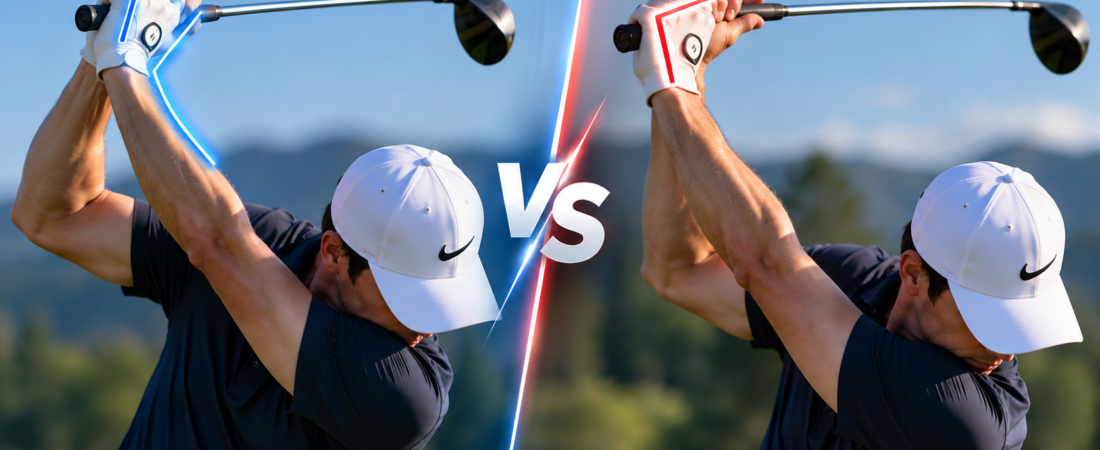
Golf instruction has a habit of turning successful professional swing positions into universal rules.
When Dustin Johnson began dominating with a dramatically bowed lead wrist, golfers everywhere started paying attention to wrist flexion.
Jon Rahm, Collin Morikawa, and several other elite players reinforced the idea that a bowed wrist could be the secret to controlling the clubface.
But then another question emerges.
If bowing is so important, how did Jack Nicklaus, Fred Couples, and other great ball-strikers succeed with neutral or cupped wrist positions?
And what happens when a golfer with a naturally cupped wrist deliberately forces it into a bowed position?
The answer begins with something many swing tips overlook: the grip.
A strong grip, neutral grip, and weak grip can produce very different relationships between the lead wrist and the clubface.
The wrist position that looks perfect in one professional’s swing may create serious problems in another golfer’s swing.
Timing matters, too.
A golfer who bows the wrist early in the takeaway may arrive at the top with a very different clubface orientation from someone who gradually develops flexion during the backswing or transition.
In this bowed vs cupped wrist at the top of the backswing comparison, we’ll examine grip strength, early wrist set, clubface control, professional swing styles, and whether forcing a bowed position actually improves consistency.
We’ll also explore why a naturally cupped wrist may be perfectly functional—and why the best wrist position is not necessarily the one that looks most impressive on video.
Quick Verdict: A bowed lead wrist can help manage an open clubface and reduce certain downswing adjustments. But a naturally cupped wrist is not automatically a flaw. Grip strength, wrist movement through transition, body rotation, and impact delivery determine whether either position works.
1. Bowed vs Cupped Wrist: Quick Comparison
| Factor | Bowed Wrist | Cupped Wrist |
|---|---|---|
| Anatomical position | Lead-wrist flexion | Lead-wrist extension |
| Typical face influence | More closed, all else equal | More open, all else equal |
| Grip compatibility | Often useful with neutral or weaker grips | Can work with stronger grips |
| Downswing requirement | Must manage face closure | May require additional closure |
| Main potential advantage | Earlier clubface organization | Comfortable natural movement |
| Main potential risk | Excessively closed face | Face remaining too open |
| Professional examples | Johnson, Rahm, Morikawa | Couples, Nicklaus, Hogan |
| Universal winner | No | No |
These comparisons assume other factors remain equal.
A bowed wrist does not guarantee a closed face at impact, and a cupped wrist does not guarantee a slice.
The grip and subsequent movement determine the result.
2. First, Understand the Three Lead-Wrist Positions
For a right-handed golfer, the lead wrist is the left wrist. For a left-handed golfer, it is the right wrist.
There are three commonly discussed positions.
Bowed Wrist — Flexion
The lead wrist bends toward the palm.
From certain camera angles, the back of the lead hand appears rounded outward.
This movement generally encourages the clubface to become more closed relative to the same grip and forearm orientation.
Cupped Wrist — Extension
The lead wrist bends backward toward the back of the hand.
The wrist appears hollow or cupped.
All else equal, this movement tends to open the clubface relative to a flatter wrist position.
Flat Wrist — Neutral
The back of the lead hand and forearm form a relatively straight alignment.
This is often presented as a neutral reference position.
But flat does not automatically mean square.
A golfer with a very strong grip and flat lead wrist may still have a relatively closed clubface.
A golfer with a weak grip and flat wrist may present a different face orientation.
The relationship matters more than the appearance.
3. Grip Strength Changes Everything
This is arguably the most important section of the entire comparison.
Golfers often look at a photograph of a professional at the top of the backswing and try to reproduce the wrist position.
But they rarely consider how that player’s grip affects the relationship between the wrist and clubface.
Strong Grip With a Cupped Wrist
A strong lead-hand grip places the hand more toward the trail side of the handle.
For a right-handed golfer, more of the left-hand knuckles may be visible at address.
This grip can create a clubface-closing tendency.
A slightly cupped wrist may be compatible with that grip because the wrist extension can offset some of the face-closing influence.
This does not mean every strong-grip golfer should cup the wrist.
It means a cupped position may be part of a functional combination.
Neutral Grip With a Flat Wrist
A neutral grip paired with a relatively flat lead wrist is a common reference position.
It can create a straightforward relationship between the hands and clubface.
But even here, forearm rotation, shaft orientation, and body movement matter.
Weak Grip With a Bowed Wrist
A weaker lead-hand grip may require more wrist flexion to achieve a desired clubface orientation.
This is one reason a bowed wrist can work exceptionally well for certain professional players.
The Dangerous Combination: Strong Grip Plus Forced Bowing
Imagine a golfer who already has a strong grip.
The clubface is naturally relatively closed.
Now the golfer watches a Dustin Johnson swing video and deliberately bows the lead wrist.
The face may become even more closed.
The golfer could then experience pulls, hooks, low shots, or a need to hold the face open through impact.
That doesn’t make strong grip plus bowing universally wrong—Johnson himself is a counterexample.
But it means the golfer must have the appropriate body rotation and face-management pattern to support it.
Golf instruction research has emphasized that wrist flexion and grip strength must be evaluated together rather than independently.
Golf
+1
The Compareason Insight: A cupped wrist with a strong grip may deliver a more functional clubface than a forced bowed wrist with the same grip.
4. Early Cocking vs Early Bowing: Two Different Movements
Another common misunderstanding involves the timing of wrist movement.
Golfers often use the terms wrist cocking, wrist hinging, and wrist bowing as though they describe the same action.
They don’t.
Wrist Cocking
Wrist cocking generally refers to radial deviation, where the thumb side of the hand moves toward the forearm.
This helps establish the angle between the shaft and lead arm.
Wrist Bowing
Bowing refers to flexion of the lead wrist.
It changes the relationship between the lead hand and clubface.
A golfer can cock the wrists without bowing them.
A golfer can also bow the lead wrist while maintaining relatively little radial hinge.
Early Cocking With Natural Cupping
Some golfers set the club early while maintaining a slightly extended lead wrist.
This can produce a stable-feeling backswing when matched with the grip and clubface.
The important question is whether the golfer can deliver the face consistently through transition and impact.
Early Cocking With Deliberate Bowing
Other golfers set the wrists early and simultaneously introduce lead-wrist flexion.
This can organize the clubface earlier in the backswing.
For a golfer who otherwise leaves the face excessively open, that may be beneficial.
But for a golfer with a strong grip or already closed face, it may introduce unnecessary compensation.
Gradual Bowing During the Backswing
Some players develop wrist flexion progressively rather than forcing it during the takeaway.
This can create a different sensation and timing pattern.
Bowing During Transition
A golfer may arrive at the top with a cupped wrist and move toward flexion during the transition.
That can be a functional pattern, but it requires repeatable coordination.
The Compareason Insight: The timing of wrist flexion may matter as much as the amount of flexion visible at the top.
5. Dustin Johnson vs Jon Rahm: Similar Wrist Appearance, Different Grip Matchups
Two of the most recognizable bowed-wrist swings belong to Dustin Johnson and Jon Rahm.
Both have demonstrated exceptional ball-striking with substantial lead-wrist flexion.
But their swings aren’t identical.

Dustin Johnson
Stronger lead-hand grip, pronounced bowing, and substantial body rotation.

Jon Rahm
Comparatively weaker lead-hand grip, compact backswing, and substantial lead-wrist flexion.
Dustin Johnson’s Pattern
Johnson combines a strong grip with significant lead-wrist flexion.
That combination creates a strong clubface-closing influence.
His body rotation and delivery pattern help manage that face orientation.
According to an instructional analysis by coach Dana Dahlquist, Johnson continues managing wrist flexion and body rotation through the downswing.
Golf
Simply copying his bowed wrist without copying the rest of his movement could produce an excessively closed clubface.
Jon Rahm’s Pattern
Rahm uses a comparatively weaker lead-hand grip and a compact backswing.
His pronounced wrist flexion helps organize the clubface.
He then maintains an effective relationship between the wrist, clubface, and body rotation through impact.
PGA of America has highlighted the connection between Rahm’s bowed wrist, compact backswing, and aggressive rotation.
PGA
The Important Difference
Two golfers can have similar-looking wrist positions at the top while using different grip strengths and different delivery patterns.
This is why copying the visual position alone is unreliable.
Our Take: Johnson and Rahm don’t prove that every golfer should bow the wrist. They prove that different grip-and-wrist combinations can produce world-class ball-striking.
6. Fred Couples and Jack Nicklaus: Proof That Cupping Can Work
If a bowed wrist were essential for consistent ball-striking, some of golf’s greatest players would have faced serious limitations.
Yet the historical evidence tells a different story.
Fred Couples: Natural Cupping

Fred Couples
Couples is a particularly interesting example because his cupped lead wrist has been discussed by respected golf instructors.
In a Golf Digest lesson, instructor Jim Flick explained that Couples maintained a cupped left wrist from address into the top of his backswing.
Golf Digest
Flick emphasized the value of maintaining a consistent relationship between the wrist and the grip.
Rather than trying to manufacture a different wrist position during the backswing, Couples allowed his natural setup to carry into the top.
This is especially relevant for golfers who naturally cup their lead wrist.
If the grip and clubface are functioning properly, changing the wrist simply to make it look flatter or more bowed may be unnecessary.
Jack Nicklaus: A Different Philosophy

Jack Nicklaus
Nicklaus described his preferred lead-wrist position as flat or slightly cupped rather than dramatically bowed.
In a Golf Digest instructional article, he explained that he preferred the ability to release the clubhead freely through impact.
Golf Digest
His perspective is particularly valuable because it differs from some modern bowed-wrist instruction.
Nicklaus believed that an excessively bowed wrist could create difficulties for golfers who released the club aggressively.
But this was his technical philosophy, not a universal biomechanical law.
Modern players such as Johnson and Rahm demonstrate that bowed positions can also work extremely well when matched with the appropriate delivery.
Ben Hogan: Cupping With a Purpose
Ben Hogan is another historically important example.
Hogan’s wrist and clubface positions were part of a highly developed system for controlling his ball flight.
His swing cannot be understood by isolating the wrist at the top.
Grip changes, forearm rotation, transition, and impact delivery all contributed.
The Compareason Insight
A naturally cupped wrist is not evidence of a defective swing. The question is whether the golfer can manage the clubface without excessive compensation.
7. Does Bowing Actually Reduce Clubface Manipulation?
One of the strongest arguments in favor of a bowed wrist is that it can help organize the clubface earlier.
For golfers who consistently leave the face open, this can be extremely valuable.
But there’s an important distinction between reducing unnecessary compensation and eliminating all clubface movement.
The Open-Face Golfer
Imagine a golfer with a neutral grip who arrives at the top with significant wrist extension.
The clubface is relatively open.
During the downswing, the golfer may need to increase lead-wrist flexion, rotate the forearms, or make other coordinated movements to deliver the desired face angle.
If those movements vary from swing to swing, the results can become inconsistent.
Introducing some earlier flexion might simplify that golfer’s face-management pattern.
The Closed-Face Golfer
Now imagine a golfer who already delivers the face too closed.
The golfer uses a strong grip and produces frequent low hooks.
Forcing additional bowing could make the problem worse.
Instead of simplifying the swing, the golfer may need to hold the face open or alter body rotation to avoid missing left.
The Natural-Cupping Golfer
A third golfer has a slightly cupped wrist at the top but consistently delivers the clubface within a narrow impact window.
There may be no meaningful reason to change.
The top position looks different from Johnson’s, but the golfer’s impact results are reliable.
What Modern Instruction Suggests
Golf Digest’s 2025 discussion of bowed wrists emphasized potential clubface-control benefits while also cautioning that grip compatibility and physical limitations matter.
Golf Digest
The lesson isn’t that bowing eliminates timing.
It’s that bowing changes which movements and matchups are needed.
Our Take: The best wrist position is the one that reduces unnecessary adjustments for your particular grip and swing—not necessarily the position that requires the least visible movement.
8. The Compareason Calculation: Why One Degree of Face Error Matters
Let’s examine why wrist position deserves attention in the first place.
The clubface has a major influence on the ball’s initial direction, especially with a driver.
For a simplified illustration, assume that a one-degree difference in delivered face orientation produces approximately 0.8 degrees of initial launch-direction change.
The exact relationship depends on club type, impact conditions, and other factors.
Hypothetical Starting-Direction Error
Using:
\[ \text{Lateral Offset}=D\times\tan(\theta) \]
Where \(D\) is the forward distance and \(\theta\) is the starting-direction error.
| Forward Distance | 0.8° Start Error | 1.6° Start Error |
|---|---|---|
| 100 yards | 1.4 yards | 2.8 yards |
| 150 yards | 2.1 yards | 4.2 yards |
| 200 yards | 2.8 yards | 5.6 yards |
| 250 yards | 3.5 yards | 7.0 yards |
These figures describe the geometry of the initial direction only. They do not predict actual landing dispersion because spin-induced curvature, wind, launch conditions, and impact location can change the final ball position substantially.
What This Means for Wrist Position
Suppose a golfer produces a more consistent face orientation with a naturally cupped wrist.
Changing to an artificially bowed wrist may increase face-angle variability.
Even if the new position looks more technically fashionable, the result could be worse.
Conversely, a golfer who consistently leaves the face open may reduce variability by learning an appropriate flexion pattern.
The meaningful measurement is not how many degrees the wrist is bowed at the top.
It’s how consistently the golfer delivers the clubface and strike at impact.
9. Can Forced Bowing Reduce Distance or Clubhead Speed?
Bowing the wrist does not inherently reduce clubhead speed.
Some of the world’s longest hitters have used pronounced lead-wrist flexion.
However, deliberately forcing a new wrist position can change a golfer’s movement.
Possible Effects of Forced Bowing
A golfer may experience increased forearm tension, altered wrist hinge, changed clubface orientation, or difficulty completing the backswing naturally.
These effects are not guaranteed.
Some golfers learn wrist flexion quickly and experience improved contact.
Others struggle because the movement conflicts with their established grip and release.
The Difference Between Learning and Forcing
A new movement may initially feel unfamiliar without being biomechanically wrong.
But there is a difference between a controlled technical change and physically forcing the wrist into an uncomfortable position.
If the golfer experiences pain or substantial restriction, the movement should not be forced.
The Important Question
Does the new wrist position improve:
- Ball speed?
- Centered contact?
- Face-to-path consistency?
- Launch and spin?
- Shot dispersion?
- Predictability under pressure?
If the answers are no, the visual change alone has little value.
The Compareason Insight: A technically attractive backswing is not necessarily a more effective backswing.
10. The Grip-Wrist Matrix: Which Combination Makes the Most Sense?
Rather than asking whether a bowed or cupped wrist is better, we should examine how different grip strengths interact with different wrist positions.
This is where the comparison becomes more useful for real golfers.
A wrist position cannot be evaluated independently of the grip.
Understanding the Nine Combinations
The following table summarizes possible tendencies for a right-handed golfer, assuming comparable forearm orientation and other swing conditions.
| Grip Strength | Bowed Wrist | Flat Wrist | Cupped Wrist |
|---|---|---|---|
| Strong grip | Very closed-face tendency | Closed-face tendency | More neutral potential |
| Neutral grip | Closed-face tendency | Neutral reference | Open-face tendency |
| Weak grip | Can offset an open-face tendency | More open-face tendency | Very open-face tendency |
These are simplified directional tendencies, not guaranteed clubface measurements.
A golfer’s actual face orientation also depends on grip placement, forearm rotation, shaft orientation, and the movement of the trail hand.
Combination A: Strong Grip With Natural Cupping
This combination can be effective for golfers who already produce sufficient clubface closure.
The slightly extended lead wrist may help balance the face-closing influence of the strong grip.
A golfer who consistently hits a controlled draw with this combination may have little reason to change.
Combination B: Neutral Grip With Bowing
This combination may benefit golfers who struggle with an open face.
Introducing lead-wrist flexion can encourage a more closed clubface orientation earlier in the swing.
But the golfer must still manage the clubface through transition and impact.
Combination C: Weak Grip With Bowing
A weaker grip and bowed wrist can form a functional combination.
The weaker grip may offset some of the closing influence of lead-wrist flexion.
This illustrates why two golfers can have similar-looking wrist positions while delivering different clubface orientations.
Combination D: Strong Grip With Bowing
This combination can create a significantly closed-face tendency.
It works for some elite players, including Dustin Johnson, because their overall swing patterns accommodate it.
But it may be difficult for golfers who already struggle with hooks or excessive face closure.
The Compareason Perspective
We don’t believe any single combination should be labeled universally correct.
The objective is to establish a relationship between grip and wrist position that produces a predictable clubface.
The Compareason Insight: The correct wrist position is not the one that looks neutral in a photograph. It’s the one that makes the clubface predictable with your existing grip.
11. The Most Important Difference: Wrist Position at the Top vs Wrist Movement During Transition
A photograph of the top of the backswing shows only one moment.
It doesn’t tell us what happens next.
Two golfers can arrive at the top with nearly identical wrist positions but deliver the clubface very differently.
Golfer A: Bowed at the Top, Maintains Flexion
This golfer establishes lead-wrist flexion during the backswing and maintains a similar relationship during the early downswing.
If matched with the grip and rotation pattern, this can produce consistent face control.
Golfer B: Cupped at the Top, Moves Toward Flexion
This golfer arrives at the top with an extended lead wrist.
During transition, the wrist moves toward a flatter or more flexed position.
That movement can help close the clubface.
It may be entirely repeatable for a skilled player.
Golfer C: Cupped at the Top, Maintains Cupping
This golfer preserves a relatively extended wrist position for longer.
Depending on the grip, forearm rotation, and release pattern, the golfer may still deliver the clubface effectively.
This is why a cupped wrist at the top should not automatically be diagnosed as a swing fault.
Golfer D: Bowed at the Top, Loses Flexion Early
A golfer may create an exaggerated bowed position at the top but quickly move into extension during the downswing.
The clubface relationship can change substantially.
The original bowed position may provide little benefit if the subsequent movement is inconsistent.
What We Should Actually Measure
Instead of evaluating only the top position, compare:
- Lead-wrist position at the top
- Lead-wrist movement during transition
- Clubface orientation halfway down
- Face angle at impact
- Face-to-path relationship
- Shot dispersion
Our Take: A repeatable wrist movement pattern is more important than achieving a particular wrist shape at one point in the swing.
12. The Compareason 30-Shot Test: Natural Cupping vs Forced Bowing
How can a golfer determine whether changing wrist position actually improves performance?
The most useful approach is to compare measurable results.
Step 1: Establish Your Natural Swing
Hit ten shots using your normal grip and natural backswing.
Do not deliberately bow or flatten the lead wrist.
Record:
- Clubhead speed
- Ball speed
- Carry distance
- Face angle
- Club path
- Face-to-path
- Launch direction
- Curvature
- Lateral dispersion
Use a launch monitor when available.
Step 2: Test Deliberate Bowing
Hit ten shots while introducing a modest amount of lead-wrist flexion.
Avoid forcing the wrist beyond a comfortable range of motion.
Keep the same grip and target.
Record the same measurements.
Step 3: Test a Neutral Wrist
Hit ten shots attempting to maintain a relatively flat lead wrist at the top.
Again, keep the grip and target consistent.
Step 4: Compare the Results
Consider this hypothetical example.
| Measurement | Natural Cupping | Deliberate Bowing | Flat Wrist |
|---|---|---|---|
| Average ball speed | 145 mph | 143 mph | 144 mph |
| Average carry | 245 yd | 239 yd | 242 yd |
| Face-to-path standard deviation | 1.4° | 2.3° | 1.7° |
| Average absolute offline distance | 9 yd | 16 yd | 12 yd |
| Severe misses | 1 | 3 | 2 |
These are hypothetical results, not actual launch-monitor measurements.
In this example, natural cupping performs best.
The golfer produces higher ball speed, tighter face-to-path consistency, and fewer severe misses.
That would suggest there is no immediate performance reason to force additional bowing.
But another golfer could produce the opposite result.
Step 5: Repeat With Different Clubs
A wrist pattern that works well with a driver may not produce identical results with a seven-iron or wedge.
Repeat the experiment using multiple clubs.
Step 6: Test Under Pressure
A technical movement may work on the range but become unreliable on the course.
Test your preferred pattern with changing targets and limited rehearsal swings.
Thirty shots are only an initial screening test. Repeat across several sessions before making a permanent technical change.
The Compareason Insight: A wrist position should earn its place in your swing through better results—not through visual similarity to a professional golfer.
13. When Should a Golfer Actually Change Their Wrist Position?
Not every unusual-looking wrist position requires correction.
A golfer can have a cupped wrist and play excellent golf.
A golfer can also have a bowed wrist and struggle with consistency.
The decision to change should begin with a measurable problem.
Situation A: Persistent Open Clubface
Suppose a golfer consistently delivers the face open relative to the intended path.
The result may be excessive fades, slices, or shots starting right of the target.
If the grip is appropriate and other movement patterns are reasonably consistent, introducing more lead-wrist flexion may help.
But it is only one possible solution.
Situation B: Persistent Hooks
A golfer with a strong grip and bowed lead wrist may already have a substantial face-closing tendency.
If the player struggles with hooks, forcing additional bowing would generally be an unlikely first solution.
A coach should evaluate the grip, clubface, path, strike location, and release.
Situation C: Inconsistent Contact
Some golfers focus on wrist shape when the primary problem is poor strike location.
Changing the wrist may alter low-point control and impact delivery.
But there is no guarantee that bowing will improve contact.
The golfer should identify the actual source of inconsistency before making the change.
Situation D: Consistent Natural Cupping
If a golfer naturally cups the lead wrist but produces predictable ball flight, reliable contact, and good scoring results, there may be no compelling reason to change.
This is especially true if forcing a bowed position creates discomfort or additional timing requirements.
Our Coaching Position
We would not change a naturally cupped wrist simply because a bowed wrist is popular among modern professionals.
We would change it only when the golfer’s impact data and ball flight suggest a clear benefit.
14. Frequently Asked Questions
Is a bowed wrist better than a cupped wrist in golf?
Not universally. A bowed wrist can help close the clubface, while a cupped wrist may work well with a stronger grip or different release pattern. The best position depends on the entire swing.
Does a cupped wrist cause a slice?
Not automatically. A cupped wrist can contribute to an open clubface, but slices depend on face-to-path relationship, strike location, and other factors.
Can I play good golf with a cupped wrist?
Yes. Several elite golfers have demonstrated that a cupped or slightly extended lead wrist can be part of a successful swing.
Why does Dustin Johnson bow his wrist?
Johnson’s pronounced wrist flexion is part of a coordinated swing pattern involving grip strength, clubface orientation, and body rotation. It should not be evaluated independently.
Does Jon Rahm use a bowed wrist?
Yes. Rahm is known for significant lead-wrist flexion and a compact backswing.
Does a strong grip require a cupped wrist?
No. A strong grip can work with bowed, flat, or cupped positions depending on the golfer’s delivery pattern. However, additional bowing can increase the face-closing tendency.
Is early wrist cocking the same as bowing?
No. Wrist cocking primarily involves radial deviation, while bowing involves lead-wrist flexion. They are separate movements.
Should I bow my wrist during the takeaway?
Only if that movement helps produce a functional clubface relationship and repeatable swing. There is no universal requirement to bow the wrist early.
Can I bow my wrist during transition instead?
Yes. Some golfers move from a more extended position toward flexion during transition. Whether this is beneficial depends on the grip and delivery pattern.
Does bowing increase distance?
Not inherently. It may improve impact conditions for some golfers, but excessive or poorly coordinated flexion can also reduce performance.
Is a flat lead wrist always ideal?
No. A flat wrist is a useful reference position, but the clubface relationship depends on grip strength, forearm rotation, and other factors.
Should amateur golfers copy professional wrist positions?
Not without considering the entire swing. A professional’s wrist position is part of a coordinated movement pattern that may not suit another golfer.
15. The Compareason Perspective: Stop Copying Positions, Start Understanding Relationships
At Compareason, we believe golfers should stop treating the top of the backswing as a beauty contest.
A bowed wrist may look powerful and technically advanced.
A cupped wrist may look old-fashioned or unconventional.
But the golf ball doesn’t respond to how the backswing looks.
It responds to the club’s delivery at impact.
Our Central Argument
The wrist position at the top is not an isolated skill.
It is one component of a larger system involving:
Grip → Wrist Movement → Clubface Orientation → Transition → Impact
A golfer who changes one component without understanding the others may create additional problems.
Why We Favor Natural Movement When It Works
If a golfer’s natural wrist position produces a predictable clubface, there is no reason to assume a more fashionable position would be superior.
Consistency should come before appearance.
This doesn’t mean every natural movement is automatically optimal.
Some golfers benefit significantly from technical changes.
But those changes should address measurable performance limitations.
The Role of Professional Examples
Dustin Johnson and Jon Rahm demonstrate that substantial bowing can work at the highest level.
Fred Couples and Jack Nicklaus demonstrate that a cupped or slightly extended wrist can also be successful.
The lesson isn’t that all wrist positions are equally effective for every golfer.
It’s that successful players develop compatible relationships between their grip, wrist movement, and delivery.
The Compareason Principle
Don’t force your wrist to match a professional’s backswing. Build a wrist-and-grip relationship that makes your clubface predictable.
16. The Compareason Verdict: Bowed vs Cupped Wrist
Overall Winner: The Wrist Position That Matches Your Grip and Produces the Most Consistent Impact
A bowed wrist is not automatically better than a cupped wrist.
And a cupped wrist is not automatically a flaw.
Both can produce excellent golf shots when matched with the correct grip and movement pattern.
When Bowing May Be Better
A bowed wrist may be useful when:
- The golfer consistently leaves the clubface too open.
- Lead-wrist flexion improves face-to-path consistency.
- The movement fits naturally with the grip and transition.
- It reduces the need for inconsistent late adjustments.
When Natural Cupping May Be Better
A cupped wrist may be preferable when:
- The golfer already produces reliable face control.
- A stronger grip offsets the opening influence of extension.
- Forced bowing creates excessive face closure.
- The natural wrist position supports comfortable, repeatable movement.
What About Early Cocking?
Early cocking does not determine whether the lead wrist should be bowed or cupped.
The golfer can establish wrist hinge while maintaining different degrees of flexion or extension.
The correct combination depends on how the clubface is organized throughout the swing.
What the Professionals Teach Us
Dustin Johnson and Jon Rahm demonstrate the effectiveness of pronounced lead-wrist flexion.
Fred Couples and Jack Nicklaus demonstrate that a more extended wrist can also be compatible with world-class performance.
None of these players proves that one wrist position is universally superior.
Our Final Recommendation
Before changing your wrist position, ask yourself three questions.
Does my current grip naturally produce a functional clubface at the top?
Can I deliver that clubface consistently without excessive compensation?
Does changing my wrist position actually improve ball flight, contact, and dispersion?
If your natural cupping produces reliable results, don’t change it simply to imitate a professional.
If your clubface is consistently open and difficult to control, appropriate lead-wrist flexion may be worth exploring.
And if you already have a strong grip and closed-face tendency, be cautious about adding more bowing.
The Compareason Verdict: Bowing can simplify clubface control for the right golfer. Cupping can be equally effective when matched with the right grip. The best wrist position is not the one that looks most professional—it’s the one that makes your impact most repeatable.
Compare with Reason.