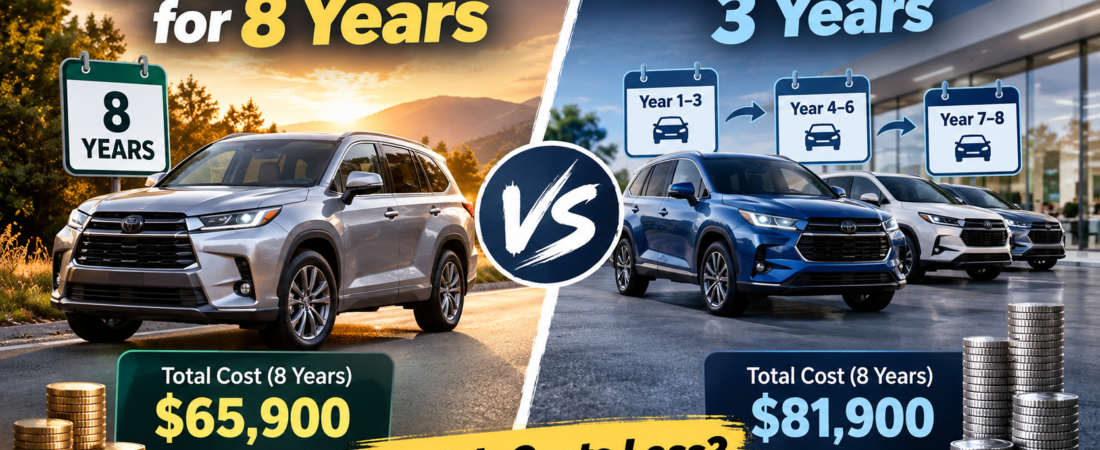
Understanding the real car replacement cost means looking beyond monthly payments to depreciation, maintenance, insurance, and the long-term financial impact of buying a new vehicle every three years.
A new car feels great.
The latest technology, updated safety features, fresh warranty coverage, and that unmistakable new-car experience can make replacing your vehicle every few years incredibly tempting.
But financially, is it worth it?
Many drivers believe keeping a car for eight years is always the smarter financial decision.
Others argue that replacing a vehicle every three years avoids expensive repairs, maintains reliability, and protects resale value.
Both arguments contain some truth.
The problem is that most comparisons focus on monthly payments instead of the total cost of ownership.
A driver paying $900 per month for a new vehicle may believe the cost is predictable.
Meanwhile, someone driving a six-year-old vehicle with no monthly payment may worry about a $2,000 repair.
But one large repair bill doesn’t necessarily make an older car more expensive.
And a lower monthly payment doesn’t necessarily mean a newer car is a better financial decision.
In this keeping a car for 8 years vs replacing every 3 years comparison, we’ll examine depreciation, financing, maintenance, insurance, repair risks, and the hidden cost of constantly resetting the ownership clock.
We’ll also calculate an eight-year ownership scenario using consistent, hypothetical assumptions.
Quick Verdict: Keeping a reliable vehicle for eight years will usually cost less than repeatedly purchasing new vehicles every three years, primarily because it avoids repeated early depreciation. However, the difference depends on financing rates, resale values, repair costs, insurance, and the cost of replacement vehicles.
1. Eight-Year Ownership vs Three-Year Replacement: Quick Comparison
| Factor | Keep for 8 Years | Replace Every 3 Years |
|---|---|---|
| Initial depreciation | Paid once | Repeated with each replacement |
| Financing | Can eventually end | Often continues |
| Warranty | May expire during ownership | More time under warranty |
| Maintenance | Generally increases with age | Generally lower early on |
| Repair risk | Higher in later years | Lower for new vehicles |
| Insurance | May become cheaper | Often reflects higher vehicle value |
| Technology | Becomes outdated | Updated regularly |
| Reliability | Depends on maintenance | Generally more predictable |
| Convenience | No repeated shopping | Frequent transactions |
| Long-term cost | Usually lower | Usually higher |
The important point is that neither strategy can be judged by monthly payments alone.
A car with no monthly payment still has depreciation, maintenance, and insurance expenses.
Likewise, a newer vehicle with low repair costs can still be expensive because of depreciation and financing.
2. Depreciation: The Cost Most Drivers Underestimate
Depreciation is the difference between what you pay for a vehicle and what it is worth when you sell it.
For many new vehicles, this is one of the largest ownership expenses.
Why the First Three Years Matter
New vehicles often lose a substantial portion of their value during their early years.
The exact amount varies dramatically by model, brand, market conditions, and mileage.
A high-demand vehicle may retain its value unusually well.
A luxury vehicle with expensive options may depreciate much faster.
Example: A $60,000 Vehicle
Suppose a new car costs $60,000.
For this hypothetical example, assume:
- Value after 2 years: $44,000
- Value after 3 years: $39,000
- Value after 5 years: $30,000
- Value after 8 years: $21,000
Over eight years, total depreciation is:
$60,000 − $21,000 = $39,000
Now consider what happens if the driver sells the car after three years.
The first three years alone produce:
$60,000 − $39,000 = $21,000
That’s more than half the assumed eight-year depreciation in only three years.
The Replacement Cycle
A driver replacing vehicles every three years repeatedly exposes themselves to the early depreciation period.
This is the fundamental financial disadvantage of frequent replacement.
The Compareason Insight: Keeping a vehicle longer doesn’t eliminate depreciation. It spreads the initial depreciation across more years of use.
3. The Eight-Year Calculation: Same Vehicle Class, Different Strategies
Let’s compare two drivers over the same eight-year period.
Both choose vehicles with an initial purchase price of $60,000.
We assume the vehicle market, tax treatment, and depreciation pattern remain consistent.
Driver A: Keeps One Car for Eight Years
- Purchases one vehicle for $60,000.
- Keeps it for eight years.
- Sells it for $21,000.
Total depreciation:
$60,000 − $21,000 = $39,000
Driver B: Replaces Every Three Years
- Buys a $60,000 vehicle at Year 0.
- Sells it for $39,000 at Year 3.
- Buys another $60,000 vehicle.
- Repeats at Year 6.
- At Year 8, owns a two-year-old vehicle.
For a fair comparison, we must account for the remaining value of that final vehicle.
Assume a two-year-old vehicle is worth $44,000.
The depreciation is:
| Ownership Period | Depreciation |
|---|---|
| Years 0–3 | $21,000 |
| Years 3–6 | $21,000 |
| Years 6–8 | $16,000 |
| Total | $58,000 |
Depreciation Difference
$58,000 − $39,000 = $19,000
Replacing every three years costs $19,000 more in depreciation alone under these assumptions.
That’s approximately $198 per month over eight years.
And we haven’t included maintenance, insurance, financing, or transaction costs yet.
The Compareason Insight: The true cost of replacing a car isn’t simply the difference between the purchase price and the trade-in offer. It’s the repeated depreciation across the entire ownership period.
4. Financing: Why Monthly Payments Can Be Misleading
Depreciation is only part of the equation.
Financing can make frequent vehicle replacement even more expensive.
When a driver replaces a car every three years, the existing loan must be paid off or settled through the trade-in transaction.
If the driver finances another vehicle, a new loan begins.
A $60,000 Financing Example
Assume the driver finances the entire $60,000 purchase at 6.5% APR for 60 months, with no down payment.
The approximate monthly payment is $1,174.
Total interest over the full 60-month loan is approximately $10,440.
These figures are illustrative and exclude taxes and fees.
For a driver keeping the vehicle eight years, the loan eventually ends, leaving several years without a car payment.
For someone replacing vehicles every three years, the payment cycle can continue indefinitely.
However, loan payments are not the same as ownership costs.
Principal payments build equity by reducing the outstanding loan balance.
To calculate the real financial cost, we must consider interest, depreciation, transaction expenses, and the remaining vehicle value.
The Hidden Problem With Negative Equity
Suppose a vehicle is worth $35,000 but the remaining loan balance is $40,000.
The driver has $5,000 in negative equity.
Trading the vehicle does not eliminate that loss.
If the dealer rolls it into a new loan, the driver begins the next ownership cycle with additional debt.
The Compareason Insight: A lower monthly payment can make a replacement feel affordable without making it financially efficient.
5. Maintenance and Repairs: The Strongest Argument for Replacing Early
Keeping a vehicle for eight years isn’t free of risk.
As a car ages, certain components wear out.
Tires, brakes, suspension components, cooling systems, and electronic equipment may require replacement.
A vehicle outside its warranty period may also expose the owner to expensive unexpected repairs.
This is the strongest financial argument for replacing a vehicle earlier.
The Eight-Year Maintenance Scenario
Let’s assume the following maintenance and repair costs for one vehicle.
| Vehicle Age | Annual Cost |
|---|---|
| Year 1 | $400 |
| Year 2 | $500 |
| Year 3 | $600 |
| Year 4 | $900 |
| Year 5 | $1,300 |
| Year 6 | $1,800 |
| Year 7 | $2,400 |
| Year 8 | $3,000 |
| Total | $10,900 |
These are hypothetical figures, not industry averages.
For the driver replacing every three years, assume maintenance and repairs total:
- First three years: $1,500
- Second three years: $1,500
- Final two years: $900
Total: $3,900
The frequent replacement strategy saves $7,000 in maintenance and repairs under these assumptions.
But remember that the depreciation difference was $19,000.
After accounting for maintenance, keeping the vehicle still saves:
$19,000 − $7,000 = $12,000
That’s before insurance, financing, and transaction costs.
What If the Older Car Needs a $5,000 Repair?
A large repair bill feels painful because it arrives all at once.
But compare it with purchasing a replacement vehicle.
If the repair allows another two or three years of reliable use, it may be financially worthwhile.
The correct comparison is not the repair cost versus zero.
It’s the repair cost plus future ownership expenses versus the total incremental cost of replacing the vehicle.
Our Take: An expensive repair isn’t automatically a reason to replace a car. The decision depends on what the repair buys you in additional reliable ownership.
6. Insurance: Another Cost of Constantly Driving a New Car
Insurance is often overlooked when comparing ownership strategies.
A newer, more valuable vehicle may cost more to insure because its potential repair and replacement costs are higher.
However, insurance premiums also depend on the driver, location, coverage, vehicle model, and claims history.
A newer car isn’t automatically more expensive to insure.
Illustrative Eight-Year Insurance Comparison
Assume the owner keeping one vehicle pays an average of $2,000 annually.
Eight-year total:
8 × $2,000 = $16,000
Now assume the driver frequently replacing vehicles pays an average of $2,500 annually.
Eight-year total:
8 × $2,500 = $20,000
The difference is $4,000.
This is a scenario assumption, not a verified insurance quote.
It illustrates how relatively modest annual differences can accumulate over time.
Don’t Forget Coverage Choices
A driver with a paid-off older car may choose to drop collision or comprehensive coverage, depending on the vehicle’s value and personal risk tolerance.
A financed vehicle generally requires broader physical-damage coverage under the loan agreement.
Those choices can affect insurance costs significantly.
But dropping coverage also increases the owner’s financial exposure after an accident or theft.
Why Luxury Vehicles Can Be Different
A luxury SUV may remain expensive to insure even after several years of depreciation.
Advanced sensors, expensive headlights, specialized body panels, and high labor costs can make repairs costly.
Therefore, insurance savings from keeping a vehicle longer should never be assumed without comparing actual quotes.
The Compareason Insight: Insurance is another reason to evaluate total ownership costs rather than focusing exclusively on monthly loan payments.
7. Sales Tax and Transaction Fees: The Costs That Repeat
Every time a driver purchases another vehicle, additional transaction expenses may arise.
These can include sales tax, registration charges, dealer documentation fees, and other costs.
The exact amount depends on state law and whether trade-in tax credits apply.
Example: Sales Tax With a Trade-In Credit
Assume an illustrative 8% sales tax rate.
A driver purchases a $60,000 vehicle and receives $39,000 for the trade-in.
If the state permits the entire qualifying trade-in value to reduce the taxable purchase amount:
($60,000 − $39,000) × 8% = $1,680
Without the credit:
$60,000 × 8% = $4,800
That’s a $3,120 difference on a single transaction.
This is why tax treatment matters when calculating frequent replacement costs.
The Cost of Repeating the Transaction
In our eight-year comparison, Driver A purchases one vehicle.
Driver B purchases vehicles at Years 0, 3, and 6.
That means Driver B completes two additional purchase transactions.
Even when trade-in credits are available, sales tax and transaction fees can create meaningful additional expenses.
What About Dealer Fees?
Documentation fees, registration expenses, and other dealer charges can vary by state and dealership.
Some expenses are relatively small.
Others can become significant when repeated across multiple transactions.
An Important Limitation
Our final eight-year ownership-cost calculation does not include sales tax or transaction fees.
We exclude them because actual amounts depend heavily on location and the structure of each transaction.
Including those expenses could increase the cost of frequent replacement, but the precise difference requires state-specific assumptions.
The Compareason Insight: Repeated replacement creates transaction costs that don’t necessarily appear in the advertised monthly payment.
8. The Hidden Cost of Always Driving a Newer Car
Frequent vehicle replacement provides benefits that are difficult to capture in a simple depreciation calculation.
A newer vehicle may offer better technology, more warranty coverage, updated safety systems, and a more predictable ownership experience.
But these benefits come at a cost.
Warranty Coverage Has Real Value
A new vehicle may include several years of manufacturer warranty protection.
That can reduce exposure to certain unexpected repair bills.
For drivers who depend heavily on their vehicles, avoiding unexpected downtime can be valuable.
However, warranty coverage doesn’t eliminate every ownership expense.
Tires, wear items, maintenance, and certain repairs may remain the owner’s responsibility.
The Technology Upgrade Cycle
Replacing a vehicle every three years may provide access to:
- Updated driver-assistance features
- Improved infotainment systems
- Newer connectivity and software
- More efficient engines or electric powertrains
- Revised safety and convenience features
But not every model-year change represents a meaningful improvement.
A vehicle that already meets the owner’s needs may remain useful long after newer versions become available.
The Psychological Cost of Repair Bills
A $2,500 repair can feel like a major financial setback.
Meanwhile, a $1,000 monthly car payment may feel normal because it is predictable.
But twelve $1,000 payments equal $12,000.
That doesn’t mean the entire $12,000 is an economic loss, because part of the payment reduces loan principal.
It does demonstrate how recurring payments can feel less painful than occasional repairs, even when their total cash-flow impact is much larger.
Convenience vs Financial Efficiency
Frequent replacement can be reasonable for someone who values reliability, warranty coverage, and new technology enough to pay more.
The mistake is assuming that convenience automatically makes the strategy cheaper.
The Compareason Insight: Replacing a car every three years may be a lifestyle preference rather than a financial optimization—and that’s perfectly reasonable when the additional cost is understood.
9. The Eight-Year Total Cost: Putting Everything Together
Now we can combine the major ownership expenses into one comparison.
Our hypothetical scenario assumes both drivers purchase $60,000 vehicles in the same class.
Driver A keeps the original vehicle for eight years.
Driver B replaces vehicles at the end of Years 3 and 6, finishing the comparison with a two-year-old vehicle.
The final vehicle’s remaining market value is already reflected in the depreciation calculation.
Eight-Year Ownership Cost Comparison
| Expense | Keep for 8 Years | Replace Every 3 Years |
|---|---|---|
| Depreciation | $39,000 | $58,000 |
| Maintenance and repairs | $10,900 | $3,900 |
| Insurance | $16,000 | $20,000 |
| Subtotal | $65,900 | $81,900 |
The difference is:
$81,900 − $65,900 = $16,000
Under these assumptions, keeping the same car for eight years saves approximately $16,000, even after accounting for higher maintenance and repair costs.
Monthly Equivalent
Eight years equals 96 months.
$16,000 ÷ 96 = $166.67 per month
That’s approximately $167 per month in average ownership-cost savings.
This is not a reduction in monthly loan payments.
It represents the average economic advantage over the entire eight-year comparison period.
Understanding the Difference
The driver keeping the vehicle saves $19,000 in depreciation and $4,000 in insurance.
However, that driver spends $7,000 more on maintenance and repairs.
The combined advantage is:
$19,000 + $4,000 − $7,000 = $16,000
What’s Excluded?
This model excludes financing interest, investment opportunity cost, sales taxes, transaction fees, fuel or electricity, parking, and differences in annual mileage.
We assume comparable driving needs and use a common eight-year comparison period.
The final resale values are already reflected in the depreciation calculations, so they should not be subtracted again.
Different vehicle values, insurance costs, depreciation patterns, and repairs could produce a substantially different result.
The Compareason Insight: Even when an older vehicle costs more to maintain, avoiding repeated depreciation can make long-term ownership significantly cheaper.
10. The Break-Even Point: How Much Repair Cost Makes Replacement Worthwhile?
This is one of the most useful calculations in the comparison.
In our example, the frequent replacement strategy has the following disadvantages before maintenance:
| Cost Difference | Extra Cost of Replacing |
|---|---|
| Depreciation | $19,000 |
| Insurance | $4,000 |
| Combined difference | $23,000 |
However, replacing vehicles every three years reduces maintenance and repair expenses.
The replacement strategy incurs $3,900 in maintenance costs, compared with $10,900 for keeping the same vehicle.
That gives the replacement strategy a $7,000 maintenance advantage.
After accounting for this advantage, keeping the vehicle still saves $16,000.
How Much More Could the Older Car Cost to Repair?
The owner keeping the vehicle could incur another $16,000 in maintenance and repair expenses before the two strategies reach the same total cost.
The break-even maintenance budget is:
$10,900 + $16,000 = $26,900
At that point:
| Expense | Keep for 8 Years | Replace Every 3 Years |
|---|---|---|
| Depreciation | $39,000 | $58,000 |
| Maintenance and repairs | $26,900 | $3,900 |
| Insurance | $16,000 | $20,000 |
| Total | $81,900 | $81,900 |
Both strategies now cost exactly the same amount under the model.
What If the Older Car Needs a $5,000 Repair?
Suppose the owner encounters an additional $5,000 repair that was not included in the original maintenance estimate.
The revised eight-year cost becomes:
$65,900 + $5,000 = $70,900
Keeping the car still saves:
$81,900 − $70,900 = $11,000
Even after that additional repair, keeping the original vehicle remains cheaper.
What If Repairs Become Extremely Expensive?
Now suppose the vehicle requires an additional $20,000 in unexpected repairs over the eight-year period.
The revised cost becomes:
$65,900 + $20,000 = $85,900
That exceeds the replacement strategy’s assumed cost of $81,900 by $4,000.
In this scenario, frequent replacement becomes the cheaper option.
The Important Limitation
These are whole-period calculations.
If a vehicle develops a serious problem in Year 6, the owner should compare the future cost of keeping it against the future cost of replacing it—not simply rely on the original eight-year totals.
Money already spent on depreciation or repairs cannot be recovered.
The relevant decision is what happens from today forward.
The Real Break-Even Question
A $5,000 repair may be financially reasonable if it restores dependable operation for several more years.
But the same repair may be difficult to justify if the vehicle has multiple unresolved mechanical problems and a high probability of further failures.
The Compareason Insight: A large repair bill doesn’t automatically justify replacing a vehicle. The decision depends on the expected cost and reliability of keeping it compared with the full cost of replacement.
11. Luxury Vehicles: Why the Difference Can Become Much Larger
The financial difference between keeping and replacing a vehicle can become especially significant in the luxury market.
Vehicles such as the BMW X7, Mercedes-Benz GLS, and Range Rover often carry substantial purchase prices, expensive optional equipment, and potentially high repair costs.
They can also experience significant depreciation.
This makes the decision more complicated than simply replacing the vehicle before its warranty expires.
A Hypothetical $120,000 Luxury SUV
Let’s assume a luxury SUV has the following values:
- Original purchase price: $120,000
- Value after two years: $90,000
- Value after three years: $75,000
- Value after eight years: $35,000
These are illustrative assumptions, not actual resale forecasts for any specific model.
Strategy A: Keep the SUV for Eight Years
The owner purchases the SUV for $120,000 and sells it after eight years for $35,000.
Total depreciation:
$120,000 − $35,000 = $85,000
Strategy B: Replace Every Three Years
The owner purchases a new $120,000 SUV at Years 0, 3, and 6.
At the end of Year 8, the final vehicle is two years old and worth an assumed $90,000.
| Ownership Period | Depreciation |
|---|---|
| Years 0–3 | $45,000 |
| Years 3–6 | $45,000 |
| Years 6–8 | $30,000 |
| Total | $120,000 |
The Depreciation Difference
$120,000 − $85,000 = $35,000
The driver replacing luxury SUVs every three years loses an additional $35,000 in depreciation over eight years.
That’s approximately $365 per month in additional depreciation.
And this calculation does not include financing, insurance, sales taxes, or maintenance.
But Luxury Repairs Can Be Expensive
A luxury vehicle outside its factory warranty may require costly repairs involving air suspension, electronic modules, cooling systems, or complex drivetrain components.
That can reduce the financial advantage of long-term ownership.
However, the possibility of a major repair is not the same as actually incurring one.
A reliable luxury SUV may remain economical to keep well beyond its warranty period.
The Compareason Insight: Luxury vehicles can make repeated depreciation especially expensive, but model-specific reliability becomes increasingly important as ownership extends.
12. Leasing Every Three Years: Is It a Better Alternative?
Many drivers who replace vehicles frequently choose leasing rather than purchasing.
Leasing can offer predictable payments, regular access to newer vehicles, and less direct exposure to resale-value fluctuations.
But leasing doesn’t eliminate depreciation.
Instead, depreciation is incorporated into the lease payment.
How Leasing Changes the Calculation
A typical lease payment reflects several factors:
- The vehicle’s negotiated capitalized cost
- The contractual residual value
- Financing or rent charges
- Taxes and fees
- Lease incentives and rebates
A vehicle with strong residual value may lease relatively inexpensively.
A vehicle with weak residual value may have a much higher payment.
The Eight-Year Leasing Example
Suppose a driver leases a $60,000 vehicle for 36 months.
Assume:
- Monthly lease payment: $750
- Initial payment: $3,000
- No additional end-of-lease charges
One three-year lease costs:
($750 × 36) + $3,000 = $30,000
For an eight-year comparison, assume the driver completes two 36-month leases and then enters a third lease for the remaining 24 months.
If the third lease has identical terms, the cash paid during the eight years would be:
($750 × 96) + ($3,000 × 3) = $81,000
This is a hypothetical cash-flow illustration, not a complete economic comparison.
The driver would still have 12 months remaining on the third lease at the end of Year 8, so the outstanding contractual obligation must be considered.
Why Leasing Can Still Make Sense
Leasing may be attractive for drivers who value:
- Regular access to newer vehicles
- Warranty-period driving
- Predictable replacement schedules
- Lower exposure to unexpected resale-market changes
However, mileage limits, excess-wear charges, lease-end conditions, and repeated upfront payments can increase the cost.
Leasing vs Long-Term Ownership
For a driver who plans to keep a reliable vehicle for eight years or longer, purchasing often offers a lower long-term cost.
For someone determined to replace vehicles every three years, leasing may be competitive with repeated purchasing, depending on lease incentives and financing terms.
The Compareason Insight: Leasing can make frequent replacement more convenient, but it doesn’t automatically make it cheaper.
13. Safety, Technology, and Reliability: When Paying More Is Worthwhile
The cheapest ownership strategy is not necessarily the best strategy for every driver.
Newer vehicles may provide improved safety systems, more advanced technology, and greater convenience.
For some households, those benefits justify higher ownership costs.
Safety Technology
New vehicles may offer improvements in automatic emergency braking, blind-spot monitoring, lane assistance, and crash protection.
However, newer doesn’t automatically mean safer in every comparison.
Vehicle-specific crash-test results, structural design, and driver-assistance performance matter more than model year alone.
Electric Vehicles and Technology Changes
Electric vehicles can experience significant improvements in battery technology, charging performance, software, and efficiency between generations.
For a driver whose existing EV lacks sufficient range or charging capability, upgrading may provide meaningful practical value.
But replacing a functioning EV simply to obtain a newer screen or minor software improvement may not be financially efficient.
Reliability and Downtime
Unexpected repairs create more than financial inconvenience.
A breakdown can result in towing charges, rental expenses, missed appointments, or lost business opportunities.
For someone who depends on a vehicle for work, reliability may be worth paying extra for.
The Value of Peace of Mind
Some drivers simply prefer having a vehicle under factory warranty.
That preference has value, even if it cannot be measured as precisely as depreciation.
The important point is to recognize the additional cost rather than assuming the newer vehicle is financially superior.
Our Take: Spending more on a newer vehicle can be a reasonable lifestyle or reliability decision. It should simply be distinguished from a cost-saving decision.
14. Five Years vs Eight Years vs Ten Years: When Should You Actually Replace?
Eight years is not a universal magic number.
The ideal replacement point depends on the vehicle’s depreciation, condition, mileage, and expected future expenses.
Replacing After Three Years
This strategy offers frequent upgrades and more time under factory warranty.
However, repeated early depreciation can make it expensive.
Replacing After Five Years
Five years may offer a middle ground.
The driver keeps the vehicle longer while potentially avoiding some later ownership risks.
But whether this is economical depends on the specific model.
Keeping the Car for Eight Years
Eight years allows the owner to spread initial depreciation over a longer period.
If the vehicle remains dependable, the financial advantage can be substantial.
Keeping the Car for Ten Years or Longer
Keeping a reliable vehicle for ten years or more may reduce annual depreciation further.
However, maintenance costs and unexpected repair risks can increase.
Mileage Matters as Much as Age
Consider two eight-year-old vehicles.
One has 40,000 miles.
The other has 160,000 miles.
Their expected repair costs, resale values, and remaining useful lives may be very different.
That’s why a fixed replacement schedule based only on age is rarely ideal.
The Most Useful Rule
Rather than replacing a vehicle automatically at a particular age, reassess its expected future costs every year.
Compare the current vehicle’s depreciation and likely repairs with the full cost of the replacement.
The Compareason Insight: The best time to replace a car is when its expected future ownership cost and practical limitations justify switching—not simply when it reaches a certain birthday.
15. Frequently Asked Questions
Is keeping a car for eight years cheaper than replacing it every three years?
Usually, if the vehicle remains reliable. Keeping a car longer avoids repeated early depreciation, which can be one of the largest ownership expenses.
How much can I save by keeping a car for eight years?
In our hypothetical $60,000 vehicle comparison, keeping the car for eight years saves $16,000 in combined depreciation, maintenance, and insurance costs.
Actual savings depend on the vehicle and ownership circumstances.
Is it better to keep a car after paying off the loan?
Often, because the owner can continue using the vehicle without monthly loan payments.
However, depreciation, insurance, maintenance, and repair expenses continue.
Should I replace a car before the warranty expires?
Not automatically. Warranty expiration increases exposure to certain repair costs, but it doesn’t mean expensive repairs will immediately occur.
Is a $5,000 repair worth paying for?
It can be. If the repair restores reliable operation and avoids substantially greater replacement costs, keeping the vehicle may still be the cheaper choice.
Do luxury cars depreciate faster?
Some luxury vehicles experience substantial depreciation, but the rate varies by model, market demand, mileage, and condition.
Is leasing every three years cheaper than buying?
Not necessarily. Leasing may provide convenience and predictable payments, but repeated lease expenses can exceed the long-term cost of keeping a purchased vehicle.
How long should I keep a new car?
There is no universally optimal number of years. For a reliable vehicle, keeping it beyond the initial depreciation period often improves financial efficiency.
Does high mileage change the decision?
Yes. Higher mileage can increase maintenance requirements and reduce resale value, potentially making replacement attractive sooner.
Should I trade in my car while it still has value?
A vehicle having resale value is not, by itself, a reason to sell. The replacement will also depreciate.
The correct decision depends on the expected future cost of both options.
Is buying a used car cheaper than keeping a new car for eight years?
It can be. Purchasing a reliable used vehicle after its steepest depreciation period and keeping it for several years may reduce total ownership costs further.
Should I replace my car if a newer model has better technology?
Only if the improvements provide enough practical value to justify the additional cost.
16. The Compareason Verdict: Keep for 8 Years vs Replace Every 3 Years
Overall Winner: Keeping a Reliable Vehicle for Eight Years
For drivers primarily focused on minimizing total ownership costs, keeping a dependable vehicle for eight years is generally the stronger financial strategy.
The biggest reason is depreciation.
Buying a new vehicle every three years repeatedly exposes the owner to the period when many vehicles lose a substantial portion of their value.
Lower maintenance costs and greater warranty coverage may offset part of that expense, but they don’t automatically make frequent replacement cheaper.
What Our Eight-Year Model Shows
| Expense | Keep for 8 Years | Replace Every 3 Years |
|---|---|---|
| Depreciation | $39,000 | $58,000 |
| Maintenance and repairs | $10,900 | $3,900 |
| Insurance | $16,000 | $20,000 |
| Total | $65,900 | $81,900 |
Eight-year savings: $16,000
Monthly equivalent: approximately $167
These are hypothetical costs and exclude financing interest, sales taxes, transaction fees, fuel, and other expenses.
Where Keeping the Car Wins
Long-term ownership is generally attractive when the vehicle remains reliable, repair costs are manageable, and the owner can avoid another expensive depreciation cycle.
Where Replacing Every Three Years Wins
Frequent replacement may be preferable when reliability becomes a serious concern, warranty coverage is particularly valuable, or the benefits of newer technology justify the additional cost.
It may also become financially competitive if the older vehicle requires unusually expensive repairs.
What the Break-Even Calculation Reveals
Our model showed that the eight-year owner could incur an additional $16,000 in repairs beyond the original maintenance budget before the two strategies reached the same total cost.
That is a substantial cushion.
But it doesn’t mean every repair should automatically be approved.
A vehicle with repeated failures, poor reliability, or major safety concerns may still warrant replacement.
Our Final Recommendation
Before buying another car, calculate the expected cost of keeping your current vehicle for the next three years.
Include depreciation, financing interest, insurance, repairs, and transaction expenses.
Then calculate the same costs for the replacement vehicle.
Don’t compare only monthly payments.
Don’t assume that an expensive repair automatically makes a new car cheaper.
And don’t ignore the value of reliability, safety, and convenience.
The Compareason Verdict: Keeping a reliable car for eight years will often save thousands of dollars compared with replacing it every three years. In our hypothetical $60,000 vehicle example, the difference is $16,000 over eight years. But the best decision is the one that balances future ownership costs with the reliability and features you actually need.
Compare with Reason.