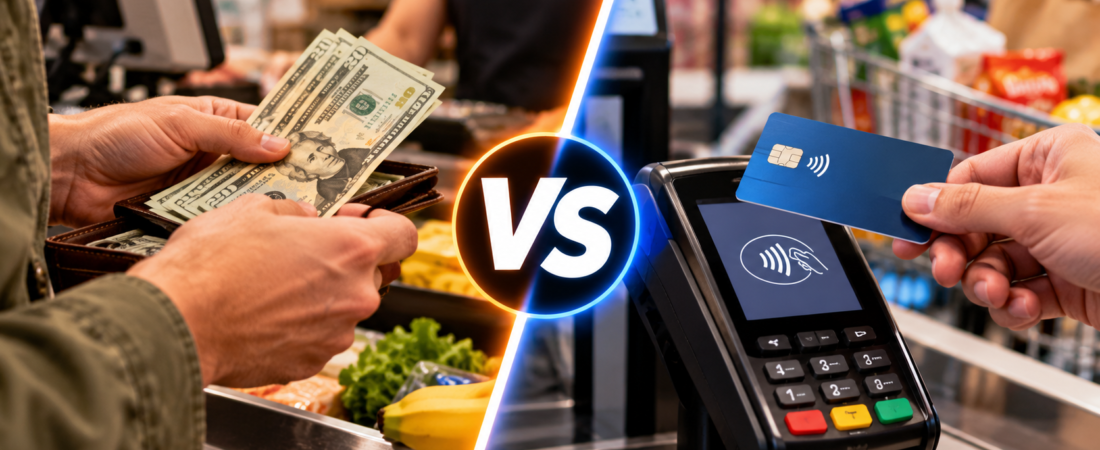
Cash vs credit card seems like a simple choice.
One comes out of your wallet.
The other earns points, protects purchases, builds credit, and takes about two seconds to tap.
If you pay your credit card balance in full every month, using the card can seem like the obvious financial decision.
Why wouldn’t you take the rewards?
But there may be a hidden cost.
You might spend more.
Not because your credit card forces you to buy anything.
Not because every card user is irresponsible.
But because paying $100 with a card doesn’t necessarily feel the same as physically handing someone five $20 bills.
And decades of behavioral research suggest that difference can affect how much we spend.
So if you walked into the same store with $100 in cash versus a credit card with thousands of dollars of available credit, would you leave with the same purchases?
Maybe not.
Let’s look at what the research actually says.
Cash vs Credit Card at a Glance
| Cash | Credit Card | |
|---|---|---|
| Spending limit | Money physically available | Credit limit |
| Payment feeling | More noticeable | Less noticeable |
| Rewards | None | Often available |
| Purchase protection | Limited | Often better |
| Fraud liability | Lost cash may be gone | Stronger protections |
| Budget visibility | Immediate | Delayed |
| Convenience | Lower | Excellent |
| Online shopping | Difficult | Excellent |
| Debt risk | None | Significant if balance carried |
| Best for | Spending control | Rewards and convenience |
Credit cards have obvious advantages.
The problem is that many of those advantages also make spending incredibly easy.
And easy spending isn’t always cheap spending.
The Cashless Effect Is Real
Researchers have studied this question for decades.
A major 2024 meta-analysis published in the Journal of Retailing combined 392 effect sizes from 71 papers, covering more than 11,000 participants and hundreds of thousands of transactions across 17 countries.
Its conclusion:
Consumers tend to spend more when using cashless payment methods than when using cash.
Researchers call this the “cashless effect.”
Importantly, the effect was statistically significant but relatively small overall — so this does not mean everyone suddenly spends 30% more simply because they use a card.
But across a large body of research, the direction was consistent enough to matter. DOI
And now there’s even newer evidence.
A Huge 2026 Study Tested It Again
You could reasonably argue that older cash-versus-card research isn’t relevant anymore.
Today’s consumers are different.
We’re used to:
credit cards,
Apple Pay,
digital wallets,
online checkout,
subscriptions,
autopay,
and tap-to-pay.
Maybe paying electronically no longer changes our behavior.
Researchers tested exactly that question.
A 2026 mega-replication published by the Journal of Consumer Research involved:
13 large preregistered replications
32,371 participants
65 different products
and prices ranging from:
$1.09 to $400.
The researchers again found that paying with cash produced more psychological “pain of paying” than paying by card.
More importantly, the effect wasn’t limited to how participants said they felt.
Payment method also affected amount spent, and the researchers found that the pain of paying helped explain that difference. OUP Academic
That’s important.
We’re not simply talking about nostalgia for dollar bills.
We’re talking about behavior.
What Is the “Pain of Paying”?
Imagine buying a $200 pair of shoes.
Option A
You tap your credit card.
Beep.
Transaction approved.
Option B
You open your wallet.
Take out ten $20 bills.
Count them.
Hand them to the cashier.
Watch the cashier take them.
Your wallet is now visibly thinner.
Economically, you spent the same:
$200.
Psychologically, the transactions may feel different.
Behavioral researchers describe this as the pain of paying.
The 2026 mega-replication found that cash continues to produce greater psychological payment pain even among modern consumers surrounded by cards, digital wallets, and other electronic payment methods. OUP Academic
Cash makes the loss visible.
Cards make the transaction smoother.
And that smoothness is exactly why we like them.
Tap-to-Pay Makes Spending Almost Frictionless
Think about how much the checkout process has changed.
Credit cards once required:
handing the card to a cashier,
swiping it,
waiting,
signing a receipt,
and getting the card back.
Now:
tap.
Done.
Sometimes you don’t even remove anything from your pocket.
Your phone or watch completes the payment.
The financial transaction becomes almost invisible.
That is fantastic technology.
But from a budgeting perspective, a little friction can sometimes be useful.
If spending becomes too effortless, the moment when you mentally ask:
“Do I really want to spend this?”
can become easier to skip.
America Has Already Chosen Cards
Whether cards make us spend more or not, Americans clearly prefer them.
The Federal Reserve’s 2026 Diary of Consumer Payment Choice found that consumers made an average of 47 payments per month.
Of those:
16 were credit card payments
15 were debit card payments
and only:
6 were cash payments.
Together, debit and credit cards accounted for roughly two-thirds of consumer payments. Federal Reserve Financial Services
Credit card preference has also increased dramatically.
In 2016, 24% of consumers said credit was their preferred method for in-person payments.
By the latest survey, that figure had reached:
38%.
Debit stood at 40%. Federal Reserve Financial Services
We’re getting increasingly comfortable spending without cash.
But Cash Isn’t Dead
Here’s the surprising part.
Despite cards dominating transactions, cash hasn’t disappeared.
The Federal Reserve found:
76% of consumers still carried cash.
The average amount carried was:
$69.
Four out of five consumers had used cash during the previous 30 days.
And:
90% said they planned to continue using cash in the future. Federal Reserve Financial Services
So cash increasingly appears to have a different role.
It isn’t necessarily the default payment method anymore.
For many people, it’s a backup — or a tool.
And spending control may be one reason to keep it.
The $100 Costco Test
Imagine two shoppers walk into Costco.
Both need:
paper towels,
coffee,
and chicken.
Their intended budget is:
$100.
Shopper A: Cash
Shopper A has exactly five $20 bills.
They see a $24.99 kitchen gadget.
It looks useful.
But buying it means physically giving up another $20 bill and possibly exceeding the money in their wallet.
They keep walking.
Shopper B: Credit Card
Shopper B sees the same gadget.
$24.99 doesn’t feel enormous.
They tap the card at checkout.
Total:
$124.99.
Neither shopper made an irrational decision.
Shopper B may genuinely enjoy the product.
But the credit card removed one constraint Shopper A couldn’t ignore:
the money available in the wallet.
Cash creates a hard stop.
Credit creates capacity.
Those aren’t psychologically identical.
The Effect May Be Stronger for Wants Than Needs
The 2024 meta-analysis found something especially interesting.
The cashless effect wasn’t equally strong in every purchasing situation.
It was stronger for conspicuous consumption — purchases connected to status or outward display. DOI
Think:
fashion,
luxury goods,
expensive accessories,
premium upgrades.
That makes intuitive sense.
If you’re buying gasoline because the tank is empty, your payment method probably won’t suddenly convince you to buy twice as much.
But discretionary purchases contain more flexibility.
Should you buy the $80 shoes?
Or the $140 pair?
Should you get the base model?
Or upgrade?
Should you buy one?
Or two?
Those are situations where making payment easier can potentially influence the final decision.
But the Cashless Effect Is Not Huge
This is important because it’s easy to exaggerate the research.
The meta-analysis found a small but statistically significant overall cashless effect.
It also found that the effect has weakened over time. DOI
That makes sense.
We’re much more accustomed to cards today than consumers were decades ago.
Paying electronically no longer feels unusual.
So don’t interpret this research as:
“Credit cards make everyone overspend.”
That’s not what it says.
A disciplined card user who tracks every purchase may spend exactly what they planned.
The more useful conclusion is:
Payment method can influence spending behavior — even when we think it shouldn’t.
Now Add Credit Card Rewards
This is where the comparison gets much harder.
Suppose your card earns:
2% cash back.
You spend:
$30,000 per year.
Rewards:
$600.
That’s real money.
If you would have spent exactly the same $30,000 using cash, the credit card clearly wins.
You receive:
rewards,
fraud protection,
purchase records,
convenience,
and potentially other benefits.
But what if using the card causes your annual spending to increase just:
3%?
Three percent of $30,000 is:
$900.
You earned:
$600
but potentially spent:
$900 more.
Net difference:
-$300.
That’s why rewards alone don’t prove a card is saving you money.
The Rewards Trap
A common credit card thought process goes like this:
“I’m getting 3% back.”
So spending $100 earns:
$3.
Great.
But you didn’t make $3.
You spent:
$97 net.
Rewards are valuable only when they are attached to purchases you would have made anyway.
If a reward encourages additional spending, the math can reverse quickly.
A 5% reward on something you didn’t need is still:
95% spending.
Credit Cards Have One Enormous Financial Advantage
None of this means cash is the superior financial tool.
Credit cards can offer substantial advantages when used correctly.
They can provide:
fraud protection,
purchase protection,
extended warranties,
travel benefits,
cash back,
points,
clear transaction records,
and the ability to dispute charges.
Cash can’t compete with many of those features.
And if cash is lost or stolen, recovering it can be difficult or impossible.
The credit card therefore has a compelling advantage for someone who can control spending.
But There’s One Rule
All of the benefits assume you do something extremely important:
Pay the statement balance in full.
If you carry a balance and pay high credit card interest, the comparison changes completely.
A 2% reward is meaningless if you’re paying interest many times larger than the reward.
At that point, the question isn’t really cash vs credit card anymore.
It’s:
cash vs debt.
And debt is far more expensive.
Cash Makes Budgeting Physical
Imagine you give yourself:
$150 per week for restaurants and entertainment.
Put $150 in an envelope.
Monday:
$25 disappears.
Wednesday:
another $40.
Saturday morning:
$85 remains.
You don’t need an app.
You don’t need a spreadsheet.
You don’t need to log into your bank.
You can see your budget.
That’s why cash-envelope budgeting has remained popular even in the digital era.
It converts an abstract spending limit into something physical.
When the envelope is empty:
you’re done.
Credit Cards Can Do the Same Thing — If You Watch Them
You don’t necessarily need cash to create spending awareness.
You can recreate much of the friction digitally.
Set:
transaction alerts,
weekly spending limits,
category budgets,
automatic balance notifications,
or a rule that you check your card balance every evening.
Some people even pay their credit card balance several times per month.
The goal isn’t to make credit cards inconvenient.
It’s to prevent spending from becoming invisible.
Try the Cash Experiment
Here’s an interesting personal experiment.
For one week, use cash for discretionary purchases.
Not:
mortgage,
utilities,
insurance,
or online bills.
Just things like:
restaurants,
coffee,
snacks,
shopping,
entertainment,
and small impulse purchases.
Withdraw:
$200.
Put it in your wallet.
Then see what happens.
You may spend exactly the same amount.
If so, great.
You probably have strong spending discipline regardless of payment method.
But you may notice yourself asking questions you rarely ask while tapping a card:
Do I really want this?
Can I get it cheaper somewhere else?
Should I wait?
That hesitation is the pain of paying doing its job.
The Best Strategy May Be Using Both
You don’t need to become cash-only.
That’s impractical for most people.
Instead, consider dividing purchases.
Use Credit Cards For:
planned purchases,
online purchases,
travel,
recurring bills,
large purchases needing protection,
and categories where you intentionally earn rewards.
Consider Cash For:
restaurants,
bars,
entertainment,
shopping trips,
vacations,
and categories where you routinely exceed your budget.
In other words:
Use the credit card where its benefits matter.
Use cash where friction helps.
Cash vs Credit Card: Which Is Better?
If the question is:
Which payment method has better features?
Credit card wins easily.
Rewards.
Convenience.
Security.
Purchase protection.
Transaction records.
Cash can’t match that package.
But if the question is:
Which payment method makes spending easier to control?
Cash has a surprisingly strong case.
And modern research supports the idea that payment method can affect how much people spend.
A 2024 meta-analysis covering 71 papers found a small but significant cashless effect. DOI
Then a major 2026 replication involving more than 32,000 participants again found that cash feels more painful to spend than cards and that payment method can affect spending amounts. OUP Academic
So the answer to our original question is:
Yes — you may spend more when you tap.
Not everyone will.
And the effect isn’t enormous.
But it doesn’t have to be enormous.
If using a credit card increases discretionary spending by even a few percent, that increase can easily exceed the 1%, 2%, or 3% rewards you’re earning.
The smartest payment method therefore isn’t automatically the one offering the biggest reward.
It’s the one that helps you make the purchases you actually intended to make.
Because earning 2% cash back is useful.
Not spending the unnecessary $100 in the first place saves 100%.
Compare with Reason.